- 224 pages
- English
- ePUB (mobile friendly)
- Available on iOS & Android
eBook - ePub
About this book
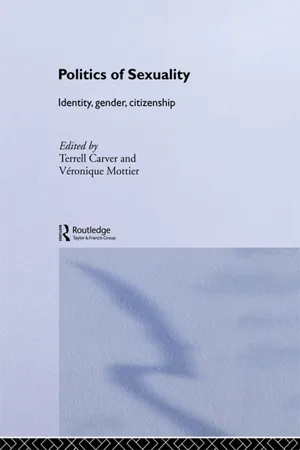
This book recognises sexuality as a mainstream concept in political analysis and explores issues in the politics of sexuality that are highly salient and controversial today. These include conceptions of citizenship and nationality linked to gender and sexuality, the legislation about the age of consent, prostitution and 'trafficing in women', the international politics of population control, abortion, sexual harrassment, and sexuality in the military. The international team of contributors provide a wide range of perspectives in a variety of contexts. On a national level they offer illustrative case studies from the UK, Ireland, the Netherlands, Spain and Israel among others, and on an international plane they cover the European Union, the UN Conference on Population and Development and the role of the Vatican as international arbiter. Moreover, the volume addresses the interaction between political discourse and the work of major theorists such as Weber, Freud, Foucault, Irigaray and Butler.
Information
Part I
Citizens’ sexualities
‘Difference’ and unequal treatment
1 Sexual citizenship
Gendered and de-gendered narratives
In this chapter I propose to examine some of the ways in which citizenship is produced as a productive and disciplinary category, which is regularly deployed within formal and informal relations of power. To do that I shall argue that constitutional and other legalistic definitions and ‘guarantees’ are readily and characteristically linked to more popular forms of understanding, conceptualised here as ‘narratives’. These narratives, so I claim, are characteristically deployed in both gendered and de-gendered forms, of which I cite examples. In order to explain this political phenomenon, I examine very closely the concept of gender in the light of recent theorisations and my observation of contemporary usage. I draw attention to the disjunction between gendered and de-gendered narratives of citizenship, and to the way that this discursive strategy operates within the current politics of sexuality In conclusion I reformulate a number of political questions in ways that are subversive of traditional hierarchies of power.
Citizens/aliens
At first glance citizenship seems to be a simple on/off kind of concept. Either you have citizenship (and are ‘a citizen’), or you do not have it (and are ‘not a citizen’). If you have citizenship, then you have the rights and obligations as constitutionally and legally specified, and if you do not have citizenship but are ‘in the country’, you are an ‘alien’. For example, citizenship may cover rights to work, reside, vote, obtain benefits such as education and welfare, etc., as well as corresponding obligations to pay taxes, perform national service or civil functions such as jury service, etc. These are, of course, subject to qualifications of age and residency, and also to nullification procedures that may require the suspension or loss of citizenship wholly or in part, such as imprisonment, renunciation, revocation and loss of voting rights or rights of movement.
Needless to say there are innumerable local variations on these themes within the constitutional and more or less democratic societies around the world. Non-constitutional, authoritarian regimes award fewer rights, if any, and sometimes follow very loose notions of legality, but some of the relevant categories survive, at least on paper, and even if only to satisfy some international agencies (e.g. UN conventions) and to put others off (e.g. Amnesty International).
Mirroring citizenship there are categorisations of ‘alienness’ and non-citizenship that exclude people altogether, allow entrance for specified periods and purposes, and sometimes give limited status within the polity (even voting, in some fairly rare cases, such as Irish nationals in the UK). Dual or multi-country citizenship creates areas of overlap and non-efficacy, as sometimes both states will contest for sole nationality (usually to the detriment of the person involved), and sometimes neither state will assume responsibility for a person, so as not to give offence to another state (see Dummett and Nichol 1991).
Yet if we dig further, the picture becomes even more complex, and the categories of citizen and alien do not merely fragment. Rather the fragments begin to form hierarchies. This view is clearly argued by David Evans:
The full weight of civil, political and social rights machineries is employed to define degrees of citizenship or, to be more precise, the non-citizenship of those manifestly outwith [i.e. outside] the absolute reified standards of the moral community. Furthermore, these degrees of non-citizenship incite the further fragmentation of communities with sectionalised access and activity to and in specialised markets, they define degrees and forms of consumer status and lifestyle…citizenship machineries enhance state management of the ‘life-world’.
(Evans 1993: 6, 63; my emphasis)
Evans develops the argument with respect to sexuality/ies, but other descriptors that fall within ‘the moral community’ (e.g. ‘race’/ethnicity, language use, religion, (dis)ability) could also be figured this way:
The logic of the distinction between private and public behaviour [for instance] was that the legal penalties for public displays of sexuality could be strengthened as private behaviour was decriminalised, but given the strict definition of ‘private’, elaborate policing of civil society became de rigueur. By concentrating on public manifestations of sexual deviance in the buffer zone between moral and immoral communities, this policing has effectively penetrated all ‘private’ territories.
(Evans 1993: 63–4)
This analysis, drawing equally on Foucault and Marx, presents citizenship as gradations of esteem – for example, with respect to the way the state conceives, represents, polices, educates, regulates, defines, criminalises and taxes what its various agencies take to be ‘sexuality’ or sexualities. The ‘community’ is then moulded, by state action and through political representation, to conform to what these disciplinary practices attempt to do.
Or is the community rather the source of the conceptions and representations according to which the state then moulds its activities? In an examination of the ways in which historical writing has been construed, Callinicos expounds the work of White, who draws attention to the links between popular culture and education, on the one hand, and the state and citizenship, on the other:
White argues that by allowing their audience to imagine a reality that is whole and complete, they [historians] contribute to ‘the production of the “law-abiding” citizen’…Historical narratives, by virtue of their tropological organisation, will always fail in their attempt to represent reality…[B]y depicting, through the device of narrative closure, a world that is whole, historical narrative helps to turn out good citizens.
(Callinicos 1995: 50–2, quoting White 1987: 21, 87)
‘Historical narrative’, of course, can be broadened out to cover the whole realm of popular culture, such as commercial ‘Hollywood’ cinema. Babington and Evans (1993), for example, survey numerous narratives among various cinematic genres, some of which were (and perhaps are) central to conceptions of citizen-virtue in the United States:
Among the…ancient/modern parallelisms two further sets predominate, idealistically linking [ancient] Israel with America as in King David’s federalists, melting-pot deathbed speech in Solomon and Sheba…The first equivalence sees two God-inspired democratic nations fighting to free the world from slavery. The second parallels two ‘chosen’ people formed out of the frontier, both looking nostalgically back to those origins from present urban corruptions…In De Mille’s second The Ten Commandments both themes are foregrounded…the politics of freedom versus slavery…and the Israelites are shown in images underlined by the commentary as virtuous free-enterprisers.
(Babington and Evans 1993: 55, 57)
Reimagining the community is thus an everyday form of cultural work conducted within and between realms that are rather irrelevantly designated political or non-political (see also Finlayson, Chapter 8 of this volume). It is this form of cultural work that I designate ‘narratives’ of citizenship. This is to say that collective experiences, or even individual experiences, in so far as they purport to tell us what ‘actually’ happened and/or what ‘it means’, are merely mobilisations of metaphors within discourses of certainty, authority and exclusion. Events or ‘history’ are not ‘there’ to be represented ‘correctly’ or ‘incorrectly’, but are rather realms of representation – whether near the time, much later or speculatively (and sometimes circularly) to do with the future.
Contemporary narratives of citizenship, in my view, are likely to incorporate factors such as the following:
• nation-states as geographical conceptions;
• formalities of official approval, such as documents of birth;
• hierarchies like federalism and transnational political communities;
• boundaries that are physically policed;
• entry and rejection, incarceration and deportation;
• renunciation, revocation, statelessness, ‘asylum seekers’;
• civil rights and obligations that are supposedly exclusive and defining.
However, no list could be completely inclusive. This is to say that citizenship is a movable metaphor of ‘belonging’ and ‘inclusion’ that is deployed at different times for various purposes. It has no universally or regularly agreed boundaries; rather there are contradictory and subversive accretions that are often used as counters in other political struggles. Citizenship is another exercise in the power/knowledge game, in that it is disciplinary and productive at the same time in terms of social relationships. Any structure distributes advantages and disadvantages, and a structureless world would have neither.
So far the analytical perspective here is individualist, because only individuals are citizens, and citizens can only be individuals. Who are the individuals? On the one hand they are human creatures with biological (though culturally conditioned) life cycles of birth, immaturity, (so-called) maturity, ageing and death. Family and community are metaphors frequently mobilised to cover some or all of these. On the other hand, citizens (as legally and morally categorised in terms that typically include age, sex, reproductive expectations and sexuality) are subjects in and of states. But before examining the ways in which these categories are manipulated in the sort of documents that are typically involved in reimagining the citizen-community, it is important to look more closely at ‘ways in which sex and sexuality become political’ – my working definition of ‘gender’ – in the light of recent theoretical work.
Gender(s?)
In the last hundred years or so, sex has become established as a ‘biological’ category, supposedly derived from observation of the body. Gender is often (though not exclusively) regarded as a ‘sociological’ category referring to the ways in which sexual behaviour is manifested by individuals in social circumstances. Once it was noticed that, for example, ‘masculine’ behaviour is not always manifested by males, and can indeed be manifested by females (and vice versa for ‘feminine’ behaviour), then two strategies emerged: one was to create categories of deviancy (such as effeminate and/or homosexual men – on various assumptions), and the other was to slide the unit of analysis away from sex as a binary aspect of the body towards sexuality as a manifold realm of ‘behaviours’, or at least ‘orientations’ (Connell 1987).
In about the last fifty years, feminist analysis and politics have raised the issue of ‘gender’ in the context of the ways in which women are oppressed or at the very least disadvantaged by men individually and collectively, and the ways in which overarching presumptions about men and women, masculinity and femininity, work to structure and reproduce this behaviour. Thus in many contexts today a reference to gender is a reference to women, as if men, males and masculinities were all unproblematic in that regard, or indeed perhaps simply nothing to do with gender at all, though there are of course circumstances where gender is used to indicate both sides of a binary (Carver 1996: 4–5). A usage of gender to designate women, while putting men to one side, can very readily become a way of making women problematic, once again, in a way that marginalises them as ‘a problem’. This leaves men where they have always been, doing pretty much what they like, or more accurately, what some of them like. On the whole there have only been minimal concessions in power relations from men to women, and none at all in the basic construction of gendered – that is, power-ridden – identities derived rather incoherently from presumptions about sex and sexuality. These identities, or perhaps rather identity claims, are the real stuff of the asymmetrical social relationships that are culturally and politically transmitted across the generations. Few people, if any, really ‘have’ these identities with utter consistency and conviction. Rather they claim them as they are performed, and in doing this they establish the symbolic codes from which disciplinary and (re)productive practices emerge (Butler 1990; Lloyd 1998).
In the common parlance of recent times, ‘gender’ has also become a euphemism for sex: that is, male or female, M or F, man or woman, as biologically, socially and legally defined. These definitions, though, are hardly unambiguous. In doctrines of ‘family’, ‘parenthood’ and ‘personal dignity’ (cited in ‘cases’ of transsexuality) considerations of individual preference and social functionality begin to cross-cut the commonplace stereotyping on which our elaborations of the two supposedly ‘opposite’ yet ‘co-requisite’ sexes are based. This synonymy of ‘gender’ for ‘sex’ seems to me to be a step backwards, or at least it marks a kind of inertia. It constantly reinscribes the supposedly obvious and supposedly well-understood categories male and female, men and women, back into political ideas, just when these ideas are starting to be really problematic, politically interesting and interestingly complex. Why map gender onto sex as one-to-one, just when the term was helping to make visible the ambiguities of sexuality, orientation, choice and change that have been under cover for centuries? Indeed modern technologies of the body, and modern methods of political mobilisation, have rendered these questions not just visible but very pressing within the media, the institutional apparatus of courts and legislatures, and all the professions in society (see Waites, Skidmore and Bell, Chapters 2, 4 and 5 of this volume).
A one-to-one mapping of gender onto a commonplace categorisation of sex as male/female is over-simple, even with respect to biology and medicine, as there are chromosomal variations and syndromes, not to mention morphological and behavioural ones, that create genuinely ambiguous individuals. Even supposing that ‘normality’ with respect to the M/F distinction (as medically and socially enforced) is good enough for most analytical purposes, why then limit gender to a restatement of that? Indeed the term was coined to do more than restate the (supposedly) obvious, by decoupling (simplified) biology from (stereotyped) behaviour. Discourses and practices of toleration and liberation have to some extent replaced the more sinister approaches and institutions – utilising concepts of normality and deviance – which historical and sociological work on the history of the human sciences have exposed as disciplinary or worse. There is yet more room in political life for discourses of variation or ‘difference’. Indeed it seems to me that we simply do not know how many genders there are, as the answer must vary according to what is assumed about sex and sexuality before any particular concept of gender is then constructed.
For instance, if there are normal or characteristic ways of being of the male or female sex, called masculine and feminine, and if these are socially learnt rather than biologically determined, then there are four genders, rather than two, as masculine men, masculine women, feminine women and feminine men become logically possible and empirically observable. If gender is the way in which sexuality is expressed between the sexes, then perhaps there are two genders, heterosexuality and homosexuality (or three, if celibacy is an option), on the assumption that these categories include both Ms and Fs, depending on whether sexuality is M to F and F to M (heterosexuality), or M to M and F to F (homosexuality). Alternatively perhaps there are four or six genders, as the line-up might then be heterosexual men, heterosexual women, homosexual women, homosexual men, celibate women and celibate men. Perhaps historically there were three genders (heterosexual men, heterosexual women, celibates) or four (heterosexual men, heterosexual women, celibate women, celibate men), before homosexuality as a sexual identity was developed, or at least as a sexual identity that we would recognise as homosexual, or that the social actors themselves would identify as such (Weeks 1985). Adding bisexuality as either one further gender or two ‘sexually’ differentiated genders then runs the total up further.
In terms of object of desire (a male or a female), then perhaps there are two genders, one encompassing heterosexual women and homosexual men (desiring men), and the other encompassing heterosexual men and homosexual women (desiring women). Arguments in some sex-discrimination cases are going thi...
Table of contents
- Cover
- Title
- Copyright
- Contents
- Contributors
- Series editor’s preface
- Acknowledgements
- Introduction
- Part I Citizens’ sexualities: ‘difference’ and unequal treatment
- Part II Theorisations of sexuality: identities and political agency
- Part III Commodification of sexuality: economic activity and public policy
- Index
Trusted by 375,005 students
Access to over 1.5 million titles for a fair monthly price.
Study more efficiently using our study tools.
Frequently asked questions
Yes, you can cancel anytime from the Subscription tab in your account settings on the Perlego website. Your subscription will stay active until the end of your current billing period. Learn how to cancel your subscription
No, books cannot be downloaded as external files, such as PDFs, for use outside of Perlego. However, you can download books within the Perlego app for offline reading on mobile or tablet. Learn how to download books offline
Perlego offers two plans: Essential and Complete
- Essential is ideal for learners and professionals who enjoy exploring a wide range of subjects. Access the Essential Library with 800,000+ trusted titles and best-sellers across business, personal growth, and the humanities. Includes unlimited reading time and Standard Read Aloud voice.
- Complete: Perfect for advanced learners and researchers needing full, unrestricted access. Unlock 1.5M+ books across hundreds of subjects, including academic and specialized titles. The Complete Plan also includes advanced features like Premium Read Aloud and Research Assistant.
We are an online textbook subscription service, where you can get access to an entire online library for less than the price of a single book per month. With over 1.5 million books across 990+ topics, we’ve got you covered! Learn about our mission
Look out for the read-aloud symbol on your next book to see if you can listen to it. The read-aloud tool reads text aloud for you, highlighting the text as it is being read. You can pause it, speed it up and slow it down. Learn more about Read Aloud
Yes! You can use the Perlego app on both iOS and Android devices to read anytime, anywhere — even offline. Perfect for commutes or when you’re on the go.
Please note we cannot support devices running on iOS 13 and Android 7 or earlier. Learn more about using the app
Please note we cannot support devices running on iOS 13 and Android 7 or earlier. Learn more about using the app
Yes, you can access Politics of Sexuality by Terrell Carver,Veronique Mottier in PDF and/or ePUB format, as well as other popular books in Politics & International Relations & Politics. We have over 1.5 million books available in our catalogue for you to explore.