The role of women in Roman culture and society was a paradoxical one. On the one hand they enjoyed social, material and financial independence and on the other hand they were denied basic constitutional rights. Roman history is not short of powerful female figures, such as Agrippina and Livia, yet their power stemmed from their associations with great men and was not officially recognised.
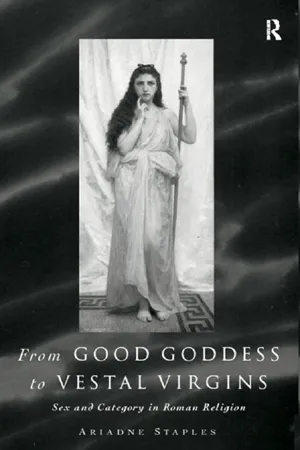
Ariadne Staples' book examines how women in Rome were perceived both by themselves and by men through women's participation in Roman religion, as Roman religious ritual provided the single public arena where women played a significant formal role. From Good Goddess to Vestal Virgins argues that the ritual roles played out by women were vital in defining them sexually and that these sexually defined categories spilled over into other aspects of Roman culture, including political activity.
Ariadne Staples provides an arresting and original analysis of the role of women in Roman society, which challenges traditionally held views and provokes further questions.
- 217 pages
- English
- ePUB (mobile friendly)
- Available on iOS & Android
eBook - ePub
About this book
Part I
THE CULT OF BONA DEA
INTRODUCTION TO CHAPTER 1
Roman religion ritualizes the dichotomy between male and female in complex ways. The cult of Bona Dea is a striking example of this complexity. On a superficial level Bona Dea appears to have been defined by sexual exclusiveness. The best known feature of her cult was a festival which permitted only participation by women, from which men were excluded on pain of sacrilege. Indeed men might not even know the ritual details of the cult, much less witness them. Sexual exclusiveness in itself is not unusual in ancient religions and is often presented as a commonplace ritual feature of one cult or another. But the literary sources for the cult of Bona Dea insist upon this exclusiveness with a stridency so unwonted as to seem suspicious. And indeed there is evidence that men did play some role in the cult. We have evidence of votive offerings made to the goddess by men, and a cryptic remark by Ovid suggests that men might have had some formal sacral role to play.
Most of the rhetoric of sexual exclusiveness focuses on the festival celebrated in early December by women only. It stems mainly from Cicero and carries a distinct political tinge to it. But Cicero does not exaggerate the importance of the feature of sexual exclusiveness to this festival. The cult presents men and women as distinct ritual categories. The ritual details of the cult—at least the ones we know about—all appear to be variations on the theme of male avoidance. These details parallel in their elaborateness the exaggerated rhetoric of exclusiveness, and like that rhetoric invite scepticism by their very elaborateness. In this chapter I analyse the myth and ritual of the cult and argue that while men were physically barred from the December festival, the ritual details were meant to invoke their symbolic presence. The thesis of this chapter is that the December festival of the Bona Dea is not just about women as is commonly supposed (see e.g., Versnel 1993) but about the relationship between men and women.
The cult of Bona Dea established a boundary between male and female. But the boundary was not a barrier. The physical exclusion of men was not meant to symbolise a total absence of the male from the cult. On the contrary the ritual features as well as the aetiological myths performed the more complex task of exploring the nature of male-female relationships. The aetiological myths connected Bona Dea with Hercules Invictus and his cult at the Ara Maxima, and with Faunus, both of whom were objects of sacrifice in the civic religion. The two myths represented the two extremes of male-female relationships. On the one hand, the story of Bona Dea and Faunus, which was explicitly intended to account for the goddess’ abhorrence of men, dealt with the theme of incest—a form of sexual intercourse that was manifestly and unequivocally unlawful. On the other, the story of Bona Dea and Hercules explored the lawful way in which male and female could come together—marriage. These contradictory themes of union through marriage and sexual avoidance were also reflected in the ritual details of the cult. Thus despite the rhetoric of the cult, which appears to suggest that the boundary that the ritual established between male and female was a solid and uncrossable barrier, the myth and ritual itself explored ways in which that boundary might be negotiated.
Fire and water; wine and milk; violence; these are some of the symbolic devices that were used to ritualize the segregation of the sexes and to negotiate the boundaries that separated them. These elements are not peculiar to the cult of Bona Dea but occur in other cults that concern themselves with the themes of gender and boundary. Some of these cults, Ceres, Liber and Libera, Flora, Venus and Vesta, I examine in later chapters. In this first chapter I discuss the symbolic elements only as they are presented in the cult of Bona Dea. But I wish to draw attention to them, and to the manner in which they are presented, for while the symbols remain constant, the symbolism is complex and multi-faceted. The cult of Bona Dea by no means exhausts the complexity of the way in which sexual categorization occurred in Roman ritual or the ways in which it was presented. But because the cult was explicit in its demarcation of boundaries, and the resulting creation of categories, it is a good place to begin to understand that complexity.
1
THE CULT OF BONA DEA
What sacrifice is so ancient as that which we received from our kings, and which is coeval with our city? Or what so secret as that which fences itself against the eye not only of the inquisitive, but even of the idle, and to which access is debarred, not merely from wickedness but even from inadvertency? A sacrifice, too, which none in all history violated before Publius Clodius, none ever approached, none made light of; a sacrifice from the sight of which no man but sank with horror; a sacrifice performed by Vestal Virgins on behalf of the Roman people, performed in the house of a magistrate, and with the most elaborate ceremonial, in honour of a goddess whose very name men are not permitted to know.
(Cic., Har. Resp., 17)
Cicero is describing here the rites of Bona Dea, a festival celebrated each December, exclusively by women, in the house of a Roman magistrate. In 62 BC the ceremony was being conducted in the house of Caesar, who was a praetor that year. P.Clodius Pulcher, apparently intent on seducing Caesar’s wife, Pompeia, disguised himself as a flute-girl and gained access to the rites.1 Hence Cicero’s fulminations. How seriously should we take Cicero’s attack? Did Clodius commit a serious act of profanation and was Cicero’s fury more than self-serving hyperbole? Was the cult of Bona Dea a central part of the civic religion? The fact is that if not for the Clodius affair we would in all likelihood have had very little knowledge, if not about the goddess herself, certainly about her festival. Our evidence comes from Cicero and later writers who based their accounts on his.2 But Cicero’s motives are, to say the least, suspect. As Brouwer observes, it was only when he himself had fallen foul of Clodius that he took the moral high ground over Clodius’ infiltration of the rites. Before that, soon after the incident itself, he displays a marked reluctance to support a senatorial motion for a trial of Clodius for incestum.3 After he had become a target of Clodius’ enmity, however, his moral indignation knew no bounds. His brilliantly vituperative rhetoric captured the imagination of later writers and we have an exceptionally large volume of material on the incident. None of it, however, tells us much more than we already know from Cicero’s own works. This has led some modern scholars to conclude that Bona Dea was a minor, relatively unimportant deity. Dumézil, for example, writes:
Did this group of savage divinities [i.e. Faunus, Silvanus, the Lares] include in ancient times, a feminine element? Fauna is hardly more than a name, which takes on substance only in legends where, as wife, daughter, or sister of Faunus, she passed into fiction, and into the Hellenized novel. Under the name of Bona Dea, she was the object of an annual ceremonial in December which was official but secret—strictly limited to women—highly coloured, but Greek. She was no more than a ‘Damia’, probably imported from Tarentum, and perhaps through a mistranslation when that city was conquered in 272.
(Dumézil 1970:350. My parentheses)
Brouwer’s is to date the most comprehensive study of the Bona Dea (Brouwer 1989). He argues that the literary evidence as derived from Cicero has given us an exaggerated view of the importance, not of the cult as a whole, but of the festival in December and its particular rites (ibid.: 260 et seq.). The epigraphical material reveals a somewhat different type of cult with some elements apparently contradicting the evidence of the December ritual. The most significant of these differences is that while the December ritual explicitly and very rigorously excluded men, the epigraphical evidence shows that men did, in fact, worship this goddess.4
Bona Dea was a goddess of many parts, as are most deities in polytheistic systems. The fact that her cult took different forms on different occasions is not in itself surprising or unusual in any way. Nor does evidence that men dedicated votive offerings to her diminish the significance of the December festival which was celebrated by women alone. That is, not unless we believe that women’s rituals were ipso facto of little importance. The December festival was undoubtedly a part of the civic religion. Whatever the political motives behind the fracas occasioned by Clodius’ escapade, the fact is that Clodius did stand trial for incestum.
Nevertheless the all-female festival does raise interesting questions. Particularly since, as we shall see, the mythology of Bona Dea seems designed to explain the goddess’ avoidance of men. Also, the rhetoric of male avoidance in descriptions of the festival is exceptionally strident. Even if allowance be made for the fact that most of it harks back to Cicero and the Clodius affair, the cult of Bona Dea does seem to protest its abhorrence of males a little too much. Sexual segregation in cult and ritual is not unusual in Roman religion and most of the time it is presented as just another ritual feature. There is generally no attempt made to explain or defend the exclusion of one sex or the other from a particular rite. The striking exceptions are the cult of Bona Dea and the cult of Hercules Invictus at the Ara Maxima, which excluded all women from its rites. Significantly, as we shall see, at least one account of the founding of the Ara Maxima explains the exclusion of women by means of a story featuring Bona Dea.
As far as the rites at the Ara Maxima were concerned the exclusion of women was merely a ritual detail. Women simply did not participate in the rites.5 And though I have nowhere found it explicitly stated, it is, I think, safe to assume that women were also excluded from the public banquets that followed sacrifices at the Ara Maxima, even when the sheer numbers of people involved would have meant that the participants in the feast spilled out of the precincts of the shrine onto the public streets.6 Gellius cannot explain why men were not allowed to swear by Castor, but finds nothing strange in the fact that women could not swear by Hercules. After all, he says, they abstained from all sacrifice to that god.7 But there do not seem to have been any elaborate ritual mechanisms for keeping women out such as the cult of Bona Dea had for keeping out men.8 The myths that are connected with the rites at the Ara Maxima are however another matter altogether. Here, the exclusion of women is given a degree of prominence that makes it appear one of the most important, if not the most important feature of the cult. Moreover, except for one variant which links the exclusion of women to the goddess Carmenta,9 it is Bona Dea, who is made to occupy the opposite end of the male/female axis which the myths create.
The ritual separation of male and female is frequently expressed in terms of the opposition of fire and water. Fire and water together symbolize life itself: hae duae res (sc. aqua et ignis) humanam vitam continent—‘These two elements constitute human life’.10
Aqua et igni tam interdici solet damnatus, quam accipiunt nuptae, videlicet quia hae duae res humanam vitam maxime continent. Itaque funus prosecuti redeuntes ignem super gradiebantur aqua aspersi; quod purgationis genus vocabant suffitionem.
Water and fire are both denied to condemned men and accepted by brides. The reason is probably because these two substances contain the very stuff of human life. Therefore, those returning from a funeral sprinkle themselves with water and step over fire. They call this suffitio, a kind of purification.11
Death is equivalent to the denial of fire and water. Hence the reason why mourners after a funeral seek symbolic contact with the two elements. The Digest states that there were just two modes of capital punishment: exile and death. Exile—exilium—was not simple banishment; it signified the loss of Roman citizenship and was expressed in terms of the denial of fire and water. Simple banishment—relegatio—was not accompanied by the denial of fire and water, did not entail the loss of citizenship and was therefore not a form of capital punishment.
Individually, fire and water represented the male and female principles respectively. In the Roman Questions Plutarch asked ‘why did the bride touch fire and water?’12 And he answered, ‘fire without moisture is without nourishment and dry, while water without heat is barren and inactive: and so male and female apart from each other are ineffectual but their coming together in marriage produces the perfect communal life’. Varro defines the ritual separation of male and female in terms of fire and water explicitly in terms of sexuality and procreation:
The conditions for procreation are two: fire and water. Thus these are used at the threshold in weddings, because there is union here. And fire is male, which the semen is in the other case, and water is the female because the embryo develops from her moisture, and the force that brings their binding (vinctio) is Venus.
(Varro, Ling., 5.61)
The perception of the dichotomy of male and female in terms of fire and water was diffused throughout what I have called the cultural system. The social rituals of marriages and funerals embodied the symbolism as did legal ritual and indeed legal discourse. There are other references13 but one is particularly striking, because it is so obviously untrue on the level of experience that it can only reflect a very strong ritual belief. Macrobius refers to a passage in Aristotle, where the philosopher maintains that women rarely become drunk, but old men often do. Aristotle gives no reason for this. The reason that is vouch...
Table of contents
- Cover Page
- Half Title Page
- Title Page
- Copyright Page
- Dedication
- Contents
- Preface
- Introduction
- Part I The Cult of Bona Dea
- INTRODUCTION TO CHAPTER 1
- 1 The Cult of Bona Dea
- PART II The Cults of Ceres and Flora
- INTRODUCTION TO CHAPTER 2
- 2 Ceres and Flora
- PART III Venus' Role in Roman Religion
- INTRODUCTION TO CHAPTER 3
- 3 Venus
- PART IV The Vestals and Rome
- INTRODUCTION TO CHAPTER 4
- The Uses of Virginity The Vestals and Rome
- CONCLUSION
- Notes
- Bibliography
- Index
Trusted by 375,005 students
Access to over 1.5 million titles for a fair monthly price.
Study more efficiently using our study tools.
Frequently asked questions
Yes, you can cancel anytime from the Subscription tab in your account settings on the Perlego website. Your subscription will stay active until the end of your current billing period. Learn how to cancel your subscription
No, books cannot be downloaded as external files, such as PDFs, for use outside of Perlego. However, you can download books within the Perlego app for offline reading on mobile or tablet. Learn how to download books offline
Perlego offers two plans: Essential and Complete
- Essential is ideal for learners and professionals who enjoy exploring a wide range of subjects. Access the Essential Library with 800,000+ trusted titles and best-sellers across business, personal growth, and the humanities. Includes unlimited reading time and Standard Read Aloud voice.
- Complete: Perfect for advanced learners and researchers needing full, unrestricted access. Unlock 1.5M+ books across hundreds of subjects, including academic and specialized titles. The Complete Plan also includes advanced features like Premium Read Aloud and Research Assistant.
We are an online textbook subscription service, where you can get access to an entire online library for less than the price of a single book per month. With over 1.5 million books across 990+ topics, we’ve got you covered! Learn about our mission
Look out for the read-aloud symbol on your next book to see if you can listen to it. The read-aloud tool reads text aloud for you, highlighting the text as it is being read. You can pause it, speed it up and slow it down. Learn more about Read Aloud
Yes! You can use the Perlego app on both iOS and Android devices to read anytime, anywhere — even offline. Perfect for commutes or when you’re on the go.
Please note we cannot support devices running on iOS 13 and Android 7 or earlier. Learn more about using the app
Please note we cannot support devices running on iOS 13 and Android 7 or earlier. Learn more about using the app
Yes, you can access From Good Goddess to Vestal Virgins by Ariadne Staples in PDF and/or ePUB format, as well as other popular books in History & Ancient History. We have over 1.5 million books available in our catalogue for you to explore.