Education in consumer affairs has become increasingly important in recent years with the growth of consumer societies in many parts of the world. This practical handbook is a guide to teachers on the various aspects of the field; it looks at the consumer world in its political, social and economic context, describing how teachers have approached some of the subjects discussed in the book in class. Although based on the UK experience, it contains many references to global consumerism.
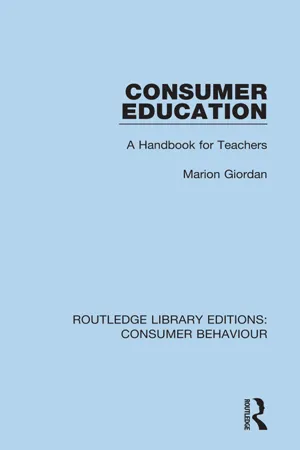
- 88 pages
- English
- ePUB (mobile friendly)
- Available on iOS & Android
eBook - ePub
1 Introduction
DOI: 10.4324/9781315733593-1
This book has grown out of considerable involvement in consumer education over several years, partly in producing materials for children and information for teachers, partly in dealing with many of the problems people have in adult life when they find themselves ill-equipped to cope with our rapidly changing society.
The framework of the book is based on lectures given at in-service training courses on consumer education at the request of a number of local education authorities, and it incorporates information and resources teachers have found helpful, as well as examples of the way they have incorporated consumer studies in their own teaching. Each chapter thus provides basic information on subject areas related to consumer studies which are demanded in examination syllabuses, some examples of teaching experiences and a list of further resource materials. Since this is a rapidly changing field, and one in which it is essential to keep in touch with the course of events, a number of pages have been left blank at the end of the book for readers to make their own notes of addresses of new organizations, teaching materials and new legislation.
The choice of these resource materials has been deliberately selective. With such a wide-ranging subject as consumer education, I have tried to ensure that the resources mentioned should lead readers on to sources of information where they can find the additional material that interests them. Some are produced by industrial organizations and project their particular viewpoint, which readers will readily recognize, and others by pressure groups or committed individuals, whose perspective is different but equally recognizable. Other sources still are textbooks, government publications, etc. Thus, while you may not always agree with my viewpoint, you will find sufficient variety among the resources listed here to provide more information on topics in which you may be interested.
The basis of the information provided in the book should also be explained. The material on the way schools and countries approach consumer education, and on the resources available in the United Kingdom is based on work undertaken over a period of years on consumer education projects, which included co-founding and co-editing a consumer information newspaper for schools. I was also commissioned by the Environment and Consumer Protection Service of the European Commission to report on consumer education in the United Kingdom under the title ‘Education of Consumers: An Extensive Documentary Search and A Report on Pedagogic Experiments in the United Kingdom’; the same organization asked me to organize the EEC Colloquium on consumer education in schools in the nine countries of the Community, and to edit the subsequent report. These experiences have produced useful insights into what teachers need in the way of information, what children find interesting, the resources available, and how different countries tackle the subject.
There are many ways of approaching consumer studies. I have tried to put them in the context of the political, social and economic framework of the United Kingdom in an attempt to make the clearest sense of them. The same applies to consumer studies in any country. Most societies seem to reach a point where pressure to protect, represent, and educate people as consumers begins to develop. The form that such developments take in practical terms relates immediately to the political organization, the economic climate and the society and traditions of the country itself. This book describes reactions in the United Kingdom to this pressure; other countries start from a different base and express the same concepts in different ways. Thus readers from other countries with an interest in consumer education may find it useful and constructive to compare what happens in the United Kingdom with what happens in their own society.
A great many people and organizations have helped me in the course of my work in consumer education, and have thus influenced the form of this book. I particularly want to thank those education authorities – particularly the Inner London Education Authority – whose advisers and inspectors have invited me to lecture at seminars and in-service courses on consumer education; those schools where I have been able to talk to children and students about many of the subjects in this book, and the Environment and Consumer Protection Service of the European Commission, for commissioning the work which has given me additional perspectives on the subject.
There are also many colleagues and friends in government departments and agencies, consumer organizations, schools and colleges, who have discussed aspects of consumer education with me, updated my information, and brought resources and schoolwork to my notice, both in the United Kingdom and in other parts of the world. They make a cast of some hundreds, and I am very grateful to them all.
Finally, the intention behind this book. I have written it, having been committed to consumer education for some years, and because I think it should be more widely incorporated in school curricula. From the information it contains, particularly in chapter 3, it must be clear that a consumer perspective can be incorporated in many subjects and at all ages, from nursery school children, as in Belgium, to preretirement courses: In time I would like it to become a subject in its own right, incorporating economics, law, mathematics, communications, politics, social studies, design and technology, and ethics, because those are the skills required of adults. Until that happy day dawns, however, I suggest that consumer education has wide-ranging application to most subjects, all students and all abilities.
2 Consumer education
DOI: 10.4324/9781315733593-2
Definitions
Consumer education can be defined in a variety of ways. Some see it as ‘wise buying’ information and training in how to budget so as to be able to take as much advantage of the consumer society as possible; manufacturers see it as a way of informing consumers about the benefits of their products to encourage them to buy. Others see the consumer society as a highly organized conspiracy to keep workers docile and uncritical, and consumer education as a means of perpetuating that situation. Others again, of whom I am one, see it as a means of creating and achieving change in society, so that instead of being formed and manipulated by our consumer society, we adapt it to our needs.
These are of course simplistic definitions, but each has its supporters. The definition offered by the International Organization of Consumers’ Union is ‘critical awareness, social responsibility, involvement or action, ecological responsibility, and solidarity (among consumers)’, and this is the interpretation closest to the one on which this book is based.
I see consumer education in the context of the rapidly changing and complex world we live in. It is a world based on and formed by technologies, industries and institutions of which most of us, even in adult life, comprehend only a small part. Consumer education creates awareness of this changing world, of the need for information and guidelines by which one may plot one's way through it, with the least possible personal damage and the means of bringing about change if that appears to be required. Thus consumer education is about asking questions and subsequently making decisions which are as much political as personal.
This is of course what education is about anyway. But consumer education has a particular perspective which casts a light on other aspects of life. The way in which people use money is intensely personal and individual. The way they allocate and spend their resources is in a sense a form of self-expression. The way we use money is the way we create our own particular physical worlds, in terms of what we eat, where we live, what we wear, our interests, our concern for what others think of us. The way we spend money and what we spend it on is the way we operate our lives, and is thus of immense importance and a very fundamental and basic part of our lives. For most of us the material world dominates, and it is our concern — or obsession — because it shows the consumer society in its most selfish and least attractive light.
The way we spend our money is one of the last areas of free choice left to us. There are constraints in every part of our lives: housing, jobs, health, personal relations may be unsatisfactory and show little prospect of improvement in the immediate future. But spending money gives the illusion of control and power, and can also be very enjoyable. It is a means by which we alleviate and furnish the fundamentally harsh conditions of life. That is what makes us vulnerable within the consumer society, and in need of protection against it. It is also something that no one can escape, no matter how high-minded: we all need, at least, food, shelter and clothing, and we can soon add to that list many other items; medical services, transport, sanitation, education, money and so on.
Moreover the choice we thought was free is not free at all. We are buying other people's decisions, just as our lives in relation to other physical and material matters such as housing, jobs, money and transport are formed by other people's decisions. Products in the market place are largely structured to use existing materials, to be made on available machinery, designed and packaged to travel long distances within the existing distribution network, and to fit in with retailers’ arrangements. Moreover our desires for these products are, in my view, highly manipulated by manufacturers, retailers, and their advertising agents, to encourage us, not just to want them but to feel they are essential to our well-being. On this premise is the industrial society based.
Now as well as wanting to know how to work your way through this maze, you also have to live and work in it. It brings many benefits, as well as hazards and exploitation. We in the United Kingdom also live in a parliamentary democracy, and we may wish to change our society's institutions or take part in the decision-making process, since as well as being consumers we are also citizens. Thus consumer education is advice for living, and moreover for living with change and perhaps creating change.
The Global Context
The growing interest in consumer education is not by any means confined to the United Kingdom. It has become a world-wide concern, though the way it is taught is related, as always, to the precepts and philosophy of each country's society. In the United States it is perhaps at its most advanced, and in some states is mandatory, and in some high schools a very popular subject. The concepts behind the teaching are closely related to the American outlook of making the best of a fundamentally exploitative society: ‘how to avoid the rip-offs’, as one boy said.
In French and West German secondary schools consumer education tends to appear in craft and economics courses. The Scandinavian outlook is one that is alert to world needs and resources, particularly to the dehumanizing dangers of concentrating on consumption as an end in itself. These concepts, on which the experimental Malmö Project in Scandinavian schools is based, start with nine-year-olds, and it includes emotive aspects, like pleasure in buying presents for others. The Belgians have a consumer education experiment aimed at encouraging consumer awareness among nursery school children from the age of three, who learn, for example, about sweets and tooth decay and are encouraged to develop a preference for apples.
The European Commission adopted a commitment to consumer education in 1975. It has commissioned reports on the state of the art in different member countries. It held a colloquium in 1977 in London to find out what was happening in schools in member countries, and then prepared teaching materials for trial in schools within the Community.
But in certain European countries such as Ireland, Spain and Portugal, consumer activists have difficulty in getting recognition for consumer education. In those countries consumer awareness is still in its infancy, in many respects and consumer education even further off.
However certain Third World countries concern themselves with consumer education in ways which relate very immediately to their own circumstances. In the Philippines, for example, consumer education is teaching people to boil water before they drink it, and to examine sugar for impurities – both products we in the United Kingdom and similar economies take for granted as being fit and wholesome for immediate consumption.
In the United Kingdom, the interest in consumer education has come from the consumer organizations and central and local government as much as from teachers anxious to protect children from the impact of the exploitative nature of the consumer society. The Welsh Consumer Council and the National Federation of Consumer Groups are active in consumer education, as are some local authority consumer protection departments. Other initiatives have come from the Department of Prices and Consumer Protection and its successor, the Consumer Affairs Division of the Department of Trade, from the Department of Energy, the Office of Fair Trading in its consumer information activities, the British Standards Institution, the Electricity Consumers’ Council, and others, possibly perceiving not only the need for consumer education but also that it might be a more effective way to protect consumers than laws and institutions. Whether these consumer education efforts will ever replace the need to protect people in these ways is of course unlikely.
Resources
Report of the 1977 Colloquium on Consumer Education in Schools in the Community, ed. Marion Giordan (Commission of the European Communities: Brussels, 1980).
Educating the Consumer, Alma Williams (Longmans, 1975). (0 582 36507 4(pb); 0 582 36310 1 (hb))*
Reading, Writing and Relevance, Mary Hoffman (Hodder & Stoughton, 1976). (0 340 21025 7)
Reading and the Consumer, Alma Williams (Hodder & Stoughton, 1976). (0 340 21027 3)
The two latter books contain useful descriptions of using consumer information in teaching, and are set books for the Open University course in Reading Development PE 231, on the teaching of reading, which itself contains some stimulating units on e.g. advertising.
- *Throughout the book ISBN numbers are given where relevant.
3 Consumer education in the syllabus
DOI: 10.4324/9781315733593-3
There is, at the time of writing, no examination syllabus in the United Kingdom called ‘consumer studies’ or any similar name. Nevertheless, topics with consumer relevance appear in many O level, A level, CSE and Scottish syllabuses, while consumer affairs can be used to illuminate and give a deeper perspective to many others which may be less immediately obvious. Because syllabuses vary from one examining board to another, it is not possible to point to particular subjects and be confident that they all contain the same sections or units. However, from the point of view of their consumer studies content, some syllabuses seem to group themselves. Thus this brief chapter is not an exhaustive list of the examination syllabuses which include some aspect of consumer studies, but a kind of overview as to where this occurs in some form, and to which the material contained in this book is relevant.
Home economics almost invariably contains sections or units on money management, consumer guidance, consumer protection and redress, shopping, product standards and safety, consumer organizations and advertising, and aspects of consumer law such as labelling. Related subjects, like needlecraft and textiles, and food and nutrition, often call for knowledge of the same kind of information, for example about consumer groups, the Fibre Content Regulations, the Offic...
Table of contents
- Cover Page
- Half-Title Page
- Title Page
- Copyright Page
- Title Page 01
- Copyright Page 01
- Table Of Contents
- 1 Introduction
- 2 Consumer education
- 3 Consumer education in the syllabus
- 4 The consumer
- 5 Shopping
- 6 Money
- 7 Consumer law
- 8 Consumer protection and consumer organizations
- 9 The consumer and the environment
- 10 More resources and useful addresses
- INDEX
Trusted by 375,005 students
Access to over 1.5 million titles for a fair monthly price.
Study more efficiently using our study tools.
Frequently asked questions
Yes, you can cancel anytime from the Subscription tab in your account settings on the Perlego website. Your subscription will stay active until the end of your current billing period. Learn how to cancel your subscription
No, books cannot be downloaded as external files, such as PDFs, for use outside of Perlego. However, you can download books within the Perlego app for offline reading on mobile or tablet. Learn how to download books offline
Perlego offers two plans: Essential and Complete
- Essential is ideal for learners and professionals who enjoy exploring a wide range of subjects. Access the Essential Library with 800,000+ trusted titles and best-sellers across business, personal growth, and the humanities. Includes unlimited reading time and Standard Read Aloud voice.
- Complete: Perfect for advanced learners and researchers needing full, unrestricted access. Unlock 1.5M+ books across hundreds of subjects, including academic and specialized titles. The Complete Plan also includes advanced features like Premium Read Aloud and Research Assistant.
We are an online textbook subscription service, where you can get access to an entire online library for less than the price of a single book per month. With over 1.5 million books across 990+ topics, we’ve got you covered! Learn about our mission
Look out for the read-aloud symbol on your next book to see if you can listen to it. The read-aloud tool reads text aloud for you, highlighting the text as it is being read. You can pause it, speed it up and slow it down. Learn more about Read Aloud
Yes! You can use the Perlego app on both iOS and Android devices to read anytime, anywhere — even offline. Perfect for commutes or when you’re on the go.
Please note we cannot support devices running on iOS 13 and Android 7 or earlier. Learn more about using the app
Please note we cannot support devices running on iOS 13 and Android 7 or earlier. Learn more about using the app
Yes, you can access Consumer Education (RLE Consumer Behaviour) by Marion Giordan in PDF and/or ePUB format, as well as other popular books in Business & Business General. We have over 1.5 million books available in our catalogue for you to explore.