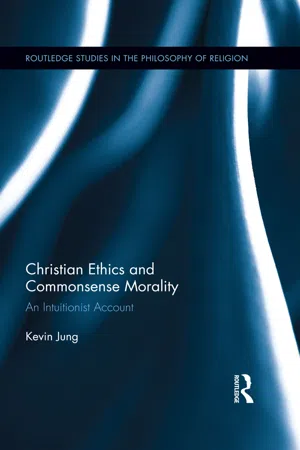
Christian Ethics and Commonsense Morality goes against the grain of various postmodern approaches to morality in contemporary religious ethics. In this book, Jung seeks to provide a new framework in which the nature of common Christian moral beliefs and practices can be given a new meaning. He suggests that, once major philosophical assumptions behind postmodern theories of morality are called into question, we may look at Christian morality in quite a different light. On his account, Christian morality is a historical morality insofar as it is rooted in the rich historical traditions of the Christian church. Yet this kind of historical dependence does not entail the evidential dependence of all moral beliefs on historical traditions. It is possible to argue for the epistemic autonomy of moral beliefs, according to which Christian and other moral beliefs can be justified independently of their historical sources. The particularity of Christian morality lies not in its particular historical sources that also function as the grounds of justification, but rather in its explanatory and motivational capacity to further articulate the kind of moral knowledge that is readily available to most human beings and to enable people to act upon their moral knowledge.
- 202 pages
- English
- ePUB (mobile friendly)
- Available on iOS & Android
eBook - ePub
About this book
Information
1 Varieties of Postmodern Ethics
DOI: 10.4324/9781315732701-2
One no longer has to seek that point of absolute origin or total revolution on the basis of which everything is organized, everything becomes possible and necessary, everything is effaced in order to begin again. One is dealing with events of different types and levels, caught up in distinct historical webs; the establishment of an enunciative homogeneity in no way implies that, for decades or centuries to come, men will say and think the same thing; nor does it imply the definition, explicit or not, of a number of principles from which everything else would flow, as inevitable consequences.1Michel Foucault, The Archaeology of Knowledge and the Discourse on Language
As James Livingston notes, the term “postmodernism” is “burdened by a lack of precision and questions are increasingly raised about the value of its use, especially in theology.”2 The situation is similar in Christian ethics, as Christian ethicists of divergent views commonly use the term to refer to themselves or others. Part of the reason for this lack of precision lies in the fact that postmodernism offers no single coherent philosophical system and espouses no particular theory of truth or knowledge. Thus, it is not always clear how we should apply the term “postmodern” to a particular thinker.
Despite many ambiguities surrounding the use of the term “postmodernism,” however, it will be useful to clarify how the term is going to be used at the outset. In this book, I will use “postmodernism” in the narrow sense of the post-Nietzschean philosophy that Richard Rorty once spoke of.3 So what characterizes this philosophy? I find Rorty's answer to be helpful: “Nietzsche was as good an anti-Cartesian, antirepresentationalist, and anti-essentialist as Dewey.”4 It is worth noting that Rorty identifies three areas in which postmodernism can be understood: the theory of knowledge, the theory of truth, and ontology. The first has to do with how we justify claims to knowledge, the second concerns the conceptions of truth, and the third has to do with the nature of what there is (e.g., the nature of properties).
For my purposes, I am not interested in a historical inquiry into the origin of postmodernism or a comprehensive study of postmodernism across various disciplines. Rather, the main task of this chapter is to outline some salient philosophical ideas that are often used to support postmodern ethics in order to facilitate subsequent discussions in later chapters. In what follows, I will examine how these ideas have been conceived and expressed in different philosophical traditions.
I Postmodernism in the Continental Tradition
One important source for postmodern ethical discourse has been continental philosophy. While it is probably impossible to identify a single origin of postmodernism within the continental tradition, one conspicuous element shared by many postmodern continental thinkers is their suspicion of reason as a trustworthy source of knowledge. By “reason,” such thinkers usually mean the rational faculty that is believed to be ahistorical and universal, a capacity that all rational human beings are said to possess and that has traditionally been held to be an important source of knowledge. Why then do postmodern thinkers distrust reason?
Against Ontology
In order to understand the philosophical grounds from which postmodern theory opposes reason, we need to go back to a crucial moment in the relatively recent history of continental philosophy: Martin Heidegger's critique of ontology as the study of the nature of being. Though Heidegger may not have been the first philosopher in modern philosophy to critique ontology,5 he is often credited for clearly articulating several major problems with it.
Heidegger's main objection to ontology was that it fails to acknowledge the temporal, social, and existential dimensions in our understanding of being. He complained that most Western philosophers seek to determine the meaning of being primarily in terms of presence as “parousia” or “ousia”: “Beings are grasped in their being as ‘presence’; that is to say, they are understood with regard to a definite mode of time, the present.”6 What he meant here is that traditional ontology assumed that we can apprehend something “objectively present in its pure objective presence [Vorhandenheit]” as it shows itself “with regard to a definite mode of time, the present.”7 Operating on this assumption, traditional ontology failed to note that being as an object of understanding is only accessible through the temporal and existential structures of Dasein, that is, the knowing self located at a particular time and place in history. Heidegger believed that ontology not only made the serious mistake of overlooking temporality, the very condition of historicity from which no ontology is free. Ontologies that have made this mistake have often treated time either as irrelevant to ontology or as one object among others, as if the study of being can ignore the question of temporality, or as if reality is always accessible by the knower in the present tense outside of the lifeworld of the knower. In response, Heidegger suggested that we destroy ontology since it is responsible for uprooting the historicity of Dasein from the understanding of being. Thus, Heidegger called for the destruction (Destruktion) of ontology,8 and thus it may be said that he paved the way for the arrival of a similar movement years later, namely deconstruction.
Instead of ontology, Heidegger called for a phenomenological study of being, which would interpret the primordial existential structures of Dasein in order to disclose the meaning of being that has been concealed by ontology. This is why Heidegger claimed that “[o]ntology is possible only as phenomenology” and that hermeneutics has a central place in phenomenology.9
Though not every contemporary postmodern thinker wants to move in the exact footsteps of Heidegger, especially with respect to his particular interpretation of the existential meaning of Dasein as the “world as existing-there-for-me” or his interpretation of death as the possibility for being understood as mineness (Jemeinigkeit), many postmodern thinkers continue to press the Heideggerian objection to ontology, joining him with the allegation that ontology has denied the inextricably intertwined relationship between the human condition and knowledge. Heidegger's argument that knowledge cannot be divorced from the historical condition of the knower has become a recurrent theme among almost all postmodern thinkers, which itself raises the question of whether there can be an objective knowledge of morality.
The Alterity of the Other and the Surplus of Meaning
In the Levinasian school of phenomenology, the critique of ontology takes an ethical turn. As Levinas understands ethics in terms of one's infinite ethical responsibility for the Other, ontology is considered as a threat to ethics.10 I have noted earlier that Heidegger problematizes the idea that “beings” can be grasped as presence (ousia), according to which the essence of being is made always “present” to the self in an eternal and immutable form. A main thrust of Heidegger's criticism of ontology involves the criticism of an implicit assumption in ontology that knowledge is a matter of representation (as in re-presentation or duplication) whereby the self (or the mind) is believed to be capable of re-presenting an object.
Following Heidegger, Levinas also criticizes this idea of representation that ontology is accused of committing. He writes that, in ontology, all knowledge is a “re-presentation, a return to presence,” in which nothing remains “other to it, and thus the ontological plane is characterized by representation.”11 He calls the temporality manifested by this re-presentation the synchronization of time. In doing so, he challenges what he takes to be Brentano's and Husserl's thesis that a subject's intentionality allows its perceived object to appear or re-appear to the subject always in the present mode of time. According to his interpretation of these two thinkers, it is a matter of intentionality to accept what is already grasped by consciousness or what is retained by memory, and through intentionality the meaning of an object is then re-presented again and again.12 In this sense, the time of representation becomes the time of “synchrony” and “contemporaneity.”
However, Levinas denies that time is synchrony or contemporaneity and asserts that time cannot be reduced merely to the present that is repeatable for the self. Why does he deny? As a student of phenomenology, he believes that we need to take the phenomenon of a being seriously, that is, the way a being is disclosed to the self in real time. Yet, unlike Brentano, Husserl, and even Heidegger, Levinas believes that the Other who appears to the knower cannot be fully given to the subject's consciousness on the contemporaneous horizon of time. He writes, “[T]he exteriority of the object represented appears to reflection to be a meaning ascribed by the representing subject to an object that is itself reducible to a work of thought.”13 The subject cannot simply claim to have grasped the meaning of the Other, as if the Other is a thing that can be known via rational intuition, uprooted from its temporal and relational contexts. The meaning of the Other is irreducible to the subject's cognition. Levinas attributes this irreducibility to “a surplus of the Good over being” in the self-manifestation of the Other and characterizes this rational act of reduction as “totality,” which he explains as the immanence of being or an adequation of the Other with an object that is present to the consciousness of the self through intentionality.14
He then contrasts the totality of reason with the infinity (he also uses terms like “alterity,” “otherness,” and “transcendence”—the terms that are meant to signify the surplus of meaning in the Other) of the Other. Levinas then traces the meaning of the Other to the primordial time of the Other, time immemorial that “cannot be recuperated by memory and history.”15 According to this view, reason works on the temporal horizon of synchrony, always seeking to thematize the Other into a comprehensible object. In contrast, the alterity of the Other is only found on the temporal horizon of diachrony, where the Other announces its own meaning as opposed to the meaning represented by the self. This is why Levinas believes that any rational act of representation reduces the meaning of the Other to something it is not. It is a form of violence that denies the alterity of the Other.
This explains why, for Levinas, reason is not a reliable source for ethics. Since reason is by nature inadequate to recognize the alterity of the Other, and is susceptible to violence due to its solipsistic attitude toward others, Levinas wants to move the source of ethical obligation to one's intersubjective relationship with the Other, a relationship in which one's ethical responsibility is defined by one's faithful response to the command of the Other. In Levinas's philosophy, ethics then becomes something that needs to be freed from the potentially tyrannical reign of reason in order to welcome the Other by hearing and obeying the Other's ethical commands. In this way, Levinas challenges a traditional philosophical belief that objective knowledge is possible only for a fully autonomous and ahistorical reason.
Instability of Meaning
In joining others in their opposition to the metaphysics of presence, another postmodern thinker, Jacques Derrida, develops an argument from a different angle. Challenging the structuralist assumption that the binary opposition of concepts arranged in a hierarchical order is a necessary condition of knowledge, Derrida seeks to deconstruct what he considers to be the rationalist and universalist biases in philosophy. The result of his work seems as radical as the term “deconstruction”; he denies that there is any fixed or permanent meaning, comprehensible or incomprehensible to reason, behind any concept or any being.
For instance, Derrida engages in a kind of extreme makeover of Husserlian phenomenology to show how deconstruction is possible. For Husserl, consciousness has intentional content; that is, every intentional act contains something as an object in itself, whether that something really exists or not. Intentional acts make sense of the object by bringing some meaning to it. In this regard, he believed that any intentional act that is meaningful (as opposed to non-sensical) must be subjectively fulfilled in intuition, whether in perception, imagination, or memory. Derrida, however, rejects Husserl's requirement of intuitive fulfillment in meaningful intentional acts, dismissing the notion that there is an a priori correlation between the signifier and the signified in intentional acts. Instead, Derrida claims that signifiers (e.g., sentence, words, or sounds) can bear signification with or without the fulfilling intuition of the referents to which the signifiers are supposed to correspond. Derrida thinks that he can exhibit—through the endless work of deconstruction—how every text, including every signifier, need not have (properly corresponding) fulfillment in intuition for it to have meaning.
His general point is that the denial of intuitive fulfillment does not necessarily lead to the loss of meaning. For Derrida, the field of meaning—and the apparent correlation of signification and intuition—is rather an effect (not a condition) of the play of presence and absence. The apparent correlation is said to be made possible by a play of the substitution of sign...
Table of contents
- Cover Page
- Halftitle Page
- Series Page
- Title Page
- Copyright Page
- Table Of Contents
- Acknowledgments
- Introduction
- 1 Varieties of Postmodern Ethics
- 2 Is Foundationalism Dead?
- 3 Moral Realism According to Lovibond and Hauerwas
- 4 How to Defend Moral Realism
- 5 Morality of Emotion
- 6 Ethical Naturalism and Theological Ethics
- 7 Commonsense Tradition and Intuitionism
- 8 Intuitionism: Philosophical Issues and Replies
- 9 Commonsense Morality and Christian Morality
- Epilogue
- Bibliography
- Index
Trusted by 375,005 students
Access to over 1.5 million titles for a fair monthly price.
Study more efficiently using our study tools.
Frequently asked questions
Yes, you can cancel anytime from the Subscription tab in your account settings on the Perlego website. Your subscription will stay active until the end of your current billing period. Learn how to cancel your subscription
No, books cannot be downloaded as external files, such as PDFs, for use outside of Perlego. However, you can download books within the Perlego app for offline reading on mobile or tablet. Learn how to download books offline
Perlego offers two plans: Essential and Complete
- Essential is ideal for learners and professionals who enjoy exploring a wide range of subjects. Access the Essential Library with 800,000+ trusted titles and best-sellers across business, personal growth, and the humanities. Includes unlimited reading time and Standard Read Aloud voice.
- Complete: Perfect for advanced learners and researchers needing full, unrestricted access. Unlock 1.5M+ books across hundreds of subjects, including academic and specialized titles. The Complete Plan also includes advanced features like Premium Read Aloud and Research Assistant.
We are an online textbook subscription service, where you can get access to an entire online library for less than the price of a single book per month. With over 1.5 million books across 990+ topics, we’ve got you covered! Learn about our mission
Look out for the read-aloud symbol on your next book to see if you can listen to it. The read-aloud tool reads text aloud for you, highlighting the text as it is being read. You can pause it, speed it up and slow it down. Learn more about Read Aloud
Yes! You can use the Perlego app on both iOS and Android devices to read anytime, anywhere — even offline. Perfect for commutes or when you’re on the go.
Please note we cannot support devices running on iOS 13 and Android 7 or earlier. Learn more about using the app
Please note we cannot support devices running on iOS 13 and Android 7 or earlier. Learn more about using the app
Yes, you can access Christian Ethics and Commonsense Morality by Kevin Jung in PDF and/or ePUB format, as well as other popular books in Philosophy & Philosophy History & Theory. We have over 1.5 million books available in our catalogue for you to explore.