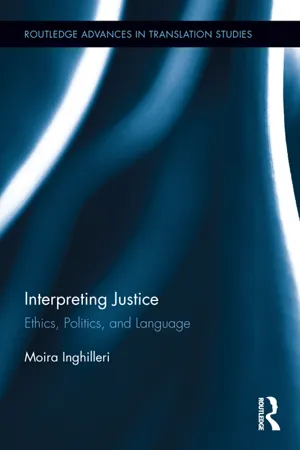
In this timely study, Inghilleri examines the interface between ethics, language, and politics during acts of interpreting, with reference to two particular sites of transnational conflict: the political and judicial context of asylum adjudication and the geo-political context of war. The book characterizes the social and moral spaces in which the translation of the spoken word occurs in ways that reflect the realities of the trans-nationally constituted, locally and globally informed environments in which interpreters work alongside others. One of the core arguments is that the rather restricted notion of neutrality that remains central to translator and interpreter practices does not adequately reflect the complex and paradoxical nature of these socially and politically inscribed encounters and others like them. This study offers an alternative theoretical perspective on language and ethics to those which have shaped and informed translation and interpreting theory and practice in recent years.
- 156 pages
- English
- ePUB (mobile friendly)
- Available on iOS & Android
eBook - ePub
About this book
Information
1 The Significance of Language in Translation
Acts of translating heighten our awareness of the fact that different languages and cultures need not imply the impossibility of achieving a unity of ideas or of purpose, however partial and impermanent. There are, however, radically different views about how, or indeed if, language achieves this unifying function and about the fundamental nature of language itself: its epistemological and ontological status. Is it a medium, a tool, a set of rules for our engagement with the material world, or reality itself? Translation scholarship, with regard to the written word, has considered this question through intellectual traditions such as German Romanticism, hermeneutics and structuralism, postmodernism and postcolonialism. This range of influences reflects the close relationship between translation studies, literary theory, and the written word. Interpreting scholarship has considered the same question with regard to the spoken word mainly through the lens of structural linguistics, and has incorporated many of its assumptions and orthodoxies about language—namely that signs have determinate forms, that each form has a determinate meaning and capacity for linear, contrastive combination with other signs, and that knowledge of this ‘system of signs’ or langue is shared amongst its speakers. Saussure emphasized the primary function of language as one of reference to a pre-given world; a correspondence view that assumes a pre-linguistic consciousness, a ‘truth’ about the world to which language corresponds.
These ideas are particularly evident in the fundamental emphasis in interpreting research and training in the interplay between rules pertaining to linguistic or cultural competence and principles underlying codes of practice. Much of interpreting theory and practice operates on the assumption of an ideal sender-receiver, context—and culture-neutral model of communication, in which thoughts are transferred from a speaker to a hearer and back again. On this assumption, the interpreter is the channel which ensures that the concept being transferred from one speaker to another becomes the ‘same’ concept in both linguistic systems. Variations on this, while allowing interpreters a degree of interpretation of utterances based on contextual and cultural knowledge, ultimately remain loyal to the pre-eminent status of langue. This view can be directly traced to the evaluation inherent in Saussure’s initial distinction between langue and parole, later reproduced in Chomsky, where parole/performance is seen as largely irrelevant to the proper workings of the language system. Even in situations where cultural mediation is accepted as a legitimate part of interpreter practice, the communicative competence deemed necessary is usually conceived of as a set of prescriptive, pragmatic rules, similar in kind to rules of grammar. Consequently, breakdowns in interpreted communication are usually attributed to one or more of the participants’ inability to use language appropriately—to choose a word, syntactic form, or utterance—based on rules of linguistic competence, i.e., lexico-grammatical knowledge, or rules of communicative competence, i.e., cultural or contextual knowledge (see Berk-Seligson 1990; Hale 2004). The assumption is that where rules of competency are mastered, and the appropriate choice selected, more successful translation, greater equivalence, can be achieved.
This chapter critically examines some of the key ideas from structural linguistics, sociolinguistics, and linguistic anthropology that have influenced many of the principles guiding interpreting theory and practice.1 I will argue for an additional, alternative point of view regarding the relationship between language, meaning, and the world which draws ideas from a number of different but related perspectives, with a particular emphasis on relevant work in linguistic anthropology and philosophy. My aim is to shift the focus of attention in interpreting contexts, and in translation activity more generally, from language as a mediating device or a barrier to communication to language as a tool which, along with an assortment of other tools, helps individuals achieve their communicative objectives in a given context. My central point is that interpreted interactions are not constituted by the presence of langue, but by the occasions of utterances. Interpreters must therefore be permitted visibility, openly facilitating negotiations over meaning and maximizing the possibility that the communicative objectives of all participants are met. This, I suggest, has significant consequences for how the interpreting task, and most importantly, the interpreter’s impartiality is conceived.
TO FOLLOW A RULE
Interactional sociolinguistics and linguistic anthropology shifted the emphasis from langue, the context-independent, synchronic logic of systems, to parole, where speakers make choices in real time and real situations (see the collection of influential papers in Gumperz and Hymes 1972; Giglioli 1972). Dell Hymes distinguished between linguistic competence and communicative competence in order to address the split introduced by Saussure and Chomsky between competence and performance by offering an account of the role of context and culture in relation to langue (Hymes 1972). Hymes’ view derived from the cognitive anthropologist, Ward Goodenough, who defined culture as whatever an individual needed to know in order to function as a member of a group (Goodenough 1964). Culture itself was perceived to exist in the minds of each individual member of a society, as a set of rules or organizing principles for generating behavior appropriate to his/her culture. Thus, ‘appropriate’ linguistic or cultural responses to a given situation were seen as displays of knowledge of the mental models or rules which ‘competent’ native speakers possessed for perceiving and interpreting their own cultures. Communicative competence assumed a knowing subject who was able to use language appropriate to a given situation. It presented a view of competence that included not just the natural acquisition of the rules of grammar, but the rules for its use in a variety of cultural contexts.
The term communicative competence, however, although it purported to write culture and context into communication, helped to sustain the view that sentence meaning or langue (in Chomsky’s terms, competence) provided a fundamental and context-neutral basis for communication; while parole (for Chomsky, performance) acted as an extra-linguistic environment from where information was drawn to assist communication in situations of uncertainty or ambiguity. This conceptualization of communication thus reinforced the dualist epistemology inherent in Saussurean accounts of language and validated the synthetic/analytic dichotomy central to structuralist models.
Communicative Competence: Mastery of Rules or Language Game?
Since Wittgenstein, critiques of systems- or rule-governed models of language have centered on their inability to account for the flexible and innovatory nature of communication and for their limitations in explaining the dialogic or dialectical nature of communicative practices. In an insightful critique of Saussure, the linguist Roy Harris has argued that langue was Saussure’s attempt to resolve the apparent contradiction between the uniqueness of our individual linguistic histories and the apparent facility with which we communicate with other members of the same linguistic community (Harris 1987: 196–237). Like Chomsky’s universal grammar, Saussure wished to guarantee a basic systematicity between sign and reference amongst speakers of a language—and between speakers of different languages. Harris argues instead for a ‘principle of cotemporality’ with respect to the sign that acknowledges temporal parity not between signifiers and signifieds, but between linguistic and non-linguistic events in human experience (Harris 1981).
The anthropologist, Johannes Fabian, has similarly suggested that speech events are inextricably involved in temporality and can therefore never meet the criterion of synchronic coexistence essential to the structuralist conception of a code (1979: 9):
This also means that such temporal units are not conceivable in terms of contrasts or oppositions only, they must also be seen dialectically, i.e., as results of processes in terms of which contradictions are being worked out. It is not difficult to think of contradictions as starting points and basic determinants of communication. I and others, speakers and audiences, speaking and silence, verbal and non-verbal, form and content, inclusiveness and exclusiveness, of communication and so forth.
Contradiction then, and not correspondence, can be thought of as a potential ‘starting point and basic determinant of communication’. More recently, Fabian has returned to this issue, identifying such speech events as instances of ‘ethnographic objectivity’ (Fabian 2001: 11–32) during which the content of knowledge is transformed inter-subjectively through “confrontation that becomes productive through communication” (ibid.: 25). According to this view, it is not systematicity between sign and reference that is the source of individual or inter-subjective understanding. Subjectivities and collective understandings are created in and through the use of language, not the rules of a language or cultural rules of appropriateness. It is in the act of communicating with others that a shared world is apprehended: there are no prior determinants, no prior truths. As Harris illustrates in the following example (Harris 1998: 38):
Keeping in step, for example, as in a parade, might be regarded as subject to rules, but the only rules that govern keeping in step require the parties involved to synchronize the movement of their feet—the rules define what constitutes keeping in step—they do not generate programmes that if followed mechanically by the participants will achieve the required synchronization. For that, each party must adjust from moment to moment to the perceived movements of the others. A’s keeping in step with B is dependent upon B’s keeping up with A. No system of rules can in principle generate all and only the correct moves for either A or B to carry out separately because the necessary adjustments required for unpredictable contextual factors cannot be foreseen. In this context, the potential behavior of A and the potential behavior of B present two relevant but quite unpredictable sets of contextual factors.
In this dialogic account, a mastery of the rules of marching, i.e., what constitutes keeping in step, can no more guarantee the successful synchronization of the marchers than the mastery of the rules of a language can guarantee successful communication. The fact that marchers do manage to keep in step in a consistent and predictable fashion is not down to the rules of marching but to their shared understandings of the task, an understanding that develops through hard work, practice, and sometimes getting it wrong. In interpreted events, ‘keeping in step’ may be even more unpredictable, given that the moves take place amongst speakers who are members of different linguistic or cultural communities, who do not necessarily share the same understandings of communicative behavior, and whose restricted contact with one another may mean they never will. This may particularly be the case in situations defined by some form of conflict amongst participants, where the individuals or groups who require an interpreter tend to be viewed as excludable outsiders rather than persons with whom the other participants seek to develop a mutually inclusive set of understandings regarding communication and the nature and aims of a particular task.
Communicative Competence and the Ethnographic Encounter
It is important to note that Hymes’ notion of communicative competence was initially introduced in order to support the claim that individuals from different linguistic and cultural backgrounds, though not competent in the same way (each adhered to different rules of appropriate communicative behavior), were nevertheless equally competent. That is, it backed a difference and not a deficit view of linguistic, cultural, and cognitive behavior. ‘Communicative competence’ thus operated as a politically expedient or “strategically essentialist” (Spivak 1988) embrace of cultural and linguistic relativism. The focus on ‘inter-cultural communication’ (Gumperz 1982) that emerged in this period supported a similar agenda; it also appealed to a number of explicit and implicit assumptions of relativism: that linguistic differences reflect cultural differences; that individual and cultural worldviews are potentially incommensurable; and that therefore, where language variation occurs the potential for incommunicability exists. The suggestion, that instances of failures to communicate between speakers from divergent linguistic backgrounds, is due to misreadings or intentional uses of culturally specific communicative strategies supports these assumptions.
Such conclusions, however, can end up supporting an inherent essentialist rather than a strategic essentialist view of culture(s) that simultaneously downplays variation within different groups. Such a view suggests that individuals are often, if not always, trapped in their cultures through language and vice versa. Moreover, it can create the assumption that individuals are not capable of interactively ‘reading’ their own and others’ cultures through a process of negotiation of social and cultural conventions into mutually oriented or orienting communication. While this may sometimes be the case, in the inter-cultural communication models, cultural differences become a taken-for-granted fact rather than a potentially salient factor in interaction.
In a critical assessment of communicative competence, written some thirty years ago when the notion had only recently emerged in sociolinguistics, Fabian provides an insightful analysis of two uses of the concept that continue to contribute to essentialist views regarding inter-cultural communication: first, a reliance on binary terms like appropriate/inappropriate or successful/unsuccessful, and second, an emphasis on pre-given, rule-governed linguistic or cultural competencies rather than dialectically and interactively created ones. In an effort to challenge these tendencies, Fabian points to types of speech events in which paradoxes arise. He cites as examples from ethnographic fieldwork occasions where in the course of an exchange, information and intentions can turn from initial norms of ‘appropriateness’ to ‘inappropriateness’ in relation to code, participants, and/or setting, or where some state of ‘inappropriateness’ is transformed into a state of ‘appropriateness’. In either case, change is brought about not by an abandonment of the right or wrong communicative rules or codes of practice, but by some form of explicit or implicit challenge to these, their applicability or validity within the space of the interaction. Such changes, Fabian suggests, are themselves crucial moments in the constitution of the speech event for they demonstrate the ethnographic significance of communicative interaction itself (Fabian 1979: 25):
Ethnographically, however, the results of either scenario can indicate/establish the boundaries of communication in the movement and the degree of ideological closure against outsiders. Both are instances of creative communication (ethnographically speaking) even though or because it is constituted by a negative dialectic. On the level of actual communicative events, maintenance of a ‘wrong’, of a slightly wrong code might have to be considered as creating intentional if not conscious contradiction with prevailing norms.
Fabian refers to these moments of contradiction where violations of ‘communicative competence’ arise as ‘time outs’ or temporal intrusions, a speech event embedded in a speech event (ibid.). His point is that though they emerge out of apparent violations of appropriateness they paradoxically create appropriateness for the larger ethnographic moment.
Interpreting activity can be experienced as a kind of ‘time out’, a temporal intrusion into the workings of one or more normative linguistic and cultural systems that have been determined in advance of the situation of use. As suggested above, a dominant assumption with regard to interpreted interactions is that interpreters must operate between two essentializing mediums to ‘recover’ appropriate linguistic and cultural forms of competence between two distinctive worldviews. Interpreters must simultaneously embody and mitigate the effects of what is perceived as an intrusive communicative violation; they are expected to move efficiently and effectively between different instantiations of langue in order to resolve semantic uncertainties. The underlying belief is that semantic and pragmatic certainties are there to be found in the distinctive systems rather than created in and through the interactional specifics of the particular interpreted communicative event. This view of interpreting activity, however, denies the interpreted event its ethnographic significance. It ignores the vital role that language and translation play, not in recovering, but in indicating, establishing, and challenging the boundaries of communication.
The continuing influence of this model of communicative competence is evident in role play activity used in interpreter training to prepare community interpreters to play an advocacy role in cases of cultural misunderstanding or where discriminatory practices may be involved. The conflict scenarios designed to train interpreters to negotiate misunderstanding between some other professional and the individual or family in need of an interpreter are for training purposes represented as a consequence of linguistic or cultural differences which it is the role of the interpreter to perceive and help the parties overcome. The role plays usually attempt to reproduce ‘worst case scenarios’ with respect to the identity/social function dualism. The result is a strong tendency toward cultural and linguistic essentialism and an emphasis on the incommensurability between members of the host country, on the one hand, and clients and their interpreters, on the other. The intended purpose is to train interpreters to serve most effectively as advocates through clarifications or repair of misunderstandings due to clashes of culture or language while maintaining impartiality. In practice, however, the paradox between cultural brokering and neutrality is often strengthened rather than diminished. Interpreters are expected to key into some ‘essential’ social and cultural nature of the interlocutors’ respective communities despite the complex nature of such ties and, simultaneously, are obliged to occupy an effectively neutral space between different cultural and linguistic communities. Moreover, what frequently occurs is that role plays that are set up to illustrate conflicts due to discriminatory practices are interpreted in the same way as ones that would be better characterized as instances of communication constituted by the ‘negative dialectic’ whic...
Table of contents
- Cover
- Halftitle
- Title
- Copyright
- Contents
- Preface
- Acknowledgments
- 1. The Significance of Language in Translation
- 2. Ethical Communication
- 3. Morality and Im/Partiality on Trial: Toward a Justice-Seeking Ethics
- 4. Linguistic Hospitality and the Foreigner: Interpreting for Asylum Applicants
- 5. Just Interpreting: Local and Contract Interpreters in Iraq
- 6. The Interpreter’s Visibility
- Notes
- Bibliography
- Index
Trusted by 375,005 students
Access to over 1.5 million titles for a fair monthly price.
Study more efficiently using our study tools.
Frequently asked questions
Yes, you can cancel anytime from the Subscription tab in your account settings on the Perlego website. Your subscription will stay active until the end of your current billing period. Learn how to cancel your subscription
No, books cannot be downloaded as external files, such as PDFs, for use outside of Perlego. However, you can download books within the Perlego app for offline reading on mobile or tablet. Learn how to download books offline
Perlego offers two plans: Essential and Complete
- Essential is ideal for learners and professionals who enjoy exploring a wide range of subjects. Access the Essential Library with 800,000+ trusted titles and best-sellers across business, personal growth, and the humanities. Includes unlimited reading time and Standard Read Aloud voice.
- Complete: Perfect for advanced learners and researchers needing full, unrestricted access. Unlock 1.5M+ books across hundreds of subjects, including academic and specialized titles. The Complete Plan also includes advanced features like Premium Read Aloud and Research Assistant.
We are an online textbook subscription service, where you can get access to an entire online library for less than the price of a single book per month. With over 1.5 million books across 990+ topics, we’ve got you covered! Learn about our mission
Look out for the read-aloud symbol on your next book to see if you can listen to it. The read-aloud tool reads text aloud for you, highlighting the text as it is being read. You can pause it, speed it up and slow it down. Learn more about Read Aloud
Yes! You can use the Perlego app on both iOS and Android devices to read anytime, anywhere — even offline. Perfect for commutes or when you’re on the go.
Please note we cannot support devices running on iOS 13 and Android 7 or earlier. Learn more about using the app
Please note we cannot support devices running on iOS 13 and Android 7 or earlier. Learn more about using the app
Yes, you can access Interpreting Justice by Moira Inghilleri in PDF and/or ePUB format, as well as other popular books in Languages & Linguistics & Linguistics. We have over 1.5 million books available in our catalogue for you to explore.