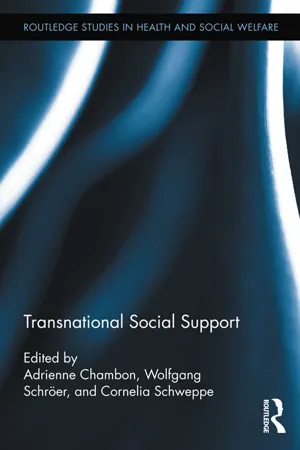
In the context of ever-increasing globalization, transnational systems of support have emerged in response to the needs of transnational families, labour forces, and the communities within which they are located. This volume will be the first to systematically address transnational support research from a theoretical and empirical perspective, making the concept of transnationality part of the core knowledge structure of social work.
- 218 pages
- English
- ePUB (mobile friendly)
- Available on iOS & Android
eBook - ePub
Transnational Social Support
About this book
Information
1 Introduction
Adrienne Chambon, Wolfgang Schröer, and
Cornelia Schweppe
Despite a wide range of theoretical and empirical analyses of the concept of transnationalism in the social sciences (sociology, political sciences, anthropology, economics, and geography), the notion has hardly been examined in a systematic fashion in social work with respect to the field's scholarly and professional developments (Homfeldt, Schroer, and Schweppe 2008; Negi and Furman 2010). Social work, as an applied professional field, can serve as a template for other professional disciplines such as education or nursing.
This volume focuses on social support from a transnational perspective and addresses a particular set of needs and the corresponding lack of appropriate responses. Social support indicates “the mechanisms through which a social environment protects its individual members from threatening and impairing events and experiences, and which can support them in their coping efforts” (Nestmann 2001: 1687). Social support encompasses measures, interventions, and social relationships that help ease burdensome and impairing life events, situations, or trajectories. Social support can further play a preventive role in promoting well-being and welfare.
In light of continually increasing mobility on a global scale, the challenges that social support will face in the future can no longer be addressed solely through the mechanisms, relationships, and structures of support shaped within national contexts. As a variety of studies implicitly show, transnationalism is associated with specific and manifold forms of social support. Yet, research that systematically locates transnational social support at the centre of analysis is just in its beginnings.
This publication addresses transnational social support from both a theoretical and an empirical research perspective. Its overall aim is to contribute to the introduction of a transnational perspective in the academic discipline and professional field of social work. Transnational approaches can extend and transform the conventional, nationally bounded approaches to both knowledge and practice. The aim is to incorporate a transnational dimension in the very knowledge structure of social work. The concept ‘transnational social support’ is a new entry point into social realities. It is located at the intersection between research on social support, social politics, and research on transnationality.
Different disciplines have adopted a wide range of meanings regarding the concept of transnationalism (Glick Schiller 1992; Faist 2000a, b; Levitt and Khagram 2007; Pries 2001, 2010; Vertovec 2009). New forms of compressed time and space have emerged against the background of growing globalisation, along with new developments in information technology and new modes of transportation. These changes include new forms of mobility and migration, and new forms of political, social, and economic cooperation in the context of social work. Recent research on transnational care already shows these new dimensions, but it has mainly concentrated on the transnational provision of care.
The term “global care chains” (Hochschild 2000) shows how the phenomenon is not a one-way process from poorer to richer countries. Thus, the Global Commission for Migration (2005) has pointed out that migration should be understood today as more of a circular process. Using this framework, it is possible not only to describe transnational processes of so-called ‘brain circulation,’ but also to observe processes of social support circulation. In the provision of care, the interconnection between the countries of origin and the destination countries has been analysed accordingly. Studies have traced forms of transnational motherhood and of family support structures in transnational sectors. And finally, attention has been paid to the working conditions of female transmigrants in different countries.
Transnationality1 (or the conditions for transnationalism) is characterised by the circulation of people, goods, money, ideas, symbols, and cultural practices across traditional national reference points. In the process, new patterns emerge in terms of biography, space, and institutions. “A narrow understanding of the concept of transnationalism only refers to lasting, extensive, and institutionalised relationships that transcend national borders” (Pries 2002: 264, translation by the editors). Conceptualised more broadly, transnational patterns include feelings of belonging, common ideas and beliefs; the inextricability of economic, political, cultural, and social factors; connections in the labour force as well as relationships of dominance and their related organisational structures, which all transcend the borders of nation-states. Pries (2010) assumes a shared understanding about transnational processes: “In an expansive understanding of the concept, transnationalism refers to the sense of belonging, cultural commonalities, intertwined forms of communication, workplace contexts and everyday life practice, as well as to related social orders and regulations that transcend the borders of nation states” (3, translation by the editors). It is important to note that the concept of transnationalism does not deny the continued importance and relevance of nation-states (cf. Westwood and Phizacklea 2000). In contrast to the concept of globalisation, which focuses on the developments beyond nation-states, “research on transnational processes depicts transnational social relations as ‘anchored in’ while also transcending one or more nation-states” (Smith, quoted in Pries 2002: 7). Transnationality may be understood as a new context for social intertwining (Elias 1986) between the micro-level of social reality—the social dispositions and positioning of actors and their everyday life practice, their lifestyles, biographical projects, and identities—and the macro-level of social and political frameworks.
In taking a social actors approach, transnational social support can be understood as a social process of appropriating and designing social worlds across national borders, in which support activities are performed in either direct or indirect ways. Based on our understanding of transnational social support as a social process, this publication will address it from individual, social, and political perspectives.
The first section focuses on transnational social policy. The post-World War II welfare state (known as the Keynes-Beveridge model in the English-speaking world) was, at origin, a project of the nation-state. National boundaries were important because they identified eligibility for state benefits and offered an appropriate funding base. Recent years have called into question the relevance of a nation-state focus. The forces of globalisation foretold the decline of the nation-state. Governments within a traditional nation-state focus have been unwilling or incapable of providing this support within a transnational context.
Social policy, so far, has tended to emphasise links, activities, and processes occurring ‘within’ nation-states, to the neglect of those cutting across nation-states. This ‘methodological nationalism’ is increasingly being questioned as transnational processes have become more significant over the last half century. The spread of activities, links, and ties beyond national borders has become more extensive, and the interactions themselves have become more intensive.
The first section of the book will explore some of the ramifications for social policy, both conceptually and operationally, of a transnational world. It will re-examine mainstream social policy questions: Whose responsibility is it to deliver services in a transnational context? Who benefits? How and in what form? What is the role of the state and that of NGOs (including international NGOs)? Lightman, Bóhnisch, and Schróer focus on these questions from two different perspectives.
Lightman analyses the challenges of transnational social policy from the perspective of migration. He embeds his analysis into an understanding of social policy, which refers to choices and options. Consequently, he understands transnational social policy as those choices that affect transnational migrants and the processes of transnational migration. Lightman contextualises his macro-level analysis within processes of globalisation and shows how these developments challenge the so-far nationally structured welfare state, and hence nationally bound social policy. He shows the close relationship between social policy and (trans)migration and analyses how (transnational) social policies have an important impact on the processes and outcomes of transmigration and vice versa. He also shows that transnational social policy is not just the inclusion of a new variable into social policy, but that it inevitably alters the calculus and the results. Lightman illustrates his chapter with examples mainly from Canada, but these are not less relevant to many other countries.
Böhnisch and Schróer approach transnational social policy from a different angle. They start from an analysis of the changing welfare state due to global developments. In the new governmental social order, previous state responsibility and its protective functions against social risks shift to conceptions that encourage self-responsibility of the individual and the activation of citizens. Asking about the future of the welfare state, the authors argue that going back to nationally bound states is no longer a viable perspective. The challenge is to look for a new balance instead, between the economic and the social, now against the background of transnationalised and globalised social structures. Within this context, Bóhnisch and Schróer turn to the capability approach developed by Sen and Nussbaum and critically ask about its potential as a transnational platform of understanding. They reveal the capability approach as an unhistorical, decontextualised, and normative concept which is based on social anthropological assumptions of a ‘good life.’ They criticise the neglect of the analysis of the structural conditions of social needs and social risks which historically develop. Therefore, Bóhnisch and Schróer plead for transnational social policy perspectives which are based on and rooted in the specific social historical development and structural conditions of the particular life conditions.
The second section of the book deals with transnational organisations and the question of how they shape transnational support processes. During the last twenty years there has been increasing attention devoted to transnational organisations that frame and provide social support and aid. Overall, transnational organisations increasingly produce knowledge and shape social and political developments that in turn have an impact upon the design of local and/or transnational support contexts. Within neo-institutional theories, these organisations are discussed primarily in terms of global governance (Kern 2004).
Transnational organisations seek to strengthen the agency of participating actors through expressed claims of self-legitimation. For instance, transnational organisations often explain their forms of social support and interventions as being informed by notions of empowerment or self-help. Additionally, they take up concepts of action from local grassroots movements (Sherraden and Ninacs 1998; McCall 2003) or foster the participation of actors in social and civil society development (Goetze 2002). Other authors, following Foucault's approach, argue that by focusing on agency, scholars tend to produce and reproduce precisely those norms—autonomy, self-determination, participation—through which the new governance has been structuring itself.
In this context, hopes are placed on a “global civil society” (Kaelble, Kirsch, and Schmidt-Gernig 2002) and on transnational non-governmental organisations (TNGO). TNGOs are still considered capable of providing considerable momentum to putting a human face on globalisation (Hofmann 2006: 179), but so far no common perspective regarding a global civil society is to be seen (‘clash of definitions’). Furthermore, the growing linkage between TNGOs and other actors such as nation-states and confederations of nation-states (like the United Nations) is becoming subject to critical scrutiny (Frantz and Martens 2006: 86) with respect to the distribution of influence, power, resources, and staff in the TNGOs.
In their chapter, Ehlers and Wolff point out that a perspective of transnational organisational learning is necessary in the field of development cooperation. The debates about transnational organisations and development cooperation seem to be dominated by a normative and political attitude. Processes of organisational learning are not very often included in the view of a critical evaluation in this field. By analysing key situations and interactions, Ehlers and Wolff are able to show how organisations demonstrate their positions and simultaneously protect their own purpose. In the end it is obvious that people who organise transnational social support have to acquire a realistic view of the institutional and organisational arrangements.
The chapter by Smith also presents an inside view of transnational organisations. Based on ethnographic research in a transnational Japanese new religious movement, Sukyo Mahikari, Smith discusses these transnational organisations as providers of social support. In this perspective, Sukyo Mahikari is a professionally organised transnational stakeholder which offers social support through structures, rituals, and social activities for the members. Overall Smith argues that we have to analyse these organisations more deeply and critically because of their growing circulation and their importance for their members.
The third section of the book offers critical analyses of transnational family support, and each chapter brings a special focus on gender issues. Researchers in social support in the context of family relationships increasingly recognise the unique quantitative and qualitative dimensions of family and kin support, which stem from norms of mutual assistance and commitments to solidarity. In numerous studies, family and kin have turned out to be significant and reliable sources of support (Pierce, Sarason, and Sarason 1996). They effectively protect their members from harm to their well-being and contribute considerably to coping with crises. However, family social support can also result in considerable strain (Laireiter and Lettner 1993).
Good Gingrich raises very serious concerns about family support in the context of transnational migration. She examines the situation of the religious communities of Mennonite families migrating from Mexico to Canada, in light of the historical migration of these groups under the pressure of severe economic hardship and survival needs, and, in some cases, their pattern of return migration. The author's multiple studies show that the positioning of Mennonite family members and their mutual support system are imperilled in the context of the profound divergence of values between those they hold in their community of origin, and the labour, educational, and family priorities imposed upon them by the neo-liberal system that is dominant in Canada. The author characterises the existential situations of these families as an ‘in-between’ space faced with irreconcilable ways of being, in which the function and contribution of women is placed in severe jeopardy. This in-between-ness is the very nature of their difficulties. Institutional mechanisms of formal support, both professional and semi-professional, regrettably tend to reinforce these disjunctures and further contribute to the economic and symbolic violence exercised upon the women and their families as a result of migration.
Wang and Lin's chapter picks up the central practice of home care delivered by women migrants from more disadvantaged countries, and illustrates it with the case of Taiwan. Transnational family studies have important implications for understanding transnational forms of family social support. Since the end of the 1990s, research on systems of care has pointed to the growing transnationalisation of family assistance, nursing, and relationships of care as a global phenomenon. One example is the increasing transfer of assistance, nursing, and care services—performed mostly by women—from poor countries to the households of wealthier countries (Anderson 2000; Hondagneu-Sotelo 2001; Parreñas 2001a, b; Ehrenreic...
Table of contents
- Front Cover
- Halftitle
- Routledge Studies in Health and Social Welfare
- Title Page
- Copyright
- Contents
- List of Figures and Tables
- 1 Introduction
- PART I Transnational Social Policy
- PART II Transnational Social Support and Transnational Organisations
- PART III Transnational Family Care
- PART IV Transnational Social Support and Biography
- PART V Transnational Social Support: Unintended Consequences and Future Challenges
- Contributors
- Index
Trusted by 375,005 students
Access to over 1.5 million titles for a fair monthly price.
Study more efficiently using our study tools.
Frequently asked questions
Yes, you can cancel anytime from the Subscription tab in your account settings on the Perlego website. Your subscription will stay active until the end of your current billing period. Learn how to cancel your subscription
No, books cannot be downloaded as external files, such as PDFs, for use outside of Perlego. However, you can download books within the Perlego app for offline reading on mobile or tablet. Learn how to download books offline
Perlego offers two plans: Essential and Complete
- Essential is ideal for learners and professionals who enjoy exploring a wide range of subjects. Access the Essential Library with 800,000+ trusted titles and best-sellers across business, personal growth, and the humanities. Includes unlimited reading time and Standard Read Aloud voice.
- Complete: Perfect for advanced learners and researchers needing full, unrestricted access. Unlock 1.5M+ books across hundreds of subjects, including academic and specialized titles. The Complete Plan also includes advanced features like Premium Read Aloud and Research Assistant.
We are an online textbook subscription service, where you can get access to an entire online library for less than the price of a single book per month. With over 1.5 million books across 990+ topics, we’ve got you covered! Learn about our mission
Look out for the read-aloud symbol on your next book to see if you can listen to it. The read-aloud tool reads text aloud for you, highlighting the text as it is being read. You can pause it, speed it up and slow it down. Learn more about Read Aloud
Yes! You can use the Perlego app on both iOS and Android devices to read anytime, anywhere — even offline. Perfect for commutes or when you’re on the go.
Please note we cannot support devices running on iOS 13 and Android 7 or earlier. Learn more about using the app
Please note we cannot support devices running on iOS 13 and Android 7 or earlier. Learn more about using the app
Yes, you can access Transnational Social Support by Adrienne Chambon,Wolfgang Schröer,Cornelia Schweppe in PDF and/or ePUB format, as well as other popular books in Social Sciences & Health Care Delivery. We have over 1.5 million books available in our catalogue for you to explore.