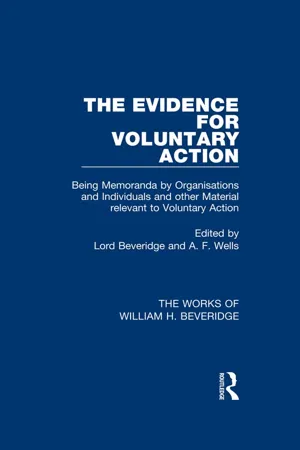
This supplementary volume to Beveridge's important work Voluntary Action sets out some of the important material on which the Report is based, and amplifies it by giving views and statements of fact submitted by many experts in the fields covered by his Inquiry.
eBook - ePub
The Evidence for Voluntary Action (Works of William H. Beveridge)
- 330 pages
- English
- ePUB (mobile friendly)
- Available on iOS & Android
eBook - ePub
The Evidence for Voluntary Action (Works of William H. Beveridge)
About this book
Trusted by 375,005 students
Access to over 1.5 million titles for a fair monthly price.
Study more efficiently using our study tools.
Information
Subtopic
Business GeneralIndex
BusinessPART I
MASS-OBSERVATION REPORTS
IT was stated in the prefatory Acknowledgments to the Report on Voluntary Action that the Voluntary Social Service Inquiry had been fortunate in securing the help of Mass-Observation, who made for it a number of valuable studies on some of the topics treated in that Report. The particular merit of these studies was, first that they produced a volume of information on the attitudes of the man in the street towards Mutual Aid and the Voluntary Social Services; and in the second place, that the field work of the investigators permitted us some illuminating insights into the actual working of some of the voluntary groups. In these fields the studies of Mass-Observation formed a valuable supplement to the other work of the Inquiry, as did those of Research Services Ltd., which are dealt with in Part II of the present volume.
Space, unfortunately, does not permit of their quotation in full; but substantial extracts follow. In all cases these have been quoted verbatim; passages omitted are indicated by dots; where it has been necessary to add some connecting passages, these are printed in italics, usually at the beginning of a section or sub-section. Italics are used also for headings and cross-headings and also for passages in the original Reports underlined by their writers for emphasis.
The first section deals with the Friendly Societies, which figure more largely in the Report on Voluntary Action than any other single class of agency. The findings here are disquieting, and the picture given of ignorance and apathy on the part both of members and of non-members of Friendly Societies will repay study by officials of those bodies. But in judging of the public attitude to Friendly Societies as shown in this section, regard must be had to the confusion in the public mind between the Friendly Societies proper, based on Mutual Aid, and the collecting businesses which legally are still permitted to call themselves Friendly Societies. (See Voluntary Action, p. 295.) In the Mass-Observation Reports, as by the mass of the people, these two very different types of organisation are not distinguished.
The second section deals with some of the less formal aspects of Mutual Aid, a subject to which the Inquiry was otherwise able to devote little attention. The third section treats of the voluntary social services in general: it includes a general study of public attitudes to the voluntary social services; of the extent of public participation in these services; and of the opinions of the public on the need for new social services.
The fourth and fifth sections again deal with particular aspects: the former with the public’s attitudes towards Charity, and the latter with the question of Holidays.
Readers will note the degree of general accord between the findings of Mass-Observation in this Part, and those of Research Services in Part II, on matters which both treat, despite the differences of technique of these two research organisations.
1. THE FRIENDLY SOCIETIES
1. OPINIONS OF THE GENERAL PUBLIC ON FRIENDLY SOCIETIES
Although the Trade Unions* can, in a limited sense, be regarded as Mutual Aid organisations, their political and industrial activities assume first importance, and it is these aspects of Trade Unionism which are most commonly stressed by people in general. The activities and policy of the Friendly Societies are nothing like as complex; and consideration of attitudes towards the Friendly Societies reveals a picture which—if interpreted simply in terms of approval—disapproval—disinterest—is superficially somewhat similar to the Trade Union attitude-pattern, though more likely to be valid because of the greater simplicity of the Friendly Society.
Thus, about two-fifths of the people who were asked how they felt at present about the Unions and the Friendly Societies expressed a generally favourable opinion. Rather fewer people disapproved of the Friendly Societies than of the Unions, fewer were disinterested. The main point of divergence—something which was a specifically Friendly Society “reaction” —was the question of lack of knowledge. Approximately two out of five had no knowledge of the meaning of the term “Friendly Society.”
General approval of Friendly Societies was very slightly more marked among women than among men, among people of working class and artisan background than among middle-class people, among people over forty as compared with people under forty. The whole number of those expressing any kind of approval was rather more than double the number of those who were in any way hostile.
Of the smaller number expressing disapproval, men were apt to be more critical than women, and, to some extent, middle-class people rather than working-class people. (Too much stress should perhaps not be laid upon middle-class opinion here; the Friendly Society was not designed to cater for middle-class needs, and middle-class attitudes are less likely to be based on actual contact with Friendly Society organisation.)
Disapproval of Friendly Societies was not to any appreciable extent conditioned by age. What does most importantly emerge from this whole consideration of attitudes, however, is the fact that such a comparatively large proportion of people under forty are unaware of the existence and nature of the Friendly Societies to the extent of confusing them, in some cases, with social clubs, political organisations, debating clubs, and, in one case, with some sort of company for selling cigarettes! A woman in a northern town remarked:
“I have had no dealings with them, but I should imagine they would be very good. During the war, the Americans had nowhere to go, had they ?”
Another in East London:
“I tell you I have nothing against them, but I think that if people want to be friends they will be, without any old society.” (Working-class man, aged 45.)
As with the use of such a phrase as “Social Services,” which proved on occasion quite incomprehensible to people, allowance must be made here for confusion in terminology. Investigators reported, for instance, that a small number of those who were questioned about the Friendly Societies did, in later conversation, reveal that their ignorance was not as complete as at first appeared. Even so, their numbers were not sufficiently large to assume much significance; and if due allowance be made for confusions of this kind, we are still left with a proportionate figure which suggests that one person in three, and nearly twice as many younger as older people, are unaware even of the existence of the Friendly Society.
Returning to those people whose attitude towards the Friendly Societies is a positive one, and to the way in which they express their approval: clearly opinion which is unqualified, intensive opinion, is, in the assessment of the degree of willing good feeling which attaches to an organisation, more valuable than the qualified opinion which may be indicative of a changing viewpoint. Where expression of opinion about the Friendly Societies is concerned, unqualified approval typifies the answers of a majority of those people whose attitudes towards the Societies are positive. This is the attitude of rather less than one person in two.
What sort of reasons do people advance for their support of the Friendly Societies?
Appreciation is, as one might anticipate, largely based on the sense of security which the Societies provide:
“I am a member of one of them. They look after sick people at ours. I’ve been a member for twenty years. I don’t go to the meetings very often but they pay sick benefit when I’m ill.” (Working-class man, 50.)
“They’re very good. You must put away something for a rainy day, if you’re working-class.” (Housewife, 40.)
“They’re all right. If there’s anything you need you get it.” (Working-class housewife, 45.)
“I myself believe in insurance. I mean there must be insurance. My husband didn’t believe in ‘em, but he died, so it was a good thing I had insured.” (Working-class housewife, 55.)
In the majority of spontaneous comments the Friendly Societies appear exclusively as a convenient mechanism for “putting by for a rainy day.” Only an occasional person takes, at this level of approach, a more personalised view, describing his attitude in terms of co-operation with others or, in any sense, showing that he feels himself part of a mutual aid movement:
“It is a safeguard against sickness, and another thing that appealed to me and still does, is, in a Friendly Society, there’s not a lot thrown away on management. What money you pay into the Society is practically your own. You don’t pay any big salaries to officials, just a nominal sum to the secretary. If there’s not a lot thrown away you can reap all the profits.” (Middle-class man, 75.)
or: “It’s a good idea. Helps to create a sense of thrift in the individual,” (Middle-class man, 45.)
Criticism of the organisations, although representative only of a minority opinion is often strongly felt. Of the reasons given for disapproval of the Friendly Societies these were the ones most frequently advanced:
(a) The Friendly Society should not really be necessary :
“They’re all right if you haven’t got a good State Health System.” (Artisan housewife, 40.)
(b) The benefits given by the Societies are not given for a sufficiently long period:
“If I had my time over again, I’d never belong to one. Yes, I’ve been a member for thirty years, and they’re no good. They say they’ll pay you when you’re ill, but they don’t! They paid me for three weeks, and then they stopped. I used to go to meetings, but never again.” (Working-class man, 63.)
(c) The Friendly Societies have no future :
“Up to now they have filled a much-needed want. But in the new scheme of 1948 they will be implemented, and then they will have served their purpose.” (Middle-class man, 45.)
(d) They make money out of the working classes :
“A lot of profiteers, and it’s time the Government took them over.” (Working-class man, 70.)
(e) They should be nationalised: Here, people do not apparently feel it necessary to elaborate their remarks, nationalisation being regarded as an all-embracing solution.
It is not our intention in this section of the Report to do more than draw attention to the complex of attitudes which surrounds the Friendly Society and other voluntarily-run groups. The feelings of the members of particular Friendly Societies, and the points of view of those who have some responsibility for local branches will be considered at a later stage. In conclusion, however, we may mention here that there is a tendency among those who have been members of Friendly Societies for some considerable period to look back with regret to the time...
Table of contents
- Cover
- Half Title
- Title Page
- Copyright Page
- Original Title Page
- Original Copyright Page
- Preface
- Table of Contents
- Tables
- Part I. Mass-Observation Reports
- Part II. Research Services' Report : A Selection of Tables
- Part III. Memoranda On Finance of Voluntary Action
- Part IV. Memoranda By Organisations
- Part V. Memoranda by Individuals on Special Topics
- Part VI. Social Service Agencies
- Part VII. Select Bibliography on Voluntary Action
Frequently asked questions
Yes, you can cancel anytime from the Subscription tab in your account settings on the Perlego website. Your subscription will stay active until the end of your current billing period. Learn how to cancel your subscription
No, books cannot be downloaded as external files, such as PDFs, for use outside of Perlego. However, you can download books within the Perlego app for offline reading on mobile or tablet. Learn how to download books offline
Perlego offers two plans: Essential and Complete
- Essential is ideal for learners and professionals who enjoy exploring a wide range of subjects. Access the Essential Library with 800,000+ trusted titles and best-sellers across business, personal growth, and the humanities. Includes unlimited reading time and Standard Read Aloud voice.
- Complete: Perfect for advanced learners and researchers needing full, unrestricted access. Unlock 1.5M+ books across hundreds of subjects, including academic and specialized titles. The Complete Plan also includes advanced features like Premium Read Aloud and Research Assistant.
We are an online textbook subscription service, where you can get access to an entire online library for less than the price of a single book per month. With over 1.5 million books across 990+ topics, we’ve got you covered! Learn about our mission
Look out for the read-aloud symbol on your next book to see if you can listen to it. The read-aloud tool reads text aloud for you, highlighting the text as it is being read. You can pause it, speed it up and slow it down. Learn more about Read Aloud
Yes! You can use the Perlego app on both iOS and Android devices to read anytime, anywhere — even offline. Perfect for commutes or when you’re on the go.
Please note we cannot support devices running on iOS 13 and Android 7 or earlier. Learn more about using the app
Please note we cannot support devices running on iOS 13 and Android 7 or earlier. Learn more about using the app
Yes, you can access The Evidence for Voluntary Action (Works of William H. Beveridge) by William H. Beveridge,A. F. Wells in PDF and/or ePUB format, as well as other popular books in Business & Business General. We have over 1.5 million books available in our catalogue for you to explore.