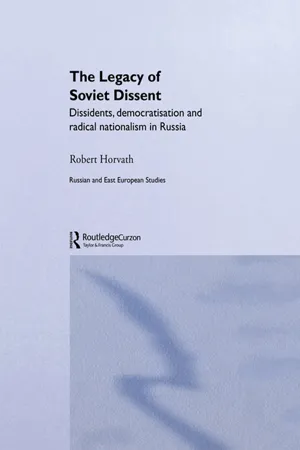
During the 1970s, dissidents like Sakharov and Solzhenitsyn dominated Western perceptions of the USSR, but were then quickly forgotten, as Gorbachev's reformers monopolised the spotlight. This book restores the dissidents to their rightful place in Russian history. Using a vast array of samizdat and published sources, it shows how ideas formulated in the dissident milieu clashed with the original programme of perestroika, and shaped the course of democratisation in post-Soviet Russia. Some of these ideas - such the dissidents' preoccupation with glasnost and legality, and their critique of revolutionary violence - became part of the agenda of Russia's democratic movement. But this book also demonstrates that dissidents played a crucial role in the rise of the new Russian radical nationalism. Both the friends and foes of Russian democracy have a dissident lineage.
eBook - ePub
The Legacy of Soviet Dissent
Dissidents, Democratisation and Radical Nationalism in Russia
- 294 pages
- English
- ePUB (mobile friendly)
- Available on iOS & Android
eBook - ePub
The Legacy of Soviet Dissent
Dissidents, Democratisation and Radical Nationalism in Russia
1
Children of terror
I want an investigation, screw by screw, of the machine which transformed a full life, the flowering activity of a human being, into a cold corpse. I want sentence to be passed. In a loud voice.
(Lidiya Chukovskaya, February 1968)1
Wherever social memory is destroyed, the possibility for all kinds of misfortune exists…. Without the past, the future is closed.
(The editors of the samizdat historical almanac Pamyat, 1916)2
To publish Solzhenitsyn’s work is to undermine the foundations on which our present life rests.
(Vadim Medvedev, Central Committee Secretary for Ideology, to a closed party conference in Riga, November 1988)3
There are two ways that the hegemony of democratic values is achieved in a society with an authoritarian past. One is to forge a lineage of democratic struggle from personalities, documents, and events that played a role in the advance of liberty. The other is the indictment of the catastrophe inflicted by dictatorship, whose perpetrators are condemned to eternal infamy and whose victims are mourned. The totalitarian regimes of the twentieth century inflicted such catastrophes on a scale unprecedented in human history. They also engaged in a relentless struggle against memory, silencing and discrediting witnesses, destroying evidence, falsifying the historical record, and murdering historians. The Nazi cover-up ended with the liberation of the death camps by Allied armies, but the victorious Soviet regime waged a protracted campaign to obscure the atrocities committed in its name. During the two decades between Khrushchev’s fall and the initiation of perestroika, Russian dissidents publicly challenged the official version of the Stalinist past. They accumulated suppressed facts to fill in blank spots. They contested the alibis that the regime offered in self-exoneration. The result was a counter-history, founded upon Solzhenitsyn’s Gulag Archipelago, which became an indictment of the Soviet regime, its creators, its ideology, and the very idea of violent revolution.
The importance of this indictment is not only that it undermined the dictatorship, but also that it shaped the course of change. It helped to short circuit what might have become a cycle of vengeance. The cataclysm that occurred in Soviet Russia between the dissolution of the Constituent Assembly and the death of Stalin was so vast and so pervasive that its aftershocks would be felt for generations. Its magnitude still defies comprehension. Even the cautious review of the available evidence by Getty, Rittersporn, and Zemskov concedes the deaths of over a million people in the gulag between 1934 and 1953, the execution of 786,098 ‘counter-revolutionaries’ between 1930 and 1953, and the death of 389,521 peasants in places of ‘kulak’ resettlement.4 But as these authors acknowledge, such a ‘cold numerical approach’ risks overshadowing the individual personal and psychological horror of the event:
Millions of lives were unjustly taken or destroyed in the Stalin period; the scale of suffering is almost impossible to comprehend. The horrifying irrationality of the carnage involves no debatable moral questions— destruction of people can have no pros and cons.5
Yet for the Soviet leaders, these were debatable moral questions: the regime had come into being through revolutionary violence, and that violence found its supreme vindication in the works of Lenin, the immortal, mummified founding father, the icon of the regime and the infallible theorist of its ideology. Precisely because the legitimacy of the Soviet regime was derived not from the electoral consent of the governed, but from a revolutionary lineage that marked the unfolding of historical truth, these sources were beyond criticism.
From the perspective of human rights, Lenin’s ideological heritage was acutely dangerous: a compendium of moral and immoral justifications for the destruction of people. It was axiomatic for Lenin that the state was ‘an organisation of violence for the suppression of some class.’6 It was equally obvious to him that ‘violence is always the midwife of the new society,’ and that the dictatorship of the proletariat meant ‘a state of simmering war, a state of military measures of struggle against the enemies of proletarian power.’7 No less pernicious was Lenin’s enthusiasm for spontaneous popular violence at the height of the revolution. He scorned the ‘present wail raised by the spineless intellectuals…against violence on the part of the proletariat and the revolutionary peasants.’8 Whilst abhorring pluralism in debate, he welcomed diversity in repression:
Variety is a guarantee of vitality here, a pledge of success in achieving the single common aim—to cleanse the land of Russia of all sorts of harmful insects, of crook-fleas, of bedbugs—the rich, and so on and so forth. In one place half a score of rich, a dozen crooks, half a dozen workers who shirk their work (in the hooligan manner in which many compositors in Petrograd, particularly in the Party printing shops, shirk their work) will be put in prison. In another place they will be put to cleaning latrines. In a third place they will be provided with ‘yellow tickets’ after they have served their time, so that all the people shall have them under surveillance, as harmful persons, until they reform. In a fourth place, one out of every ten idlers will be shot on the spot.9
The extent of Lenin’s dependence upon Marx and Engels, and the extent of his responsibility for Stalinism, is a matter of debate. What is incontrovertible is that a dictator whose own writings exhibited such indifference to human life, such enthusiasm for violence, and such contempt for the legal process, was a poor model for future generations. The Soviet regime’s cult of Lenin, which transformed him into the exemplary Soviet man, and his works into a fount of infallible wisdom, boded ill for the future.
The destructive potential of Lenin’s ideas about violence and about ‘cleansing’ Russia of ‘harmful insects’ was magnified by Soviet ethnic policies, which aggravated both national sentiment and national grievances. On the one hand, Lenin’s anti-colonial rhetoric legitimised the idea of national liberation struggles, and ensured that discontent was channelled into nationalist discourse. On the other, the mass repressions of the Stalin period frequently assumed an ethnic dimension, real or perceived. The most obvious were the deportations of nations during the Second World War: the Chechens, the Crimean Tartars, the Kalmyks, and the Volga Germans.10 Whatever the Kremlin’s intentions, the Ukrainian famine would also be perceived as an act of imperial tyranny, a pre-meditated attempt to suppress Ukrainian nationhood. Non-Russian resentment was exacerbated by Stalin’s perverse adoption of Russian nationalist rhetoric, which ensured that for non-Russians, the atrocities of his reign would be interpreted as a form of Russification. Yet Russian national sentiment was no less traumatised by the Bolshevik experiment. The anti-religious campaigns and the collectivisation of agriculture had devastated two sources of traditional Russian culture: the Orthodox Church and the village. Yet national resentment was deflected by Stalin’s discovery of Russian nationalism, and redirected against the Jews by his anti-cosmopolitan campaign. A multitude of grievances, obvious scapegoats, and an elite educated in the uses of political violence: this was the volatile reality of the ‘friendship of the peoples.’
As long as the regime outlawed discussion of the relationship between the Stalinist cataclysm and the theory and practice of Leninism, demands for justice and vengeance were channelled into an acrimonious debate between two elite factions. A leftist tendency assailed the bureaucrats, drawing on Lenin’s later writings, and hinted that Stalinism represented a recrudescence of Russian authoritarian traditions. The possibilities for mass mobilisation against the ‘new class’ and ‘vestiges of the past’ would soon be demonstrated by Mao’s Cultural Revolution. The right alternative was National Bolshevism: anti-Semitic nationalism, using Trotskii as a cipher to blame the Jews for the atrocities of the revolution and its crimes against Russian culture. The tension between these tendencies erupted into sporadic public recriminations during the Brezhnev era, in the 1969 clash between the ‘liberal Leninists’ of Novyi Mir and the patriots of Molodaya Gvardiya, and in the notorious 1977 debate at the Central House of Writers, ‘We and the Classics.’11 With the relaxation of censorship under perestroika, the struggle was resumed with renewed virulence. And the very exclusion of Leninism from the field of contention served to radicalise and pathologise both parties, since Lenin authorised aggressive, intolerant rhetoric and the resort to violence as the ultimate answer to one’s opponents.
The Great Alibi
When Lenin theorised the cleansing of Russia from ‘harmful insects,’ he did not contemplate the possibility of facing justice for the atrocities he was inciting. Only in 1946 did the Nuremberg tribunal establish the principle that perpetrators of crimes against humanity might be punished by the international community. This precedent posed a major dilemma for the Soviet leadership, which had previously benefited from the explicit character of Nazi repression. Even during the war, Soviet anxieties about the similarity of their prolonged revolutionary violence to the Nazi Holocaust were evident in the belated and ambiguous response of deputy foreign minister Andrei Vyshinskii, the show-trial prosecutor, to allied inquiries about Auschwitz after its liberation by the Red Army in 1945. At the Nuremberg proceedings, the likeness of the two totalitarian regimes was suggested by the Soviet prosecutor Roman Rudenko—a future Chief Prosecutor and architect of dissident trials in the 1960s and 1970s—who attempted to blame the Nazis for the Katyn massacre of Polish army officers; when the ploy failed, the Western powers saved their ally embarrassment by consenting to the removal of the item from the indictment. Soviet insecurity was also evident in the fate of the Soviet Black Book, which recorded the experiences of Jews during the Nazi Holocaust. In 1949, at the height of the ‘anti-cosmopolitan’ campaign, the plates of the Black Book were destroyed.12 It may have been a counterproductive move. One of the authors of the Black Book was Vasilii Grossman, a war correspondent who had been one of the first outside observers to witness the gas chambers of Auschwitz after its liberation. The fate of the Black Book was to prefigure the central theme of his later writings: the identity of Nazism and Stalinism.
The death of Stalin in March 1953 offered the Soviet leadership a unique opportunity. Two decades of glorification of Stalin—‘the Father of the Peoples,’ ‘The Great Teacher,’ ‘The Great Shepherd,’ ‘The Shining Sun of Humanity’—made him the ideal subject for one more myth: that he was the sole architect of Soviet mass terror, a scapegoat for the regime and the millions who had made possible its crimes against humanity. The gradual disengagement of the Soviet leadership from Stalin began with the exonera-tion of the Jewish Doctors, a Pravda editorial on ‘Socialist Legality,’ and in June the arrest of the ‘British spy’ Lavrenti Beria. The state of political flux produced a tenuous cultural liberalisation, but the limits of the permissible were quickly defined by the hostile reaction to the publication of Pomerantsev’s article ‘On Sincerity in Literature,’ which forced Tvardovskii to resign as editor of Novyi Mir.13
While establishment intellectuals debated literary aesthetics and the role of the artist under socialism, a far more momentous agitation was underway behind the scenes. After Beria’s fall, the simmering turmoil in the camps of the gulag erupted into strikes and open revolts at Norilsk, Vorkuta, and Kengir.14 At the same time, the regime was being bombarded by increasingly insistent appeals from victims of repression and their families. Zhores Medvedev, who wrote letters with his brother Roy calling for their father’s rehabilitation, later reflected on the magnitude of the petition campaign: ‘Thousands of letters can be ignored, but when millions start to arrive they must make a certain impact.’15
The insurgencies in the camps and the chorus of the victims made possible what Solzhenitsyn called the ‘Khrushchevian miracle’: that ‘unpredictable, improbable miracle, the release of millions of innocent prisoners.’16 The miracle culminated in Khrushchev’s Secret Speech to the 20th Party Congress. Allegedly written by the former camp ...
Table of contents
- Cover
- Title
- Copyright
- Contents
- Acknowledgements
- Introduction
- 1 Children of terror
- 2 ‘Honest and total glasnost’
- 3 The rights-defenders
- 4 The invention of Russophobia
- 5 The politics of Russophobia
- Conclusion
- Notes
- Bibliography
- Index
Trusted by 375,005 students
Access to over 1.5 million titles for a fair monthly price.
Study more efficiently using our study tools.
Frequently asked questions
Yes, you can cancel anytime from the Subscription tab in your account settings on the Perlego website. Your subscription will stay active until the end of your current billing period. Learn how to cancel your subscription
No, books cannot be downloaded as external files, such as PDFs, for use outside of Perlego. However, you can download books within the Perlego app for offline reading on mobile or tablet. Learn how to download books offline
Perlego offers two plans: Essential and Complete
- Essential is ideal for learners and professionals who enjoy exploring a wide range of subjects. Access the Essential Library with 800,000+ trusted titles and best-sellers across business, personal growth, and the humanities. Includes unlimited reading time and Standard Read Aloud voice.
- Complete: Perfect for advanced learners and researchers needing full, unrestricted access. Unlock 1.5M+ books across hundreds of subjects, including academic and specialized titles. The Complete Plan also includes advanced features like Premium Read Aloud and Research Assistant.
We are an online textbook subscription service, where you can get access to an entire online library for less than the price of a single book per month. With over 1.5 million books across 990+ topics, we’ve got you covered! Learn about our mission
Look out for the read-aloud symbol on your next book to see if you can listen to it. The read-aloud tool reads text aloud for you, highlighting the text as it is being read. You can pause it, speed it up and slow it down. Learn more about Read Aloud
Yes! You can use the Perlego app on both iOS and Android devices to read anytime, anywhere — even offline. Perfect for commutes or when you’re on the go.
Please note we cannot support devices running on iOS 13 and Android 7 or earlier. Learn more about using the app
Please note we cannot support devices running on iOS 13 and Android 7 or earlier. Learn more about using the app
Yes, you can access The Legacy of Soviet Dissent by Robert Horvath in PDF and/or ePUB format, as well as other popular books in History & Russian History. We have over 1.5 million books available in our catalogue for you to explore.