This ground breaking work explores the genealogical analysis of the discourses of reflection. Barry Sandywell traces the differences between the traditional discourses of reflection and the experiences of reflexivity in everyday, social and philosophical thought.
Brilliantly organised and abounding with astonishing insights, Reflexivity and the Crisis of Western Reason offers a fundamental challenge to our normal ways of viewing social thought.
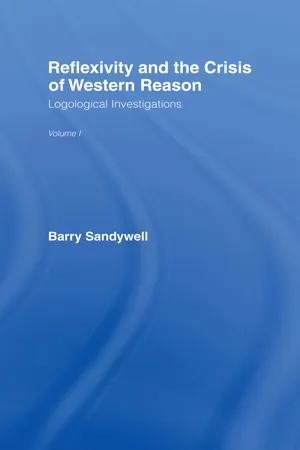
eBook - ePub
Reflexivity And The Crisis of Western Reason
Logological Investigations: Volume One
- 552 pages
- English
- ePUB (mobile friendly)
- Available on iOS & Android
eBook - ePub
About this book
Information
Part I
MIMESIS
In the two chapters of Part II examine the mimetic impulse underwriting the dominant logics of European reflection and representation. Chapter 1 explores the metarhetorics of language justifying representationalist conceptions of the world. Chapter 2 shows how these modes of thought and selfhood function by actively occluding and repressing the contextual alterities of incarnation, historicity, sociality, interpretation, and power. By deconstructing the constitutive rules of modern mimetic consciousness we can begin the task of prefiguring a richer concept of reflexivity that would incorporate these principles of difference and otherness in a more radical ‘politics of representation’.
1
RHETORICS OF REPRESENTATION
Here too a basic capacity of the mind becomes apparent: that of separating itself from the ideas that it conceives and representing these ideas as if they were independent of its own representation.
(Georg Simmel, 1990: 67–8)
Chapter 1 introduces the theme of mimesis or representation. Mimesis is in fact a label for a vast field of representations which invites empirical and comparative analysis. The legitimating principles of Western mimesis are identified and analyzed as specular metarhetorics informing some of the basic cognitive positions and orientations of our reflective logics. The temptation inherent in the mimetic paradigm is to believe that language ‘maps’ the world in representations without thereby constituting or transforming its referents. Authorized by this conception of language and world, the speaking subject may ‘forget’ the partial and limited character of linguistic action and, in certain circumstances, pursue the project of universal depiction (or absolute mimesis). The aporetic idea of universal mimesis underwritten by a correspondence theory of truth sets the scene for Chapter 2. Chapter 1 is divided into three sections:
1Mimetic faculties
2Four metarhetorical views of language
3Language-games
1 MIMETIC FACULTIES
All knowledge is representation.
(Arthur Schopenhauer 1989: 240–1)
‘Representation’ (from the Latin repraesentare) is a complex, almost mythical, word with innumerable functions in a diverse range of discourses and cultural practices. In the dominant philosophical tradition of the West, however, the concept of representation has been overdetermined by a powerful mimetic cosmology of original presence which now defines the word's pragmatic grammar. The hegemony of presence, it should be said, has a complex verbal and social history which we will ignore for the purposes of this introductory study. In varying – and often quite hetereogeneous – ways both the Hellenic and the Judaic streams of European thought privileged the temporal mode of ‘present being’ and correlatively the paradigm of existence as being-present and truth as the visible presence of existing things: what is actual is lived and experienced in the present (‘Wesentbeiten werden in der Gegenwart gelebt’ Buber, 1970: 64); what has-been but is not-now-present can only be retrieved through semiotic acts of imaginary mimesis – through the signs and interpretations of belated traces, inscriptions, texts, and graphs; what will-be is projected as a realm of virtualities created by the enigmatic modality of symbolic representation called anticipation. In essence the question ‘What is present?’ is posited as the framing question of all knowledge – ‘What is?’ We thus have a ready-made folk-ontology of lived experience in the tripartite organization of temporal verbs (a schema of ‘past-present-future’ which orient our thinking toward a linear schema of temporal change in constructing psychological, sociological, and historical models). Once in force this onto-logical schema can function as a deep structure for other discursive representations (and representations of representations – in the shift from ‘What is?’ to the question ‘What is?’). From this point of view representations are artifacts which enable the ‘whatness’ of what was ‘originally present’ to speak once again. Thus we might live within the flow of consciousness, but to say anything about our experience we must reflect upon and represent its ‘contents’ through language or an analogous propositional medium. Moreover the very ‘desire to say what-is’ presupposes an older and more opaque ‘faculty of mimetic desire’ – the desire to recover, symbolize, and stabilize the stream of experience in which anything like an existent might be identified. In contemporary thought it has become conventional to refer to this privileged concept of ‘the given’ as pre-sence (pré-sence) as logocentrism (although I will refer more generally to the framework as representationalism and its generative motivation as the mimetic desire to descriptively capture reality (cf. Girard, 1988).
It appears that logocentric concepts of self, time, world, and reality have aesthetic origins: the nature of ‘real existence’ (ousia) is accessed through concrete acts of perception just as the ‘real existent’ is an actually existing thing disclosed to the percipient mind as an intuitive spectacle. We might say that in this seductive ontology the field of the actual is prior to the domain of reality. But upon reflection, we find that the aesthetic ‘plentitude’ of present meaning is interminably sliding into the past and prefiguring the future. Or, at least, this is what the vital illusion of the schema of presence intimates. Once we accept the metaphorical terms of this ‘metaphysics of presence’ other ‘modes of being’ can only be measured by means of ‘presentist’ existential criteria: what is real or actual is what is present and self-identical before our eyes. In everyday speech, representations are taken to be either true reflections or deformations of the ‘nature’ of real presence. This is where the specular discourse of ‘truth’ holds its sovereign court. If actuality is a stream of consciousness, and reality is lived actuality and its collective products, then articulations which represent the real as Object' belong to speech and language. In a more modern idiom, forms of existence – or more generally, modes of existential reference – are knowable only as predicatively (re)presented being in truth-making statements (for example, as a cognitive simulacrum in the mind's predicational structuring of the sensory manifold or in the schematic work of the faculty of imagination, Vorstellungsvermögen, or even in sentences and propositions which truthfully re-present their ‘referents’). But the totality of these mediations do not form a seamless whole or ‘mirror of being’. It is evident that ancient mythological images of mimesis – what Jacques Derrida has aptly called the metaphorics of proximity or what Girard terms the mimetic desire – are implicated in these ways of representing representation: a representation is something that stands for an original (the German ‘Vorstellung’, ‘idea’, ‘conception’, and ‘representation’ incorporate this world theory in its etymological construction – stellung meaning ‘position’, ‘standing’, ‘rank’, ‘place’, ‘referent’, etc.), a word is a sign which makes its signifier manifest, art is an imitation of the Idea, Nature, Truth. As we observed in the Introduction this metaphysical model of specular reference and subject-centred reflection, in varying degrees, also invokes a negative model of heteropoiesis: the ‘other’ and, more abstractly, ‘otherness’, is projected as the ‘agonist’ of representation, the unrepresentable beyond the margins of sense (whatever is not darstellbaren; we might then speak of things beyond the boundaries of conceivability (das geht über alle Vorstellungen)). For many mimetic regimes of desire, then, ‘alterity’ is simply whatever is construed as falling beyond or resisting the work of mimesis (presence/absence). Thus in the dominant paradigms of modern thought alterity is established by the generative question-grid: is ‘it’ a subject, object, or mode of representation? On the basis of the brief analysis of discursive limits in the Introduction above, we can either proceed within the metaphorical grid of this subject-object framework or, shifting levels of analysis, subject the metaphorics of presence to critical deconstruction. The latter strategy transforms the assumptions of representationalism into a thematic phenomenon for further genealogical investigation.
Understood literally, representatio (what Kant called representation in general) is a repetition of what was originally present (‘presented’ for example as the ‘data of sensation’ or sensatio in the terminology of empiricism). In a nutshell: reality as experienced being is a correlate of representation (or of the formal conditions of representation). But Kant also understood that the concept of representation displayed several distinct modalities. At a higher or second-order cognitive level, perceptio also instantiates a structure of mimetic repetition (videological discourse privileges the intuitive recovery of absent meaning). And finally, by further redoubling mechanisms consciousness recovers past objects through strategies of non-intuitive representation (among these ‘faculties’, the operations of recollective memory and abstract thought are pre-eminent – nostalgia indexing the field of repetitive desire). The work of the understanding is thus for Kant a higher-order level of representation a ‘metarepresentation’ of the structure of perception through concepts; and, finally, cognition deriving from reason is the representation of the ‘data’ of the understanding on the basis of universal principles, to comprehend an object or gain an ‘insight’ into a thing (1992: 466). In the so-called ‘Jäsche Logic’, the stratification of representation is explicitly explicated as a general model of cognition in general:
(i) the lowest degree of cognition is ‘to represent something’;
(ii) the second degree is to represent something with consciousness, to perceive (percipere);
(iii) the third level is to be acquainted (noscere), defining something in terms of similarities and differences;
(iv) the fourth level is to be acquainted with something with consciousness (cognoscere) (Kant comments that animals are acquainted with objects, but they do not cognize them);
(v) the fifth level, is to understand something (intelligere), the work of the understanding, subsuming particulars under concepts;
(vi) the sixth level is cognition through reason (to have insight) into a phenomenon (perspicere);
(vii) and the final level, is to cognize something through reason (1992:569–70).
Yet all of these representational modes are founded upon categories of immediacy and presence – a tissue of metaphors represented in German usage by the term for ‘actuality’, Wirklichkeit. What was once actually present can be relived as a virtual presence and where experience plays into the hands of conceptual representation we speak of objective perception (cognitio). From this perspective, cognition is mimesis which desires to ‘correspond with’ its objects, as an image correctly depicts its original. Thus Kant can strip language of its affective horizons and define a valid concept as an objective representation of a representation (a definition which immediately precipitates the problems of the general ‘form’ of representation – in Kant's problematic a thought which takes the mind in the direction of the a priori, schematism, the transcendental imagination, subliminal experience, etc.) and the generic question of representativeness. Yet something like a congealed Kantian framework persists in the folk epistemology which predisposes inquiry to identify a subject of representation, an object represented, and a mode of representation: is ‘X’ a subject, object, or form? (self/other/relation; ego/experience/representation; subjectivity/objectivity/exchange; agent/structure/structuration). Even without philosophical elaboration it can be seen that the conventions of a metarhetoric lure thought to represent ‘representation’ (and thereby the whole realm of conceptual and non-conceptual representation) in concrete, videological metaphors (the great ontological divide between the knower (imagined as a disembodied eye) and the known (imagined as an external referent) can only be bridged by transcendentally veridical ‘representations’: Mind and World are transcendentally related).
I will refer to this generative schema as the videological conception of the world: reflection links consciousness and object by means of representation (as both the process of re-presentation and the product, intellectual representations) anchored in the cognitive gaze of the knowing subject. In this chapter I will suggest that the philosophical foundations of Repre-sentationalism provide the ‘depth grammar’ of Western reflective consciousness and, to varying degrees, inform all of the theorizing and model-building constructed in videological space – whether ‘materialist’ or ‘idealist’ in its self-description (Husserl's phenomenology with its problematics of noetic-noematic correlates is a distant variation of this schema).
From symbol and thing to signifier and signified
[T]he first thing philosophy has to consider must be the medium or form in which experience in general presents itself; this medium is the representation or knowledge. For this reason all philosophy must start with an investigation of the cognitive faculty and of the laws thereof.
(Arthur Schopenhauer, 1989: 241)
Kant, of course, was a resolute critic of a simple copy theory of knowledge and its underlying dualistic model of the autonomous subject facing a pre-existent object. Valid knowledge does not mirror or duplicate a self-standing world of objects; rather, knowledge is an active, mediate representation of sensory experience (a way of forming experience which constitutes the phenomenal world under a priori modes of representation – Darstellungsweise). ‘Truth’ in this context is an attribute of representational thought. And in Kantian philosophy, human cognitive limits are coeval with the limits of a priori mental representation. Thus the faculties of Sensibility, Understanding, and Reason can be understood as three complementary mimetic ways of mediating object and its conception – three ‘faculties’ for grasping the world in sensory, perceptual, and cognitive Vorstellungen. Representation in this context is an active faculty of the mind in its quest to know Realität. But Kant was sufficiently reflexive to recognize that the ultimate nature and origins of representation lay beyond inquiry – that the basic fabric of knowledge always already presupposed the possibility of re-presentation. In the Jäsche Logic he writes that since cognition always presupposes representation ‘this latter cannot be explained at all. The doubling of consciousness is simply accepted as a primary truth’. Otherwise ‘we would always have to explain what representation is by means of another representation’ (1992: 545; cf. ‘representation is an elementary expression which cannot be further analyzed’, 1992: 485).
Three related concepts are in play here: the concept of a thing, the concept of an object, and the concept of representation. Being restricted to knowledge of phenomenal objects we can only imagine the noumenal thing-in-itself as a regulative Idea ‘beyond representation’ (acknowledging the aporetic judgement that this ‘beyond’ is also a phenomenal stucture). As naive ontological realists we think that we have immediate access to things whereas in fact we relate to objects as phenomenal domains constituted by means of our cognitive functions (or as we might say today, by the frameworks of sayability). The mind is not imitative (mimesis in its literal sense), but representational (mimesis in its dramatic, ‘productive’, image-forming sense). The ‘thing’ of common sense recedes into the distance with every act of (re)presentation. This effect of ‘recession’ – the ‘precession of the object’ as a kind of echo of transcendence – cannot be rationally determined or eliminated from the Kantian system. Interpreted literally, the ‘thing’ which knowledge aspires to represent becomes a regulative Ideal. In this way the videological coordinates inherent in the ancient metaphorics of ‘mimesis’ create the problem of original meaning and promise a form of ‘sublime’ insight that transcends phenomenal knowledge (the profane equivalent of ‘final meaning’). The ambivalence of Kantian mimesis, of course, originated from a contradictory legacy of metaphysical problems – being and appearance, mind and matter, soul and God. The dialectic between the ‘imitative’ and the ‘dramatic’ concepts of mimesis pervade the Kantian problematic. This ambivalence in the concept of the structure of representation enters into the fabric of modern discussions of representation and the ‘crisis of representation’.
With the exception of his theory of judgement, Kant provided no explicit theory of the linkages between mental representation and discursive thought. However, recently the mimetic model of the regulative Thing and its signs has been troped into a structural theory of linguistic representation – ‘language’ is viewed as a symbolic order of propositional representations which organizes manifold object domains in...
Table of contents
- Cover Page
- Half Title page
- Title Page
- Copyright Page
- Epilogue
- Dedication
- Contents
- Preface: by way of a general introduction
- Acknowledgements
- 1 Introduction: Towards a metacritique of pure reflection
- Part I Mimesis
- Part II Reflection
- Part III Reflexivity
- Part IV Dialogue
- Bibliography
- Name Index
- Subject Index
Trusted by 375,005 students
Access to over 1.5 million titles for a fair monthly price.
Study more efficiently using our study tools.
Frequently asked questions
Yes, you can cancel anytime from the Subscription tab in your account settings on the Perlego website. Your subscription will stay active until the end of your current billing period. Learn how to cancel your subscription
No, books cannot be downloaded as external files, such as PDFs, for use outside of Perlego. However, you can download books within the Perlego app for offline reading on mobile or tablet. Learn how to download books offline
Perlego offers two plans: Essential and Complete
- Essential is ideal for learners and professionals who enjoy exploring a wide range of subjects. Access the Essential Library with 800,000+ trusted titles and best-sellers across business, personal growth, and the humanities. Includes unlimited reading time and Standard Read Aloud voice.
- Complete: Perfect for advanced learners and researchers needing full, unrestricted access. Unlock 1.5M+ books across hundreds of subjects, including academic and specialized titles. The Complete Plan also includes advanced features like Premium Read Aloud and Research Assistant.
We are an online textbook subscription service, where you can get access to an entire online library for less than the price of a single book per month. With over 1.5 million books across 990+ topics, we’ve got you covered! Learn about our mission
Look out for the read-aloud symbol on your next book to see if you can listen to it. The read-aloud tool reads text aloud for you, highlighting the text as it is being read. You can pause it, speed it up and slow it down. Learn more about Read Aloud
Yes! You can use the Perlego app on both iOS and Android devices to read anytime, anywhere — even offline. Perfect for commutes or when you’re on the go.
Please note we cannot support devices running on iOS 13 and Android 7 or earlier. Learn more about using the app
Please note we cannot support devices running on iOS 13 and Android 7 or earlier. Learn more about using the app
Yes, you can access Reflexivity And The Crisis of Western Reason by Barry Sandywell in PDF and/or ePUB format, as well as other popular books in Social Sciences & Sociology. We have over 1.5 million books available in our catalogue for you to explore.