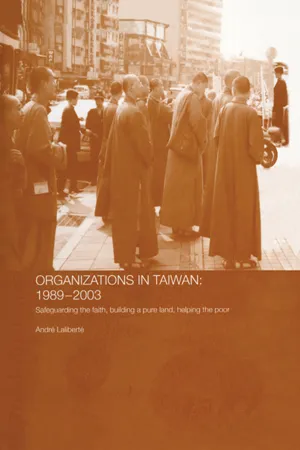
Laliberté looks at a relatively unexplored aspect of modern Taiwan: the influence of religion on politics. This book offers a detailed survey of three of the most important Buddhist organizations in Taiwan: the Buddhist Association of the Republic of China (BAROC), the Buddha Light Mountain (or Foguanshan) monastic order, and the Buddhist Compassion Relief Tzu Chi Association (or Ciji). It examines their contrasting approaches to three issues: state supervision of religion, the first presidential election of 1996, and the establishment of the National Health Insurance.
This study analyzes the factors that explain the diverse paths the three organizations have taken in the politics of Taiwan. Based on an in-depth examination of Buddhist leaders' behaviour, The Politics of Buddhist Organizations in Taiwan compels us to question conventional views about the allegedly passive aspect of religious tradition, deference to authority in societies influenced by Confucian culture and the adverse legacy of authoritarian regimes.
1 The political participation of Taiwanese Buddhist organizations in comparative perspectives
Introduction
The political participation of religious organizations of different denominations and in different cultures is a major phenomenon in contemporary global politics.1 Although we are starting to understand the politics of religious organizations identified with Christianity, Islam, Judaism, Hinduism and Sikhism around the world,2 we know much less about the politics of religious organizations in the Chinese cultural area, especially those that are not identified with Christianity or Islam.3 This book attempts to augment our knowledge of this relatively unexplored topic by looking into the multifarious involvement of Buddhist organizations in the politics of a society that is unquestionably part of the Chinese cultural area, the Republic of China established in Taiwan.4 In particular, it examines the factors that can best explain the variations observed in the range of political behaviors adopted by these organizations. The quietism of these organizations has long contrasted with the boldness of the Taiwanese Presbyterian Church, which has been calling for the islanders’ right of self-determination since the 1980s. During the presidential election of 1996, however, Ven. Xingyun [Xingyun Fashi
] the leader of a well-known Taiwanese Buddhist organization, the Buddha Light Mountain monastic order [Foguangshan Si
] (hereafter Foguangshan), broke ranks with his co-religionists’ previous practice, when he publicly endorsed a candidate from the opposition, Chen Lü’an
. One year later, Xingyun joined a campaign pushing for the removal of then-Premier Lian Zhan
. Then, the interplay of Buddhism with politics in Taiwan was not limited to supporting government policy.
This does not mean, however, that a Buddhist political alternative to the Kuomintang [Guomindang
], the Democratic Progressive Party [Minjindang
] (DPP), the People’s First Party [Qinmindang
] (PFP) or the Taiwan Solidarity Union [Taiwan Tuanjie Lianmeng
] (TSU), comparable to Christian Democracy is emerging in Taiwan.5 There is no organization that can claim credibly to represent the views of most Taiwanese Buddhists. Furthermore, the many Buddhist organizations found in Taiwan adopt a wide range of behaviors that makes it difficult to determine on which grounds an eventual consensus could emerge. Their behaviors range from indifference to politics, as is the case with the Buddhist Compassion Relief Tzu Chi Association [Ciji Gongdehui
] (hereafter Ciji), to cooperation with the government, as is usually the case with the Buddhist Association of the Republic of China [Zhongguo Fojiaohui
], to political opposition, as demonstrated by Foguangshan. The inability of Taiwanese Buddhists to constitute a viable alternative to the current government was made clear in 1996, when both the BAROC and Ciji refused to endorse the candidacy of Chen Lü’an for the ROC presidency.
This book seeks to identify the factors that might explain the differences in the political behaviors these organizations adopt. It questions macro-explanations according to which Buddhist theology, East Asian political culture or state policies can determine the political behavior of Buddhist organizations in Taiwan. These explanations fail in particular to shed light on the different ways these organizations get involved in politics, not only in different countries, but even within a single polity. In order to explain the variations that are observed in the political behavior of Taiwanese Buddhist organizations, this book focuses on organizational characteristics, exploring whether the views of organizations’ leaders or the nature of their membership are more important.
Buddhist organizations and politics in contemporary Taiwan
The relative importance of Buddhism among religions in Taiwan and the favorable political conditions that currently prevail in the ROC after more than a decade of democratization provide Taiwanese Buddhist organizations the opportunity for direct or indirect political involvement. Most Buddhist groups, however, do not behave like the Presbyterian Church and the other civic organizations on the island that have pressured the authorities for political and social reform. Even when their corporate interests are challenged by state actions, most Taiwanese Buddhist organizations are not very assertive. They tend to get involved in the political process only sporadically or to withdraw entirely from public debates. Some important exceptions to that rule, however, have emerged in the 1990s. Organizations such as Foguangshan and individuals such as Xingyun have started to take advantage of political liberalization to mobilize Buddhists. This phenomenon indicates that Taiwanese Buddhists are not always apolitical and that some of them do not uncritically support the government. A look at the place occupied by Buddhist institutions in contemporary Taiwanese society helps to illuminate the importance of these trends.
Buddhism in contemporary Taiwan
Buddhism in Taiwan is undergoing a remarkable revival.6 Prominent members of the Sangha [Sengjia
], the ecclesiastical community within Taiwanese Buddhism, are media icons with the same visibility as pop stars.7 Bookstores display a plethora of titles on Buddhist studies; two television channels are devoted entirely to the broadcast of lectures by several Buddhist Masters; huge temples have been built throughout the country. In 2000, according to statistics issued by the Ministry of Interior (MOI), more than 34 percent of the population that claimed to believe in one or more religions identified themselves as Buddhists.8
The reliability of these figures is routinely questioned on the grounds that self-declared Buddhists are not necessarily considered genuine adherents of the faith by clerics and scholars.9 Nonetheless, these numbers are highly significant in one respect, especially when they are compared with figures from scientific surveys using more rigorous definitions of belief in Buddhism and practice of the religion. Investigations carried out in the late 1980s by Academia Sinica sociologist Qu Haiyuan
, about observance of Buddhist beliefs and practices, for example, suggested that only between 7 and 15 percent of the Taiwanese population could be considered “real Buddhist devotees.”10 The enormous discrepancy between these numbers suggests that the label “Buddhism” is prestigious in Taiwan. In other words, relatively few people actually practice Buddhism but many profess belief. Some observers of religion in Taiwan argue that the stature of Buddhism as a transnational ethical system, in contrast to “superstitions (mixin
),” and its roots in Asia, in contrast to “Western” Christianity, are central parts of people’s appreciation of the religion.11
Other figures help provide an idea about the importance of Buddhism in Taiwan. For example, statistics about the distribution of temples in the country combined with demographic data indicate that Buddhism is practiced all around the island.12 In 2000, the ROC government noted that Buddhists had registered about 4,010 temples and a clergy of more than 9,300. In the domain of education, they administered thirty-five seminaries, five universities, three colleges, four high schools and forty-six kindergartens. In the area of social services, they operated thirty-two nurseries and six orphanages. In the realm of health care, they had registered five retirement homes, three hospitals and three clinics. Finally, in the area of culture, they administered thirty-five publishing houses.13
The associations (hui
]), foundations (jijinhui
), societies (xiehui
) and research institutes (xuehui
) that claim to represent the Buddhist tradition in Taiwan possess considerable resources and exercise significant influence in society. That influence, however, seldom goes as far as intervention in politics by Taiwanese Buddhist organizations. Most of them are engaged in proselytizing activities and charity work, and there are no associations in Taiwan comparable to the Japanese Sōka Gakkai (Society for the Creation of Value) and its political arm, the Buddhist political party Kōmeitō (the Party for Clean Politics).14 When members of the Sangha seek to demonstrate their opposition to specific policies, most of them prefer to use informal means to influence the government. Whenever Buddhist leaders, whether clerical or lay, want to promote Buddhist interests, they do not mobilize their followers, but rather make representations to members of the executive, legislators or civil servants in meetings or conferences. On these occasions, representatives of Buddhist organizations inform government officials about their concerns, and, as Chapter 3 on the BAROC documents, may push for the adoption of laws serving their interests.
Many other Buddhist organizations, however, go further than avoiding open confrontation with the government by encouraging abstention from political participation altogether. They may even refuse to endorse any politician, even a respected lay Buddhist, as was the case when Ciji refused in 1996 to support Chen Lü’an for the ROC presidency. These organizations not only refuse to sponsor any opposition, but also want to avoid giving the impression that they sanction the government. In sum, even though Buddhists are numerous and organized enough to be politically assertive, most of their leaders behave cautiously: they either cooperate with the government or profess indifference to politics.
In the 1990s, however, a third trend has emerged, as some Buddhist leaders have become critical of government policies and have been willing to express publicly their disagreements with state officials. As previously mentioned, Xingyun, although a member of the KMT Central Committee, openly supported in 1996 the candidacy of a politician belonging to the party’s non-mainstream faction for the presidency of the ROC. As will be documented in Chapter 4, Xingyun and the organizations he has founded have since repeatedly adopted forms of political behavior and attitude that are more assertive than those preferred by the leaders of the BAROC and Ciji.
The political environment of Taiwan
The current political attitudes of Buddhist organizations need to be put in the context of the more open environment in which they can articulate their own sets of concerns. Until 1987, the ROC was under the regime of martial law, and political participation by actors outside of the KMT was repressed by a security apparatus that arrested, tried, imprisoned and even executed individuals who were considered threats to the regime.15 Under its corporatist structure of governance, the ruling party also extended its control over different sectors of society by influencing the choice of leadership and providing financial support to key strategic organizations in business, labor and finance.16 In 1970, the Defense Ministry went further and issued a decree enlarging the powers of the Garrison Command, the organ charged wi...
Table of contents
Cover
Full Title
Copyright
Contents
Foreword
Acknowledgments
Abbreviations
1. The political participation of Taiwanese Buddhist organizations in comparative perspectives
2. Taiwanese Buddhist organizations and politics in historical perspective
3. The BAROC and the safeguarding of the religion through lobbying
4. Foguangshan’s humanistic Buddhism and the duty of remonstrance
5. Ciji’s humanistic Buddhism and the avoidance of politics
6. Conclusions
Appendices
Notes
Selected bibliography
Index
Trusted by 375,005 students
Access to over 1.5 million titles for a fair monthly price.
Study more efficiently using our study tools.
Frequently asked questions
Yes, you can cancel anytime from the Subscription tab in your account settings on the Perlego website. Your subscription will stay active until the end of your current billing period. Learn how to cancel your subscription
No, books cannot be downloaded as external files, such as PDFs, for use outside of Perlego. However, you can download books within the Perlego app for offline reading on mobile or tablet. Learn how to download books offline
Perlego offers two plans: Essential and Complete
Essential is ideal for learners and professionals who enjoy exploring a wide range of subjects. Access the Essential Library with 800,000+ trusted titles and best-sellers across business, personal growth, and the humanities. Includes unlimited reading time and Standard Read Aloud voice.
Complete: Perfect for advanced learners and researchers needing full, unrestricted access. Unlock 1.5M+ books across hundreds of subjects, including academic and specialized titles. The Complete Plan also includes advanced features like Premium Read Aloud and Research Assistant.
Both plans are available with monthly, semester, or annual billing cycles.
We are an online textbook subscription service, where you can get access to an entire online library for less than the price of a single book per month. With over 1.5 million books across 990+ topics, we’ve got you covered! Learn about our mission
Look out for the read-aloud symbol on your next book to see if you can listen to it. The read-aloud tool reads text aloud for you, highlighting the text as it is being read. You can pause it, speed it up and slow it down. Learn more about Read Aloud
Yes! You can use the Perlego app on both iOS and Android devices to read anytime, anywhere — even offline. Perfect for commutes or when you’re on the go. Please note we cannot support devices running on iOS 13 and Android 7 or earlier. Learn more about using the app
Yes, you can access The Politics of Buddhist Organizations in Taiwan, 1989-2003 by André Laliberté in PDF and/or ePUB format, as well as other popular books in History & Asian History. We have over 1.5 million books available in our catalogue for you to explore.