- 224 pages
- English
- ePUB (mobile friendly)
- Available on iOS & Android
eBook - ePub
The New Pragmatism
About this book
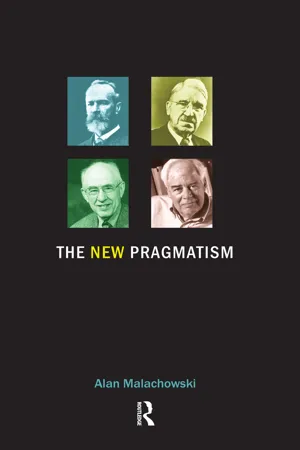
Some hundred years after its inception, Pragmatism has reclaimed centre stage, not just within philosophy, but also within intellectual culture as a whole. This book sets out to explain what it is about Pragmatism that makes it such a distinctively attractive prospect to so many thinkers, even in previously hostile traditions. Alan Malachowski sets out in a clear and accessible manner the original guiding thoughts behind the Pragmatist approach to philosophy and examines how these thoughts have faired in the hands of those largely responsible for the present revival (Putnam and Rorty). The Pragmatism that emerges from this exploration of its "classic" and "new wave" forms is then assessed in terms of both its philosophical potential and its wider cultural contribution. Readers will emerge from the book with a more secure grip on what Pragmatism involves and a correspondingly clearer grasp of what it has to offer and what its current resurgence is all about.
Information
1
Introducing the New Pragmatism
There is absolutely nothing new in the pragmatic method.
(William James, Pragmatism and The Meaning of Truth)
Pragmatism, when looked at in wide perspective and against the background of earlier epochs of philosophic thought, is justified in thinking of itself as 'a new way of thinking'.
(Milton K. Munitz, Contemporary Analytic Philosophy)
The aim of this book is to provide a broad-based introduction to the New Pragmatism for those who are to a large extent, or perhaps even completely, unfamiliar with it. In tackling that task, it ranges over five large questions: what is the New Pragmatism? Why has it come into prominence in recent years? What, if anything, is new about it? What are its main strengths? And what are its prospects?
In dealing with such big questions, the book cannot help but evoke further issues. Some of these are subsidiary, and hence disposable. Others are quite important. However, most of the latter, especially those involving complex matters of history and textual interpretation, cannot be dealt with in the space available. And the others simply have little relevance to an introductory project of this kind. Furthermore, the overarching goal here is to cut through such complexities in order to provide a clear, accessible, general guide to the New Pragmatism, one that explains what it involves in the most general sense, why it has created such an intellectual stir in many quarters1 and what makes it so interesting and challenging at the present time.
Notwithstanding its avowed introductory status, the book may also be of some interest to those who regard themselves as familiar, perhaps all too familiar, with the kind of pragmatism it describes. For the relationship between the New Pragmatism and its historical ancestor is often misunderstood, and this generates confusion and faulty lines of criticism. In setting the record straight, the book may encourage some victims of such misunderstanding to view the New Pragmatism in a different light, and to reconsider its potential.
The general structure
This short opening chapter outlines the structure of the book as a whole. It then goes on to discuss, in preparatory terms, what is meant by the label the 'New Pragmatism! In doing so, it goes beyond the brief terminological justification given in the Preface and sets the scene for the more explicit treatment of the topic provided towards the end of Chapter 2.
That chapter fills in some background concerning classic pragmatism. This was the original form of pragmatism. It was given birth to by the writings of the American philosopher Charles Sanders Peirce. But it only began to make significant impact in the hands of two other famous American thinkers: William James and John Dewey. We do not discuss classic pragmatism in any depth. Just enough historical detail is furnished to flesh out an informative contrast with the New Pragmatism. For we need to show what it is that the New Pragmatism is trying to leave behind, why it finds it necessary to part company in this way, and why it makes consistent sense to say that the New Pragmatism is both historically rooted and something of a fresh departure. This material will perhaps provide additional insight into why the work of some New Pragmatists has provoked such harsh criticism from many of those who nevertheless remain attracted to pragmatism itself.
Building on the account offered in these preliminary remarks, Chapter 2 argues that a number of main features distinguish the New Pragmatism from its venerable ancestor. It contends that these features in particular also help mark it out as something new. Some of these are worth flagging now In the first place, the New Pragmatism is resolutely 'cosmopolitan'. It has lost, in Giles Gunn's suitably evocative phrase, its "American colouration" (1995:298) and thereby shaken off the provincial image that dogged classic pragmatism for so long.2 It is now thereby able to exert a stronger influence across borders, both academic and geographical.3 The second feature is 'autonomy'. The New Pragmatism has largely broken free of the analytic tradition that trapped its predecessor in unending, and largely fruitless, disputes. For this reason, the New Pragmatism has been able to start fashioning its own agenda and is liable to continue doing so in ways that are currently unpredictable. Its proponents do not generally waste much time engaging with the kind of tradition-bound criticisms of classic pragmatism that were once believed to be compelling. This is a controversial matter because some such criticisms remain in currency and are still considered unanswerable. The final feature can be tagged 'neoteric'. It concerns the way in which the New Pragmatism has updated the philosophical approach of its predecessor and become more attuned to the present-day ethos. It is not, for example, enamoured with science or wedded to certain empiricist notions that prevented adherents of classic pragmatism from adapting it to take advantage of useful developments in both philosophy itself and the wider intellectual tradition. Among these developments, the so-called 'linguistic turn! when philosophy began to focus on language as a means of clarifying, if not dissolving its problems, is the most important.
Chapters 3 and 4 deal, consecutively, with the two philosophers who have done by far the most to develop, inspire and promote the New Pragmatism. The first is Richard Rorty, who taught for extended periods at Princeton University and the University of Virginia before moving to Stanford University where he was highly productive until his death in 2007. And, the second is Hilary Putnam, who has stayed at Harvard University throughout his lengthy philosophical career and is now Emeritus Professor there. Many other thinkers have paved the way for the recent revival of interest in pragmatism. These include Richard Bernstein, Susan Haack, Robert Westbrook, Richard Shusterman, Nicholas Rescher, Christopher Hookway and Cheryl Misak, whom we mentioned in the Preface.4 However, it is Rorty and Putnam who have been most responsible for the ascendance of the New Pragmatism itself. For that reason, and to clarify the nature of the very different contributions that they have made in this respect, their work dominates many of our discussions and most of these pages.
Chapter 5 identifies some of the key differences between the ways in which these two major thinkers approach pragmatism, then assesses the implications of such differences for the New Pragmatism. It concludes that the New Pragmatism can flourish on the input of both Rorty and Putnam without needing to reconcile all their differences. However, it also contends that other thinkers with fresh ideas will need to come forward to carry the New Pragmatism on to the next stage. Only then will it begin to fulfil the potential envisaged by its recent advocates.
Chapter 6 starts by quickly recalling some common objections to the New Pragmatism. Since this is an introductory account, no attempt is made to explore these or provide detailed arguments in the New Pragmatism's defence. However, by then it should already be clear that in many cases such arguments are unnecessary because these objections are often outdated or now tend to miss the point for other reasons.
Critics who voice the objections in question fall into two camps. There are those who argue that the New Pragmatism has found itself in much philosophical trouble because it has strayed from the path of classic pragmatism. Here, Peirce is often invoked as the path-maker, and founding father of pragmatism proper, a person of scientific rectitude and logical rigour whose principles have since been harshly betrayed. Others contend that the New Pragmatism does not hold water precisely because it is still, despite some catchy cosmetic changes, a form of pragmatism and thus vulnerable to certain basic objections that were voiced, or so it is claimed, with great clarity and force long ago by critics such as G. E. Moore and Bertrand Russell. In keeping with our theme 'it is time to move on', we do not investigate these criticisms in any depth. But, to give an indication, and some assurance, as to why this is not required, we outline Putnam's objections to Russell's treatment of James in Chapter 4.
A third camp should be mentioned. Its members also reject the New Pragmatism because it resembles classic pragmatism. But, they are equally opposed to the early critics of classic pragmatism. For they are practitioners of continental philosophy who take their bearings from such thinkers as G. W. F. Hegel, Friedrich Nietzsche and Martin Heidegger, thinkers they regard as standing apart from, if not in opposition to, the Western Platonic tradition. This is a bankrupt tradition that, in their eyes, classic pragmatism colluded with even when appearing to dispute it. The third camp's attitude is briefly discussed in the chapter on Rorty, a philosopher who daringly and provocatively attempted a pragmatist appropriation of some of the very thinkers who are deemed to separate the continental approach from Platonism and its alleged co-conspirators.
The book finishes with a general discussion of the future prospects for the New Pragmatism. These prospects are themselves mainly pragmatic. They cannot be properly assessed independently of the New Pragmatism's burgeoning relationships with diverse disciplines including literature, law, education, feminism, politics and religion. For although it has achieved a large measure of philosophical autonomy in the sense just mentioned, and later explained in more detail in Chapter 2, the New Pragmatism derives much of its intellectual vitality and practical utility from its various connections with other forms of thought and cultural expression. Indeed, the verdict of the primary concluding argument is that the New Pragmatism has the best chance of consolidating its recent progress if it continues to engage imaginatively with ideas outside the traditional spheres of philosophy. To do this will require plenty of skill, imagination and perseverance. For advocates of the New Pragmatism must manage to steer past the Sirens of classic pragmatism who beckon them towards a nostalgic, but now hopelessly irredeemable, past and those of post modernism who seek to serenade them away from their more serious social hopes and political ambitions. The New Pragmatism has the best chance of staying on course if it makes the most of the intellectual freedom it has carved out for itself and then, to borrow a thought from Coleridge that Rorty liked to recall, helps create the standards of taste by which it is to be properly judged.
The whole project is rounded off with ' Reading the New Pragmatists", a short bibliographical essay. This offers some suggestions for the kind of further reading that encourages deeper exploration of the various issues raised at a more preparatory level throughout the book. In that sense at least it helps plug some of the gaps that necessarily occur in an introductory text.
What is the New Pragmatism?
At first sight, the question is thoroughly unpragmatic. Its form replicates that of the great Socratic questions invoked by the Platonic dialogues: what is X?5 These questions seduced a whole tradition of Western philosophizing into elevating 'theory' over 'practice'. It thereby embarked on a seemingly endless quest for the elusive 'necessary and sufficient conditions' supposedly required to put such persistently troublesome queries to rest. Nevertheless, our question can be posed in a suitably pragmatic way if we use it merely to probe for some very general practical features: those that will help us identify the kind of things that a New Pragmatist is liable to assert, to be interested in, to oppose and to write about.
When the celebrated American philosopher W. V. Quine surveyed pragmatism's relationship to empiricism, he wittily suggested that the term "pragmatism" may be one "we can do without" because "it draws a pragmatic blank" (1981: 3). However, there was still a hint of the Socratic approach even in Quine's pithy ploy For it places too much emphasis on the idea of locating a 'pragmatic criterion' - one without which a word, phrase, distinction, claim or whatever is surplus to philosophical requirements - almost as if, without the quest for 'necessary and sufficient conditions', there would have to be some other quest because some other criterial hole would have to be filled. By contrast, the New Pragmatism circumvents all such concerns. It relies, instead, on a family of more practical considerations. These include whether something is useful, whether it engages our interests, whether it helps us cope in the appropriate circumstances, whether it helps us make better sense of the world around us, and, more generally, whether, following James's lead, it fits in with our already secured fund of beliefs and experience. The New Pragmatism does not seek to provide a substitute for the Socratic problematic, but rather tries to show how we can live comfortably without it. If we substitute 'non-practical' for 'non-empirical', the following quotation from Dewey captures what it is that New Pragmatists generally try to avoid here: "The problems to which non-empirical method gives rise in philosophy are blocks to inquiry, blind alleys; they are puzzles rather than problems" (EN: 6). And James famously provided a graphic example of how practical concerns can be invoked to put to rest disputes that can otherwise seem interminable;
Some years ago, being with a camping party in the mountains, I returned from a solitary ramble to find everyone engaged in a ferocious metaphysical dispute. The corpus of the dispute was a squirrel - a live squirrel supposed to be clinging to one side of a tree-trunk; while over against the tree's opposite side a human being was imagined to stand. This human witness tries to get sight of the squirrel by moving rapidly round the tree, but no matter how fast he goes, the squirrel moves as fast in the opposite direction, and always keeps the tree between himself and the man, so that never a glimpse of him is caught. The resultant metaphysical problem now is this: Does the man go round the squirrel or not? He goes round the tree, sure enough, and the squirrel is on the tree, but does he go round the squirrel? In the unlimited leisure of the wilderness, discussion had been worn threadbare. Everyone had taken sides, and was obstinate; and the numbers on both sides were even ... "Which party is right," I said, "depends on what you practically mean by 'going round' the squirrel. If you mean passing from the north of him to the east, then to the south, then to the west, and then to the north of him again, obviously the man does go round him, for he occupies these successive positions. But if on the contrary you mean being first in front of him, then on the right of him, then behind him, then on his left, and finally in front of him again, it is quite obvious that the man fails to go round him, for by the compensating movements the squirrel makes, he keeps his belly turned towards the man all the time, and his back turned away. Make the distinction [i.e. between these two practical senses of the phrase 'going round'], and there is no occasion for any further dispute".
(PMT: 27-8)
New Pragmatists take from this kind of example exactly the kind of lesson that James did. Philosophical disputes that may appear to be intractable are best tackled by trying to identify the respective practical consequences of the different viewpoints at stake and then making distinctions accordingly But, as we shall see, they do not try to work this lesson up into a full-blood...
Table of contents
- Cover
- Half Title
- Title
- Copyright
- Contents
- Preface
- Acknowledgements
- Abbreviations
- 1. Introducing the New Pragmatism
- 2. Leaving classic pragmatism behind
- 3. Rorty against the tradition
- 4. Putnam's contributions
- 5. Putnam and Rorty: pragmatism without reconciliation
- 6. Prospects
- Conclusion: the New Pragmatism and philosophy
- Notes
- Reading the New Pragmatists
- Bibliography
- Index
Trusted by 375,005 students
Access to over 1.5 million titles for a fair monthly price.
Study more efficiently using our study tools.
Frequently asked questions
Yes, you can cancel anytime from the Subscription tab in your account settings on the Perlego website. Your subscription will stay active until the end of your current billing period. Learn how to cancel your subscription
No, books cannot be downloaded as external files, such as PDFs, for use outside of Perlego. However, you can download books within the Perlego app for offline reading on mobile or tablet. Learn how to download books offline
Perlego offers two plans: Essential and Complete
- Essential is ideal for learners and professionals who enjoy exploring a wide range of subjects. Access the Essential Library with 800,000+ trusted titles and best-sellers across business, personal growth, and the humanities. Includes unlimited reading time and Standard Read Aloud voice.
- Complete: Perfect for advanced learners and researchers needing full, unrestricted access. Unlock 1.5M+ books across hundreds of subjects, including academic and specialized titles. The Complete Plan also includes advanced features like Premium Read Aloud and Research Assistant.
We are an online textbook subscription service, where you can get access to an entire online library for less than the price of a single book per month. With over 1.5 million books across 990+ topics, we’ve got you covered! Learn about our mission
Look out for the read-aloud symbol on your next book to see if you can listen to it. The read-aloud tool reads text aloud for you, highlighting the text as it is being read. You can pause it, speed it up and slow it down. Learn more about Read Aloud
Yes! You can use the Perlego app on both iOS and Android devices to read anytime, anywhere — even offline. Perfect for commutes or when you’re on the go.
Please note we cannot support devices running on iOS 13 and Android 7 or earlier. Learn more about using the app
Please note we cannot support devices running on iOS 13 and Android 7 or earlier. Learn more about using the app
Yes, you can access The New Pragmatism by Alan Malachowski in PDF and/or ePUB format, as well as other popular books in Philosophy & Modern Philosophy. We have over 1.5 million books available in our catalogue for you to explore.