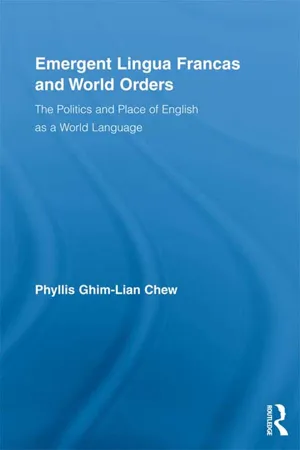
This book presents an alternative paradigm in understanding and appreciating World Englishes (WEs) in the wake of globalization and its accompanying shifting priorities in many dimensions of modern life, including the emergence of the English language as the dominant lingua franca (ELF). Chew argues that history is a theatre for the realization of lingua francas, offering a model that shows the present as derived from the past and as a bearer of future possibility, the understanding of which is rooted in the understanding of World Englishes and ELF. The book will engage with some of the current theoretical debates in WEs and includes, as a means of fleshing out the model, sociolinguistic case studies of Arabia, China Fujian, and Singapore.
eBook - ePub
Emergent Lingua Francas and World Orders
The Politics and Place of English as a World Language
- 288 pages
- English
- ePUB (mobile friendly)
- Available on iOS & Android
eBook - ePub
Emergent Lingua Francas and World Orders
The Politics and Place of English as a World Language
About this book
Information
1 Emergent Lingua Francas and World Orders
A DEFINITION OF LINGUA FRANCAS
When asked what the main function of language is, most people will say that language is a tool used to learn or gather information on topics such as computing or astronomy. In other words, language is needed to enable us to find out “things” about the world. While such a function of language may explain the thriving role of language, it does not tell us why it spreads, dies, multiplies, colonizes, and rejuvenates, or why it sometimes is used as a lingua franca (LF). In fact, we rarely utilize language when computing, as it is often a solitary activity. Accounting, welding, and/or dancing is also more often learned by demonstration and practice than by speech. So too when we try to find out information about the world on the Internet or in the library, a totally literate activity; we are, ironically, once again often alone. Information is more likely to be digested upon reflection rather than through interaction. So the “best” answer here as to the primary function of language is that it is a device for social bonding rather than information gathering. In this study, language is viewed instrumentally, and its social interactional capacity enables it to have far-reaching sociopolitical implications (Dunbar 2003). This social interactional phenomena does not only take place within close networks such as families, friends, and neighbors for before long, populations expand and people will feel the need to communicate beyond these immediate networks due to extended purposes. The world we live in has long been a multilingual and multicultural one, and hence people are tempted, constantly, to break down language barriers so as to create a common medium of communication. To do this, new languages are then created or existing languages made to fulfill this communicative function.
In this study, a lingua franca (LF) is defined as a “contact language” (Arends et al. 1994), which is used by individuals to overcome the challenge of Babelization. LF may also be referred to as a “common language” (Kahane 1958; Richards et al. 1996: 214) in the sense of being “common” to both interlocutors. It can also mean a Hilfssprache, an auxiliary language “whose native language may not have acquired any status beyond its own parochial world” (Harrak 1992:140). The UNESCO (1951: 689) definition is a useful one in this context: “Language used habitually by people whose mother tongues are different in order to facilitate communication between them.” LF is a “common” or “contact” language not just within nations but also between them. Viewed in this cross-nation sense, the LF may also be regarded as an “international language” (McKay 2008) or as an “international auxiliary language” (Smith 1978). As intra- or inter-national “language of convenience” there are myriad opportunities for people to practice the lingua franca either in school or on the street, and occasionally laugh at their own translations. It goes without saying then that border areas are notorious for the flourishing of LFs as they are basically “contact zones.”
Another reference is to see LF as a “vehicular language” (Heine 1970), that is, as a “vehicle” or “tool” to enable us to go beyond the boundaries of our original community and as a means to widen our scope of interactional strategies. Whereas a vernacular language is used as a native language in a single speaker community, a vehicular language goes beyond boundaries. In this sense, a vehicular language is almost always a second language for communication between communities. For example, in India, English is used as a LF and as a second language between different Indian cultural groups such as the Punjabis and the Tamils or between the Sikhs and the Punjabis. Vehicular languages are often associated with the phenomenon of bilingualism or multilingualism. Holmes (1997: 86) writes that “the term lingua franca describes a language serving as a regular means of communication between different linguistic groups in a multilingual speech community.”
Often, LF are looked upon functionally rather than structurally—the latter being subordinate to the former as it is the usage of the lingua franca rather than its form that is uppermost in the user's mind. Any language could therefore conceivably serve as a lingua franca between two groups, no matter what sort of language it is. Many languages in the world today would therefore qualify as LFs in one sense or another because they are occasionally used for the purpose of communication with speakers of other languages when the need arises. Russian is the Soviet Union's lingua franca (and still partly is today between former Soviet territories); Mandarin is the lingua franca of oral communication between Chinese of different Chinese “dialects”; Malay is the lingua franca of Indonesia and its surrounding areas. In the past, Greek was the lingua franca of huge areas in the Mediterranean and the Middle East to the extent that the New Testament was written in Greek; Latin became the lingua franca of the Catholic Church, and Aramaic—a relatively unknown language today—once had a surprising status of lingua franca in many parts of the Middle East. In other words, not all languages are LFs but all LFs are languages. If we view LF functionally in its primary role as a tool of contact and social interaction, then we can also extend the name of lingua franca to artificial languages such as Esperanto, Ido, Interlingua, Latino Sine Flexione, and Novial, which have been originally designed for communication between speakers of different native languages.
LFs are often implicated in current discussions on bilingualism, multi-lingualism, and the emergence of mixed modalities. There are no languages today without some signs of grammar mixture; for example, Yiddish has grammatical features from Slavic languages, such as Polish and Hindi, since they place their verbs at the end of sentences (cf. Uriel 1977). In some cases, languages mix so intimately that they become new ones, such as Media Lengua in Ecuador, which uses Spanish words with endings and word order from the local Indian language of Quechua (McWhorter 2001). Unfortunately, many people see the natural process of “such mixtures” as a “deficiency” rather than as an enrichment or natural process. Hence, there are mixed feelings about LFs, especially prominent ones such as English and Spanish. Indeed LFs are often associated with less-welcomed social phenomena such as language change, language shift, language death. They therefore receive much controversial attention and are likely to continue to be of great interest not just to linguists but also historians, anthropologists, sociologists, philosophers, and so forth, not least because their emergence and dominance are often caused by both internal (i.e., linguistically based) and external (i.e., historical, geographical, and political) factors. Their emergence and dominance also result in numerous ripple effects influencing many sectors of human civilizations. Cross-disciplinary studies have referred to lingua francas in terms of variables such as its status, the size of its community, its function as a mother tongue or auxiliary tongue, the number of countries where it has official status, the number of people using the “foreign” language (i.e., the LF), the functional range of the language, the economic strength of the language, and the unplanned promotion of the language.
While we have defined LFs in a general and functional way, we are not quite sure when the specific term “Lingua Franca” was first used. In a narrow sense, the original term, with the capital letters intact, is the Italian term for Frankish, which was used in Levant and was a mixed language with vocabulary from Italian dialects and other Romance languages as well as Arabic, but which lacked their inflections. It was the jargon of maritime contacts in the Levant, spoken by Arabs in contact with Europeans. Knapp and Meierkord (2002: 9) refers to it as “a variety that was spoken along the south-eastern coast of the Mediterranean between approximately the 15th and 19th centuries probably based on some Italian dialects in its earliest history, and which included elements from Spanish, French, Portuguese, Arabic, Turkish Greek.” This Mediterranean LF is believed to have been in existence since the Middle Ages, and texts of this variety survive from the 16th century.
In a broader sense, however, the specific term “lingua franca” (without the capital letters) refers to—as previously defined—a “contact language” used by Arab traders, and later the Turks in their contact with travelers, prisoners of wars, and crusaders from Western Europe. It has come to mean a “common language” used between speakers who speak different first languages. For example, in China in the 19th century along the ports on its eastern coastline, a lingua franca called pidgin (from the Cantonese pei tsin “pay money,” which is what traders in Canton called the pidgin English they used there from the1600s to the 1900s) developed from contacts between English and Chinese in commercial situations and may be considered a lingua franca (Kirkpatrick 2007b). It has a Chinese grammatical base and an English vocabulary pronounced as in the Chinese. Pidgin was used by both communities when they needed to communicate, but of course each of them returned to its own linguistic form (the vernacular form) outside of these limited exchanges. It is now generally accepted that the term pidgin derives form the English word “business” relating to the commonplace function of these languages as vehicles for trade. Eventually, the term became a generic label for all contact varieties of this type (ibid.).
THE RELATIONSHIP OF PIDGINS AND CREOLES TO LINGUA FRANCAS
We may also understand the enduring nature of LFs and their place in history through their relationship to pidgins and creoles, the contexts in which they are found and their relationship with the written script.
The word “pidgin” has existed long before linguists attempted to attach such a label. There are evidence of numerous pidgins in pre-colonial Africa, Asia and North American. Indeed, we may postulate that there have been countless births of pidgins and lingua francas (around 5000 to 6000), mostly unrecorded since documented language accounts for only a small percentage of its total history (Schendl 2001). Pidgins arose to facilitate communication between groups of different linguistic backgrounds in restricted contexts such as trade, forced labor, and other kinds of marginal contact. They are a kind of lingua franca because they allow communication between two strangers who need to communicate. From early Greek history, one notes that Hermes was both the god of trade and the god of the boundary stones, which used to separate one city from another (Orrieux and Pantel 1999). To facilitate trade between the cities, a pidgin form of lingua franca was used during random encounters of hunting bands or mixed with warfare in ancient Greece by the 8th century BC). In the more stereotypical case, they are formed when speakers of one language engage in trade with speakers of another language or when speakers of one language work in plantations managed by speakers of another, and neither knows the other's language (McWhorter 2001).
Pidgins may be defined as simplified dialects, where commonly shared features of their language are retained and nonshared features ignored but where a great deal of communication can still take place.1 Hence, early lingua francas are essentially pidgins since we know that there are many contexts in the world where the lingua franca comprises only a partial command of the language. For example, Winford (2003) recounts how in the 1700s and 1800s, Norwegian and Russian traders used a makeshift language, Russenorsk, with about 300 words borrowed partly from Russian and Norwegian. Native Americans in North America probably used a pidgin of this kind in their encounters with the pilgrim fathers. In this sense, pidgin may be said to share features of “baby talk” and “foreigner talk” (cf. Ferguson and DeBose 1977). Indeed, in discussions on second language acquisition, pidgin-like features are commonly discussed (cf. Adamson 1988). The similarity results because both L2 learning and pidgin speakers creatively exploit their limited resources to achieve their communicative ends. They expand their lexicon through polysemy, compounding and paraphrase, assign new functions to available morpheme, and create new syntactic rules. However, pidgins can be differentiated from interlanguage varieties (imperfect learning) and foreigner talk because unlike foreigner talk and imperfect learning, they are targets of learning in their own right.
There is a wide range of LF-pidgins stemming from different types of contact and influences among peoples, and it is difficult to define them structurally. Some pidgins are more “restricted” than others, because they serve as a contact language between two groups and involve limited and not extensive contact. Hence there is a restricted situation involving contact between groups, where neither has the opportunity or the real need to learn the other's language. Some pidgins involved domestic settings—for example, Butler English2—or military invasion—Japanese pidgin English, Vietnamese pidgin French—or are vehicles for interaction with tourists. Pidgins also encompass a wide variety of contexts, for example, rudimentary languages like Russenorsk or full-fledged languages like Hiri Motu, which serves as a lingua franca in Papula, the southern half of Papua New Guinea.
In the beginning of their lives, pidgins functioning as lingua francas stretch their small vocabularies with circumlocutions and there is more reliance on contexts. Examples of such LFs are French-based Haitian of Haiti, the Congo-based Kituba of Zaire, the German-based Unserdeutsch of Papua New Guinea (PNG), and the Arabic-based Nubi of Uganda. Here, one notes the reduction and simplification of input materials, internal innovation, and systematic regularization of structure, with L1 influence also playing a major role (Sebba 1997). To facilitate learning, such early LFs will drop difficult-to-learn lexical, phonological items. For example, Zulu, a language of southern Africa, is one of the Bantu languages that have some click sounds. One of its daughters, Fanakalo, a contact language, was developed by Africans from other regions brought in originally to work the mines in South Africa. Fanakalo speakers usually replace the clicks with a /k/ to make it simpler for its users. In addition, Zulu has tones; Fanakalo does not. However, while most LF-pidgins are “simple,” some are more difficult than others (Winford 2003).
Over time some pidgins grow to become truly new languages as people need to communicate on a more nuanced level and the simplicity of a given pidgin language does not fit their expanding needs. The “new” language is necessarily a new hybrid rather than a dialect of the language that provides the words. For example, the South Seas pidgin was used as a lingua franca to communicate by the English with men from several islands in Oceania when they came to work on long-term contracts in plantations in Queensland. These migrant workers often continued to use pidgin when they went home, because of the multiplicity of languages spoken in their home in PNG and other Oceanic islands. Gradually, this pidgin expanded into a “real” language—a branch of which is Tok Pisin, spoken today in PNG alongside the hundreds of indigenous languages there (cf. Ostler 2006).
Such pidgins are often referred to as creoles. For example, one of the earliest documented LF was the koine dialektos (“common dialect”) of the Hellenistic age (327–323 BC), used in the Mediterranean. Used in trade, this LF, in all probability originating as a pidgin, quickly changed its phonology, morphology, syntax, and lexicon and grew to become more creolized. Similarly, around the same time, the Celtic people were using the Gallo-Brittonic “common language” spoken among the Gauhlish-speaking Celts of the mainland and the Brittonic-speaking Celts of Britain. However, through the passage of time, it later became a creole among the Anglo-Saxon, Jute, and Danish people who were invading southern Britain (Harding 2004). Unlike pidgins, creoles are acquired as native languages in the first few years of life. Children of pidgin speakers introduce complexity into their language, enabling the language to become not just longer strings of words but a real full-fledged natural language, functionally unrestricted and used for a wider purpose.3 Lightfoot (2006: 140) points to evidence suggesting structural properties of well-established languages in creole.
The study of creoles is the most politically charged area of sociolinguistics due to its inherently unstable nature and the fact that it is used predominantly in marketplaces and fairs, with native speakers being of mixed races and working classes, as was the case with the Koine dialektos. As LFs, pidgins and creoles, being LFs, are also associated with the history of racism and enslavement.4 However, our purpose is not to dwell on territorial definitions of pidgins and creoles but to examine how pidgins and creoles may in their own special way and in certain circumstances be closely related to our story of lingua francas.
The earliest known origin of the term is the Spanish word “criollo,” which was adopted into French as creole and then into English (Winford 2003). Dell Hymes (1971: 65) suggested that the study of pidginization and creole is not as unique or marginal as is commonly presupposed, but rather comprises a central part of our general understanding of language change:
Pidginization is that complex process of sociolinguistic change comprising reduction in inner form, with convergence in the context of restriction in use.
Creolization is that complex process of sociolinguistic change comprising expansion in inner form, with convergence, in the context of extension in use.
Pidginization is usually associated with simplification in outer form, Creolization with complication in outer form.
Hymes’ (1971) definition enables us to overcome the hitherto negative connotations surrounding “pidgins” and “creoles.” For example, it enables us to apply the term pidginization to trade languages such as Swahili, Arabic or Hindi without precipitating controversy over its negative connotations. It must be remembered that only until very recently, pidgins and creoles were regarded, especially by non-linguists, as inferior languages, and perhaps not even languages at all (cf. Mufwene 2001).
Although as “neutral” as it can get, Hymes’ (1971) definition does not enable us to pinpoint when an LF may suddenly turn from an “extended pidgin” into a creole. It remains difficult for us to know exactly when minimal development in English (manifested in jargons, pidgins, or fossilized interlanguage) progress to an acceptable community norm to be considered as a language in its own right. Both pidgins and creoles involve similar processes of restructuring over time and there is a lack of structural criteria which can enable us to distinguish one from the other (Winford 2003). It is therefore a “soft boundary” when we wish to regard how trading language or pidgin will no longer be the functional tools or lingua francas of traders and cultural intermediaries but will evolve into a “normal” language without the original pidgin-like characteristics and one with its own native speakers (Holm 2004).5
With even more prolonged periods of time, some LFs will also display identity marker code switching and the use of nativized norms. Here, the lingua francas under the influence of the exuberant process of language change will tend to develop far more machinery than they need. When this happens, they become what we have defined as the “vernacular,” as opposed to the “vehicular.” The main aim of the vernacular is the highlighting of the desire to belong. By choosing this variant or that variant, the speaker indicates where he places himself, and behind which boundary. The boundaries of related vernaculars are indicated by regional accent, the introduction of dialect work in the standard form, or the use of a different language in multilingual situations....
Table of contents
- Front Cover
- Half Title
- Title Page
- Copyright
- Dedication
- Contents
- List of Figures
- List of Tables
- Preface
- Acknowledgments
- 1 Emergent Lingua Francas and World Orders
- 2 A Model of Evolving World Orders and Lingua Francas
- 3 Liminality
- 4 The Last Liminal Period: Emergent Arabic in the Middle Ages
- 5 Three Phases of Liminality
- 6 Embracing Liminality: A Case Study of Singapore
- 7 A Case Study of The Peoples’ Republic of China
- 8 A Case Study of Southern Min Language
- 9 The Place of English in the World Today
- Notes
- Bibliography
- Index
Trusted by 375,005 students
Access to over 1.5 million titles for a fair monthly price.
Study more efficiently using our study tools.
Frequently asked questions
Yes, you can cancel anytime from the Subscription tab in your account settings on the Perlego website. Your subscription will stay active until the end of your current billing period. Learn how to cancel your subscription
No, books cannot be downloaded as external files, such as PDFs, for use outside of Perlego. However, you can download books within the Perlego app for offline reading on mobile or tablet. Learn how to download books offline
Perlego offers two plans: Essential and Complete
- Essential is ideal for learners and professionals who enjoy exploring a wide range of subjects. Access the Essential Library with 800,000+ trusted titles and best-sellers across business, personal growth, and the humanities. Includes unlimited reading time and Standard Read Aloud voice.
- Complete: Perfect for advanced learners and researchers needing full, unrestricted access. Unlock 1.5M+ books across hundreds of subjects, including academic and specialized titles. The Complete Plan also includes advanced features like Premium Read Aloud and Research Assistant.
We are an online textbook subscription service, where you can get access to an entire online library for less than the price of a single book per month. With over 1.5 million books across 990+ topics, we’ve got you covered! Learn about our mission
Look out for the read-aloud symbol on your next book to see if you can listen to it. The read-aloud tool reads text aloud for you, highlighting the text as it is being read. You can pause it, speed it up and slow it down. Learn more about Read Aloud
Yes! You can use the Perlego app on both iOS and Android devices to read anytime, anywhere — even offline. Perfect for commutes or when you’re on the go.
Please note we cannot support devices running on iOS 13 and Android 7 or earlier. Learn more about using the app
Please note we cannot support devices running on iOS 13 and Android 7 or earlier. Learn more about using the app
Yes, you can access Emergent Lingua Francas and World Orders by Phyllis Ghim-Lian Chew in PDF and/or ePUB format, as well as other popular books in Languages & Linguistics & Linguistics. We have over 1.5 million books available in our catalogue for you to explore.