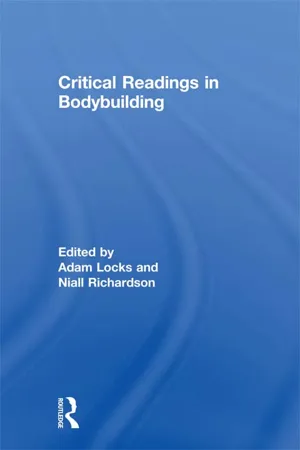
In recent years the 'body' has become one of the most popular areas of study in the arts, humanities and social sciences. Bodybuilding, in particular, continues to be of interest to scholars of gender, media, film, cultural studies and sociology. However, there is surprisingly little scholarship available on contemporary bodybuilding. Critical Readings in Bodybuilding is the first collection to address the contemporary practice of bodybuilding, especially the way in which the activity has become increasingly more extreme and to consider much neglected debates of gender, eroticism, and sexuality related to the activity. Featuring the leading scholars of bodybuilding and the body as well as emerging voices, this volume will be a key addition to the fields of Sociology, Sport Studies, and Cultural Studies.
eBook - ePub
Critical Readings in Bodybuilding
- 262 pages
- English
- ePUB (mobile friendly)
- Available on iOS & Android
eBook - ePub
Critical Readings in Bodybuilding
About this book
Information
Part 1
Practices

Figure I.1 Noel Gordon. Courtesy of Rebecca Andrews.
Introduction to Part 1
What is the “Practice” of Bodybuilding?
When I teach classes on the “body,” I always try to emphasize to my students that we are all body-builders. In other words, we all “build” the body on a daily basis. For example, we decide how we make-up our skin and we tan it, paint it or even modify its appearance with cosmetic procedures; we decide whether to shave or wax the hair on our bodies; we style and/or color the hair on our heads; we ornament the body with jewelry or piercings; we choose clothes which re-shape the body's silhouette, and nearly all of us, at some time or other, are involved in a process of dietary manipulation and exercise in order to lose fat and tone/shape the voluntary muscles of the body. In contemporary culture the “body” is now viewed as a project, rather than an essential or fixed attribute, and all of us, to some degree or other, are involved in the practice of body-building in that we are shaping or styling the tissues of our body.
However, bodybuilding is usually read as an area of body-modification in which a person engages in a regime of resistant weight-training exercises, and follows a very specific diet, in order to build and shape the voluntary muscles of the body. Of course, many people engage in a process of diet and resistance weight training for purposes other than that of bodybuilding. Dancers and athletes, for example, will all “work out” in order to support or enhance their performance on the stage or the track. Yet the difference is that although other athletes and sports people may employ bodybuilding practices, they do so in order to supplement or enhance the performance in their specific sport. Bodybuilding, by contrast, holds the sculpted physique as the final product of the activity rather than the additional gains in strength or endurance which the activity may promote. While other activities may require a highly muscular physique in order to enhance performance; in bodybuilding the development of the muscular physique is the final goal.
For this reason, much academic writing to date has focused on one possible final product of bodybuilding: the competition level physique. Understandably, critics and writers have been intrigued by the semiotics of the competition-level physique, especially how it challenges or conforms to traditional gender iconography. While male bodybuilding has often been viewed as the assertion of hegemonic masculinity (Bridges 2009; Gillett and White 1992; Wiegers 1998), female bodybuilding has been regarded as feminist resistance and critics have considered how/if it challenges traditional feminine iconography (see Brook 2001; Coles 1999; Grogan et al. 2004; Guthrie and Castelnuovo 1992; Ian 2001; Schulze 1990; St. Martin and Gavey 1996). Other critics have been interested in the debates about gendered spectatorship and gazing which are implicit in the dynamics of bodybuilding competitions/representations (Brady 2001; Chare 2008; Holmlund 1989; Patton 1994; Richardson 2008; Simpson 1994) while some have attempted to “queer” the bodybuilding physique (Richardson 2004; Shippert 2007). Most importantly, it is often assumed that bodybuilding simply is the competition-ready physique.
Arguably, there are a few problems with this assertion. For example, underpinning much of the writing which focuses simply on the “competition” physique is an assumption that the bodybuilder will look like this all year long. As any of us who have been competitive bodybuilders ourselves will know, this is not the case. First, these bodies are the product of an intense period of dieting and dehydration and if the bodybuilder attempted to maintain this “condition” for a prolonged period, s/he would create considerable health problems. Second, this physique is very much the product of “staging” techniques – especially tanning/make-up and stage lighting. Much of bodybuilding is about “illusion” – the appearance of dense slabs of muscle flexing beneath paper-thin skin. In day-to-day activities, however, many bodybuilders, dressed as they do in “baggies” (loose bodybuilding clothes which cover their pumped-up muscles) will have a very different appearance and, if anything, merely appear bulky (see Locks 2003 and Chapter 8 this volume).
Therefore, this part is an attempt to broaden much of the existing writing on bodybuilding by widening the focus so that the only consideration is not simply the politics of the stage-ready, oiled and flexing physique. Indeed, most of the bodybuilding work takes place in the gym, these modern-day torture chambers where bodybuilders push themselves to the absolute limit every day of their lives. As Bunsell and Shilling in Chapter 2 of this collection asks, what are the politics of the gym in relation to training regimes and how does the gender of the bodybuilder inflect this space? Similarly, how do bodybuilding regimes map onto health and fitness ideologies and the self-identifications which bodybuilders make in this respect (Bailey and Gillett, Chapter 4)? What about the other factors which deserve consideration in the forging of a bodybuilding physique, such as the personal emotions (shame/pride) experienced by the athlete (Sparkes et al., Chapter 5) and his/her “possible” use of pharmaceutical, performance-enhancing drugs (Monaghan, Chapter 3)? Of course, there are many people who train regularly in the gym but never intend to step onto a competition stage in their life. How do these people identify? Can bodybuilding be deemed an identity if its participants never move into the competition stage (Heywood, Chapter 6)? All these questions are at the forefront of the following chapters.
One aspect which we hope will distinguish this book from previous collections is that this part will maintain a focus upon bodybuilding life outside of the competition stage. Although some contributors are considering the dynamics of competition level bodybuilding (Bolin, Chapter 1), the focus of many of the chapters will be on bodybuilding identifications and gym culture. One of the most interesting aspects of gym culture is that although many people are actively engaged in bodybuilding (i.e. following an ascetic diet and a program of resistance weight training in order to build and shape the voluntary muscles of the body), they tend to avoid identifying as bodybuilders. Most people prefer to say that they ‘go to the gym’ or ‘work out’ or ‘weight train’ rather than claim the identity of being a bodybuilder. There are a number of probable reasons as to why this is the case. First, as I have already pointed out, the idea of bodybuilding as something linked to the competition stage is ingrained in much contemporary culture. Can someone identify as a bodybuilder if he/she has never stepped onto the competition stage? One possible comparison could be with someone identifying as a ‘writer’ when he/she has never had anything published. Related to this is the area which the second part of the book will address in more detail: the idea of bodybuilding as representation. If the image of the competition-ready bodybuilder is canonized as the look of bodybuilding, then most people would acknowledge that their off-season physique does not match up to the recognized norm and so feel a sense of embarrassment in failing to compare. Obviously it is rather humiliating to identify as a bodybuilder and receive a puzzled stare from someone who then says, ‘Oh really? I hadn't noticed.’
Second, bodybuilding has always been a “suspect” activity. For men, it is dogged by the stigma of homoeroticism (see Richardson, Chapter 9 this volume), while for women it is gender transgression and, given that gender is the scaffold for heterosexuality, then female bodybuilding is also dismissed as sexually “deviant.” What problems do female bodybuilders encounter, not only in the competition circuit, but also in the gym itself? Likewise, can a male bodybuilder identify beyond the two stereotypes of either metropolitan gay “gym-bunnies” or narcissistic, vacuous “muscle-hedz?” Related to the last stereotype is, of course, the stigma of illicit steroid use. Most towns or cities will have one “hardcore” bodybuilding gym which is synonymous with steroid use. Parents may well quiver with fear that their teenage son might be enticed into such a gym which is “filled with steroids.” In other words, there has always been something rather “deviant” about bodybuilding. Many times I have had middle-class acquaintances frown with disgust when they learn that I engage in the activity of bodybuilding. Surely this is not a suitable pastime for a university academic? In this respect there may be a problem for many people in finding a space (often a literal gym space) in which they can identify.
Related to this has been the challenge posed by the rise of “middleclass” health clubs in Anglo-American culture from the 1980s onwards (see Heywood, Chapter 6, this volume). Far from promoting the practice of bodybuilding, these venues often operate as a defining other against the bodybuilder who is usually not welcome in such establishments. When I asked a local “health club” why they did not have heavier dumbbells, the manager informed me that they did not want to encourage bodybuilders around the place. This was a “nice” establishment. In this respect, despite the legacy of Arnold Schwarzenegger as Governor of California, and the mainstreaming of the bodybuilder physique in 1980s Hollywood, the practice of bodybuilding still remains a subcultural activity in which it is difficult to find space for identification. The following contributions hope to address some of the difficulties surrounding the practice of bodybuilding and its enthusiasts.
Anne Bolin is a name familiar to many of us – whether scholars of bodybuilding or competitors on the US competition circuit. Bolin starts this part with her consideration of female bodybuilding competitions and how “fitness” competitions have eclipsed female bodybuilding comps. In ‘Buff Bodies and the Beast: Emphasized Femininity, Labor and Power Relations among Fitness, Figure and Women Bodybuilding Competitors,’ Bolin considers how inauguration of the sport of women's bodybuilding in 1975 gave women the chance to push the perimeters on femininity with their unruly bodies; challenging the hegemonic gender order. Indeed, much of the writing on female bodybuilding viewed it simply as feminist resistance to traditional feminine iconography and it was often the case that female bodybuilding was a key topic on Women's Studies or Gender Studies academic programs. Bolin, however, suggests that by the new millennium, a bodily backlash in feminine ideals of beauty had begun to perforate this trend of transgressive embodiment and this is registered in the relative eclipsing of women's bodybuilding through the increasing popularity of fitness contests and the recent introduction of figure competitions. Bolin's chapter provides a very important cultural history of female bodybuilding and focuses on four watersheds in women's bodybuilding.
While Bolin's chapter focuses on the evolution of the female bodybuilding competition circuit, Tanya Bunsell and Chris Shilling's chapter considers how female bodybuilders identify within the gym. In ‘Outside and Inside the Gym: Exploring the Identity of the Female Bodybuilder,’ Bunsell and Shilling explore how female bodybuilders seek to develop and maintain a viable sense of self despite being stigmatized for nonconformity to traditional gender iconography. Bunsell and Shilling consider the workout; a ritualized activity-space which allows the female bodybuilder to be distanced from the gendered demands of public life. Bunsell and Shilling argue that this activity is central to the identityaffirming activities female body builders engage in. Drawing on Victor Turner's (1992) analysis of liminality, Bunsell and Shilling argue that while the workout is key to the creation and sustenance of female body builders’ identities, providing a form of physical capital within this milieu and a relative autonomy from wider interactional norms, the experiences associated with, and the social consequences of, this activity remain culturally ambivalent. Immersion in the rituals and routines of weightlifting provide female body builders with what Turner (1992) describes as a temporary, ‘liminoid’ escape from daily life, but they offer no permanent solution to the “deviant” role these women are often seen to occupy in society.
From the politics of the competition circuit and the space of gym floor, Lee F. Monaghan broadens the debates by considering the open secret of much of the world of bodybuilding: steroid use. In ‘Accounting for Illicit Steroid Use: Bodybuilders’ Justifications,’ Monaghan considers that although the illicit use of anabolic-androgenic steroids, for purposes of performance and physique enhancement, is widely deemed unnecessary, wrong and dangerous, many bodybuilders do make use of these drugs. Indeed, there seems to be a tension within contemporary culture in that there exists, simultaneously, both a romanticization and demonization of steroids. For example, someone might describe a state-of-the-art computer as being ‘on steroids’ – suggesting that the computer was exceptionally effective/impressive. By contrast, nobody would ever say ‘that's a computer on MDMA.’ In other words, there is a romantic investment in the “power” of steroids but yet their use is culturally vilified. Monaghan explores bodybuilders’ vocabularies of motive for illicit steroid use and how their accounts justified, rather than excused, steroid use. Monaghan finds that supporting the fundamental tenets of their drug subculture, and as part of the underlying negotiation of potentially deviant identities, bodybuilders espoused three main justifications for illicit steroid use: self-fulfillment accounts, condemnation of condemners, and a denial of injury. Here steroid use was rationalized as a legitimate means to an end, people who passed negative judgments were criticized and it was claimed steroid use does not (seriously) harm health or threaten society more generally.
Brian Bailey and James Gillett offer the other side of the bodybuilding coin and, from a discussion of “roids” and the idea of bodybuilding as “harmful” to either the self or society, their chapter considers the idea of bodybuilding as something practised for health. In ‘Bodybuilding and Health Work: A Life Course Perspective,’ Bailey and Gillett point out that the body image portrayed as ideal in bodybuilding magazines is often closely associated with notions of health. Bailey and Gillett's chapter explores the health dimensions of bodybuilding for men who are at different stages of their life course. Their research builds upon existing social scientific research that has examined the meaning of bodybuilding practices for men who work out regularly but do not compete professionally. In this literature, questions have been posed about the health benefits and risks of the sport for participants. Bailey and Gillett's chapter sheds light on this issue by exploring the meaning of health for men who engage in bodybuilding practices. While bodybuilding is usually recognized as being appearance driven, Bailey and Gillett point out that the ideal of an aesthetic body was understood among younger men as achieving a healthy body. Indeed, for older men, aesthetics was secondary to the development of a functional body which was understood as key to preventing health problems.
From considerations of “roids,” supplements, and the relation bodybuilding holds to perceived notions of health, Andrew Sparkes, Joanne Batey and Gareth Owen's chapter discusses the emotional investment in the activity of bodybuilding. Most bodybuilders would assert that bodybuilding is not simply an activity which somebody “does” in the gym for a few nights in the week, but is a lifestyle which performatively shapes identification. Sparkes, Batey and Owen's chapter addresses a timely topic in cultural studies: the cultural politics of emotions. In ‘The Shame–Pride–Shame of the Muscled Self in Bodybuilding: A Life History Study’, Sparkes, Batey and Owen draw on the life history of an elite, black, male bodybuilder in order to explore the association of pride and shame in the construction of this man's bodybuilder identity. A cycle of shame–pride–shame is identified which begins in childhood from the shaming experiences of being small, black and “Other” in an overwhelmingly hostile environment. These experiences of shame motivate the beginning of the bodybuilding project to create a stronger “protected” self-identity and, as the proud muscled body emerges, bodybuilding becomes increasingly linked to self-esteem and shame avoidance. When the successful muscled body is interrupted by a fateful moment that prematurely ends his bodybuilding career, pride turns again to shame as the body is once more experienced as unsuccessful, small, black – the shameful “Other.” Considering the influences of racism and social class, the chapter concludes by offering a bio-psychosocial process model to illustrate the competitive dynamic of shame–pride–shame in the “looking-glass self” of this bodybuilder's life history.
Leslie Heywood is certainly a name which requires no introduction for scholars of bodybuilding, having contributed extensively to the existing debates about female bodybuilding and its relationship to feminism and femininity. Here Heywood revisits many of her original arguments and offers some self critique. In ‘Building Otherwise: Bodybuilding as Immersive Practice,’ Heywood addresses the very issue which this introduction has tried to flag up: if competitive bodybuilding is situated at the top of the gym pyramid, how do non-competitive bodybuilders identify other than through the derogatory label of “gym rat”? Heywood points out that bodybuilding as an activity practiced for health of body and mind has remained relatively unexplored – in fact, without drugs and competitions, “lifting weights” is the operational term rather than “bodybuilding.” Heywood wants to move away from the usual explorations of bodybuilding as a form of plastic art (see Locks, Chapter 8, this collection) or else the critique of weightlifting/bodyshaping as a form of self-improvement and begin to formulate a crucial doubleness that shapes the athletic experience in the gym. Rather than occupying a wholly co-opt...
Table of contents
- Cover Page
- Half Title page
- Title Page
- Copyright Page
- Contents
- List of Illustrations
- Acknowledgments
- Introduction
- Part 1 Practices
- Part 2 Representations
- Contributors
- Works Cited
- Index
Trusted by 375,005 students
Access to over 1.5 million titles for a fair monthly price.
Study more efficiently using our study tools.
Frequently asked questions
Yes, you can cancel anytime from the Subscription tab in your account settings on the Perlego website. Your subscription will stay active until the end of your current billing period. Learn how to cancel your subscription
No, books cannot be downloaded as external files, such as PDFs, for use outside of Perlego. However, you can download books within the Perlego app for offline reading on mobile or tablet. Learn how to download books offline
Perlego offers two plans: Essential and Complete
- Essential is ideal for learners and professionals who enjoy exploring a wide range of subjects. Access the Essential Library with 800,000+ trusted titles and best-sellers across business, personal growth, and the humanities. Includes unlimited reading time and Standard Read Aloud voice.
- Complete: Perfect for advanced learners and researchers needing full, unrestricted access. Unlock 1.5M+ books across hundreds of subjects, including academic and specialized titles. The Complete Plan also includes advanced features like Premium Read Aloud and Research Assistant.
We are an online textbook subscription service, where you can get access to an entire online library for less than the price of a single book per month. With over 1.5 million books across 990+ topics, we’ve got you covered! Learn about our mission
Look out for the read-aloud symbol on your next book to see if you can listen to it. The read-aloud tool reads text aloud for you, highlighting the text as it is being read. You can pause it, speed it up and slow it down. Learn more about Read Aloud
Yes! You can use the Perlego app on both iOS and Android devices to read anytime, anywhere — even offline. Perfect for commutes or when you’re on the go.
Please note we cannot support devices running on iOS 13 and Android 7 or earlier. Learn more about using the app
Please note we cannot support devices running on iOS 13 and Android 7 or earlier. Learn more about using the app
Yes, you can access Critical Readings in Bodybuilding by Adam Locks, Niall Richardson, Adam Locks,Niall Richardson in PDF and/or ePUB format, as well as other popular books in Social Sciences & Sociology. We have over 1.5 million books available in our catalogue for you to explore.