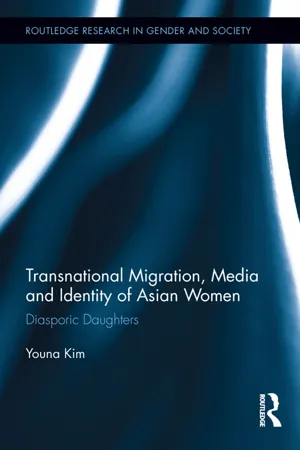
This book explores the unstudied nature of diaspora among young Korean, Japanese and Chinese women living and studying in the West. Why do women move? What are the actual conditions of their transnational lives? How do they make sense of their transnational lives through the experience of the media? Are they becoming cosmopolitan subjects? Exploring the key questions within their particular socio-economic and cultural contexts, this book analyzes the contradictions of cosmopolitan identity formation and challenges the general assumptions of cosmopolitanism. It considers the highly visible, fastest growing, yet little studied phenomenon of women's transnational migration and the role of the media in everyday life, offering detailed empirical data on the nature of the women's diaspora. Drawing on a wide range of perspectives from media and communications, sociology, cultural studies and anthropology, the book provides an empirically grounded and theoretically insightful investigation into this evolving phenomenon.
- 170 pages
- English
- ePUB (mobile friendly)
- Available on iOS & Android
eBook - ePub
About this book
Information
1 Transnational Migration, Media and Identity
Women are travelling out of South Korea (hereafter Korea), Japan and China for very different reasons than those that sent them into diaspora only twenty years ago. From the mid-1980s onward there has been a rising trend of women leaving their country to experience life overseas either as tourists or students, eventually surpassing the number of men engaging in foreign travel. Now, 80% of Japanese people studying abroad are women (Kelsky 2001; Ono and Piper 2004), an estimated 60% of Koreans studying abroad are women, and more than half of the Chinese entering higher education overseas are women (IIE 2006; HESA 2006). This phenomenon is part of a larger trend described as the “feminization of migration” yet there remains a striking lack of analysis on the gender dimension (World Bank 2006). Today women are significant and active participants in the increased scale, diversity and transition in the nature of international migration. Studying abroad has become a major vehicle for entry into Western countries (Lucas 2005) and East Asia continues to be the largest sending region every year. In 2005, 53,000 Koreans, 42,000 Japanese and 62,000 Chinese moved to US institutions of higher education; 4,000 Koreans, 6,000 Japanese and 53,000 Chinese moved to UK institutions of higher education. Studying abroad has become a common career move for relatively affluent women in their twenties. These new generations of women, who depart from the usual track of marriage, are markers of contemporary transnational mobility, constituting a new kind of diaspora, a “knowledge diaspora.”
Why do women move? Starting with this question, this book explores the unstudied nature of diaspora among young Korean, Japanese and Chinese women living and studying in the West. What are the actual conditions of their transnational lives? How do they make sense of their transnational lives through the experience of the media? Are they becoming cosmopolitan subjects? Exploring the key questions within their particular socio-economic and cultural contexts, this book challenges the general assumptions of cosmopolitan identity formation as intersected with the media.
It documents and analyzes the highly visible, fastest growing, yet little studied phenomenon of women’s transnational mobility and its relationship to the impact of media consumption in everyday life. While this transnational mobility has been recognized as important from an economic perspective in Western higher education (Nania and Green 2004), there has been very little research from a socio-cultural angle. In particular, scant attention has been paid to the gender composition of transnational mobility and what it actually means to the women on the move. Questions of identity are refigured in flows of desire that now operate transnationally, enacted by Asia’s economic growth and integration into globalization that have enabled new generations of women to experience and then create a different life trajectory using Western educational institutions as a contact zone. This book brings forth a deepened understanding of the consequences of transnational mobility and the role of the media, providing detailed empirical data on the nature of the women’s diaspora.
DIASPORIC DAUGHTERS
Taking a global-historical perspective, Chapter 2 of this book starts with mapping out the diaspora—Korean, Japanese and Chinese women on the move. It is necessary to analyze the historically specific circumstances that a particular group of women, definable as diasporic daughters, experience and are compelled to move away from, and understand these contexts in light of their complexities. Chapter 2 argues that this feminization of migration should be recognized as being of growing significance for several reasons. First, women’s active participation in the global migration circuit, despite its considerable magnitude, remains underestimated, or they are presumed to be companions to their male counterparts; such views tend to ignore equally important experience of women on the move. Second, this mobility forms a prolonged temporary status or diasporic sojourner mentality, “willing to go anywhere, everywhere provisionally” (Yang 2000) in pursuit of maximal opportunities, “greener pastures” (Kuah-Pearce 2006), potentially entailing an unending sojourn and settlement across national borders with unpredictable consequences on women’s transnational lives. Third, its unpredictable, temporary and transient nature is precisely one of the unique features that characterize today’s transnational mobility, calling for an understanding of a new formation of diasporic women. Last, but most significantly, this contemporary manifestation has been intensified by the proliferation of new media communications, digital technologies and the deregulation in the 1990s creating “multi-vocal, multimedia and multidirectional flows” (Thussu 2007), thereby making transnational networks and relations available with much greater frequency and regularity, as well as creating new meanings of being in the world.
Women’s mobility is certainly on the rise, and its scale and meaning mark it out as quite distinctive. Women are now migrating more than ever; nearly half of the world’s migrants are women (World Bank 2006). The gendered phenomenon of “global woman,” whose broad-scale journeys go often unnoticed, is part of a larger trend described as the feminization of migration, and a consequence that is increasingly shaped by the new economy of globalization and global inequality (Ehrenreich and Hochschild 2002). In particular, migration from globalizing East Asia has become increasingly feminized, knowledge intensive, widespread and frequent through forms of study abroad and work, giving rise to “student diasporas” (Asmar 2005), “global knowledge diasporas” (Welch and Zhen 2007), sustained by the expansion of “international education industry” (Waters 2008), knowledge-based economies, and information and communication technologies. Transnational mobility of young people from Korea, Japan and China has increased massively since the 1990s, and women now constitute a considerable proportion of this cross-border flow and diasporic population (Ono and Piper 2001; Ryan 2002).
However, there are relatively little insights with regard to the causes and implications of women’s movement. Historically, the migration literature tends to reveal that both migration and research on migration have been gendered processes, and more attention to understanding male migrants led to the unfortunate consequence that women’s experiences of migration became under-researched; but recent scholarship documenting the predominance of women in migratory flows makes the exclusion of women in research on migration untenable (Pessar and Mahler 2001). It shows how women’s mobility has been affected by global capital, men and hierarchical relationships, social differentiation, uneven regional development and the differential power geometry of time-space compression in relation to the movement, interconnection and change (Massey 1994). Rapid economic growth in globalizing East Asia has diversified and shifted the patterns of international migration towards movement of the highly skilled and knowledge intensive into Western countries (Lucas 2005). The majority of women make their way to the US, with the UK rapidly becoming a popular destination, although there is little evidence of grafting themselves permanently onto the wider societies of destination.
Diasporic daughters are the new emblems of contemporary transnational mobility—nomadic, transient, individualistic and networked, risk-taking and multiply displaced subjects (see Chapter 2). The choice of study abroad is not just a legitimate channel for physical mobility and displacement, but importantly involves the very nature of identity itself emerging as an increasingly popular do-it-yourself “reflexive biography” (Giddens 1991), a self-determined yet highly precarious biographical strategy that is driven by imagined futures of individualization, work and economic power, self-fulfilment and the enlargement of the self in confrontation with new and global forms of social life (see Chapter 3). These new generations of women thus depart from the often naturalized images of women as bearers of tradition who are confined to the realm of home, domesticity and limited spatial freedom, and who can only be visible as the dependent daughters or the wives of travelling men and families but rarely seen as independently travelling social actors. This mobility is not an elite phenomenon, at least in Korea and Japan, but is firmly grounded in the middle classes, becoming an almost taken-for-granted and normal middle-class practice and expectation, rather than something exclusively confined to and marked out by an economic elite. The question of how these new contemporary features intersect with women’s everyday experience of the world—both lived and mediated—is the focus of the proceeding chapters. The question to be explored is not simply about who travels, but “when, how, and under what circumstances” (Brah 1996).
INDIVIDUALIZATION AND MEDIATED MIGRATION
Why do women move? What are the social conditions, the push-and-pull factors that compel women to move away from Korea, Japan and China? How do the media play a role in this migration process? Specifically, Chapter 3 of this book begins by analyzing the gendered socio-economic and cultural conditions of each society, with a particular focus on systems of education and employment. It will argue that the attainment of higher education does not necessarily increase women’s work opportunities and the subsequent role of work in developing a new mode of identity formation—individualization.
In Korea, there is an inverse relationship between women’s higher education and job opportunity; female individualization as an alternative, emancipatory life politics remains frustratingly limited for reasons that are structural to the labor market (Kim 2005: 169–177). With the rapid expansion of education through the 1980s and 1990s, the value of university education declined, guaranteeing neither employment nor middle-class life (Abelmann 2003). The unmet promises of education, the increasing awareness of inequalities and the lack of job opportunities have propelled a new surge of movement to the West.
Similarly in Japan, it is increasingly common for women to quit their “office lady” jobs and move to a Western destination (Kelsky 2001). Half of the employed women in Japan are temporary part-time workers; highly educated women are often under-employed; and the rapid rise of youth unemployment since the 1990s has led to the ambivalent lengthening of the transition from school to work (ILO 2006). Ironically, some Japanese women rather feel that education could actually hurt young women’s chances of getting a job (Ono and Piper 2004). A new desire has emerged among young women making a Westward journey to redefine a work identity and to have a degree of control over the conditions of their individual lives (Ichimoto 2004).
In contemporary China, increasing international openness linked to economic development since the 1980s appears to encourage conditions for job opportunities, yet traditional gender dynamics within Chinese work environments limit women’s employment. In the urban labor market, young women graduating from university find it particularly difficult to get their first job (Jiang et al. 2004). Urban women tend to postpone marriage for the sake of a career, independence and personal freedom, seeking opportunities in Western higher education that would allow them to access international jobs outside of the Chinese labor system. Exposure to international education and progression to work in foreign-invested companies—effectively moving out of the domestic work environment altogether—may be one of the few legitimate avenues open to Chinese women to live in a non-traditional, personally emancipatory and individualized fashion (Turner 2006).
Arguably, female individualization has emerged as a major mode of identity formation that is now operating in a transnational flow of desire, giving rise to the experience of increased freedom, as well as increased insecurity and personal responsibility for every move. A generalization about women’s decision to move can be grounded in an understanding of the transnationally dispersed sites, instances and cultures of female individualization that are refracted into various degrees, forms and interests. Educated women have a strong interest in the idea of individualization, autonomous choice and the aspiration for self-actualization; however, interest in individualization is a growing response not to the successful actualization of that aspiration, but to the frustrated desire for subjective autonomy that is increasingly felt in the “no choice” situation. Chapter 3 of this book intends to draw attention to the rise and the problematic of female individualization among young Korean, Japanese and Chinese women in the context of transnational mobility, while making a case for a more interrogatory approach towards gender and social change in the malestream debate about individualization.
The individualization of life experiences has become one of the central claims of contemporary social theory (Giddens 1991; Beck 1992; Bauman 2001; Beck and Beck-Gernsheim 2002). Education and career opportunities are generally regarded as the driving force behind the individualization of people’s lives and social mobility. It is suggested that labor market positions now are constituted less by determinants such as gender, class, age and place, but more by self-design, self-creation and individual performance: “The educated person becomes the producer of his or her own labour situation, and in this way, of his or her social biography” (Beck 1992: 93). The emergence of privatized work, the devaluation of social order by globalization processes, and the uncertainty of changing societies have become powerful individualizing forces as the borders between social institutions disappear and fluidity becomes more characteristic than structure (Bauman 2001). There is a tendency to emphasize the increased fluidity of contemporary social life, as well as the mobile reflexive individual and his or her freedom of movement along with a consequence of personal choice. This individualization process is characterized by a growing reflexivity, self-monitoring and awareness, and an expansion of disembedding mechanisms (Giddens 1991), including global flows of the media that lift social interactions out of the individuals’ local context and allow them to relocate themselves in a transnationally dispersed culture. The result of these social conditions is seen to be an individualized individual. It is up to the individual, who wants to or must be economically active (Beck and Beck-Gernsheim 2002), to be free to choose for herself, to plan what she will do with her choices and capacities. Significantly, work is regarded as a “motor of individualization” (Beck 1992: 92).
A shared ground and possibility of individualization is predicated on the labor market—finding work and achieving equality as well as success in education. Chapter 3 of this book will argue that the claim that education encourages work freedom, economic power and the enlargement of choice can be illusory for educated women in Korea, Japan and China, where gendered socio-economic and cultural conditions persist and continue to structure labor market outcomes and lifestyles. Whose individualization? A contradiction lies at the heart of female individualization. The individualization of life experiences may reflect a discursive shift in the ways women in today’s age “imagine” and “talk” about their lives, rather than a substantive change in actual life conditions, regulative dimensions of gender and social structure which continue to shape available opportunities and constrain personal choice and freedom. The resulting contradiction of female individualization and women’s stories that do “not reach beyond the narrow and painstakingly fenced off enclosure of the private and subjective self” (Bauman 2001: 12) now become apparent in the growing phenomenon of transnational mobility. Free mobility is itself a deception, since the seemingly voluntary movement or the women’s self-determined choice to move is a forced, gendered process mediated by larger forces that push women into different routes across the world.
Against these social contexts, Chapter 3 of this book will consider a pull-effect of the media; which is women’s mediated symbolic encounter with the West that generates “imaginations of alternative lifestyles and work” (Kim 2005: 184–192). The media play a significant role as symbolic and cultural forms people live by, constituting “residual culture” (Williams 1977) that has been accumulated throughout a life history and that is still active as an effective element in the present. People seem to imagine routinely the possibility that they will live and work in places other than where they were born, and their plans are affected by a mass-mediated imaginary that frequently transcends national space (Appadurai 1996). Since the 1990s the media landscape of Asia has been rapidly globalizing; the growth in satellites, transnational television channels and online networks in Asia is said to be the most rapid worldwide (Thomas 2005). Such profusion of the media, with new imaginations, new choices and contradictions, generates a critical condition for reflexivity, engaging everyday people to have a resource for the learning of self, culture and society in Asia (Kim 2008). This plausibly powerful capacity of the media, deeply ingrained in what people take for granted, should be recognized in any attempt to understand the present phenomenon of transnational mobility.
The linking of the media and migration is a relatively new and underexplored field of investigation, but recent studies have started to recognize the significance of mediated migration, the media’s role as a significant pull variable in migratory processes (King and Wood 2001). The symbolic dimensions of displacement have often been neglected in the approaches to the subject of migration, but should be integrated within a perspective acknowledging the complex ways in which migration emerges from the increased symbolic contact between societies that are different in their socio-cultural organization (Sabry 2003). Those who wish to move and those who have moved rarely formulate their plans outside the sphere of the media. It is mass mediation, the expanding scale, circulation and impact of media consumption, which distinguishes the present transnational mobility from migration of the past (Appadurai 1996).
Television, in particular, has become a key site for the emergence of a new contemporary subject, “migratory youth,” and for the construction of a “migratory project” (Mai 2004). This mobility is seen as an extension of the previous immersion of young people in consuming images transmitted from a Western destination, while dreaming of escape from their social constraints. Global television, including Hollywood movies, popular dramas and travel shows, helps to create an important condition for the practice of reflexivity, by opening up a rare space where women can make sense of their life conditions in highly critical ways and can imagine new possibilities of freedom, social mobility and individualization, within the multiple constraints of their social context (Kim 2005). In Asian society, where women’s social roles and public voices are otherwise highly constrained, women are either allowed to be, or coerced into being, the primary agents of cultural consumption (Skov and Moeran 1995). Under social controls that deny women the ability to act on their own, the chances for individualization become smaller, and individualization can be sought in ever greater participation in media cultural consumption, the complex symbolic project women engage with.
Media consumption can be understood as a key cultural mechanism creating the emergence of individualized identities, both imagined and enacted. Chapter 3 of this book will therefore show how the West is represented in the imagination of young Korean, Japanese and Chinese women through engagement with the media in their homeland by which female individualization operates as a self-reflexive and imaginative social practice. It will argue for the potential role of the media in triggering enactment of transnational mobility; the interplay between media consumption and physical displacement towards a deliberately encouraging yet precarious movement of freedom.
Why do women move? Tackling this question requires that transnational mobility needs to be understood with multi-faceted insights; considering some of the key macro factors affecting women’s decision to move and the micro processes of the ways in which women experience the mediated world of everyday culture, while reflecting the interconnection of these seemingly opposite and contradictory levels of push-and-pull elements within the particular socio-economic and cultural contexts in which women live their everyday lives.
TRANSNATIONAL MOBILITY, DIASPORIC MEDIA, NATIONAL IDENTITY
What are the actual conditions of their transnational lives? Do women find their transnational lives progressive or emancipatory? Chapter 4 of this book considers these important questions. In the contemporary discussion of transnational mobility, there is a widespread tendency to romanticize all forms of mobility as themselves intrinsically progressive, and this meaning has become celebrated as a transgressive and liberating departure from living-as-usual. Physical mobility is seen as the basis of emancipatory practice, and diaspora as the site of contingency par excellence because it generates stasis-disrupting forms of cultural displacement (Clifford 1994). It is further related to the possibility for endless hybrid self-creation, since it involves a translational sense of culture in new in-between spaces to initiate innovative, anti-essentialist signs of identity (Bhabha 1994). Transnational mobility is assumed as a journey that already destabilizes borders, transgresses all forms of boundary-making, and breaks ...
Table of contents
- Cover
- Title
- Copyright
- Dedication
- Contents
- Acknowledgments
- 1. Transnational Migration, Media and Identity
- 2. Mapping the Diaspora: A Global-Historical Perspective
- 3. Female Individualization?
- 4. Diaspora: Lived and Experienced
- 5. Diasporic Nationalism and the Media
- 6. Female Cosmopolitanism?
- 7. The Nowhere Women: Feeling Stuck in Diaspora
- Bibliography
- Index
Trusted by 375,005 students
Access to over 1.5 million titles for a fair monthly price.
Study more efficiently using our study tools.
Frequently asked questions
Yes, you can cancel anytime from the Subscription tab in your account settings on the Perlego website. Your subscription will stay active until the end of your current billing period. Learn how to cancel your subscription
No, books cannot be downloaded as external files, such as PDFs, for use outside of Perlego. However, you can download books within the Perlego app for offline reading on mobile or tablet. Learn how to download books offline
Perlego offers two plans: Essential and Complete
- Essential is ideal for learners and professionals who enjoy exploring a wide range of subjects. Access the Essential Library with 800,000+ trusted titles and best-sellers across business, personal growth, and the humanities. Includes unlimited reading time and Standard Read Aloud voice.
- Complete: Perfect for advanced learners and researchers needing full, unrestricted access. Unlock 1.5M+ books across hundreds of subjects, including academic and specialized titles. The Complete Plan also includes advanced features like Premium Read Aloud and Research Assistant.
We are an online textbook subscription service, where you can get access to an entire online library for less than the price of a single book per month. With over 1.5 million books across 990+ topics, we’ve got you covered! Learn about our mission
Look out for the read-aloud symbol on your next book to see if you can listen to it. The read-aloud tool reads text aloud for you, highlighting the text as it is being read. You can pause it, speed it up and slow it down. Learn more about Read Aloud
Yes! You can use the Perlego app on both iOS and Android devices to read anytime, anywhere — even offline. Perfect for commutes or when you’re on the go.
Please note we cannot support devices running on iOS 13 and Android 7 or earlier. Learn more about using the app
Please note we cannot support devices running on iOS 13 and Android 7 or earlier. Learn more about using the app
Yes, you can access Transnational Migration, Media and Identity of Asian Women by Youna Kim in PDF and/or ePUB format, as well as other popular books in Scienze sociali & Emigrazione e immigrazione. We have over 1.5 million books available in our catalogue for you to explore.