The twelfth century was a period of rapid change in Europe. The intellectual landscape was being transformed by new access to classical works through non-Christian sources. The Christian church was consequently trying to strengthen its control over the priesthood and laity and within the church a dramatic spiritual renewal was taking place.
Christians and Jews in the Twelfth-Century Renaissance reveals the consequences for the only remaining non-Christian minority in the heartland of Europe: the Jews. Anna Abulafia probes the anti-Jewish polemics of scholars who used the new ideas to redefine the position of the Jews within Christian society. They argued that the Jews had a different capacity for reason since they had not reached the 'right' conclusion - Christianity. They formulated a universal construct of humanity which coincided with universal Christendom, from which the Jews were excluded. Dr Abulafia shows how the Jews' exclusion from this view of society contributed to their growing marginalization from the twelfth century onwards.
Christians and Jews in the Twelfth-Century Renaissance is important reading for all students and teachers of medieval history and theology, and for all those with an interest in Jewish history.
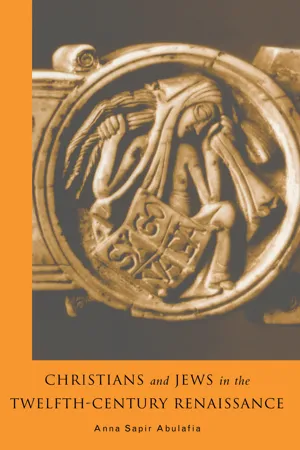
eBook - ePub
Christians and Jews in the Twelfth-Century Renaissance
- 208 pages
- English
- ePUB (mobile friendly)
- Available on iOS & Android
eBook - ePub
Christians and Jews in the Twelfth-Century Renaissance
About this book
Part I: THE TWELFTH-CENTURY RENAISSANCE
1: THE SCHOOLS
The thinkers who will feature in the pages of this book did not operate in a vacuum. They were brought up and educated in the rapidly changing world of the end of the eleventh century and the initial decades of the twelfth century. Their attitudes to Judaism and the Jews were closely associated with their reception of the new sources of knowledge on offer to them. Equally what they thought about Jews was also linked to their appraisal of the socio-economic, political and ecclesiastical changes of their day. It is essential to remember that for all these people Jews were only one subject out of many upon which they pondered. To understand the implications of what they wrote about Jews it is necessary first to know something about the milieux in which they were educated and what they chose to do with the opportunities now open to them.
Gilbert Crispin (c.1045–1117) and Rupert of Deutz (c.1075–1129) were products of a custom that would decline in the course of the twelfth century.1 They both entered monastic life as oblates: Gilbert was given by his parents, Norman aristocrats, to the newly founded monastery of Le Bec near Brionne; Rupert was given by much more modest parents to the monastery of St Lawrence in Liège which was dedicated in 1034, the same year Herluin founded Bec. Gilbert became abbot of Westminster in 1085; Rupert abbot of Deutz in Cologne at the end of 1120 or the early days of 1121.2 Peter the Venerable (c.1094– 1156) was an oblate too. He hailed from an Auvergne family that was intimately connected to Cluniac monasticism. He took his monastic vows in Vézelay, where he was put in charge of education. He was prior at Vézelay and Domène before being elected abbot of Cluny in 1122.3
Guibert of Nogent (1055?–c.1125) had been dedicated to God by his noble parents as a baby. He entered St Germer de Fly after a short period on his own after he had been released from the clutches of his pious mother and punitive tutor. In Fly he continued his education and soon became a monk. He also received instruction from Anselm, who often visited Fly in his capacity first as prior and then as abbot of Bec (1063–93).4 Guibert would later record how much that incidental teaching had meant to him.5 Guibert became abbot of Nogent in 1104.6
Anselm (b. 1033) himself had come under the spell of Lanfranc, whom he found teaching in the school of Bec in 1059. Anselm had left his home in Aosta in 1056 after quarrelling with his high-born father whose economic position was insecure. Soon he was helping Lanfranc run the monastic school. In 1060 he joined Bec as a monk. He took over the school from Lanfranc when the latter left Bec to become abbot of Caen in 1063.7
The other scholars whose works will guide us in our understanding of the nature of the development of twelfth-century thinking about Jews were trained in and taught at the cathedral—and not the monastic —schools of Flanders and northern France. Odo of Cambrai (c.1050– 1113) had enjoyed a successful teaching career at the cathedral school of Tournai since 1089 when he chose to retire to an austere form of monasticism in 1092. In his monastery of St Martin in Tournai he set in motion the creation of an impressive library. In 1105 he was chosen bishop of Cambrai in opposition to the imperial incumbent of that see.8 Hildebert of Lavardin (1056–1133) became head of the cathedral school of Le Mans before becoming archdeacon (1091) and bishop (1096) of that town. His parents were not only poor but unfree.9
Peter Abelard (1079–1142) gave up what was his due as a noble first-born son in Brittany to study dialectic in Paris. He taught intermittently at Melun and Corbeil and set up a school on Mont Sainte Geneviève just outside Paris where he taught at various intervals in his life. Before his fateful affair with Heloïse he had achieved his ambition of teaching at the cathedral school of Notre Dame (c.1114–18). Prior to that he had spent a short period of time in 1113 in Laon where Anselm of Laon (d. 1117) was teaching what Abelard branded as outmoded. After becoming a monk in Saint Denis (1119) Abelard continued to teach (and to be censored) in different places, returning to Mont Sainte Geneviève in 1136. After his condemnation at the Synod of Sens in 1140, he was befriended by Peter the Venerable who looked after him until he died in 1142 at Saint-Marcel-lès-Chalon.10
The mysterious Odo, who composed a theological compendium in England in the 1140s, had evidently attended Parisian schools. His work betrays the imprint of two rival schools: the school of Abelard and the School of St Victor, founded by one of Abelard’s major antagonists, William of Champeaux in 1108.11 William himself had been taught by Anselm of Laon; he was archdeacon of Notre Dame when Abelard was drawn to Paris to hear his lectures.12
Peter Alfonsi (c.1060–c.1140) is the odd man out. Not only was he born a Jew; he was born in territory that was being incorporated into the kingdom of Aragon. There he had at his fingertips a wealth of culture which his counterparts in northern Europe were only beginning to glimpse. Indeed, it was Alfonsi, who travelled to England and France after his conversion (in 1106), who introduced scholars of these kingdoms to elements of Greek, Muslim and Jewish thought.13
In the brief outlines of the careers of the scholars who will concern us in this study the term ‘school’ has cropped up time and again. But what do we actually mean when we use the word ‘school’? How did schools function in monasteries and in cathedrals and what was their purpose? How did cathedral schools differ from those in a monastic setting? Did other forms of instruction exist? Who went to school and why? And finally, who did the teaching?
To begin at the beginning: the word ‘school’ or ‘schools’ can be used in a number of ways. First it can simply mean the physical setting where instruction took place. But it can also denote a group of masters each teaching in his own school. Finally it can signify the spirit or the method of the teaching of a particular master or group of masters.
The disintegration of public administration in the early Middle Ages meant that with the exception of Italy public schools ceased to exist. To find a school of any sort in this period one would have to go to a religious house or church where unlettered recruits found some form of instruction. Impressed by the quality of teaching he discovered in Anglo-Saxon monasteries, Charlemagne decided to harness this type of teaching in his programme for the revitalization of learning. Thus he stipulated in a capitulary which he sent at the close of the eighth century to the archbishops of his empire, that all bishoprics and monasteries provide an education to those who were capable of learning. This formalized and encouraged the development of monastic schools and schools attached to cathedrals.14
The establishment of schools in monasteries and cathedrals did not mean that tutors were no longer in demand. Throughout the period between the ninth and twelfth centuries tutors were employed by the upper echelons of society to give their children, who were not destined for the Church, some basic education. But tutors were also used to give children a rudimentary education before they went to school. Some tutors would accompany their charges to one of the available cathedral schools.15
Guibert of Nogent’s private tutor was employed when Guibert turned six. It is indeed not without interest to dwell on what Guibert wrote in his autobiography about the appointment of this tutor. He writes that there were few available teachers in the cities and even fewer in settlements surrounding castles. The tutors who were available were much less learned than the ‘moderni temporis clericulis vagantibus’, the wandering young clerks of the modern age, that is to say of c.1115, the time of writing of his book. The man Guibert’s mother finally got hold of taught his charge on his own in a room in the castle near Catenoy in the region of Clermont-en-Beauvais where Guibert’s family lived.16 There is no doubt that had Guibert been born some fifty years later, his mother would have had much less trouble finding him a teacher among the many clerks looking to put to use what they had learned in the schools.
Monasteries which had to cope with a steady influx of completely uneducated oblates and novices would always need to provide at least some schooling for those destined to become monks in their midst. Following Charlemagne’s instruction many monasteries opened these schools to the sons of local notables. For obvious reasons this did not always prove to be a successful formula. After all, the priorities of monks-to-be were substantially different from those of the offspring of the local gentry. Almost immediately a synod of abbots at Aachen in 817 decided to forbid the practice. Consequently some monasteries ran two schools, an internal one for oblates and an external one for outsiders.17
A perennial problem in monasteries, which ultimately affected the existence of not only their external but also their internal schools, was the vexing question concerning the proper place of study and teaching in the lives of people who had dedicated themselves to God. Part of the question had to do with ideas concerning the role monks could or should play in pastoral work. Rivalry between the secular diocesan clergy and the monks did nothing to simplify the issue. But on a more fundamental level there were worries about finding the right mean between studying for the sake of enhancing knowledge and studying as part of a monk’s devotional exercises. As the amount of scholarly material expanded in leaps and bounds in the late eleventh and twelfth centuries it was generally felt more and more strongly that cathedral schools and not monastic schools were the proper places for what we might call academic endeavours. The fervour of the new religious orders of the Reform Movement, stressing as it did the importance of individual devotion leading to individual spirituality, encouraged this view. In the course of the twelfth century many monasteries closed their external schools; some employed a clerk to stand at its head.18
Two other factors contributed to the decline of monastic schools. With the decline in the numbers of oblates within the traditional Benedictine houses and their total absence in most of the new monastic orders, providing a basic education became less of an obviously necessary task. With so many flourishing cathedral schools available, those who came to the monasteries as novices did not need to depend on their chosen monastery for their education. What happened to unlettered novices depended on the religious house in question. The Cistercians accepted such men as lay brothers who served their monastery as manual labourers; they did not take it upon themselves to educate them.19 The other important factor to consider is that monastic schools sui generis lacked one of the prerequisite conditions for maintaining an exciting place of learning over a substantial period of time. Monastic schools could not provide the fluctuating population of students and masters that did so much to enrich the curriculum and the ambiance of some of the cathedral schools. It is not for nothing that clerks tended to look down on those who had not sat at the feet of the famous masters. Rupert of Deutz smarted under the contempt that the products of the cathedral schools had for the learning that he had received in the school of Saint Lawrence.20
All these factors meant that in the course of the twelfth century the great monastic schools of the Continent like St Gall, Fleury and Fulda lost their lustre. This is not to say that where schools were absent twelfth-century monks stopped using their minds. Contemplating and meditating on the Scriptures, the so-called lectio divina, could never cease to be an essential component of a monk’s spiritual life. But the studying this involved did not necessitate the existence of a classroom. When Guibert entered Fly towards the last quarter of the eleventh century, he completed his education by making good use of the excellent library he found at his disposal. He does not speak of attending a school in his monastery. Nor does he describe the monastery as a particular place of collective scholarship. On the contrary he complains with his characteristic bitterness about the jealousy shown by the brethren for his learning.21 But his near contemporary, Gilbert Crispin, was lucky enough to have been educated in one of the best schools of the day: the monastic School of Bec.
The School of Bec, with which so many of our scholars were connected in one way or another, is an excellent illustration of the possible range of educational activities within a monastic institution. Eight years after Herluin founded Bec, in 1034 Lanfranc arrived at the monastery. At the time of his arrival he had already made his name as an expert dialectician in the schools of northern Italy. When in 1045 he was made prior of Bec he took over the school for oblates which was providing a run of the mill education in elementary Latin and the monastic office. He proceeded to develop the school into a place offering a new curriculum in which the trivium was harnessed to expound the Psalms and the Pauline Epistles, Lanfranc’s set texts.22 Before long Abbot Herluin allowed Lanfranc to open an external school to augment the finances of the monastery. To this school were attracted pupils from Normandy, France and Germany. Both Popes Nicholas II and Alexander II sent clerks to sit at Lanfranc’s feet. It was Lanfranc’s fame that attracted the wandering Anselm to Bec in 1059. Soon he was teaching alongside his mentor. But for all its success the external school at Bec was not an integral part of the monastery. In many ways—not least in charging for lessons—it was actually atypical of its genre. When Lanfranc left to take up the abbacy at Caen, the school was probably shut down again. The fact that even after this Bec did not immediately lose renown as a place of learning, with Orderic Vitalis referring to the monks of Bec as ‘seeming to be philosophers’, was entirely due to Anselm’s inspired presence and teaching. But the future of Bec did not depend on its teaching facilities.23 That became the business of the institutions of learning which had potentially more scope for long-term development: the cathedral schools.
The liturgical training of the choir stood at the centre of any cathedral school. Next to the choir school there could exist any number of classes to teach the diocesan clergy what they needed to know as administrators and pastors. Indeed an effective functioning of these classes had been made mandatory by Gregory VII’s decree of 1078, in which he stipulated that the clergy be taught their letters.24 It is plain that Gregory’s vision of a hierarchic Church, structured with the Pope at its apex governing through papal legates in conjunction with the leaders of well administered local dioceses, could ill afford ignorant pastors.
It was indeed the urge for renewal, which was generated by the Gregorian Reform, that prompted masters and students to ponder in a professional way the pastoral questions arising from the social and economic changes of the period. The pastoral thinking that emerged concerned itself with the human condition, i.e. freewill, sin, redemption, marriage, money and so on. It also looked to the underlying meaning of Christian doctrine which led scholars to thinking about God and his creation. This prompted some masters, like Peter Abélard, to move on to a more speculative plane and contemplate matters like the nature of God.25 For all these studies the Bible remained a textbook, offering on the one hand material to expound and on the other prooftexts to substantiate Christian doctrines of faith and precepts of behaviour. The natural companions of the Bible were the writings of the Fathers. But in the schools this was not considered sufficient material to cope adequately with the questions of the day. More and more attention was given to the study of the liberal arts, and in the hands of many a master it was the liberal arts, not pastoral exigencies, that became the prime focus of attention.
It is thus not difficult to appreciate that within a cathedral school the school attending to the diocesan clergy might find it difficult to keep in sight its sense of priorities. The situation would be exacerbated if the master in question was of such renown that he attracted vast numbers of students, who had little or nothing to do with the diocese. The continuing success of such a cathedral school depended on whether or not there was room in its structure for more than one master to cater for the disparate needs of the diocese and sch...
Table of contents
- COVER PAGE
- TITLE PAGE
- COPYRIGHT PAGE
- PREFACE
- INTRODUCTION
- PART I: THE TWELFTH-CENTURY RENAISSANCE
- PART II: CHRISTIANS AND JEWS IN THE TWELFTH-CENTURY RENAISSANCE
- PART III: THE JEWISH-CHRISTIAN DEBATE
- EPILOGUE
- NOTES
- BIBLIOGRAPHY
Trusted by 375,005 students
Access to over 1.5 million titles for a fair monthly price.
Study more efficiently using our study tools.
Frequently asked questions
Yes, you can cancel anytime from the Subscription tab in your account settings on the Perlego website. Your subscription will stay active until the end of your current billing period. Learn how to cancel your subscription
No, books cannot be downloaded as external files, such as PDFs, for use outside of Perlego. However, you can download books within the Perlego app for offline reading on mobile or tablet. Learn how to download books offline
Perlego offers two plans: Essential and Complete
- Essential is ideal for learners and professionals who enjoy exploring a wide range of subjects. Access the Essential Library with 800,000+ trusted titles and best-sellers across business, personal growth, and the humanities. Includes unlimited reading time and Standard Read Aloud voice.
- Complete: Perfect for advanced learners and researchers needing full, unrestricted access. Unlock 1.5M+ books across hundreds of subjects, including academic and specialized titles. The Complete Plan also includes advanced features like Premium Read Aloud and Research Assistant.
We are an online textbook subscription service, where you can get access to an entire online library for less than the price of a single book per month. With over 1.5 million books across 990+ topics, we’ve got you covered! Learn about our mission
Look out for the read-aloud symbol on your next book to see if you can listen to it. The read-aloud tool reads text aloud for you, highlighting the text as it is being read. You can pause it, speed it up and slow it down. Learn more about Read Aloud
Yes! You can use the Perlego app on both iOS and Android devices to read anytime, anywhere — even offline. Perfect for commutes or when you’re on the go.
Please note we cannot support devices running on iOS 13 and Android 7 or earlier. Learn more about using the app
Please note we cannot support devices running on iOS 13 and Android 7 or earlier. Learn more about using the app
Yes, you can access Christians and Jews in the Twelfth-Century Renaissance by Dr Anna Brechta Sapir Abulafia,Anna Abulafia in PDF and/or ePUB format, as well as other popular books in History & World History. We have over 1.5 million books available in our catalogue for you to explore.