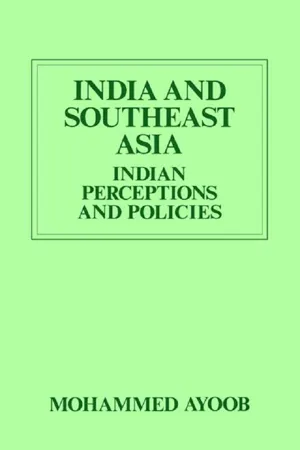
This title, first published in 1990, provides a close contextual analysis of how influential Indian policy-makers have perceived India's interests within the ASEAN region since Indian independence in 1947. Placing these perceptions in the context of India's broad strategic and foreign policy framework, Ayoob analyses the policies which had emerged by the close of the 1980s and stresses the close link between the futures of the two regions. Including a thorough analysis of superpower involvement, as well as Indian relations with Indonesia, Vietnam and Cambodia, this is a comprehensive study of great value to students with an interest in Indian and Southeast Asian history and diplomacy.
eBook - ePub
India and Southeast Asia (Routledge Revivals)
Indian Perceptions and Policies
- 120 pages
- English
- ePUB (mobile friendly)
- Available on iOS & Android
eBook - ePub
About this book
Information
1
India's Foreign Policy Framework and Strategic Perspective
Before one can begin to examine either Southeast Asia's importance to India in terms of its foreign policy objectives and its strategic interests or the importance that India has, or might come to have in the near future, for the security environment of Southeast Asia, one must have a clear picture of India's broad foreign policy framework and its overall strategic perspective. This is extremely important because, without the awareness of this larger canvas, it would be impossible to decipher the entire range of Indian interests in Southeast Asia, to assign comparative weight to these various interests, and realistically to evaluate the type and amount of capabilities that India is likely to devote to the protection and furtherance of its interests in the region. In other words, without such a framework it would be impossible to locate the position and importance of Southeast Asia in the Indian scheme of things and to assess the kind of role that India is likely to play in the international politics of the Southeast Asian region for the rest of this century.
The basic framework of Indian foreign policy that can be distilled from its actions in world affairs during the forty years of its independence comprises the following major elements:
(a) A world-view shaped both by the movement for national independence and by the nationalist leaders’ perception of India's past and their aspirations for its future;
(b) The coincidence of the emergence of a bipolar world following the Second World War, with India's emergence as an independent actor on the world scene;
(c) The threats to, and the problems for, India's security that emerged directly from the partition of the British Indian empire and, therefore, the disruption of India's strategic unity that had been accepted as a given fact during the period of the Raj;
(d) The emergence of China as a major Asian actor following the Communist victory of 1949, two years after India's independence, and China's annexation of Tibet the following year (1950) thus bringing Chinese presence and power in direct contact with India on the latter's northern and northeastern borders;
(e) The need for fruitful economic interaction with the rest of the world in terms of trade, aid, and investment, which was considered crucial for India's developmental goals.
The enmeshing of these fundamental concerns in various forms and at different times has, by and large, determined the broad contours of Indian foreign policy, including its policy towards Southeast Asia as a whole and towards the individual countries that comprise this region. It is, therefore, important for us to examine the major consequences for Indian foreign policy that have emerged out of the interplay of these variables over a period of time.
The Indian elite's world-view, shaped as it was by the anti-colonial movement and the deliberately generated nationalist ‘myths’ about the greatness of the country's past, became operational in two ways that were relevant to India's foreign policy. First, it generated an anti-colonial, therefore, anti-hegemonistic foreign policy ethos. It meant that Indian policymakers refused to accept the legitimacy of the argument that the major powers in the international system had the right to determine the fundamental issues of world order exclusively on the basis of their military, industrial, and technological might. Second, it meant that the ‘power-vacuum theory which had become fashionable in the West in the aftermath of decolonization, particularly in relation to the then prevailing situation in Asia, was treated with scepticism if not derision by the Indian elite. This theory was perceived as an instrument for the reintroduction of Western presence into Asia through the backdoor and an intellectual apology for what had come to be known as ‘neo-colonialism’. In a word, this world-view provided the mainspring for the Indian aspiration to act independently of the ‘managers’ of the international system and to judge every major international issue on its own merits and/or on the basis of its effects on India's vital national interests.
The post-war configuration of global power reinforced the Indian elite's proclivity for autonomous action in the international political sphere. The Indian reaction to the rigidity in the international system introduced by the strategic and political bipolarity of the immediate post-war years was best encapsulated in the term ‘non-alignment’,1 a concept that became increasingly popular in many other decolonized polities as well. This was not a policy of mechanical equidistance from both the poles of global power but an attempt to maintain India's capacity to decide the basic thrust of its foreign policy without dictation by either superpower. The rejection of the rigidity of alliance systems conceived in the context of the Cold War was the logical corollary of this policy. A further corollary was the Indian attempt, largely unsuccessful, to keep Asia, and especially South Asia, free from Cold War competition and conflict. Although in the process of implementation this policy had to be modified periodically to take account of certain contingencies as they arose, the basic thrust of India's non-alignment has survived the ups and downs that the country, and, therefore, its foreign policy, have undergone in the four decades of its independent existence.
The disruption of India's strategic unity in 1947, the emergence of Pakistan as an independent state in the northwest and northeast of the subcontinent and the basically hostile relationship between the two successors to the British Indian empire, not merely created an unprecedented security problem for India (in the sense that it introduced a fundamental discontinuity in the Indian strategic environment), it also embroiled the subcontinent in global Cold War issues, thus defeating the Indian objective of keeping South Asia free from Cold War rivalry. Pakistan, obsessed by its need and desire to balance India's inherent power superiority in the subcontinent, aligned itself with the United States in the early 1950s and signed not only a Mutual Defence Assistance Pact with Washington but joined SEATO and the Baghdad Pact (later renamed CENTO) as well. The United States, having been unsuccessful in its attempt to woo India into its web of anti-Soviet alliances, was willing to accommodate Pakistani interests in its overall strategic scheme. Washington, thereby, succeeded in alienating India and paving the way for the growth of friendly and mutually profitable relations between New Delhi and Moscow.2 The pattern of India-US-Soviet relationship established in those early days of the Cold War has by and large survived to this day.
This pattern has been reinforced by India's concern with China. The Communist takeover of China in 1949 led to the emergence of a unified and potential great power in Asia. The subsequent assertion of Beijing's authority over quasi-independent Tibet also meant that this potential great power was now India's next-door neighbour with a direct presence on India's Himalayan borders. If the process of partition destroyed India's British-imposed strategic unity, the Chinese annexation of Tibet removed the buffer between India and China which the British had successfully maintained between the two largest countries of Asia. The change of status quo in Tibet was beyond India's capacity to prevent given its limited trans-Himalayan capabilities, its preoccupation with the problems of the subcontinent following partition, and the dramatic increase in the military capability and the political will of the central government in China following the revolution. However, this change was to have immensely important implications for the future of Sino-Indian relations and of the Asian balance of power as a whole. As we will discuss later, the nature of the Sino-Indian equation has had important effects on India's policy towards Southeast Asia on the one hand, and on Southeast Asian perceptions of India on the other.3
The emergence of China as a major power centre in Asia also had substantial impact, both in positive and negative terms, on many other dimensions of Indian foreign policy. First, China's militantly anti-colonial and anti-capitalist stance coupled with its aspirations for autonomy of action similar to those of India strengthened India's bargaining power with the West This resulted from the fact that in the context of China's revolutionary rhetoric the reformist demands that India made on the managerial powers of the international system appeared both moderate and reasonable. Furthermore, China's alignment with the Soviet Union, which lasted through the 1950s, added to India's importance in Western eyes both as an alternative model of economic development to China's in the newly independent countries of Asia and as a potential, if non-aligned, balancer of what was then perceived as the monolithic Sino-Soviet Communist bloc on the Eurasian landmass.
However, the negative implications of Chinese power in close proximity to India far outweighed the positive implications for New Delhi. These included: (a) China's support, both political and military, for Pakistan in its disputes with India, once Sinolndian relations began to deteriorate from the late 1950s onward; (b) Beijing's encouragement, particularly after the Tibetan uprising of 1959 and the Indian decision to give refuge to the Dalai Lama, of anti-Indian sentiments in the sub-Himalayan monarchies of Nepal, Bhutan, and Sikkim which were considered by India as falling within its strategic perimeter; (c) China's support in terms of military training and the supply of weapons to the various tribal insurgents in northeastern India, especially the Nagas and the Mizos; (d) the support extended by China, particularly in the 1960s and the early 1970s, to revolutionary Marxist (Maoist) movements, especially in West Bengal; (e) the complications introduced into Indo-Soviet relations in the late 1950s and early 1960s as a result of the deterioration in Sino-Indian relations; (f) the development of a two-front threat, one from China and the other from Pakistan, from the early 1960s onward, which led to a major escalation in India's defence expenditure, especially following the military debacle of the Sino-Indian border war of October-November 1962; and (g) the threat, in New Delhi's perception, of China, Pakistan, and the United States colluding against India's vital national interests following the Sino-American rapprochement beginning in 1971. The parallel US and Chinese policies on the Bangladesh crisis of that year and in relation to the subsequent war between India and Pakistan epitomized for India the sort of threat such a collusion could pose to what New Delhi considered to be its rightful role in the subcontinent.
The imperatives of economic development and, therefore, of profitable economic interaction with the rest of the world in terms of trade, aid, and investment, meant that relations with the Western industrialized countries of North America and Western Europe dominated the pattern of India's economic interaction during the first decade of the country's independent existence. This position of Western economic dominance began to erode from the late 1950s onward, as much for political as economic reasons, as India began to diversify its economic contacts by building mutually profitable relations with the Soviet Union and the socialist countries of Eastern Europe.
An additional aspect of this economic diversification was the Indian commitment to promote, what is now fashionably called, South-South relations, i.e., to increase trade, joint ventures and technological collaboration with other developing countries. However, it was not until the 1970s that this aspect of India's foreign economic policy began to make a modest impact on the overall pattern of the country's economic relations. This was the result of a number of factors including the established patterns of India's trade with the West (partially modified by the growing interaction with the Socialist bloc), the lack of complimentarity among the economies of the developing world, as well as the established patterns of the other developing countries’ economic interactions, which were, once again, heavily tilted in favour of the Western industrialized world. As we will discuss later, India's economic transactions with the countries of Southeast Asia, particularly those in ASEAN, have come to form an important component of India's South-South trade and investment policy.
Notes
1 For an attempt at a systematic analysis of the Indian policy of non-alignment and its linkages both with India's political culture and the international environment, see A.P.Rana, The Imperatives of Nonalignment: a Conceptual Study of India's Foreign Policy Strategy in the Nehru Period, Macmillan, Delhi, 1976.
2 For an overview of Indo-Soviet relations, see S.Nihal Singh, The Yogi and the Bear, Allied Publishers, New Delhi, 1986. For an in-depth study of the early period of Indo-Soviet relations, see Arthur Stein, India and the Soviet Union: the Nehru Era, Chicago University Press, Chicago, 1969.
3 For a perceptive discussion of Sino-Indian relations in the 1950s with special reference to South East Asia, see Ton That Thien, India and Southeast Asia, 1947–1960, Librairie Droz, Genève, 1963, 29–-31 and 285–307.
2
Southeast Asia's Importance in Indian Foreign Policy: the Background
Southeast Asia has been important for Indian foreign policy for a number of reasons:1
First, the nationalist leadership, i.e., the first generation of India's post-independence leaders, had perceived the anti-colonial struggles in Southeast Asia as indivisible from their own fight for freedom from colonial subjugation. The Indonesian and Vietnamese freedom struggles, especially the former, had been followed with great sympathy by the politically-conscious Indian public during the last years of the British Raj. The Congress leadership, with Jawaharlal Nehru as its foremost articulator on international issues, was convinced that the future of India was indivisible from the future of Asia, and particularly of Southeast Asia. It was no coincidence, therefore, that even before the formal dawn of independence the interim Indian government organized an Asian Relations’ Conference in March 1947, and independent India performed its first high-profile act in international affairs by convening the Conference on Indonesia attended by fifteen nations in January 1949.
The major purpose of the 1949 conference was to express solidarity with, and support for, the Indonesian nationalist leadership and to put pressure on the Dutch government and its supporters to accelerate the process of Indonesian independence. There was a general belief among the nationalist elite in New Delhi that India's goal of preserving its autonomy of action in world affairs could be achieved only in the context of decolonization in the rest of Asia and in cooperation with genuinely independent governments in the continent's larger and more important states. In India's perception, Sukarno's Indonesia fitted this description better than any other Asian political entity in the late 1940s and during much of the 1950s and this explains in great part the Indian attempt to coordinate closely its international moves with Indonesia, particularly on issues of decolonization and those related to the policy of non-alignment.
In this context it is interesting to note that while the Indian leadership was as convinced of Ho Chi Minh's nationalist credentials as it was of Sukarno's and Hatta's, its attitude towards the Vietnamese freedom struggle against the French can be certainly classified as lukewarm when compared to its enthusiastic support to the Indonesian nationalists. This difference can be explained only with reference to the Communist-dominated character of the Vietnamese national movement as compared to the largely bourgeois and petty-bourgeois character of its Indonesian counterpart. Given the Indian leadership's own aversion to indigenous Communists and the recognition on its part that a Communist-dominated Vietnam (in those days of Stalin's ‘two-camp’ thesis and of the American conception of a ‘free’ world pitted against a presumably ‘enslaved’ one) would automatically become a member of one of the Cold War blocs, the Indian lack of enthusiasm for the Vietminh can be easily understood. The Communist victory in China, which bordered Vietnam, added to Indian reservations regarding the Vietminh, who were viewed at that stage as the Chinese Communists’ natural and logical allies in Southeast Asia.2
Second, the strategic importance of Southeast Asia to India was evident to India's prospective policy-makers and strategic thinkers even before the transfer of power from British to Indian hands. The events of the Second World War, especially the dramatic Japanese sweep through archipelagic and mainland Southeast Asia in a remarkably short time, had driven home the lesson to India's nationalist elite that India's eastern flank and the seaward approaches to the subcontinent were as important for India's defence as the land boundaries of the northwest and the north which had been the traditional concerns of strategists during the days of the British Raj. The latter attitude was understandable in the context of the British Indian empire because Britain was the unchallenged master of the seas around the subcontinent until the Japanese drive into Southeast Asia; however, it had to change under the dual impact of the Second World War and the withdrawal of British power from India.
The events of the war also increased Indian awareness of, and concern with, maritime strategy and the great importance of the Indian Ocean to the defence of the Indian peninsula. The lesson that India had lost its independence to European colonists because of the latter's control of the sea was relearnt by the Indian nationalist elite as a result of the experiences of the Second World War. ...
Table of contents
- Front cover
- Half Title
- The Institute of Southeast Asian Studies
- Title Page
- Copyright
- Contents
- Preface
- 1 India’s Foreign Policy Framework and Strategic Perspective
- 2 Southeast Asia’s Importance in Indian Foreign Policy: the Background
- 3 Southeast Asia in Indian Foreign Policy: Moving into the 1980s
- 4 India, China, and Southeast Asia
- 5 India, Indonesia, and Vietnam: Coincidence of Interests?
- 6 India and the Kampuchean Issue
- 7 India, the Superpowers, and Southeast Asia
- 8 India and Southeast Asia: Concluding Remarks
- Index
Trusted by 375,005 students
Access to over 1.5 million titles for a fair monthly price.
Study more efficiently using our study tools.
Frequently asked questions
Yes, you can cancel anytime from the Subscription tab in your account settings on the Perlego website. Your subscription will stay active until the end of your current billing period. Learn how to cancel your subscription
No, books cannot be downloaded as external files, such as PDFs, for use outside of Perlego. However, you can download books within the Perlego app for offline reading on mobile or tablet. Learn how to download books offline
Perlego offers two plans: Essential and Complete
- Essential is ideal for learners and professionals who enjoy exploring a wide range of subjects. Access the Essential Library with 800,000+ trusted titles and best-sellers across business, personal growth, and the humanities. Includes unlimited reading time and Standard Read Aloud voice.
- Complete: Perfect for advanced learners and researchers needing full, unrestricted access. Unlock 1.5M+ books across hundreds of subjects, including academic and specialized titles. The Complete Plan also includes advanced features like Premium Read Aloud and Research Assistant.
We are an online textbook subscription service, where you can get access to an entire online library for less than the price of a single book per month. With over 1.5 million books across 990+ topics, we’ve got you covered! Learn about our mission
Look out for the read-aloud symbol on your next book to see if you can listen to it. The read-aloud tool reads text aloud for you, highlighting the text as it is being read. You can pause it, speed it up and slow it down. Learn more about Read Aloud
Yes! You can use the Perlego app on both iOS and Android devices to read anytime, anywhere — even offline. Perfect for commutes or when you’re on the go.
Please note we cannot support devices running on iOS 13 and Android 7 or earlier. Learn more about using the app
Please note we cannot support devices running on iOS 13 and Android 7 or earlier. Learn more about using the app
Yes, you can access India and Southeast Asia (Routledge Revivals) by Mohammed Ayoob in PDF and/or ePUB format, as well as other popular books in Social Sciences & Diplomacy & Treaties. We have over 1.5 million books available in our catalogue for you to explore.