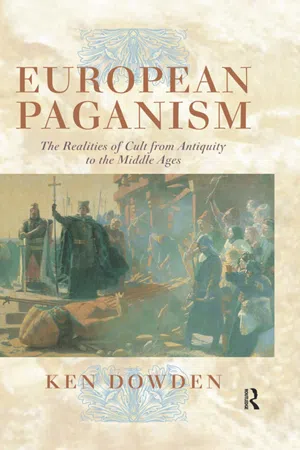
European Paganism provides a comprehensive and accessible overview of ancient pagan religions throughout the European continent.
Before there where Christians, the peoples of Europe were pagans. Were they bloodthirsty savages hanging human offerings from trees? Were they happy ecologists, valuing the unpolluted rivers and mountains? In European Paganism Ken Dowden outlines and analyses the diverse aspects of pagan ritual and culture from human sacrifice to pilgrimage lunar festivals and tree worship. It includes:
a 'timelines' chart to aid with chronology
many quotations from ancient and modern sources translated from the original language where necessary, to make them accessible
a comprehensive bibliography and guide to further reading
What is ‘paganism’? Where did it exist in Europe and by what stages did it disappear? What do authors tell us about European paganism in its heyday? These are the questions which this introductory chapter addresses. We shall look later at the stylised views that Christian authors have of dying paganism, in Chapter 8.
Pagans, So Primitive
Shortly before the Second World War, the editor of a translation of medieval books of penance began his introduction with the observation that these documents ‘were employed in administering a religious discipline to our forefathers during their transition from paganism to Christianity and from barbarism to civilization’.1 Thus our forefathers had ready to hand convenient repressive codes, as hallmarks of their transition to civilisation, which told them how many days penance they must do if, due to overeating and overdrinking, they vomited up the holy wafer and, worse, failed to throw it on the fire (or, even worse again, a dog ate it), or if they committed acts of bestiality or sodomy or masturbated ‘with their own hand or someone else’s’, or burnt down a church, or, catastrophically, saved a soul from Hell that didn’t deserve to be saved, or found a cow that had fallen from a rock and wondered whether it was pious to eat it (answer: only if it has shed blood), or sought healing at springs, trees, stones or crossroads. We all have our ideas of what constitutes civilisation and it is perhaps best to be clear at the outset that there is no uniform evolution of civilisation such that barbarity and paganism go hand in hand. To most classicists it will seem that the pagan Greek and Roman civilisations, for all their terrible errors, were at least as ‘civilised’ as much of the Christian Middle Ages and if it does not seem so, they had better learn another discipline.
Or take this:
In religion the savage is he who (while often in certain moods, conscious of a far higher moral faith) believes also in ancestral ghosts or spirits of woods and wells that were never ancestral; prays frequently by dint of magic; and sometimes adores inanimate objects, or even appeals to the beasts as supernatural protectors.
Lang 1913: i.34 n. 1
From this single sentence we can recognise Andrew Lang’s Myth, ritual and religion as a product of the Victorian age, confidently rehearsing and implying views which would cause offence in our own age. Yet we should be careful that we do not ourselves slip into this type of view when thinking about our ancestors. Ancient Europeans were not at some primitive stage of intelligence because they practised pagan rites or focused their worship at stones and trees, nor were they superstitious slaves to ghosts, spirits and ancestors. Superstition is in the eye, and religious code, of the beholder. It is not a puzzle that these ancient peoples failed to be Christian and we should abandon the Christianocentric supposition that ‘in certain moods’ they sensed a ‘far higher moral faith’, viz. Christianity. It is true that in most modern religions, religious codes of conduct have taken the character of morals, but it is certainly not a necessary feature of religion as such to supply morals to a population – and without religion we are not therefore immoral.
Finally, it may indeed be characteristic of many modern religions, notably Christianity, to promote ‘faith’ to the extent that nowadays to be a religion is to be a ‘faith’, preferably a ‘living faith’; but students of ancient religion are well aware that paganism did not promote ‘faith’. Of course, ancient pagans believed certain things without adequate evidence, but whether they believed ‘in’ them (a peculiar piece of jargon which we derive from New Testament Greek)2 is another question. Paganism was not credal, but a matter of observing systems of ritual. Ritual too is a language, one which involvingly defines the place of man in the world. It is no worse than credal or theological language in achieving that objective and in some ways escapes more easily the danger of asserting something which needs to be verified or died for. Paganism can accept the beliefs and practices of others much more readily than more ideological religions. The persecution of the Christians by the Romans was not a matter of crusade or jihad and was caused by an unusual and special conflict in views of ritual and society.
‘Paganism’ is a misnomer. With its Latin first element (paganus, a ‘villager’) and Greek second (-ism, as though it were a system of belief), it is an impossible contradiction. The only pagans who held to systems of belief were, contingently, philosophers who happened also to be pagans and philosophised religion as they philosophised everything else. It was, however, characteristic of philosophy under the Roman Empire that it was drawn increasingly into the description and articulation of religion – the catalyst for the incorporation of theology within Christianity. Paganismus, a singulär religious environment, is a word invented by the fourth-century Christians so that they can talk about ‘it’ in the same breath that they talk about Christianity and Judaism.3
Until the advent of neopaganism, paganism had always been a derogatory term denoting any non-Christian religion. As it is derogatory, it would be accurate but insulting to call the religious practices of Hindus ‘pagan’. Because, however, our ancestors find no shelter under a multi-cultural umbrella, are protected by no legislation, will never have to be confronted face to face, and are remote enough to be gratuitously insulted, we have the freedom to call them ‘pagans’ and mentally to demean their cultures. Thus overwhelmingly ‘paganism’ refers intolerantly to the pre-Christian religious practices of Europe and that is what it was originally designed for. A paganus is a ‘villager’; why this should come to mean ‘pagan’ is not clear. Zahn suggested in 1899 that it extended the sense ‘local people, non-combatants’ in reference to the ‘soldiers’ who fight the good fight in the metaphorical army of Christ.4 More usually, the ‘villager’ has been seen as a backward country person, a yokel, who is still engaged in the rustic error of paganism. This would then go back to the difficulty which Christianity experienced in advancing from the towns of the Roman Empire into the countryside. The problem is that the word pagani applies as much to townspeople as to rural people. To solve this problem, Chuvin (1990: 9) has proposed returning to an earlier Interpretation that they ‘are quite simply “people of the place,” town or country, who preserved their local customs, whereas the alieni, the “people from elsewhere,” were increasingly Christian’. Be that as it may, paganism did in fact last longest in the countryside and rustici (‘country-people, rustics’) becomes a term interchangeable with pagani.5
English, and the Germanic languages, have another word, ‘heathen’, which we owe to the Goth Ulfila (on whom more below). He used the word häithnö at Mark 7.26 to translate the Greek word Hellenis, ‘Greek (female)’ in the extended sense of non-Jew (‘Gentile’ in the Revised English Bible).6 It looks from the perspective of the other Germanic languages as though it is their equivalent of the Latin paganus or rusticus and refers once again to those who live at a distance from perceived centres of culture: these inhabit open, rough land, heaths in fact. As a matter of fact, the word ‘heath’ does not turn up in Gothic, but, to be brutal, there is nothing else it can come from. Before it was taken up for use by Christians, I suspect this was a term of comparative civilisation, such as Goths conceived it, and denoted ‘someone who lives in wild places’.7
Modern ‘pagans’ are naturally convinced that there is a continuity between ancient pagans and themselves, something which I doubt but am not particularly concerned to dispute.8 Nor am I qualified to analyse spiritual conditions in late twentieth/early twenty-first-century liberal Europe. One cannot fail, however, to notice a problem of deracination and of disgust with certain aspects of the development of material culture and with established institutions that find it so hard to recognise sea-changes. Thus ‘ecology’, ‘environment’ and ‘green’ have become first buzzwords, then commonplace; and above all urban dwellers have increasingly feit a deep sympathy with the unpolluted landscape and its ‘endangered’ creatures. A special place is held in this recovery of a Golden Age by the term ‘Celtic’, a vector to the quasi-primeval inhabitants of the land (so very ‘old’), their ancient songs and stränge myths, and their mysterious magical powers in a revered landscape. This is a modern mythology, and like all myths works so well because it is not true.9
Christian Ending
Roman government
If paganism is simply the negative of Christianity, it follows that the history of the end of paganism is the history of the rise of Christianity. Thus the end of the pagan period is a matter of Christian rulers and councils and bishops stamping out the last vestiges of pagan practice. This naturally happened at different times in different parts of Europe: the arrival of Christianity, and with it the demise of paganism, is part of a wave of culture slowly sweeping across the continent. Barbarian kings may be viewed as signing up for membership of the European Union and entering into profitable communication with great powers by the act of adopting Christianity. One tale, however mythic, may stand as an icon of this religio-cultural influence, the story of how Vladimir, Prince of Rus’, the embryonic Russia, convoked a council of boyars in 986/7 in order to decide which religion they should sign up for of those that were being pressed upon them – the Judaism of the Khazars,10 the Islam of the Bulgars,11 the Roman Christianity of the Germans, or the Greek orthodoxy of the Byzantines. It is reminiscent of choices offered to Third World
Figure1.1 Nero and the Christians, an enduring image
countries during the Cold War and the interpretations of Marxism and of western democracy that resulted.
Populär culture hears much of how ‘the Romans’ persecuted the Christians, fed them to lions and so on, but in fact the Roman Empire was the vehicle by which Christianity conquered Europe. The Great Persecution of Diocletian in 303-11 (in fact more of others who were driving his policy by then) was the last in the west: in 312 Constantine seized Rome and became its first Christian Emperor. Against all cynicism, there can be no doubt that Constantine, within his own understanding of it, was committed to Christianity and concerned to harmonise and harness it in the interests of the Empire. This was decisive, despite the reversion to paganism of the Emperor Julian (‘the Apostate’) in 360-3, despite some futile resistance by the tiny, if temporarily indulged, conservative establishment in the city of Rome under Symmachus (praefectus urbi, i.e. mayor, 384-5), and despite occasional relapses or concessions to paganism in the wake of the demoralisation caused by barbarian depredations of great urban centres (Trier 406, Rome 410, Bordeaux 414).12
Repression of pagans was more sustained than the persecutions of Christians had been. Almost every set of Emperors established their Christian credentials by issuing pompous, repetitive and not therefore wholly effective edicts.13 In 341-2 sacrifices were banned, but temple buildings outside the walls of Rome were to be left to be the focus of plays and spectacles. In 346 sacrifices were banned on pain of death and temples closed. In 353-8 nocturnal sacrifices, then any sacrifices and any adoration of statues, were banned on pain of death and the temples were closed. In 381-5 sacrifices, day or night, were forbidden and so was divination. Emperors were particularly worried about divination, in whose efficacy they clearly believed: in a Standard Roman sacrifice, you inspected the liver and entrails of the sacrificed animal for signs (banned 385) and traitors might look for signs of when the Emperor might die. Temples, however, might now be opened for meetings: statues were to be considered as mere art, museum stuff – too highbrow a view to last long. At the end of the Century, in 389-92, pagan holidays were turned into workdays, sacrifices and visiting temples or sanctuaries at all were banned, as was ‘raising eyes to statues’, on pain of a hefty fine; even household cult was proscribed. Nor did it matter what dass you belonged to. Sacrifices to inspect entrails were treason. And you sho...
Table of contents
Cover Page
Half Title Page
Title Page
Copyright Page
Contents
List of illustrations
Acknowledgements
Foreword
How to use this book
Authors and events: a time-chart
1 Approaching Paganism
2 Dividing the Landscape
3 Focus I: Spring, Lake River
4 Focus II: Stone and Tree
5 Area I: Land
6 Area II: Growth
7 Technology: Statues, Shrines and Temples
8 Christian Paganism
9 Pagan Rite
10 Pagan Time
11 A Few Aspects of Gods
12 Priests
13 Cradle to Grave
14 Unity is the Thing
Afterword
Notes
Bibliography
Index
Trusted by 375,005 students
Access to over 1.5 million titles for a fair monthly price.
Study more efficiently using our study tools.
Frequently asked questions
Yes, you can cancel anytime from the Subscription tab in your account settings on the Perlego website. Your subscription will stay active until the end of your current billing period. Learn how to cancel your subscription
No, books cannot be downloaded as external files, such as PDFs, for use outside of Perlego. However, you can download books within the Perlego app for offline reading on mobile or tablet. Learn how to download books offline
Perlego offers two plans: Essential and Complete
Essential is ideal for learners and professionals who enjoy exploring a wide range of subjects. Access the Essential Library with 800,000+ trusted titles and best-sellers across business, personal growth, and the humanities. Includes unlimited reading time and Standard Read Aloud voice.
Complete: Perfect for advanced learners and researchers needing full, unrestricted access. Unlock 1.5M+ books across hundreds of subjects, including academic and specialized titles. The Complete Plan also includes advanced features like Premium Read Aloud and Research Assistant.
Both plans are available with monthly, semester, or annual billing cycles.
We are an online textbook subscription service, where you can get access to an entire online library for less than the price of a single book per month. With over 1.5 million books across 990+ topics, we’ve got you covered! Learn about our mission
Look out for the read-aloud symbol on your next book to see if you can listen to it. The read-aloud tool reads text aloud for you, highlighting the text as it is being read. You can pause it, speed it up and slow it down. Learn more about Read Aloud
Yes! You can use the Perlego app on both iOS and Android devices to read anytime, anywhere — even offline. Perfect for commutes or when you’re on the go. Please note we cannot support devices running on iOS 13 and Android 7 or earlier. Learn more about using the app
Yes, you can access European Paganism by Mr Ken Dowden,Ken Dowden in PDF and/or ePUB format, as well as other popular books in Histoire & Histoire antique. We have over 1.5 million books available in our catalogue for you to explore.