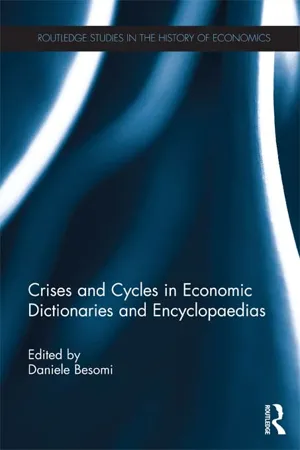
This book aims at investigating from the perspective of the major economic dictionaries the notions of economic crisis and cycle. The project consists in giving an extensive summary of a number of significant entries on this subject, with an introductory essay to each entry placing them (and the dictionary to which they belong) in their context, giving some details on the author of the dictionary entry, and assessing the entry's (and its author's) contribution. The broad picture (including the history of these encyclopedic tools) will be examined in the introductory essays.
- 624 pages
- English
- ePUB (mobile friendly)
- Available on iOS & Android
eBook - ePub
Crises and Cycles in Economic Dictionaries and Encyclopaedias
Part I
Introductory
1 Introduction
Les dictionnaires sont les meilleurs moyens de propager les sciences, d'accélérer leurs progrès, et de les faire arriver rapidement au plus haut degré qu'elles puissent atteindre. Le plus grand perfectionnement de la pensée humaine est dans sa diffusion.
(PRÉFACE,→Ganilh, Dictionnaire analytique
d’économie politique, 1826, p. xxvii)
d’économie politique, 1826, p. xxvii)
Crises, cycles and other distressful phenomena intrinsic to the dynamics of capitalist economies have been, and still are, the subject of a vast literature, often topical (coming in waves following the events themselves: see Chapter 3) but sometimes also dedicated. There are therefore multiple viewpoints from which the subject can be studied historically.
In this volume we examine how these phenomena have been and are discussed in encyclopaedias and specialized dictionaries. These reference works played an important role in the popularization but also in the systematization of knowledge during the nineteenth century and the early twentieth century, and – judging from the continuing exponential increase in their publication – are still widely used in the support of teaching and, to a lesser extent, research. What is recorded in dictionaries is therefore rather influential, in particular for those works recognized by contemporaries to be authoritative.
Yet the choice of this perspective is perhaps unnatural enough to require an explanation. Encyclopaedia writings, in fact, nowadays can hardly claim to lie at the cutting edge of research, the outcome of which is normally housed in dedicated treatises and articles, and their purpose is related much more to the diffusion of knowledge than to its conception. Nevertheless, dictionary articles have not always been rearguard materials, while the peculiar nature and style of such writings define a literary genre offering, individually and as a class, a precious vantage point for assessing the state of the reflections on specific topics such as crises and cycles, and on their perception by the scholarly community (both qualified academics and those being trained) and laypeople. The texts so produced, in fact, carry some features that make them particularly interesting for historians of thought due to the selection of materials they discuss, the structure of the argument and their expert authorship. Most of these articles – in particular, those incorporated in large encyclopaedic works, thus having enough space to expound their argument in full – place the subject in the context of contemporary debates on crises, and thus reveal the perspective their prominent authors deemed to be noteworthy.
This introductory chapter begins by characterizing the scientific–literary genre of dictionary and the structure and purpose of this project.
1.1 DICTIONARIES AS A LITERARY GENRE
1.1.1 Encyclopaedias, dictionaries, lexica and glossaries
Before entering into a characterization of dictionaries as a literary genre, it is necessary to delimit the nature of such works considered in this volume. Lexicographic works concerning economics (exclusively or not) are a motley set of objects. As we shall see below (Section 1.2), they include a wide range of sizes, purposes, languages, editorial histories and intended audiences. And they have different names: we have dictionaries, encyclopaedias, encyclopaedic dictionaries, lexica, vocabularies and glossaries, which correspond to different kinds of reference works.
The distinction between these kinds of works in practice is rather fuzzy. Several of them – both of general scope and specifically addressed to economics or the social sciences – actually carry more than one of these denominations in their title. Famously, Diderot and d'Alembert’s Encyclopedia (1751–1780) was titled Encyclopédie ou dictionnaire raisonné des sciences, des arts et des métiers. Similarly, Chambers's Cyclopædia (1728) and the first edition of the Encyclopædia Britannica (1768–1781) were both subtitled Universal dictionary of arts and sciences. Whitelaw combined three terms as follows: The popular encyclopaedia: or, ‘Conversations lexicon’: being a general dictionary of arts, sciences, literature, biography, history, ethics, and political economy (1834–1842). Several specifically economic and commercial works were equally generous in qualifying themselves, as for instance →Macardy's Commercial cyclopaedia: or, Dictionary of practical commerce (1833), →Rotteck's Staats-Lexikon. Encyklopädie der sämmtlichen Staatswissenschaften für alle Stände (1834–1843), →Guillaumin's Encyclopédie du commerçant, the main title of which was Dictionnaire du commerce et des marchandises (1837–1839), →Antonelli's Enciclopedia del negoziante ossia Gran dizionario del commercio, dell'industria, del banco e delle manifatture (1839–1843), →Pitman's commercial encyclopædia and dictionary of business (Slater 1912–1913), →Müller and Löffelholz's Bank-Lexikon: Handwörterbuch für das Bank- und Sparkassenwesen (1953), or →Mori's Nuovo dizionario di economia: la prima enciclopedia dei termini economici (1989).1
Although dictionaries and encyclopaedias are complex objects, difficult to pin down to an exhaustive and mutually exclusive list of features, they can be usefully distinguished on the ground of the nature of their entries. The basic function of ‘dictionaries’ is to define the words of a language, or a subset of them, to which dictionaries may add information as to the etymology, use, pronunciation, variants, history, grammatical forms and functions, and synonyms, occasionally supplemented by citations illustrating the use of the various sense of words. ‘Encyclopaedias’ provide instead information on all or some branches of knowledge. Dictionaries thus relate linguistic knowledge about words, aiming at clarifying their meaning and their usage in speech within the cultural organization to which they belong, while encyclopaedias relate to knowledge about facts, objects or theories, thereby providing extra-linguistic information.2 Dictionaries thus define terms, while encyclopaedias deal with concepts. Encyclopaedias can, and do, carry entries on people, while proper names are excluded from dictionaries.3 Encyclopaedic dictionaries perform both functions. The designation of ‘lexicon’, in English, is usually associated with sectorial rather than general dictionaries, that is, dictionaries covering one or a few disciplines.4 ‘Vocabularies’, commonly termed ‘glossaries’, often have a more limited scope, as they list a selection of words or phrases relating to a discipline or a special subject and are sometimes appended to treatises, although some are printed as autonomous volumes.5
In practice, the spectrum of the reference works concerning economics and related disciplines listed in the bibliography of specialized dictionaries in Chapter 29 (more than 650 titles, a number of which went through several editions) forms a continuum, as scarcely any specialized dictionary can avoid incorporating some encyclopaedic ingredients. Yet its extremes are easily discernible. On one side, we have the writings sharing the features of specialized encyclopaedias, carrying more or less detailed entries not only defining the concept under discussion but also reporting the economic understanding concerning it, supplying essential (occasionally rich) bibliographies and offering a systematization of the subject within the corpus of economic knowledge. On the other side, there are the writings limiting themselves to a definition of the word under examination, or very little more. The latter naturally offer short entries for each heading, so that the former kind of works result in much larger numbers of pages; the length of these volumes6 (indicated in the bibliography) offers a rough proxy for their position in the spectrum. In this book we are essentially concerned with encyclopaedic entries on crises, cycles and related topics in general and specialized encyclopaedias, the length of which range from a few pages to small treatises of more than 80 pages7 – without, of course, disdaining information on the etymology and usage of these notions (on which, see Chapter 3).
1.1.2 The fragmentation of knowledge
Dictionaries and encyclopaedias are reference works, devised to be consulted rather than read from cover to cover. Accordingly, what characterizes these works as a literary genre, and distinguishes them from the remainder of the specialized and educational literature, is their breaking down of knowledge into a number of semimonographic articles, usually presented in alphabetical order and connected with other relevant articles by means of a system of cross-references. This feature has a number of implications.
In the early days of specialized dictionaries, the fragmentation of knowledge was perceived as a problem. Boccardo, for instance, opened the preface to his →Dizionario della economia politica (1857–1863) with a defence of dictionaries as a useful quick reference tool (see Chapter 11). He conceded, however, that ‘if the purpose of scientific dictionaries were to teach methodically the science, as intended by the French encyclopedists, and to substitute treatises in presenting doctrines as logically connected between each other, the critics would be justified in their anathemas’ (p. vii).8 In reviewing Boccardo's Dizionario, Rosa – defending dictionaries and other forms of popularization against the ‘aristocracy of knowledge’ that disdained them in the name of the purity of form and expression – also admitted that the breaking down of knowledge hinders ‘that orderly, logical and magnificent treatment that elevates science by mean of eloquence and gives it the power of the arts’, but maintained that the growth of knowledge requires the creation of dictionaries as convenient and economical repositories of science: ‘to many treatises, as they grew more and more vast and complex, alphabetical subject index have been added at the end. It was thus found to be expedient to start with the alphabetical order at the outset, and to write dictionaries instead of compiling treatises governed by arbitrary classification’ (Rosa, 1857, pp. 114–116).
Two further potential dangers were pointed out by Chailley, in the INTRODUCTION to his and Say's →Nouveau dictionnaire d’économie politique (1891–1892). The first concerns the homogeneity of the articles:
A dictionary is rarely the accomplishment of one person alone. Normally it is the result of the collaboration of several people, and it seems preferable that this is so. Although these people may have wide agreement on the fundamental traits of the discipline, they are bound to differ on one aspect or another. This gives rise to disagreements and inconsistencies that may mislead the reader.
(p. vi)
At the time of writing, Chailley had already (unknowingly) witnessed the extinction of the major one-man dictionaries: in particular →Ganilh's Dictionnaire analytique d’économie politique (1826), quoted as an example to be superseded by →Coquelin and Guillaumin's Dictionnaire de l’économie politique (see Chapter 8), of which Say and Chailley purported to be a new edition (see Chapter 12); →McCulloch's Dictionary, practical, theoretical, and historical, of commerce and commercial navigation (1832–1839, and various subsequent editions); →Ott's
Dictionnaire des sciences politiques et sociales, 1854–1855 (see Chapter 10); →Macleod's Dictionary of political economy, 1863 (aborted at letter C: see Chapter 13); and finally →Boccardo's Dizionario (Boccardo, as we have seen, had criticized Guillaumin and Coquelin precisely on the ground of the danger of inconsistency pointed out by Chailley).
The second of Chailley's concerns pertains to the quasi-monographic character of the articles:
Each article forms a unity. It is a small self-contained and self-standing treatise on its chosen subject. But in life as in science there is no such thing as a self-standing and self-contained subject. Isolating it is an expedient for studying it. Phenomena are chained to other phenomena which alter their original physiognomy and meaning. Questions are coupled to other questions which modify their original position and correct their scope. The dictionary form, with its separate articles, is itself a […] cause of errors.
(p. vi)
Say and Chailley's dictionary, like most others at the time, used a system of cross-references that partly remedied the problem. →Seligman's Encyclopaedia of the social sciences (1930–1935) attempted to offset the atomizing effect of this fragmentation by means of special surveys of social sciences, of long general articles of an historical character, and of ‘symposium treatment’ offering different perspectives on special problems (Lasswell, 1936, p. 388; Lentini, 1999, pp. 262–263). Yet the problem of the fragmentation of knowledge leading to a partial understanding of problems not only remains, but grows worse with the increased specialization of scientific disciplines. This leads to further breaking down of the main topics into subentries, so that Chailley's two problems merge into one, as the potential lack of homogeneity affects not only the dictionary as a whole, but even a specific topic. The subject matter of this book, crises and cycles, offers a neat example. While up to the Second World War most dictionaries carried one or two entries on cycles or crises, in recent dictionaries we find a plethora of articles discussing one or another special aspects of the problem.9 While there are cross-references to some (but by no means all) cognate entries, it is generally not remarked in the apparatus that crises pertain as essentially as does ‘equilibrium’ (and related concepts) to the discussion of the ‘normal’ behaviour of the economic system; but crises are usually discussed separately from their antithesis and rarely (if at all) do the corresponding entries cross-refer to each other. Moreover, it happens that entries within the same dictionary go as far as incorporating, without discussion, views that are antithetic to each other – such as, for example, TRADE CYCLE by Medio and BUSINESS CYCLES by Dotsey and King in →The new Palgrave (1987).10
This problematic situation is still unresolved. As neatly summed up by the Encyclopædia Britannica,
Those who favoured this more fragmented approach argued that by focussing on the smaller part of the whole, the editors could facilitate the user's search for specific information and that the liberal provision of cross-references would facilitate a recombination of the fragments by those interested in the bigger picture. Against this practice, it was argued that most cross-references are not followed up by most readers, that the shorter fragmented pieces work against a correct understanding of the larger subject, and that fragmentation inevitably involved a great am...
Table of contents
- Front Cover
- Title Page
- Copyright
- Contents
- List of figures and tables
- List of contributors
- Symbols and conventions
- Part I Introductory
- Part II The classic dictionaries
- Part III The recent dictionaries
- Name and subject index
- Index of dictionaries and dictionary entries cited
Trusted by 375,005 students
Access to over 1.5 million titles for a fair monthly price.
Study more efficiently using our study tools.
Frequently asked questions
Yes, you can cancel anytime from the Subscription tab in your account settings on the Perlego website. Your subscription will stay active until the end of your current billing period. Learn how to cancel your subscription
No, books cannot be downloaded as external files, such as PDFs, for use outside of Perlego. However, you can download books within the Perlego app for offline reading on mobile or tablet. Learn how to download books offline
Perlego offers two plans: Essential and Complete
- Essential is ideal for learners and professionals who enjoy exploring a wide range of subjects. Access the Essential Library with 800,000+ trusted titles and best-sellers across business, personal growth, and the humanities. Includes unlimited reading time and Standard Read Aloud voice.
- Complete: Perfect for advanced learners and researchers needing full, unrestricted access. Unlock 1.5M+ books across hundreds of subjects, including academic and specialized titles. The Complete Plan also includes advanced features like Premium Read Aloud and Research Assistant.
We are an online textbook subscription service, where you can get access to an entire online library for less than the price of a single book per month. With over 1.5 million books across 990+ topics, we’ve got you covered! Learn about our mission
Look out for the read-aloud symbol on your next book to see if you can listen to it. The read-aloud tool reads text aloud for you, highlighting the text as it is being read. You can pause it, speed it up and slow it down. Learn more about Read Aloud
Yes! You can use the Perlego app on both iOS and Android devices to read anytime, anywhere — even offline. Perfect for commutes or when you’re on the go.
Please note we cannot support devices running on iOS 13 and Android 7 or earlier. Learn more about using the app
Please note we cannot support devices running on iOS 13 and Android 7 or earlier. Learn more about using the app
Yes, you can access Crises and Cycles in Economic Dictionaries and Encyclopaedias by Daniele Besomi in PDF and/or ePUB format, as well as other popular books in Business & Business General. We have over 1.5 million books available in our catalogue for you to explore.