Rape, traditionally a spoil of war, became a weapon of war in the ethnic cleansing campaign in Bosnia. The ICTY Kunarac court responded by transforming wartime rape from an ignored crime into a crime against humanity. In its judgment, the court argued that the rapists violated the Muslim women's right to sexual self-determination. Announcing this right to sexual integrity, the court transformed women's vulnerability from an invitation to abuse into a mark of human dignity. This close reading of the trial, guided by the phenomenological themes of the lived body and ambiguity, feminist critiques of the autonomous subject and the liberal sexual/social contract, critical legal theory assessments of human rights law and institutions, and psychoanalytic analyses of the politics of desire, argues that the court, by validating women's epistemic authority (their right to establish the meaning of their experience of rape) and affirming the dignity of the vulnerable body (thereby dethroning the autonomous body as the embodiment of dignity), shows us that human rights instruments can be used to combat the epidemic of wartime rape if they are read as de-legitimating the authority of the masculine autonomous subject and the gender codes it anchors.
eBook - ePub
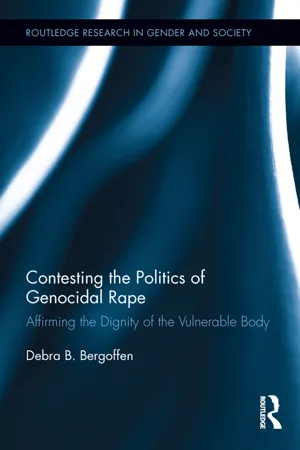
Contesting the Politics of Genocidal Rape
Affirming the Dignity of the Vulnerable Body
- 132 pages
- English
- ePUB (mobile friendly)
- Available on iOS & Android
eBook - ePub
Contesting the Politics of Genocidal Rape
Affirming the Dignity of the Vulnerable Body
About this book
Information
1 The Case
The Vulnerable Body on Trial
RAPE AND WAR
War time rape is not a new phenomenon. It is as ancient as war itself. Also not new is the prohibition against the rape of civilian women by military personnel. Until recently, however, this crime was a crime in name only. Accusations were rare. If made they were not as a rule taken seriously enough to be brought to trial. If brought to trial they seldom resulted in convictions. That changed dramatically when the United Nations Security Council authorized criminal tribunals in the wake of the genocides in Rwanda and the former Yugoslavia. These courts, the International Criminal Tribunal for Rwanda (ICTR) and the International Criminal Tribunal for the former Yugoslavia (ICTY), convicted the Rwandan and Bosnian-Serb soldiers who raped civilian women and girls of war crimes, the ICTY on February 22, 2001, taking the dramatic step of categorizing these rapes as a crime against humanity, the second most egregious international criminal offense. These verdicts transformed the act of raping, sexually assaulting and sexually enslaving civilian women and girls from an ignored, tolerated or trivialized crime into a real and punishable criminal act.
The first conviction, the September 2, 1998 ICTR judgment against Jean-Paul Akayesu, linked the criminality of rape to the criminality of genocide. It found that rape, like torture, was a criminal genocidal tactic. In issuing its guilty verdict, the Akayseu court defined rape as: “a physical invasion of a sexual nature, committed on a person under circumstances which are coercive. … Threats, intimidation, extortion and other forms of duress that pry on fear or desperation could be coercion” (UNICTR, 1998, p. 167). This definition is important for what it says as well as for what it does not say—it does not require signs of physical force as evidence of coercion.
The ICTR Akayesu case established the relationship between rape and genocide. It also rejected the argument that rape only occurred where there was evidence of physical violence. The coercive circumstances the court examined included non-physical threats as well as physical attacks. The ICTY case against the Bosnian-Serb soldiers Dragoljub Kunarac, Radomir Kovač and Zoran Vuković, (hereafter referred to as the Kunarac case) took account of the ICTR criteria of rape. Like the ICTR, the ICTY recognized the relationship between rape and genocide. In effect, both courts criminalized the ways that women’s bodies were being used as weapons of war. The ICTY, however, pushed the boundaries of the ICTR judgments on three counts. First, recognizing that the coercive tactics of rape need not include physical violence, the ICTY ruled that rape could not be identified as a species of torture. Second, in addition to convicting the Bosnian-Serb soldiers of war crimes, it convicted them of crimes against humanity. Third, in ruling that the rapes, sexual enslavements and assaults violated the women’s right to sexual self-determination, it created a new human right—the right to sexual integrity.
The ICTY trial and verdict were hailed as groundbreaking by the news media, court watchers, human rights organizations and women’s groups. Though their perspectives were different, each saw the Kunarac case pushing the legal understanding of the criminality of rape into new territory. Each noted that this was the first war crimes trial that dealt exclusively with sexual violence, the first time an international tribunal prosecuted and condemned sexual slavery and the first time rape was condemned as a crime against humanity (Simons 2001a).
The judgment made the headlines. As dramatic as the judgment however, but too complex for sound bites was the court’s decision to prosecute a case that dealt exclusively with sexual violence. Here, as in the Akayesu case, the women’s testimonies, their refusal to abide by the rule of silence expected of rape victims, was crucial. In breaking this rule, the women insisted on their right to be heard, on their authority to define the meaning of their abuse and on their power to demand accountability. Granting the women this right, authority and power, the court came to grips with the unique criminality of rape, sexual abuse and sexual slavery and the specific role these crimes played in the ethnic cleansing/genocide campaign.
The radical implications of the ICTY verdict concern the meanings of women’s and men’s bodies. The significance of the trial concerns women’s epistemic status—their authority to establish the meaning of their experience. The very possibility of the trial required a prosecutor like Carla Del Ponte who, in adopting a “normalization” policy of prosecuting sexual violence as a serious violation of humanitarian law, challenged the trivialization of war time rape captured in the language of collateral damage and in the acceptance of behavior categorized as “boys being boys” (Human Rights Watch 2000, 34). The court, in providing an authoritative forum for the facts of the rapes to become public, upset accepted legal understandings of rape and traditional assessments of women’s social position and epistemic authority. Instead of making it humiliating for a woman to report being raped, it made it demeaning for a man to be accused of raping.
In rejecting codes of modesty that made it shameful for a woman to report being raped and in challenging gender codes that rendered women’s testimonies suspect, the women who took the witness stand took a risk. They had no way of knowing if their testimonies would be accepted as credible. History suggested otherwise; thus the importance of the verdict. It broke with history. It validated the women’s courage by confirming their epistemic legitimacy. In breaking with history, the judgment also spoke to the force of the histories at work in the creation of the court, the trial itself and the final judgment; the history of the women’s movement; the history of human rights law; and the history of the internal politics, conventions and protocols of the United Nations.
SETTING A WOMAN’S AGENDA AT THE UNITED NATIONS
The women who testified in the Akayesu and the Kunarac cases testified both to their right to demand accountability for their suffering and to their right to speak and be heard. Their conviction that they were due these rights was the effect of women’s grassroots actions and international lobbying, for it was this work that laid the ground for recognizing women’s rights as human rights and that put the issue of violence against women on the international agenda. In taking the witness stand, the women who testified in the ICTR and ICTY cases were both beneficiaries of the efforts of those who came before them and benefactors of women yet to come. They became a part of the history of women who held local, national and international organizations responsible for recognizing the concrete rights of women and for protecting the real women who embodied these rights.
Insofar as this history is intimately tied to the history of the globalization of the women’s movement, it might be said to have its origins in the 1878 Conference on Women’s Rights. Held in conjunction with the World Exposition in Paris, the conference drew delegates from twelve countries. It saw the fight for suffrage as the way to challenge women’s political, civic and social subordination. Over the next decade, women created national women’s councils and held international conferences in Chicago, Brussels, London and Rome (Hawkesworth 2006, 45). Beginning in this way, women, working outside of official government channels, created trans-national networks aimed at transcending nationalist agendas without losing sight of local issues.
Continuing the practice of organizing an independent women’s forum beholden neither to government support nor official international sponsorship, over 2,000 women from 40 countries attended the March 1976 International Tribunal on Crimes Against Women. Held after the first United Nations-sponsored Mexico City Conference on Women and ending on March 8, International Women’s Day, the Brussels Tribunal was characterized by Simone de Beauvoir as an important challenge to the Mexico City conference and to the Year of the Woman:
In contrast to Mexico where women, directed by their political parties, by their nations, were only seeking to integrate Woman into a male society, you are gathered here to renounce the oppression to which women are subjected in this society … For the first time … women coming from all over the world will become conscious of the scandal of their condition. You are right to consider this condition the source of real crimes … (Russell & Van de Ven 1984, xiii)
Testifying to their victimization by the crimes of Forced Motherhood, Compulsory Heterosexuality, Economic Oppression and Violence Against Women, the women at the tribunal refused to be categorized as victims. They saw themselves as taking charge of their destiny by formulating strategies to combat these crimes.
Challenging the shortcomings of the Mexico City conference, feminists did not, however, dismiss it as insignificant. Neither did they abandon the United Nations as a forum for making their case. As the first United Nations conference on women, the composition of the 1975 Mexico City meeting was telling. Of the 133 national delegations, 113 were headed by women. The very presence of these women, their position as public figures voicing their demands, meant that women had already been somewhat effective in changing their status from that of passive recipients of support and assistance to that of active advocates who had equal rights to resources and opportunities. Aside from the fact that it was held at all, the most notable accomplishment of the Mexico City conference was the drafting of the UN Convention on the Elimination of All Forms of Discrimination Against Women (CEDAW) and the establishment of the Decade for Women (http://www.choike.org/nuevo_eng/informes/1453.htm).
From the perspective of the Akayesu and the Kunarac cases, what is most notable about the Mexico City conference and the CEDAW document it produced is the silence surrounding the issue of violence. The sounds of this silence persisted at the 1985 Nairobi UN Third World Conference on Women that marked the end of the decade for women. The Nairobi conference addressed the relationship between equality, development and peace, but said nothing about the relationship between equality, development, peace and violence against women. During the Decade for Women, the pandemic of violence against women was invisible.
It was at a human rights conference, not a women’s conference, that violence against women was officially recognized. It may be the case that the different languages in play at these meetings accounts for this seeming anomaly. The women’s conferences used the language of peace and security to focus on the broad range of issues that affect women: family, health, social, political and cultural practices. In this context it may be possible either to lose sight of the issue of violence against women, or to determine that other issues are more pressing. A conference that uses the language of human rights cannot sideline the matter of violence. It must focus on the bodily abuses that threaten our dignity. Depending, however, on how the body is conceived and on how abuse is defined, the language of human rights can lose sight of the specific ways that women are victims of dignity-threatening violence. The women who lobbied at the 1993 Vienna Conference on Human Rights made sure that this did not happen. They insisted that the conference put the issue of violence against women on the table. Thus the Vienna Conference recognized women’s rights as human rights. It adopted the Declaration on the Elimination of Violence Against Women (DEVAW) and appointed a Special Rapporteur on Violence Against Women. Two years later, this human rights language became part of the discourse at the fourth World Conference on Women in Beijing. The Beijing Declaration showed what can happen when the discourses of women’s rights and human rights meet. In addition to containing a special section on violence against women, in addition to recognizing war time rape as a war crime, the Beijing Declaration announced that victims of war time rape have the right to compensation (Coomaraswamy 1999, 172).
In giving women concrete and specific rights, and in identifying the existence of the global problem of violence against women, the resolutions passed at these UN conferences established women’s fundamental right to define the meaning of their experience of indignity and abuse. With regard to rape, this meant that instead of being defined in terms of a man’s intention or in terms of a man’s understanding of a woman’s desire, it would now be defined in terms of the woman’s experience of being coerced. Establishing a woman’s right to determine the meaning of what happened to her, these resolutions made it possible for a raped woman’s testimony to carry weight in a court of law.
THE WAR IN BOSNIA-HERZEGOVINA: ETHNIC CLEANSING/SCRIPTED RAPE
The women who took the witness stand at the ICTY testified anonymously. We can only speculate about their motives. Minimally we can assume that they were interested in holding those responsible for their humiliation and suffering accountable for their crimes. Whether or not these women knew how the work of women in the previous decades compelled the court to pay attention to their testimonies, they did know that they could talk to the women’s groups working in the refugee camps and that these groups would take their reports seriously. They knew that feminists in Zagreb had been working with victims of sexual atrocities since November 1991 to gather evidence of the crimes and to seek relief for the women (MacKinnon 2006, 158).
According to Human Rights Watch, however, there is a big difference between reporting a rape to a Non Government Organization (NGO) and agreeing to become a witness in a legal proceeding. Many rape survivors refused to testify in court because they feared being shunned by their communities and having their chances of marriage ruined. Others were angry and were willing to talk to the ICTY but feared retaliation from their attackers. If the ICTY wanted/needed the women’s testimonies, it would have to provide robust assurances of protection (Human Rights Watch 2000, 24). Though fear of retaliation deterred some women from coming into the courtroom, others agreed to testify despite these possible repercussions. Their decision may be understood by considering the motives of the women who asked Catherine MacKinnon to represent them in their case against Radovan Karadžić in New York City under the Alien Tort Claims Act (MacKinnon 2006, 198).
MacKinnon tells us that the women who asked her to take their case wanted to testify in a courtroom because, in addition to wanting to stop the violations, in addition to wanting to properly name them as genocidal rapes and in addition to wanting to establish accountability, they wanted to change the law (MacKinnon 2006, 199–200). The women MacKinnon represented, however, understood what they were up against. They knew that even though UN protocols and resolutions “publicly reframed [rape] as a political outrage to women,” and that the UN promised to provide support for raped and sexually abused women who agreed to testify, traditional prejudices are not easily overcome (MacKinnon 2006, 197). They anticipated that their credibility would be challenged and took steps to meet this challenge. Thus they urged reporters to investigate their charges and thereby provide “objective” confirmation of their testimonies. The fact that the women who approached MacKinnon were not shamed into silence tells us how far we have come. The fact that they needed journalists to anchor the credibility of their testimonies tells us how far we have to go. The women MacKinnon represented succeeded in getting their stories told and validated. They did not, however, succeed in changing the law. This was left for the women who testified at the ICTY. It was not a matter of more credible testimonies, but rather, as we shall see, a matter of judges, prosecutors and jurisdictions.
The Bosnian-Serb ethnic cleansing campaign can best be understood as a strategy of state ordered terror. What made it unique was not that men, women and children were tortured and killed, but that the Bosnian-Serb command believed that torture and murder could not by themselves ethnically cleanse a territory. It determined that driving a people from their land required something more than these well worn terrorist tactics—the rape, the sexual enslavement and the forced impregnation of Muslim women and girls. It determined that a gendered terror strategy was necessary for the success of its mission. Raping women, especially if the rapes were staged as public spectacles, would shame the women, humiliate the men and pollute the community. Forced impregnations would create a future Bosnian-Serb presence among the Muslims, further undermining their coherence as a community. The success of this last tactic relied on two points of agreement between the Serbs and the Muslims—one, the ethnicity of a child was determined by the father, and two, the bodies of the mother and child were owned by the state. For both communities, the birthing body, though essential to the reproduction of future generations, played no role in establishing the child’s national or ethnic status. A mother neither determined the identity of the child she carried nor decided its place in the community’s future. Her purity, however, was essential. A polluted maternal body would contaminate the embryonic material and render it unfit for the necessary cultural imprints provided by the father. It was these shared assumptions, and not, as the Bosnian-Serb command believed, the radical difference between Bosnian-Serb and Bosnian-Muslim cultures that provided the impetus for the rape campaign.
The Bosnian-Serb command launched its “ethnic cleansing” campaign at a meeting in Belgrade in 1991. The objective of the “ethnic cleansing” policy, as stated in the Ram plan, was to occupy and control the areas in Croatia and Bosnia-Herzegovina where Muslim fundamentalism thrived. The plan called on local militia groups to create unrest in order to provoke calls for intervention (Allen 1996, 57). The experts in psychological warfare who attended this meeting argued that the ethnic cleansing strategy would only work if the Muslim community’s will and moral were broken. This, they said, required attacking the point where the community’s religious and social structure was most fragile—the women, especially adolescent girls and young children (Allen 1996, 57). It is interesting to note that the argument for attacking the women and girls was not that they were the most vulnerable members of the community (they were not more vulnerable, for example, than the old men or toddler boys), but that the community’s most vulnerable point was its women. Attacking women, these psychologists asserted, would create confusion, fear and panic. It would trigger a Muslim exodus from the targeted territories. As a result of these discussions, a propaganda campaign called the Brana plan was also approved (Allen 1996, 57). The objective of this combined strategy was to provoke “spontaneous” flight. The methods included turning women’s bodies into weapons of war.
The Belgrade meeting identified a commander for this new military operation against non-combatant women and children. It decided that the chain of command should be as small as possible and the full details of the operation remain secret. Late in 1991 reports of death/rape camps reached Zagreb. The Ram and Brana plans seem to have been put into effect immediately. Commanders in the field reported that the “cleansing” of the Bosnian territories and the psychological attacks on the Muslim population were succeeding. They recommended that these tactics be continued (Allen 1996, 56–61).
The Bosnian-Serbs believed that their rape campaign would be successful because it targeted a unique feature of Bosnian-Muslim culture—its codes of honor. Focused on this difference, they ignored their shared understanding of women. In seeing public rapes as a way to destroy Muslim women’s reproductive capacities, they may be seen as expressing their own anxieties. While the Bosnian-Serb military was devising a strategy that would destroy Muslim women’s ability to ensure the future of their people, Bosnian-Serb non-military leaders were accusing Serb women of treason for not reproducing sufficiently to ensure Bosnian-Serb dominance. In October 1992, one year after the Brana and Ram plans were put in place, the Serbian ruling party, the Serbian Socialist party, the Serbian Academy of Arts and Sciences and the Serbian Orthodox Church published a document titled “Warning.” According to “Warning,” the high birth rate of Albanians, Muslims and Romanians threatened Serbian nationalism. As the source of this threat, Serb women were held responsible for countering it. They had a duty to serve their nation by reproducing. In 1994 Patriarch Pavle, leader of the Serbian Orthodox Church, denounced women who did not have children as the “White Plague.” He called their refusal to bear children a sin against themselves and their nation. He held these women accountable for reducing Serbs to an ethnic minority. The low Serbian birth rate meant that there would not be enough soldiers to ensure the nation’s survival (Salzman 1998, 351–352).
When Bosnian military, religious or intellectual leaders looked at Muslim or Serb women, they saw the same thing, reproductive bodies in the service of national and military objectives. As Muslim bodies, women’s reproductive capacities had to be destroyed or put to the service of the Serbs (the forced pregnancies). As Serb bodies, they had to contribute to the war machine. The Bosnian-Serbs were so focused on what they saw as the differences between them and their Muslim enemies that they missed what they shared—a gendered vision of women’s bodies that affirmed their power as men. In miss...
Table of contents
- Cover
- Halftitle
- Title
- Copyright
- Contents
- Acknowledgments
- Introduction
- 1. The Case: The Vulnerable Body on Trial
- 2. Slavery, Torture, Rape: Assaulting the Dignity of the Vulnerable Body
- 3. Genocidal Rape as Spectacle
- 4. The Verdict: Affirming the Dignity of the Vulnerable Body
- 5. Representing the Human: The Lingua Franca of Human Rights
- 6. Of the Politics and Pleasures of the Vulnerable Body
- Bibliography
- Index
Trusted by 375,005 students
Access to over 1.5 million titles for a fair monthly price.
Study more efficiently using our study tools.
Frequently asked questions
Yes, you can cancel anytime from the Subscription tab in your account settings on the Perlego website. Your subscription will stay active until the end of your current billing period. Learn how to cancel your subscription
No, books cannot be downloaded as external files, such as PDFs, for use outside of Perlego. However, you can download books within the Perlego app for offline reading on mobile or tablet. Learn how to download books offline
Perlego offers two plans: Essential and Complete
- Essential is ideal for learners and professionals who enjoy exploring a wide range of subjects. Access the Essential Library with 800,000+ trusted titles and best-sellers across business, personal growth, and the humanities. Includes unlimited reading time and Standard Read Aloud voice.
- Complete: Perfect for advanced learners and researchers needing full, unrestricted access. Unlock 1.5M+ books across hundreds of subjects, including academic and specialized titles. The Complete Plan also includes advanced features like Premium Read Aloud and Research Assistant.
We are an online textbook subscription service, where you can get access to an entire online library for less than the price of a single book per month. With over 1.5 million books across 990+ topics, we’ve got you covered! Learn about our mission
Look out for the read-aloud symbol on your next book to see if you can listen to it. The read-aloud tool reads text aloud for you, highlighting the text as it is being read. You can pause it, speed it up and slow it down. Learn more about Read Aloud
Yes! You can use the Perlego app on both iOS and Android devices to read anytime, anywhere — even offline. Perfect for commutes or when you’re on the go.
Please note we cannot support devices running on iOS 13 and Android 7 or earlier. Learn more about using the app
Please note we cannot support devices running on iOS 13 and Android 7 or earlier. Learn more about using the app
Yes, you can access Contesting the Politics of Genocidal Rape by Debra B. Bergoffen in PDF and/or ePUB format, as well as other popular books in Social Sciences & Gender Studies. We have over 1.5 million books available in our catalogue for you to explore.