- 345 pages
- English
- ePUB (mobile friendly)
- Available on iOS & Android
eBook - ePub
About this book
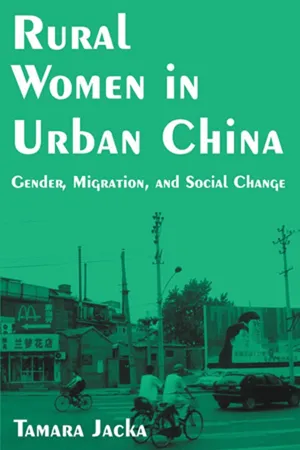
Based on in-depth ethnographic research - and using an approach that seeks to understand how migration is experienced by the migrants themselves - this is a fascinating study of the experiences of women in rural China who joined the vast migration to Beijing and other cities at the end of the twentieth century. It focuses on the experiences of rural-urban migrants, the particular ways in which they talk about those experiences, and how those experiences affect their sense of identity. Through first-hand accounts of actual migrant workers, the author provides valuable insights into how rural women negotiate rural/urban experiences; how they respond to migration and life in the city; and how that experience shapes their world view, values, and relations with others. The book makes a major contribution to our understanding of the relationship between gender and social change, and of the ways in which globalization and modernity are experienced at the most personal level.
Part I
The Subject
The Subject
——— 1 ———
Between “Rural Idiocy” and “Urban Modernity”
Between “Rural Idiocy” and “Urban Modernity”
As a way of beginning to understand the experiences of rural migrant women in China this first chapter looks at the genealogy of rural migrant subject positions. Two basic propositions underlie this chapter. The first is that migrants construct and perform their identities and understand their experiences both in reaction to and within the framework of dominant state and popular discourses1 in which they have been cast as a group that is in essential ways different from, and outside of, the urban citizenry. In order to understand migrant women’s lives, we need then to understand the construction of migrant subjects in dominant discourses. The second preliminary proposition is that the definition and representation of particular groups within a society as marginal, deviant, inferior, or outsider “others” can be central to the construction and maintenance of conventional or dominant notions about the identity of that society and about what constitutes a “normal” or “good” citizen. In the case of China, scholars have recently begun to examine the ways in which an “othering” of peasants, women, and members of ethnic minorities intersects with and contributes to elite or dominant discourses on modernity and national identity (Cohen 1993; Schein 1997; Feuerwerker 1998; Rofel 1999). In this chapter I demonstrate that the figure of the rural migrant is yet another signifier of “otherness” against and around which dominant national ideas about identity are constructed and reproduced. She is, to use Judith Butler’s (1993) term, an “abject” that threatens the project of national modernity and in so doing gives it shape. She is also an object of pity, titillation, and fascination. And she is a subject that must be both put to work and worked upon, if the project of modernity is to succeed.
Where, then, does one begin a genealogy of this abject/object/subject? In previous studies a range of explanations for the high levels of discrimination and exploitation suffered by people of rural origin in the cities of contemporary China has been given. There are those who have attributed it to the notion that the beneficial workings of a free market have been stymied by the ongoing influence of authoritarian Maoist outlooks and institutions, most notably the household registration system (HRIC 2002b). Others have explained it in terms of the particular conjunction of Maoist institutions and market mechanisms characterizing post-Mao economy and society (Solinger 1999), and yet others have seen capitalism and the nature of the post-Mao regime’s efforts to “join tracks” (yu shijie jiegui) with, and profit from, the global capitalist order as the root cause of the problem (Yan Hairong 2001, 2003a, 2003b).
I will state at the outset that I align myself most closely with those who analyze the status of rural migrants not in terms of the incomplete “liberation” of market forces in contemporary China, but as an outcome of the particular conjunction of Maoist institutions and market mechanisms that makes up the current sociopolitical and economic order in China. Thus I argue that the most pervasive and dominant understandings of the subject positions available to rural migrants and the social valuations attached to those positions in contemporary China result from the particular ways in which they are taken up by, and seen to function in, the post-Mao order. However, the various principles of categorization and evaluation according to which a person is identified as a rural migrant and which underlie understandings of what migrant subject positions entail did not arise “out of thin air” with the unleashing of market reforms in the late 1970s. Nor can they be explained as originating with the household registration system introduced under Mao in the 1950s. On the other hand, these principles of categorization and evaluation are also neither timeless nor “natural.” Rather, what we see is the coming together of a number of ideas and concepts that emerged in an earlier period and new formulations, narrations, and performances of these concepts in new contexts, serving new functions. Specifically, I will argue in the first section of this chapter that the emergence of concepts that are key to rural migrant subject positions is intimately bound up with a form of “internal orientalism” on the part of Chinese intellectuals searching for a way to respond to Western projects of modernity and colonialism in the late nineteenth and early twentieth centuries.2
Among the various concepts that go into the identification of subjects as rural migrant women, the most fundamental relate to discourses of rural/urban difference, outsider/local status and gender, and to the ways in which these are intertwined with, and contribute to, notions of modernity. This is apparent both in other peoples’ representations of migrant women, for example in the media, and in the narratives of migrant women themselves. This chapter, therefore, seeks to unravel the connections between the constitution of the female migrant subject and the genealogy of these discourses in the modern era. More specifically, the first section of the chapter briefly sketches out the emergence of the “peasant question” and the “peasant woman question” in the late nineteenth and early twentieth centuries and responses to those questions in the Maoist period. Section two of the chapter examines post-Mao reformulations of, and responses to, the peasant question. Section three then looks at the ways in which the constitution of rural migrant subject positions in the post-Mao period has brought into play and reworked these questions and answers, drawing also on notions of outsider and local status. This part of the chapter first discusses connotations embedded in the terms used to refer to rural migrants and then focuses on the ways in which rural/urban migration and migrants have been constructed in the Chinese media between the mid-1980s and the early 2000s.
Modernity and the Peasant Question Before and After 1949
In his book The Country and the City, Raymond Williams discusses the existence of a rural/urban divide and an assumption of urban superiority in the work of a large number of English writers from 1600 onward and traces the origins of that divide even further back, to classical Greek culture (Williams 1973). Frederick Mote claims, however, that no such rural/urban divide existed in imperial Chinese culture (Mote 1977, quoted in Cohen 1993, 156). There are plenty of grounds for contesting this view.3 It is clear, nevertheless, that in traditional Chinese political and cultural discourse, the rural/urban divide was much less significant than a distinction between the scholar-official class (shi) and the ordinary people (min). This distinction had been given its classic formulation in the fourth century B.C., when Mencius stated that those who used their minds and hearts (laoxin) ruled and those who used their muscles (laoli) were ruled (Feuerwerker 1998, 11). It was thought that the power and authority of the ruling scholar-official class rested in their moral and intellectual superiority over the ordinary people. It was the former’s duty to provide for the welfare of the people and to promote moral improvement and keep order among them by themselves being exemplars of self-cultivation and family regulation (ibid.; Bakken 2000, 42). If these duties were not properly upheld, the people would rise up in rebellion and the mandate to rule would be lost.
As various writers have documented, contact with the West and the decay of the imperial state system in the nineteenth and early twentieth centuries led to a crisis of identity among Chinese intellectuals and a subsequent struggle to shape for themselves new ways to exercise their traditional role of intellectual and moral leadership. Underlying the most significant discursive shifts that occurred in the course of this struggle was a drastically new concept of time and a new state teleology (Dikötter 1995, 9). Previously dominant ideas of the past as the golden age and of the fortunes of dynasties as cyclical, reflecting the gain and then loss of the Mandate of Heaven, were now replaced by various modernist discourses in which both individuals and societies were seen to evolve and “progress” in a linear line and through different stages toward maturity and modernity. It became intellectuals’ urgent new task to guide and pull the rest of China along this path, so as to restore it to greatness.
Accompanying this new teleology two important new discourses relating to “the people” emerged. In the first, “the people” (min) became “a people” (renzhong), a “race” (minzu), and a “population” (renkou); an object of ethnographic and scientific investigation and definition and a resource to be improved for the good of the nation. As Dikötter has argued, by the late nineteenth century “political power was no longer considered to be the result of public virtue or individual morality: demographic strength was the only criterion by which the expansion or destruction of the state could be measured” (ibid., 107–8).
Defining, measuring, and evaluating the “race” and the “population” were seen as essentially the equivalent of describing and evaluating the nation. It therefore became a central plank in intellectuals’ attempts to answer the question, “What is wrong with China?” a question brought on by defeat at the hands of colonial powers that became, and has remained to this day, a key problematic for the educated elite (Fitzgerald 1996, 108). By the 1920s, it had become almost universally accepted by intellectuals that “what was wrong with China” were grave defects in the “national character” (guomin xing). Previously, as indicated above, the Confucian elite already drew a link between the maintenance of social order and harmony and human cultivation and improvement. Now, however, an improvement in the national character and in the quality of the population became a more pressing task with a definite goal: the modernization of the nation.
When Chinese nationalists, such as Liang Qichao and, later, Lu Xun, wrote about defects in the national character, they were reacting to, and in many cases mirroring, Western colonial treatises on the topic. One of the most influential Western critiques of the Chinese, a book called Chinese Characteristics, was written by an American missionary, Arthur Smith, and published in 1894. In this book, Smith detailed a long list of defects in the Chinese character including a “disregard of time and accuracy,” an “absence of nerves,” “intellectual turbidity,” and an “absence of public spirit” (Smith 1894).4
Arthur Smith believed that these defects could be ameliorated only through conversion to Christianity. For many Chinese intellectuals the answer lay in the promotion of mass education and the popularization of culture. A key strand in the May Fourth Movement5 was the promotion of mass literacy and of literature written in the vernacular. For others, concern about the defects in the Chinese national character led to an emphasis on the cultivation of “civilization” (wenming) and etiquette. In 1924 Sun Yatsen, in his last lectures on the Three Principles of the People, poured scorn on the manners of his audience and urged an improvement in public etiquette. Ten years later, Chiang Kaishek launched the New Life movement, central to which was the promulgation of ninety-six rules governing public conduct and hygiene, including “Be clean,” “Do not spit in the streets,” and “Button your suit properly” (Fitzgerald 1996, 104–5; Bianco 1971, 127–28).
For yet others, concern about the characteristics of the Chinese people led to support for a eugenicist program, targeted in particular at the lower classes. Numerous scholars from the nineteenth century on blamed racial degeneration on the overbreeding of the poor. Some advocated a selective, class-based program for limiting reproduction. Others warned against the dangers of disseminating contraceptive knowledge, for fear that it would be taken up disproportionately by the educated classes and the race would be swamped by hordes of inferior creatures born in the lower classes (Dikötter 1995, 120).
Alongside the emergence of the population and the national character as prominent concerns in intellectual debates, a second discourse emerged in the early twentieth century, in which the shi/min divide was reconstituted as one between the urban population or, more particularly, urban intellectuals and the “peasantry” (nongmin) (Feuerwerker 1998, 9).6 During the late nineteenth century a differentiation between urban and rural society had begun to grow as a result of the establishment of foreign “treaty ports” and the example they set in the areas of commerce and administration. Administration, communication, capital, and mechanized industry became increasingly concentrated in a few coastal cities, especially Shanghai. As a consequence, the distinctiveness of the quality of life and culture of these cities relative to the rural hinterland also increased and city dwellers sought more and more to distinguish themselves from their rural cousins (Stockman 2000, 48–49). During this period several terms were adopted that had roots in classical Chinese, but which had then been (re)constructed by Meiji-era Japanese modernizers for use in translating works from the West. These included the neologism nongmin (peasant), which, as in English, had connotations of backwardness that had not been present in the previously usual term nongfu or farmer. It also included terms now used to describe “the peasantry,” such as fengjian (feudal) and mixin (superstition) (Cohen 1993, 155).
During the May Fourth Movement, the “peasant” became a central theme in literature and sociopolitical discourse. According to Myron Cohen, only a minority of intellectuals during this period viewed peasants with any positivity:
The notion of the peasantry as a culturally distinct and alien “other,” passive, helpless, unenlightened, in the grip of ugly and fundamentally useless customs, desperately in need of education and cultural reform, and for such improvements in their circumstances totally dependent on the leadership and efforts of rational and informed outsiders, became fixed in the outlook of China’s modern intellectual and political elites. For the elites governing China, or seeking to assume power over it, this image of the peasant confirmed their own moral claim to an inherently superior, privileged position in national political life, and their conviction that populism or popular democracy were utterly unacceptable if China was to avoid chaos and achieve national strength. (Cohen 1993, 155)
My own sense is that intellectuals’ feelings about the peasantry were rather more complicated than this suggests. Even among the most reformist, Lu Xun, for example, was scathing about the backwardness of village life and particularly adamant about the need for its destruction but, at the same time, evinced considerable nostalgia for it. The same kind of tension is evident in the essay “Youth and the Countryside” published in 1919 by Li Dazhao, a founding member of the Communist Party. In his essay Li claimed that “the darkness of the Chinese countryside has reached an extreme” and that peasants needed urgent liberation from their suffering, pain, ignorance, and sickness, but he also urged young people to travel to the countryside, saying that “darkness prevails in the city while brightness prevails in the countryside. Life in the city is almost ghostly while in the countryside activities are for humans. The air in the cities is filthy while the air in the countryside is fresh” (Li Dazhao 1984 [1919], 651). From the mid-1910s to the 1930s various intellectuals echoed Li’s call to youth, exhorting them to “go among the people” and to “head inland” (Feuerwerker 1998, 29–30; Fitzgerald 1996, 136). The search was on for the “re...
Table of contents
- Cover Page
- Half Title page
- Title Page
- Copyright Page
- Dedication
- Contents
- List of Figures and Maps
- Acknowledgments
- Introduction From the “Margins” to the “Center”
- Part I The Subject
- Part II Place
- Part III People
- Part IV Time
- Appendix 1 List of Interlocutors Named in the Text
- Appendix 2 Maps
- Notes
- Glossary
- Bibliography
- Index
- Other
Trusted by 375,005 students
Access to over 1.5 million titles for a fair monthly price.
Study more efficiently using our study tools.
Frequently asked questions
Yes, you can cancel anytime from the Subscription tab in your account settings on the Perlego website. Your subscription will stay active until the end of your current billing period. Learn how to cancel your subscription
No, books cannot be downloaded as external files, such as PDFs, for use outside of Perlego. However, you can download books within the Perlego app for offline reading on mobile or tablet. Learn how to download books offline
Perlego offers two plans: Essential and Complete
- Essential is ideal for learners and professionals who enjoy exploring a wide range of subjects. Access the Essential Library with 800,000+ trusted titles and best-sellers across business, personal growth, and the humanities. Includes unlimited reading time and Standard Read Aloud voice.
- Complete: Perfect for advanced learners and researchers needing full, unrestricted access. Unlock 1.5M+ books across hundreds of subjects, including academic and specialized titles. The Complete Plan also includes advanced features like Premium Read Aloud and Research Assistant.
We are an online textbook subscription service, where you can get access to an entire online library for less than the price of a single book per month. With over 1.5 million books across 990+ topics, we’ve got you covered! Learn about our mission
Look out for the read-aloud symbol on your next book to see if you can listen to it. The read-aloud tool reads text aloud for you, highlighting the text as it is being read. You can pause it, speed it up and slow it down. Learn more about Read Aloud
Yes! You can use the Perlego app on both iOS and Android devices to read anytime, anywhere — even offline. Perfect for commutes or when you’re on the go.
Please note we cannot support devices running on iOS 13 and Android 7 or earlier. Learn more about using the app
Please note we cannot support devices running on iOS 13 and Android 7 or earlier. Learn more about using the app
Yes, you can access Rural Women in Urban China by Tamara Jacka in PDF and/or ePUB format, as well as other popular books in Business & Management. We have over 1.5 million books available in our catalogue for you to explore.