eBook - ePub
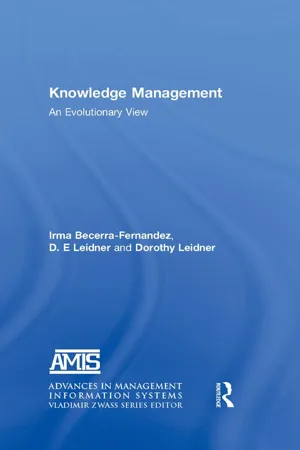
Knowledge Management
An Evolutionary View
- 327 pages
- English
- ePUB (mobile friendly)
- Available on iOS & Android
eBook - ePub
About this book
This book serves as a complete introduction to the subject of Knowledge Management (KM), and incorporates technical as well as social aspects, concepts as well as practical examples, and traditional KM approaches as well as emerging topics. Knowledge Management: Systems and Processes enhances the conventional exposition of KM with an in-depth discussion of the technologies used to facilitate the management of knowledge in large and small organizations. This includes a complete description of the theory and applications of the various techniques and technologies currently in use to manage organizational knowledge. The discussion of technology is at a level appropriate for the typical business administration graduate student or corporate manager. Special features:* Includes case studies of actual implementations of KM systems, including details such as system architecture * Contains numerous vignettes describing practical applications of KM initiatives at leading firms and governmental organizations * Provides a balanced view of knowledge management, while incorporating benefits and controversial issues, and both technology and social aspects * Extremely current, making extensive use of latest developments in, and examples from, the field of KM * Written by two proficient and recognized researchers in the field of KM.
CHAPTER 1
____________________________________
____________________________________
ON KNOWLEDGE, KNOWLEDGE MANAGEMENT, AND KNOWLEDGE MANAGEMENT SYSTEMS
An Introduction
IRMA BECERRA-FERNANDEZ AND DOROTHY LEIDNER
Abstract: The discipline of knowledge management (KM) has evolved over time. This introduction presents the motivation for organizations to continue to pursue the goal of effectively managing their intellectual resources, even in light of prior failures. This research monograph offers a collection of fifteen refereed research chapters in the field of KM. Written by researchers who have made significant contributions to the field of KM and KM systems in the past several years, each chapter seeks to synthesize how research perspectives on a particular topic in KM have progressed over the years, thereby illustrating the dynamic and evolutionary nature of KM theories and documenting the intellectual milestones of KM. In presenting how thinking about KM has evolved over a period of time, the chapters elucidate how ideas have moved from being novel to being commonly accepted, how seemingly obvious truths have turned out to have more nuances and be more multifaceted over time, how new lines of KM research have emerged from the shortcomings of other lines, and how the presumed purpose of KM, and thus of KM systems, has changed over time.
Keywords: Knowledge Management, Knowledge Management Systems
How do we want to leave the world for the next generation? What are good initial conditions for them? One desideratum would be a world offering as many alternatives as possible to future decision makers, avoiding irreversible commitments that they cannot undo. … A second desideratum is to leave the next generation of decision makers with a better body of knowledge and a greater capacity for experience. The aim here is to enable them not just to evaluate alternatives better but especially to experience the world in more and richer ways.—Herbert A. Simon (1996, p. 163)
INTRODUCTION
In the past few years, KM has been viewed as an increasingly important field of study that promotes the creation, capture, sharing, and application of an organization’s knowledge. It has been argued that the most vital resource of today’s enterprise is the collective knowledge residing in the minds of an organization’s employees, customers, and vendors. Learning how to manage organizational knowledge therefore may produce many benefits, including leveraging core business competencies, accelerating innovation and time-to-market, improving cycle times and decision-making, strengthening organizational commitment, and building sustainable competitive advantage. There is little doubt that the fundamental challenge of organizing and making available important knowledge has probably been present in all types of organizations for thousands of years. Yet, this need became particularly acute in the latter half of the twentieth century, as competitive pressures increasingly pushed employees in large and geographically distributed organizations to specialize in cognitively demanding tasks and to integrate their knowledge across location and specialty.
Much of the emphasis in KM has been on knowledge that has been validated and articulated in some form, including knowledge about processes, procedures, intellectual property, documented best practices, forecasts, lessons learned, and solutions to recurring problems. A greater challenge rests in the development of ways to manage the expertise of employees that resides solely in their minds, and to enhance the returns of such knowledge.
A wide range of scholars has made important contributions toward understanding the management of knowledge and learning in organizations, and by now it is clear that managers see information technologies as very relevant in solving some kinds of KM problems. The tremendous technological advances that made it possible for organizations to manage large amounts of raw data have culminated to a point where information technology (IT) solutions also have been developed to accomplish a wide range of KM-related tasks. Early innovators capitalized on the superior speed of transmission of IT to enhance knowledge sharing, as well as accelerating the growth of knowledge. Later developments included technology to locate and map the distribution of expertise in organizations, to guide users efficiently to find the solutions that uniquely meet their needs from a repository of thousands of best practices, and to create virtual communities. IT thus has provided a major impetus for the development of new approaches toward managing knowledge in organizations. The promise of effective IT-based KMS was grand, and in the 1990s many organizations experimented with the implementation of such systems, often prior to understanding their implications for the firm.
Despite these developments, it seems clear that KM research is still in the early stages. KM has facilitated the integration of knowledge from a variety of different perspectives. The works of five philosophers—Leibniz, Locke, Kant, Hegel, and Singer—have significantly influenced the development of KMS, as has the integration of organizational theory into the literature of management information systems. Likewise, information systems researchers have made significant contributions to KM that also extend into related disciplines, from psychology to artificial intelligence. KM research has influenced our understanding of other relevant research streams, including virtual teams, social networks, and organizational learning (OL).
ABOUT DATA, INFORMATION, AND KNOWLEDGE
Early papers in KM described the differences among data, information, and knowledge in terms of a richness hierarchy, which considers knowledge as the richest and deepest of the three: data consist of facts, observations, or perceptions. Data may be devoid of context, meaning, or intent but can easily be captured, stored, and communicated via electronic or other media. For example, the wind component (u and v) coordinates for a particular hurricane’s trajectory, at specific instances of time, are considered to be data (Becerra-Fernandez, Gonzalez, and Sabherwal, 2004).
Information has been described as data that possess context, relevance, and purpose. Information involves the manipulation of raw data to obtain a more meaningful indication of trends or patterns in the data. Continuing with the above example, based on the u and v components, hurricane software models may be used to create a forecast of the hurricane trajectory, which is considered information (Becerra-Fernandez, Gonzalez, and Sabherwal, 2004).
Finally, knowledge is distinguished from data and information in that knowledge refers to information that enables action and decisions, or information with a direction. Knowledge is then seen at the highest level of a hierarchy, with information at the middle level, and data at the lowest level. Knowledge is then the most valuable of the three. Western philosophers have in general accepted Plato’s definition of knowledge as a “justified true belief.” More recent perspectives treat knowledge as a transformation process, enabling the conversion of data into information or information into decisions. Continuing with the same example used above, the knowledge of a hurricane researcher is used to analyze the u and v wind components, as well as the hurricane forecast produced by the different software models, to determine the probability that the hurricane will follow a specific trajectory. Thus, knowledge helps produce information from data, or more valuable information from less valuable information. Knowledge helps to use information to make decisions. Knowledge is typically described as being either tacit or explicit (Polanyi, 1966). Explicit knowledge refers to knowledge that has been expressed in words and numbers, and it can be easily codified and shared as data, specifications, computer programs, videos, etc. Tacit knowledge, on the other hand, includes knowledge that is difficult to express and share, such as intuitions and insights. Nonaka (1994) describes how knowledge can be converted from these explicit and tacit forms through four different conversion modes, which are (1) from tacit knowledge to tacit knowledge through socialization, (2) from tacit knowledge to explicit knowledge through externalization, (3) from explicit knowledge to explicit knowledge through combination, and (4) from explicit knowledge to tacit knowledge through internalization.
THE STRUCTURE OF THIS VOLUME
This research monograph offers a collection of fifteen refereed research chapters in the field of KM. Each chapter seeks to synthesize how research perspectives on a particular topic in KM have progressed over the years, thereby illustrating the dynamic and evolutionary nature of KM theories and documenting the intellectual milestones of KM. The chapters in this volume are grounded in multiple disciplines, including computer science, engineering, management information systems, psychology, sociology, economics, strategy, and organizational behavior. In addition, the research methodologies represented in the chapters in this volume include conceptual analysis, empirical research, and qualitative methods. All the chapters synthesize prior work and highlight the key contributions of different streams of research on the topic of analysis.
This research monograph is organized as follows: the Introduction consists of this chapter, which helps to introduce the topic of KM and KM systems and the topics discussed in the volume. Part I presents a conceptual lens for the treatise of organizational topics related to the concept of KM, such as organizational learning and organizational culture. Part II presents a collection of papers that describe the role of information technology in KM, including how KM systems and other forms of organizational memories can support many organizational processes, from supporting social networks to solving knowledge problems. In addition this chapter presents the role of intelligent technologies in KM. Part III presents a collection of papers that describe the changing roles of KM and KM systems in organizations. As practitioners have experimented and found ways to leverage knowledge in their organizations, academics have been developing new theories to help explain the success or failure of KM implementation efforts. Finally, Part IV presents a collection of chapters that describe how KM connects with related research streams that have their theoretical bases in other disciplines, including social psychology, organizational behavior, strategy, and organization theory. Topics include virtual teams, expert teams and teams of experts, and communities of practice.
ABOUT KNOWLEDGE MANAGEMENT
Knowledge Management (KM) refers to identifying and leveraging the collective knowledge in an organization to help the organization compete: “the company’s overall performance depends on the extent to which managers can mobilize all the knowledge resources held by individuals and teams and turn these resources into value-creating activities” (von Krogh, 1998, p. 133). KM can also be defined as “performing the activities involved in discovering, capturing, sharing, and applying knowledge so as to enhance, in a cost-effective fashion, the impact of knowledge on the unit’s goal achievement (Becerra-Fernandez, Gonzalez, and Sabherwal, 2004, p. 31). The chapters in this part of the monograph trace the origins of KM along theories of OL and organizational culture.
In Chapter 2 “Individual, Group, and Organizational Learning: a Knowledge Management Perspective,” Irma Becerra-Fernandez and Rajiv Sabherwal trace the foundations for the current KM literature to lie in the early discussion of OL, which is said to take place through individuals (Simon, 1991). Without a doubt, KMS have had an impact on learning, at the individual, group, and organizational levels, and these are seen as evolutionary shifts in KM. For some OL researchers, KM is seen as a subset of OL, while KM researchers claim that KM lies beyond OL boundaries. Regardless, KMS and OL tie together via the development of the Internet and other collaboration technologies that provide opportunities for organization-wide and interorganizational socialization.
Equally important as the impact of KM in OL is the understanding about the impacts that KMS may have on the firm’s ability to discover, capture, and share intellectual resources. Dorothy E. Leidner and Timothy R. Kay worth address those questions in Chapter 3 “Knowledge Management and Organizational Culture” by examining the work related to organizational culture and KM. An understanding of organizational culture and its relationship to KM is key to understanding how firms can effectively deploy organization-wide KMS.
ABOUT THE ROLE OF INFORMATION TECHNOLOGY IN KNOWLEDGE MANAGEMENT
KMS have been defined as “an emerging line of systems [which] target professional and managerial activities by focusing on creating, gathering, organizing, and disseminating an organization’s ‘knowledge’ as opposed to ‘information’ or ‘data’” (Alavi and Leidner, 2001). A framework for classification of KMS (Becerra-Fernandez, Gonzalez, and Sabherwal, 2004) suggests the following types of KMS:
1. Knowledge discovery systems create new knowledge through the implementation of intelligent algorithms such as data mining, and through the inference of data relationships.
2. Knowledge capture systems preserve and formalize the knowledge of experts so it can be shared with others. Knowledge capture systems formalize knowledge in models such as concept maps, which allow others to learn the domain.
3. Knowledge sharing systems organize and distribute knowledge. Knowledge repositories comprise the majority of the KMS currently in place. Several types of knowledge repositories are described to support the capture and reuse of experience in different contexts. In addition to corporate memories, there are lessons-learned systems, incident report databases, alert systems, best practices databases, and expertise locator systems that are also described as knowledge sharing systems. The differences among these systems are ...
Table of contents
- Cover Page
- Half Title Page
- Series Page
- Title Page
- Copyright Page
- Contents
- Series Editor's Introduction
- Preface
- 1 On Knowledge, Knowledge Management, and Knowledge Management Systems: An Introduction
- Part I. A Conceptual Lens for Knowledge Management
- Part II. The Role of Information Technology in Knowledge Management
- Part III. The Role of Knowledge Management Systems in the Organization
- Part IV. Knowledge Management and Teams Within and Across Organizations
- Editors and Contributors
- Series Editor
- Index
Trusted by 375,005 students
Access to over 1.5 million titles for a fair monthly price.
Study more efficiently using our study tools.
Frequently asked questions
Yes, you can cancel anytime from the Subscription tab in your account settings on the Perlego website. Your subscription will stay active until the end of your current billing period. Learn how to cancel your subscription
No, books cannot be downloaded as external files, such as PDFs, for use outside of Perlego. However, you can download books within the Perlego app for offline reading on mobile or tablet. Learn how to download books offline
Perlego offers two plans: Essential and Complete
- Essential is ideal for learners and professionals who enjoy exploring a wide range of subjects. Access the Essential Library with 800,000+ trusted titles and best-sellers across business, personal growth, and the humanities. Includes unlimited reading time and Standard Read Aloud voice.
- Complete: Perfect for advanced learners and researchers needing full, unrestricted access. Unlock 1.5M+ books across hundreds of subjects, including academic and specialized titles. The Complete Plan also includes advanced features like Premium Read Aloud and Research Assistant.
We are an online textbook subscription service, where you can get access to an entire online library for less than the price of a single book per month. With over 1.5 million books across 990+ topics, we’ve got you covered! Learn about our mission
Look out for the read-aloud symbol on your next book to see if you can listen to it. The read-aloud tool reads text aloud for you, highlighting the text as it is being read. You can pause it, speed it up and slow it down. Learn more about Read Aloud
Yes! You can use the Perlego app on both iOS and Android devices to read anytime, anywhere — even offline. Perfect for commutes or when you’re on the go.
Please note we cannot support devices running on iOS 13 and Android 7 or earlier. Learn more about using the app
Please note we cannot support devices running on iOS 13 and Android 7 or earlier. Learn more about using the app
Yes, you can access Knowledge Management by Irma Becerra-Fernandez,D. E Leidner,Dorothy Leidner in PDF and/or ePUB format, as well as other popular books in Business & Business General. We have over 1.5 million books available in our catalogue for you to explore.