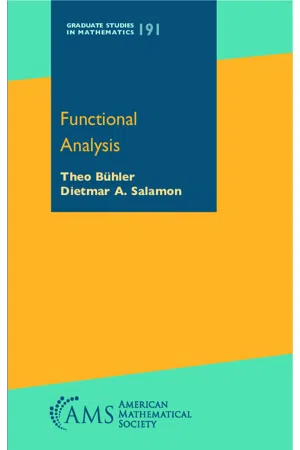
Functional analysis is a central subject of mathematics with applications in many areas of geometry, analysis, and physics. This book provides a comprehensive introduction to the field for graduate students and researchers.It begins in Chapter 1 with an introduction to the necessary foundations, including the Arzelà–Ascoli theorem, elementary Hilbert space theory, and the Baire Category Theorem. Chapter 2 develops the three fundamental principles of functional analysis (uniform boundedness, open mapping theorem, Hahn–Banach theorem) and discusses reflexive spaces and the James space. Chapter 3 introduces the weak and weak$^*$ topologies and includes the theorems of Banach–Alaoglu, Banach–Dieudonné, Eberlein–Šmulyan, Kre\x{012D}n–Milman, as well as an introduction to topological vector spaces and applications to ergodic theory. Chapter 4 is devoted to Fredholm theory. It includes an introduction to the dual operator and to compact operators, and it establishes the closed image theorem. Chapter 5 deals with the spectral theory of bounded linear operators. It introduces complex Banach and Hilbert spaces, the continuous functional calculus for self-adjoint and normal operators, the Gelfand spectrum, spectral measures, cyclic vectors, and the spectral theorem. Chapter 6 introduces unbounded operators and their duals. It establishes the closed image theorem in this setting and extends the functional calculus and spectral measure to unbounded self-adjoint operators on Hilbert spaces. Chapter 7 gives an introduction to strongly continuous semigroups and their infinitesimal generators. It includes foundational results about the dual semigroup and analytic semigroups, an exposition of measurable functions with values in a Banach space, and a discussion of solutions to the inhomogeneous equation and their regularity properties. The appendix establishes the equivalence of the Lemma of Zorn and the Axiom of Choice, and it contains a proof of Tychonoff's theorem.With 10 to 20 elaborate exercises at the end of each chapter, this book can be used as a text for a one-or-two-semester course on functional analysis for beginning graduate students. Prerequisites are first-year analysis and linear algebra, as well as some foundational material from the second-year courses on point set topology, complex analysis in one variable, and measure and integration.
- 482 pages
- English
- PDF
- Available on iOS & Android
eBook - PDF
Functional Analysis
About this book
Information
Topic
MathematikSubtopic
FunktionsanalyseTable of contents
- Cover
- Title page
- Contents
- Preface
- Introduction
- Chapter 1. Foundations
- Chapter 2. Principles of Functional Analysis
- Chapter 3. The Weak and Weak* Topologies
- Chapter 4. Fredholm Theory
- Chapter 5. Spectral Theory
- Chapter 6. Unbounded Operators
- Chapter 7. Semigroups of Operators
- Appendix A. Zorn and Tychonoff
- Bibliography
- Notation
- Index
- Back Cover
Trusted by 375,005 students
Access to over 1.5 million titles for a fair monthly price.
Study more efficiently using our study tools.
Frequently asked questions
Yes, you can cancel anytime from the Subscription tab in your account settings on the Perlego website. Your subscription will stay active until the end of your current billing period. Learn how to cancel your subscription
No, books cannot be downloaded as external files, such as PDFs, for use outside of Perlego. However, you can download books within the Perlego app for offline reading on mobile or tablet. Learn how to download books offline
Perlego offers two plans: Essential and Complete
- Essential is ideal for learners and professionals who enjoy exploring a wide range of subjects. Access the Essential Library with 800,000+ trusted titles and best-sellers across business, personal growth, and the humanities. Includes unlimited reading time and Standard Read Aloud voice.
- Complete: Perfect for advanced learners and researchers needing full, unrestricted access. Unlock 1.5M+ books across hundreds of subjects, including academic and specialized titles. The Complete Plan also includes advanced features like Premium Read Aloud and Research Assistant.
We are an online textbook subscription service, where you can get access to an entire online library for less than the price of a single book per month. With over 1.5 million books across 990+ topics, we’ve got you covered! Learn about our mission
Look out for the read-aloud symbol on your next book to see if you can listen to it. The read-aloud tool reads text aloud for you, highlighting the text as it is being read. You can pause it, speed it up and slow it down. Learn more about Read Aloud
Yes! You can use the Perlego app on both iOS and Android devices to read anytime, anywhere — even offline. Perfect for commutes or when you’re on the go.
Please note we cannot support devices running on iOS 13 and Android 7 or earlier. Learn more about using the app
Please note we cannot support devices running on iOS 13 and Android 7 or earlier. Learn more about using the app
Yes, you can access Functional Analysis by Theo Buhler,Dietmar A. Salamon in PDF and/or ePUB format, as well as other popular books in Mathematik & Funktionsanalyse. We have over 1.5 million books available in our catalogue for you to explore.