NONE
eBook - ePub
Fixed or Flexible? Getting the Exchange Rate Right in the 1990s
- English
- ePUB (mobile friendly)
- Available on iOS & Android
eBook - ePub
Fixed or Flexible? Getting the Exchange Rate Right in the 1990s
About this book
Information
Publisher
INTERNATIONAL MONETARY FUNDeBook ISBN
9781455220038
Year
1998Summary
Until recently, most evidence suggested that developing countries with pegged exchange rates enjoyed relatively lower and more stable rates of inflation. In recent years, however, many developing countries have moved toward flexible exchange rate arrangements—at the same time as inflation has come down generally across the developing world. Indeed, the average inflation rate for countries with flexible exchange rates has fallen steadily— to where it is no longer significantly different from that of countries with fixed rates. The perceived need for greater flexibility has probably resulted from the increasing globalization of financial markets—which has integrated developing economies more closely into the global financial system. This in turn imposes an often strict discipline on their macroeconomic policies.
Trade-offs exist between fixed and more flexible regimes. If economic policy is based on the “anchor” of a currency peg, monetary policy must be subordinated to the needs of maintaining the peg. As a result the burden of adjustment to shocks falls largely on fiscal policy (government spending and tax policies). For a peg to last, it must be credible. In practice, this often means that fiscal policy must be flexible enough to respond to shocks. Under a more flexible arrangement, monetary policy may be more independent but inflation can be somewhat higher and more variable.
Considerations affecting the choice of regime may change over time. When inflation is very high, a pegged exchange rate may be the key to a successful short-run stabilization program. Later, perhaps in response to surging capital inflows and the risk of overheating, more flexibility is likely to be required to help relieve pressures and to signal the possible need for adjustments to contain an external imbalance. To move toward full capital account convertibility, especially in a world of volatile capital flows, flexibility may become inescapable.
Exchange Rate Arrangements as of December 31, 1997
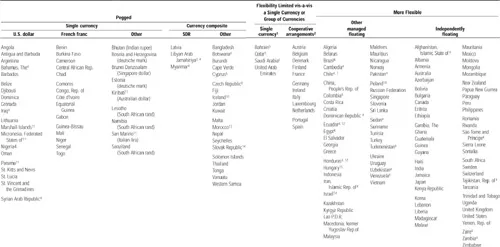
1 In all countries listed in this column, the U.S. dollar was the currency against which exchange rates showed limited flexibility.
2 This category consists of countries participating in the exchange rate mechanism (ERM) of the European Monetary System (EMS). In each case, the exchange rate is maintained within a margin of ±15 percent around the bilateral central rates against other participating currencies, with the exception of Germany and the Netherlands, in which case the exchange rate is maintained within a margin of ±2.25 percent.
3 The exchange rate is maintained within margins of ±47 percent.
4 Member maintained exchange arrangement involving more than one market. The arrangement shown is that maintained in the major market. For Zaire, note that the official name was changed to Democratic Republic of the Congo on May 17, 1997.
5 Exchange rates are determined on the basis of a fixed relationship to the SDR, within margins of up to ±7.25 percent. However, because of the maintenance of a relatively stable relationship with the U.S. dollar, these margins are not always observed.
6 The ex...
Table of contents
- Cover Page
- Title Page
- Copyright Page
- Fixed or Flexible? Getting the Exchange Rate Right in the 1990s
- Analysts agree that “getting the exchange rate right”
- From Fixed to Flexible
- Macroeconomic Performance Under Different Regimes
- Choosing a Regime
- Challenges Posed by Fast Growth and Capital Inflows
- Capital Account Convertibility
- Summary
- The Economic Issues Series
Trusted by 375,005 students
Access to over 1.5 million titles for a fair monthly price.
Study more efficiently using our study tools.