NONE

eBook - ePub
Building Integrated Economies in West Africa : Lessons in Managing Growth, Inclusiveness, and Volatility
- English
- ePUB (mobile friendly)
- Available on iOS & Android
eBook - ePub
Building Integrated Economies in West Africa : Lessons in Managing Growth, Inclusiveness, and Volatility
About this book
Information
Publisher
INTERNATIONAL MONETARY FUNDeBook ISBN
9781513511832
Year
2016Part I: Overview and Policy Setting
Chapter 1. Institutional Arrangements and Regional Integration
The West African Economic and Monetary Union (WAEMU) is a currency and a customs union. Improved competitiveness, economic convergence, common market, policy coordination, and law harmonization are the statutory objectives of the Union, which is led by the Conference of Heads of State and Government, its highest governing body. Achievements have been substantial, but much remains to be done. Several countries remain noncompliant with the convergence criteria, which were revised in 2015 and should be met by 2019. The WAEMU is moving toward harmonizing budget laws and procedures in member countries—including budget and accounting laws, laws governing public accounting, and the chart of accounts—although progress has been slow. Multilateral surveillance focuses on members’ compliance with convergence criteria and their compatibility with the Union’s monetary policy. The Union has achieved progress in pursuing a common market and has established a common external tariff, which was expanded and revised in 2015 to include all Economic Community of West African States (ECOWAS) countries. However, nontariff restrictions on regional trade still persist and not all impediments to the declared free movement of people and capital in the region have been eliminated. Finally, the WAEMU has common institutions responsible for the monetary policy and banking supervision for the region as a whole.
Institutional Setup
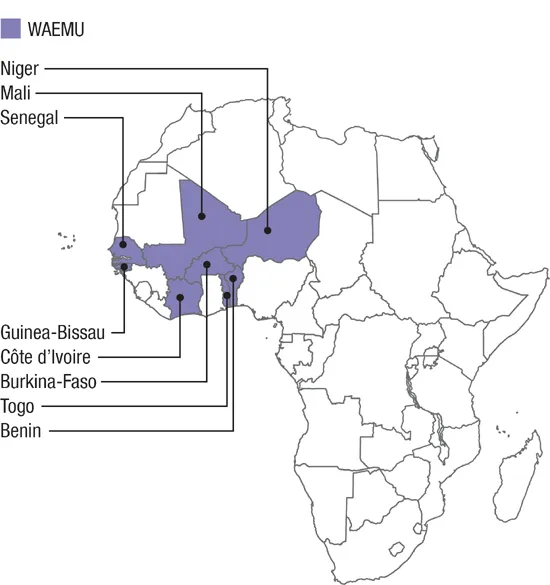
The WAEMU was created by a treaty signed at Dakar, Senegal, in 1994, by the heads of state and governments of Benin, Burkina Faso, Côte d’Ivoire, Mali, Niger, Senegal, and Togo. In 1997, Guinea-Bissau became the organization’s eighth (and only non-Francophone) member country. The WAEMU is a customs union and a currency union. Its objectives include greater economic competitiveness through open markets, in addition to the rationalization and harmonization of the legal environment; convergence of macroeconomic policies and indicators; creation of a common market; coordination of sectoral policies; and harmonization of fiscal policies. Key institutional arrangements are spelled out in the WAEMU Treaty.
The Union pursues the following objectives:
- Increasing the competitiveness of the member countries’ economic and financial activities in the context of an open, competitive market and a rational, harmonized legal environment
- Ensuring the convergence of member countries’ economic performance and policies through the institution of a multilateral surveillance procedure
- Creating a common market among member states, based on the free movement of persons, goods, services, and capital; the right of establishment of independent or employed professionals; a common external tariff; and a common trade policy
- Coordinating national sector policies through the implementation of joint actions and, eventually, common policies, particularly in the areas of human resources, regional planning and development, transportation and telecommunications, the environment, agriculture, energy, industry, and mines
- Harmonizing member countries’ laws—with an emphasis on tax laws—to the extent necessary for the orderly functioning of the common market
Historically, the WAEMU has started as a monetary institution. The West African Monetary Union (WAMU) was established in 1962 and reformed twice, in 1973 and 2010, to streamline its institutional architecture. The WAMU is organized around the following principles: a common currency, the Communauté Financière Africaine (CFA) franc; the free circulation of banknotes and coins and freedom of transfers among members of the Union; pooling of foreign currency reserve; the harmonization of monetary, banking, and foreign currency legislation (Figure 1.1).
Figure 1.1. Members of WAEMU
Note: WAEMU = West African Economic and Monetary Union.
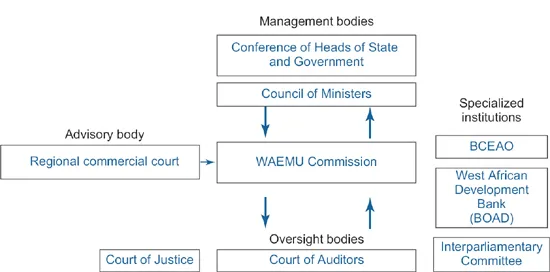
WAMU bodies include the Conference of Heads of State and Government, which is the supreme authority of the Union; the Council of Ministers, which is its executive body; the Banking Commission, responsible for the organization and supervision of credit institutions; and the Regional Council for Public Saving and Financial Markets, responsible for the organization and supervision of public offerings and for the licensing and supervision of participants in regional financial market. The Institutions of the WAMU are: the Central Bank of West African States (BCEAO), the common central bank, and the West African Development Bank (BOAD), whose mission is to promote the balanced development of the WAMU member states and contribute to their economic integration.
The 1994 WAEMU Treaty supplemented the monetary integration based in the WAMU Treaty with deeper economic integration. The WAEMU retained the same policy-making bodies and is managed by the same authorities as the WAMU. However, WAEMU has its own specific institutions, which are: the WAEMU Commission, which represents the overall interests of the community and its role consists in making policy proposals; Council of Ministers; the WAEMU Parliament; and the Court of Justice and the Court of Auditors, the WAEMU judicial review authority.
The primary objective of the WAEMU Treaty is economic integration, beyond the already existent monetary integration. In that context, the WAEMU Treaty seeks to broaden the scope of the community, notably through: creating a common, harmonized legal and fiscal environment; harmonization of fiscal policies; strengthening of the economic competitiveness of member states in the context of a market-based economy; and coordination of economic and sectoral policies.
This parallel functioning of the WAMU and WAEMU has a twofold objective. First, from a legal and political standpoint, the aim is to strengthen the principle of the supranational nature of community institutions, decisions, and instruments. The instruments enacted by the bodies of the Union to meet the objectives of this treaty, and in accordance with the rules and procedures contained therein, are implemented in all member states regardless of any previous or subsequent national legislation to the contrary. Second, the intent is to develop a common market over time. To that end, the WAEMU has provided for multilateral surveillance mechanisms and penalties with a view to harmonize economic policies. On the whole, both treaties are mutually reinforcing and are expected to be merged over time, in keeping with Article 112 of the WAEMU Treaty, which states that the Conference of Heads of State and Government shall adopt a treaty merging the WAMU Treaty with this WAEMU Treaty at the appropriate time (Box 1.1).
The budget for the Union is voted before the beginning of the fiscal year by a two-thirds majority of the Council. The budget includes all revenue of the Union and all expenditures of the institutions with the exception of the specialized autonomous institutions, the BCEAO, the BOAD, and the institutions involved in implementing common policies, and should be balanced. The resources of the Union are derived, among other things, from a fraction of the proceeds of the common external tariff and indirect taxes received throughout the Union. Additional taxes may also be introduced by the Union as needed. The Union may receive loans, subsidies, and external assistance compatible with its objectives. The resources of the Union are subject to the principle of financial solidarity and individual countries cannot claim equivalence between its financial contributions and the advantages it receives from the Union. The budget is executed by the WAEMU Commission.
Convergence Criteria
WAEMU members conduct economic policies to ensure sustainable convergence of their economic performance and establish the bases for sustainable growth. The Council adopts the rules required for the convergence of national economic policies and their harmonization with the regional monetary policy; establishes the rules, the terms of their application, and the timetable for their implementation; and determines the reference values for the quantitative criteria on which compliance with convergence rules is based. The Council reviews policies that relate to the economic objectives of member countries—particularly to the objectives for sustained growth and revenue collection, revenue allocation, sustainable current balance of payments, and improved international competitiveness. Common policies also take account of the need for consistency between fiscal policies and monetary policy objectives, particularly the objective of price stability.
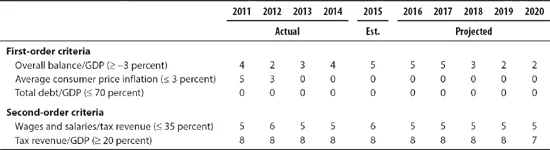
On January 19, 2015, the Conference of Heads of State and Government of the WAEMU adopted a new set of convergence criteria to be met by 2019. First-order criteria now include a ceiling on overall fiscal balance, a ceiling on average consumer price inflation, and a ceiling on total debt-to-GDP ratio. Second-order criteria include wages and salaries-to-tax revenue ratio and tax revenue-to-GDP ratio. The nonaccumulation of arrears, the limit on the current account deficit, and the floor on investment-expenditure-to-revenue ratio were eliminated from the list of criteria.
Box 1.1. WAEMU Governing Bodies
The WAEMU’s governing structure makes it possible to centralize monetary transactions while taking into account the economic and political interests of each member country.
Source: Banque de France (2015).
- The Conference of Heads of State and Government is the highest governing body of the WAEMU. This body defines the general framework for the policies of the Union and meets at least once year.
- The Council of Ministers implements the general framework defined by the Conference of Heads of State and Government and meets at least twice a year. The Council of Ministers is primarily convened in the form of the Council of the ministers in charge of economy, finance, and planning, but for the purpose of adopting decisions in other areas the Council convenes ministers responsible for these areas. The Council may delegate to the WAEMU Commission the enactment of regulations implementing the instruments it adopts.
- The WAEMU Commission promotes the orderly functioning and developments of the Union, executes the Union budget, collects information useful to the accomplishment of its mandate, prepares an annual general report and an action plan, and publishes the Official Bulletin of the Union. Commissioners are appointed by the Conference of Heads of State and Government based on expertise and personal integrity. They serve a renewable four-year term. Commission members perform their duties with full independence and in the general interests of the Union. They refrain from soliciting or accepting instructions from any government or organization. The decisions of the Commission are adopted by simple majority of its members.
- The Parliament provides democratic oversight of the bodies at the Union. The Parliament takes part in the Union’s decision-making processes and integration efforts in the areas covered by the WAEMU Treaty. The Parliament meets in two ordinary sessions per year. At the initiative of the Parliament or at its request, the Council president, the president and members of the Commission, the BCEAO governor, and the president of the BOAD may be heard by the Parliament. The president of the Commission submits a general report on the functioning and evolution of the Union to the Parliament each year for review. The Parliament may be dissolved by the Conference of Heads of State and Government of the WAEMU.
- The Court of Justice and the Court of Auditors are the judicial oversight bodies of the Union.
- The BCEAO and the BOAD serve as the specialized autonomous institutions of the Union. Without prejudice to the objectives attributed to them by the WAEMU Treaty, the BCEAO and the BOAD function independently toward the fulfillment of the objectives of the treaty. The governor of the BCEAO is entitled to participate in Commission meetings on an advisory basis, and may designate a representative for that purpose. The BCEAO governor may request that items be included on the Commission’s agenda or suggest to the Council of Ministers to invite the Commission to undertake an initiating within its mandate.
While progress has been achieved, compliance with convergence criteria remains uneven, particularly with the second-order criteria (Table 1.1).
Table 1.1 WAEMU: Compliance with New Convergence Criteria
(Number of Countries Noncompliant with Criteria)
Sources: WAEMU; BCEAO; and staff estimates and projections.
Under the convergence rules, any excessive deficit should be eliminated, and budget policies must respect a common discipline of supporting multiyear efforts toward fiscal consolidation and improving the structure of public revenue and expenditures.
As part of convergence, WAEMU countries are working towards harmonization of their fiscal policies. The aim is to reduce existing excessive disparities in the structure and amount of their respective tax structures. The Union is moving toward harmonizing budget laws and procedures, including budget and accounting laws and laws governing public accounting and the chart of accounts.
Multilateral Surveillance
Convergence in the WAEMU is monitored by members through the multilateral surveillance mechanism. For the purposes of multilateral surveillance, the WAEMU Commission issues decisions specifying the types of information required for surveillance, and members on a regular basis transmit it to the Commission, including statistical data and information relating to economic policy measures. The Commission prepares and publishes a semiannual execution report about its multilateral surveillance procedures. The report discusses the convergence of economic policies and their compatibility with the Union’s monetary policy.
The WAEMU Treaty specifies measures, which can be taken in principle, to promote compliance with regional convergence criteria. If a member country fails to satisfy the convergence requirements, the Commission can propose corrective measures, which should be adopted by the Council by two-thirds majority of its members. The member country, which fails to meet the convergence requirements, is required to prepare and implement a program of corrective measures.
The Council may enhance these procedures by implementing a range of explicit positive or negative measures. Positive measures include the publication of a communiqué from the Commission, the Union’s support in the search for financing required to execute the program of corrective measures, and priority access to the resources of the Union.
Negative measures (sanctions) may be applied if a member country has not prepared a corrective program, if such a program is not compliant with the Union economic pol...
Table of contents
- Cover Page
- Title Page
- Copyright Page
- Contents
- Foreword
- Acknowledgments
- Contributors
- Abbreviations
- Introduction: Lessons from the WAEMU: Findings and Recommendations
- PART I | OVERVIEW AND POLICY SETTING
- PART II | GROWTH AND INCLUSIVENESS
- PART III | FISCAL POLICY AND COORDINATION
- PART IV | REGIONAL MONETARY POLICY
- PART V | FINANCIAL DEVELOPMENT AND STABILITY
- PART VI | COMPETITIVENESS AND INTEGRATION
- Index
- Footnotes
Trusted by 375,005 students
Access to over 1.5 million titles for a fair monthly price.
Study more efficiently using our study tools.