NONE

- English
- ePUB (mobile friendly)
- Available on iOS & Android
eBook - ePub
Coordinated Portfolio Investment Survey Guide
About this book
Information
Publisher
INTERNATIONAL MONETARY FUNDeBook ISBN
9781557756060
Year
1996IV. Survey Notes of Individual Countries
Argentina
Institutions Responsible for Data Collection and Compilation
CPIS data were compiled and estimated by the National Directorate of International Accounts of the Argentine Ministry of Economy and Public Works and Services. The directorate is also responsible for compiling balance of payments statistics.
Legal Authority to Collect CPIS Data (Compulsory/Voluntary Reporting)
Some data were obtained from the records of domestic supervisory agencies having legal authority to collect information from supervised entities.
Survey Approach
The Argentine National Directorate of International Accounts conducted an aggregate survey of end-investors and supplemented survey data with estimates. The information consisted of data reported by selected categories of end-investors (banks, insurance companies, pension funds, and investment funds) to relevant supervisory agencies. (These investors generally submit supplementary data on investments in nonresident securities by means of appendices to balance sheet reports provided to supervisory agencies.) The information also included data—which were reported by other directorates—for the general government sector and estimates of the portfolio investment assets of the private nonfinancial sector. (Most of these assets were thought to be directly owned by entities located abroad and entrusted to nonresident custodians. The CPIS was the first instance in which such data were compiled for statistical purposes, and some types of data were collected for the first time. IMF-designed survey forms were not used. Records of supervisory agencies proved effective as existing sources of data.) The estimates were based mainly on the results of a survey of international financial experts, but BIS and partner country data were also used. The estimated component amounted to nearly US$24 billion and could not be allocated geographically. (Estimation methodologies are described in the Metodología de Estimación del Balance de Pagos of the Ministry of Economy and Public Works and Services.)
Coverage of Institutional Units by Sector
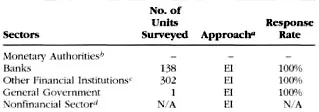
a EI (end-investor), CU (custodian), or BO (both end-investor and custodian)
b Securities held as reserve assets were not included in CPIS data.
c Pension funds, investment funds, and insurance companies
d The nonfinancial sector was not surveyed directly. Sector holdings of nonresident securities were estimated.
Exemption/Simplification Thresholds
No threshold was established for survey coverage.
Exclusion of Direct Investment
Data on direct investment were reported and collected separately; an attempt was made to ensure that data for the CPIS did not include direct investment positions.
Market Price Valuation
Respondents reported portfolio investments at market prices.
Treatment of Accrued Interest
Most respondents included accrued interest in market values.
Views of National Compilers on Accuracy of Reported Data
A major effort was made to cover portfolio investment assets of resident households. The prevalence of high risk during past decades encouraged the development of long-term positions in financial assets issued abroad and held through nonresident intermediaries. The mix of survey data and sectoral estimates of portfolio investment was thought to result in more reliable data. However, estimated components could not be geographically disaggregated, and this lack of detail diminished the quality of the data.
Australia
Institutions Responsible for Data Collection and Compilation
CPIS data were collected and compiled by the Australian Bureau of Statistics (ABS), which is also responsible for the compilation of balance of payments and IIP statistics.
Legal Authority to Collect CPIS Data (Compulsory/Voluntary Reporting)
The Census and Statistics Act of 1905 provided the authority to conduct the CPIS on a compulsory basis. This legislation permitted Australian statisticians (or their delegates) to issue, if necessary, a “Notice of Direction” that instructs a person or organization to provide the information requested by a specific date. If compliance does not result, the matter may be referred to the director of public prosecutions for settlement through the courts. However, the ABS has always preferred to seek the cooperation of people and businesses being surveyed, and the vast majority of respondents recognized the importance of official statistics to the community and provided the required information without recourse to the compulsory powers available under the law.
Survey Approach
The ABS collected aggregate data from custodians and end-investors. Information for the CPIS was collected through the regular, quarterly Survey of International Investment (SII) covering large units that collectively account for approximately 90 percent of the nonresident investment in Australia and Australian investment abroad. In addition, a special collection of data was taken from all smaller resident enterprises known to have relevant portfolio investment activity. (In keeping with the SII methodology prevailing at the time, such enterprises were usually surveyed annually at the June 30 fiscal year end.) The regular, aggregate SII collection was deemed to provide, in terms of coverage and accuracy, satisfactory quarterly outputs. Some minor adjustments were made to comply with CPIS requirements. Collection, on a security-by-security basis, of information from custodians was investigated but proved to be impractical.
Coverage of Institutional Units by Sector
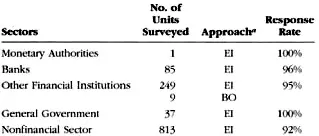
a EI (end-investor), CU (custodian), or BO (both end-investor and custodian)
Exemption/Simplification Thresholds
No threshold was established for survey coverage. For holdings of nonresident, short-term debt securities, data obtained from the SII were combined with estimated contributions from smaller units. (Information on small units that were not sampled was extrapolated from census data obtained one year earlier.)
Exclusion of Direct Investment
Respondents were asked to record separately data for direct investment and portfolio investment. Guidance notes to the CPIS provided clear definitions of direct investment, direct investment relationships, and portfolio investment. Respondents were required, for each instrument, to record separately the particulars of nonresident direct investors, direct investment groups residing abroad, and other nonresident investors. This method of reporting further emphasized the distinctions and relationships among these three categories.
Market Price Valuation
Respondents were asked to report portfolio investments at market prices. Guidance notes to the CPIS described possible methods for determining market value in the absence of market price data. Positions denominated in foreign currencies were converted to Australian dollars at the midpoints of appropriate buy and sell rates applicable on the reference dates.
Treatment of Accrued Interest
Respondents were asked to report market prices that did not include accrued interest. Accrued interest was added to market prices to obtain market value positions.
Country Attribution of Portfolio Investment Assets/Liabilities
Respondents were asked to identify the countries in which immediate nonresident creditors or debtors resided. For assets, these attributions were accurate parallels to countries of issuers. However, it was not possible to determine the countries of ultimate beneficial owners...
Table of contents
- Cover Page
- Title Page
- Copyright Page
- Preface
- Contents
- I. Introduction
- II. Allocation of Portfolio Investment Assets Among Major Partner Countries
- III. Tables Showing CPIS Data of Individual Countries
- IV. Survey Notes of Individual Countries
- V. Bibliography
- Footnotes
Trusted by 375,005 students
Access to over 1.5 million titles for a fair monthly price.
Study more efficiently using our study tools.