NONE
- English
- ePUB (mobile friendly)
- Available on iOS & Android
eBook - ePub
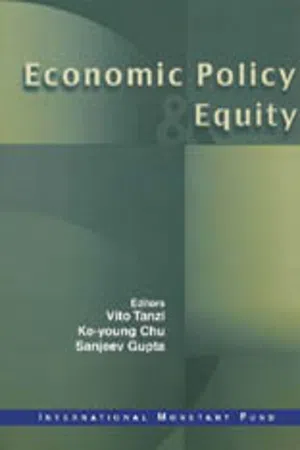
Economic Policy and Equity
About this book
Information
Publisher
INTERNATIONAL MONETARY FUNDeBook ISBN
9781557757883
Year
19991 Introduction
Revisiting a topic that had been the subject of a largely analytical focus in a 1995 conference, the IMF’s Fiscal Affairs Department on June 8–9, 1998, hosted a conference on “Economic Policy and Equity.” The sessions spotlighted the participants’ perspective and reflected an increasing concern within the IMF on how its policy advice to members could be better designed and implemented to promote and sustain equitable growth. With the participation of academics, labor leaders, and clergy as well as policymakers, the wide-ranging discussions underscored the importance of, and the synergy between, sound policies and good governance for establishing and maintaining an equitable society. The panels also highlighted the increasingly critical role that popular support plays in successfully implementing major reforms.
In his opening remarks, Stanley Fischer, the IMF’s First Deputy Managing Director, posed four questions to frame the discussion:
- How widespread is the increasing trend in income and consumption inequality across the world?
- Has globalization tended to increase or reduce inequality within countries?
- Do income redistribution policies necessarily slow economic growth?
- What are the most effective policies for promoting equity?
Economic Policy and Equity: An Overview
In the opening session, Amartya Sen emphasized that equity should not be viewed narrowly as an issue of equitable income distribution. Equity has many dimensions, including an individual’s ability to perform valuable functions in society and to take part in the life of the community. Because equity is multidimensional, neither a single indicator nor a single best policy prescription can address the multitude of equity concerns. Income inequality cannot be the most important aspect of equity, and economic policy should be mindful of nonincome aspects of equity, such as educational achievements, health care, and nutritional status. Economic policy should also be concerned with identifying instances of patent injustice (e.g., famines), on which reasoned agreement is possible, rather than with achieving improvements in a single indicator of equity.
A full appreciation of the multidimensional character of equity would help policymakers design better-informed equity-enhancing policies. For example, India has a lower income inequality than the People’s Republic of China, but a higher rate of illiteracy, infant mortality, and malnutrition. Europe has lower income inequality than the United States, but a higher unemployment rate with all its associated deprivations. South Asia in 1991 had a higher life expectancy and median age at death than sub-Saharan Africa, but it also had a higher share of undernourished children as well as a substantially higher antifemale bias in child mortality. Policymakers should give priority to removing inequities that directly impoverish human life, such as premature mortality, undernourishment, unemployment, and widespread illiteracy.
Serious deprivations can also marginalize countries in an increasingly integrated world. Globalization provides an opportunity and a challenge, and this challenge is more difficult to meet in countries where the population has low literacy rates and lacks adequate nutrition and medical care.
Commenting on Sen’s paper, Nicholas Barr said that any equity checklist should also include security. Insecurity about future outcomes (e.g., unemployment, disability) lowers individuals’ welfare and prompts them to buy private insurance. However, if the market fails to offer adequate insurance, governments should provide insurance schemes in addition to social safety nets. He further emphasized the interaction between various dimensions of equity and health outcomes.
Monsignor Diarmuid Martin welcomed the broadening of the concept of equity. Successful economic policies require finding new ways to invest in human capital as well as allowing social institutions that build human capital to flourish. The poor must be empowered to participate in society, and social safety nets should be a central part of economic policy.
Alicia Munnell reminded participants that wide income disparities may be the price of a vibrant economy. These income disparities are more readily tolerated, she said, if wealth is perceived as the product of talent and effort and if opportunity affords economic mobility. She further added that sound macroeconomic policies are important to keep the economy operating at full capacity.
Finally, Guo Shuqing suggested that—despite the fact that equity is a multidimensional concept—income inequality is still an important indicator, especially when income is defined broadly to include subsidies and in-kind benefits. For instance, in the People’s Republic of China, wages are low but in-kind benefits and subsidies are large.
Equity Issues in a Globalizing World: The Experience of OECD Countries
Keynoting the second session of the conference, Anthony Atkinson found that the statistical evidence shows a variety of national experiences, with income inequality increasing in the United States, the United Kingdom, Germany, and Japan, while remaining broadly stable in Canada, France, and Italy. He noted that observers have attempted to explain rising income inequality in some of these Group of Seven (G-7) major industrial countries by the shift toward skill-intensive technology and the liberalization of international trade. However, these forces have affected all G-7 countries, yet income distribution trends have differed. This diversity of results proves that the introduction of skill-intensive technologies and trade liberalization are not the only determinants of income distribution.
Atkinson suggested that changing social norms have had an impact on income distribution by determining how much inequality is socially acceptable. These norms have also shaped government policy, which has had a further impact on income inequality through tax and expenditure decisions. Although globalization may have restricted governments’ freedom to design tax and transfer programs, there is still much governments can do and have done to affect income distribution. In fact, Atkinson concluded that the variation in government policies combined with the diversity in social norms explain a large part of the differing trends in income distribution across G-7 countries since the 1970s. If globalization has imposed limits on government policy, he argued, these limits are largely political in nature.
In her comments, Irma Adelman noted that the changes in the Gini coefficient (a standard measure of income inequality) were “shockingly large”—too large to be laid solely at the doorstep of globalization. But globalization may severely limit governments’ ability to affect income distribution; in particular, she argued that developing countries may have lost control over exchange rate policy, interest rate policy, and social and transfer policy.
Nancy Birdsall remarked that the Atkinson paper left her “more worried than ever” about income inequality in Latin America. Trade liberalization and deregulation has increased returns to existing assets (including education), thereby enhancing income differentials further. The resulting social acceptability of income inequality has led to an “unequal equilibrium trap.”
Susan Collins argued that—at least in the United States—“measurable” differences in the skill levels of workers can explain only one-sixth of the increase in income inequality. This, she suggested, left ample room for government to mitigate income inequality with enlightened social programs, including health care, education, and social safety nets. Finally, Archbishop Oscar Rodriguez Maradiaga argued that individual freedom does not negate the ethical duty, and anthropological obligation, of solidarity in promoting equity. Solidarity entails a responsibility of individuals and policymakers to design and implement programs where poverty reduction is the central concern.
Picking up the theme of equity in a globalizing economy in his luncheon address, Lawrence Summers stressed that while the global economy offered enormous potential, people must believe this extraordinary transformation “works for them.” For the developing countries, this will mean addressing fears that market-led development breeds inequality. In the advanced economies, it will mean confronting concerns that the unskilled will be impoverished. Summers argued that just as governments have enormous power to affect how fast an economy grows, so can they shape how equitably it grows. Though globalization need not breed inequality, it does reinforce the need to pursue the “right” policies to reduce income inequality (investment in human capital and basic infrastructure) and discourage the “wrong” policies (protection and distortionary state controls). As never before, Summers argued, government decisions determine society’s fate.
Addressing Equity Issues in Policymaking
How have policymakers dealt with equity issues and are there any policy lessons? Two case studies were presented in the third session of the conference. Eduardo Aninat examined the experience in Chile, suggesting that prudent macroeconomic policy, including sound fiscal policy, helped reduce poverty. By prepaying its foreign debt and saving on interest payments, Chile reduced its debt service, which created room in the budget for equity-enhancing spending on basic education and health. Declining inflation raised real incomes and created a “lower-inflation dividend,” which directly benefited the poor and those who live on incomes not indexed to inflation. Macroeconomic stability and economic growth helped raise tax revenue. As a result, the amount of resources available for social expenditure increased. Efforts were also made to improve the efficiency and composition of social expenditure, as well as its targeting to low-income groups. Chile’s government has also focused on expanding equality of opportunity, including the distribution of wealth-generating factors, especially education, as a long-term strategy to lower income inequality. Income inequality, however, has so far remained roughly stable.
Grzegorz Kolodko recounted the diverse experience in transition economies, with particular emphasis on Poland. He noted that extraordinary economic contraction and rising inequality, in sharply varying degrees, has characterized the transition process in virtually all the countries of Central and Eastern Europe. In most of these countries, the movement of labor from the public to the private sector translated productivity differentials into wage differentials, thereby increasing income inequality. The removal of subsidies, the rise in unemployment, the inflation tax, and fraudulent financial schemes also contributed to growing poverty and income inequality.
Although systemic shocks have played an important role in transition economies, Kolodko argued that so too have policy errors. He counseled policymakers in similar circumstances to tolerate higher inequality in the short term to boost national savings and thus contribute to higher long-term growth. There is no substitute for growth, he said, though safety nets help in the short term. Kolodko suggested combining appropriate macroeconomic policies with effective social safety nets to mitigate the hardships of transition.
One common theme in the two case studies was the importance of public consensus and political support for sustainable reforms. In the case of Chile, the building of a broad-based social consensus on government policies ensured the sustainability of economic reforms and that the country did not revert to “stop-and-go” policies that undermine economic stability, hurt long-term growth, and prevent a reduction in income inequality. The experience of transition economies indicates that formulation of equitable policies requires that the dialogue between the government and the international institutions include trade unions and those most directly affected by government policies. In Poland, policy errors—particularly in the early stages of privatization—contributed to rising inequality.
Mikhail Dmitriev sounded a note of caution on the ease with which government policies can mitigate income inequality. He noted that the pattern of transfers in Russia is currently very regressive. However, it is difficult to reform these programs, because the current beneficiaries of government transfers resist policy reforms aimed at reducing their benefits. Moreover, personal income and payroll taxes are primarily paid by low- and middle-income workers, while severe budget revenue shortfalls result in highly regressive expenditure arrears.
Even government policies with no apparent tie to equity may help a great deal in promoting it. For example, Santiago Levy emphasized the link between banking crises and equity. The impact of banking crises can be regressive if the associated fiscal costs displace social spending. Consequently, governments should strive to develop a well-functioning regulatory framework for the financial sector, particularly during capital account liberalization.
Maria Ramos was more optimistic about the ability of governments to pursue policies that are directly or indirectly equity-enhancing. For example, the improvement of tax administration and privatization revenues are helping the South African government raise the resources necessary to increase infrastructure investment and improve the quality of social programs. The government is also working closely with the church and other groups to ensure that expenditure programs are more participatory and have the intended results.
Arjun Sengupta welcomed the increased emphasis by the IMF on improving the composition of public expenditures and providing adequate social safety nets. He also emphasized the need to carefully tailor policies to address the particular manifestations of inequity faced by different countries or even different regions within a country.
Policy Responses: Design and Implementation
The aim of the fourth session of the conference was to identify the facets of political economy that constrain the design and implementation of equity-enhancing policies. In his paper, Aníbal Cavaco Silva noted that in European Union countries the objective of reducing income inequality and combating social exclusion tends to rank higher on politicians’ equity agenda during electoral campaigns than when they are in office. Despite politicians’ and electorates’ concern for equity, the high costs of implementing redistributive measures and the inability to affect income inequality in the short run tend to force a change in the equity agenda. Moreover, globalization and tax competition, as well as the unsustainability of the present social security and welfare system, impose constraints on traditional tax-and-transfer policies.
As a result, Cavaco Silva suggests that equity-enhancing measures should be redesigned in a way that persuades politicians to include them in their policy agendas. Initiatives that are more likely to be accepted by politicians include incentives to increase employment opportunities (e.g., lower taxes on labor, job subsidies), investment in human capital to improve employment prospects (e.g., education, vocational training, apprenticeship schemes), and reform of the social security and welfare system. Greater flexibility in labor markets is also needed to improve the efficiency and competitiveness of the economy. The importance of an appropriate and fiscally sound social safety net to accompany labor market reforms, and indeed most macroeconomic and structural reforms, cannot be overstated.
In the experience of European Union countries, programs that target the poorest segments of society have a better chance of being accepted by voters and politicians and tend to produce better results at lower cost if implemented at the local level. The involvement of private and voluntary institutions in the implementation of welfare programs also helps to improve their quality and cost-effectiveness.
One of the core roles of governments is to provide social safety nets and reduce market-induced inequalities. Alberto Alesina argued in his presentation that governments fail to achieve this goal because they tend to gravitate toward one of two extreme equilibria. Developed countries gravitate toward a large government with a high tax burden that impedes growth, whereas developing countries gravitate toward a small government that lacks the revenue and political will to provide adequate infrastructure and an effective social safety net. Self-sustained political and economic forces push governments toward the two extremes of the spectrum. Therefore, the reforms needed to reduce poverty and income inequality should take different forms in different countries. Alesina suggested that OECD countries should reduce the extent and coverage of the welfare state, move toward fully funded pension schemes, and increase labor market flexibility. Developing countries, on the other hand, should raise more revenue and improve the composition of government expenditure, focusing more closely on the provision of well-targeted social safety nets that have political support. To be successful, reforms in developing countries will likely require a reduction in corruption and an increase in government efficiency.
In her comments, Chia Siow Yue cited Singapore’s tremendous social mobility and culture of self-reliance, but noted that continuing globalization will place added emphasis on human resource development. She portrayed the current situation in Asian countries as one in which the traditional role of the extended family and the community was being eroded by modernization and not being replaced by the state.
Ravi Kanbur observed that as underlying income inequity decreased in OECD countries during 1950–80, redistributive efforts increased. The same inverse relationship held in the 1980s and 1990s, although in this period redistributive efforts declined as underlying income inequality grew. As the impact of globalization on industrial country workers widens, Kanbur theorized that some redistributive measures would need to be taken.
Archbishop Njongonkulu Winston Ndungane emphasized the international dimension of inequality. He stressed the key role that debt cancellation could play in giving Africa a fresh start and allowing the continent to channel its considerable resources to the task of development. He also emphasized the need for good governance, accountability, transparency, and competence of policymakers.
Guillermo ...
Table of contents
- Cover Page
- Title Page
- Copyright Page
- Contents
- Foreword
- Acknowledgments
- 1 Introduction
- Part I. Perspectives on Economic Policy and Equity
- Part II. Globalization and Equitable Growth
- Part III. Equity-Oriented Policymaking: Country Experience
- Part IV. Policy Responses: Design and Implementation
- Part V. Roundtable Discussion
- Participants
- Index
- Footnotes
Trusted by 375,005 students
Access to over 1.5 million titles for a fair monthly price.
Study more efficiently using our study tools.