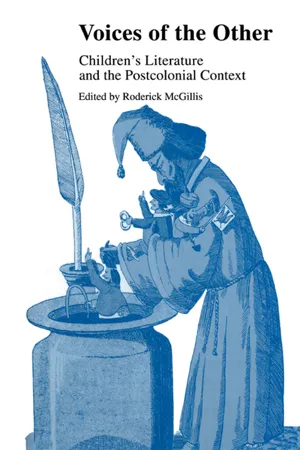
This book offers a variety of approaches to children's literature from a postcolonial perspective that includes discussions of cultural appropriation, race theory, pedagogy as a colonialist activity, and multiculturalism.
The eighteen essays divide into three sections: Theory, Colonialism, Postcolonialism. The first section sets the theoretical framework for postcolonial studies; essays here deal with issues of "otherness" and cultural difference, as well as the colonialist implications of pedagogic practice. These essays confront our relationships with the child and childhood as sites for the exertion of our authority and control. Section 2 presents discussions of the colonialist mind-set in children's and young adult texts from the turn of the century. Here works by writers of animal stories in Canada, the U.S. and Britain, works of early Australian colonialist literature, and Frances Hodgson Burnett's A Little Princess come under the scrutiny of our postmodern reading practices. Section 3 deals directly with contemporary texts for children that manifest both a postcolonial and a neo-colonial content. In this section, the longest in the book, we have studies of children's literature from Canada, Australia, Africa, the Caribbean, and the United States.
- 316 pages
- English
- ePUB (mobile friendly)
- Available on iOS & Android
eBook - ePub
About this book
Information
CHAPTER 1
Rethinking the Identity of Cultural Otherness: The Discourse of Difference as an Unfinished Project
SHAOBO XIE
Every time consciousness breaks with its past, it renews itself through identifying with an “other’s” thought. To speak from an other’s thought is to redefine and renarrativize the world. The critical mind’s recent turn to postcolonialism aims to rethink, recuperate, and reconstruct racial, ethnic, and cultural others that have been repressed, misrepresented, omitted, stereotyped, and violated by the imperial West with all its institutions and strategies for dominating the non-Western. Indeed, the world over the last four hundred years has been dominated by an asymmetry of power relations between West and non-West. Only recently have those other peoples and cultures begun to make their voices heard. Following the postmodern dissolution of the West, postcolonial narratives or counternarratives have emerged in large numbers, interrogating and investigating the history of encounters between metropolis and periphery, colonizer and colonized, and dismantling imperial structures of knowledge and feeling in the realm of culture.
Like all other counterhegemonic projects, postcolonialism recuperatively celebrates and theorizes the experience of otherness as a matrix of counterhegemonic agency. The emergence of postcolonial narratives dialectically marks a complex historical moment. On the one hand, it testifies to a changed world characterized by increased tolerance and understanding of racial and cultural difference; on the other, it unmistakably mirrors a world saturated with imperialist ideas, stereotypes, and narratives. In this view, postcolonialism as a powerful, systematic critique of the Eurocentric “Grand Narrative” of history is best assessed as a mere beginning. Indeed, it will take a protracted, arduous neo-Gramscian project to educate a world burdened with four hundred years of coloniality. Instead of having completely emancipated itself from imperialism, the world remains caught up in neocolonialism or the “hegemonic phase” of imperialism (JanMohamed 62). This is why, as I have argued elsewhere, the postcolonial “does not signify the demise or pastness of coloniality; rather, it points to a colonial past that remains to be interrogated and critiqued”; the postcolonial project as such is “more formal and symbolic yet more thorough and subversive in addressing colonialism than anticolonialism has been” (Xie 15).
Underwriting all postcolonial counterhegemonic projects is the urgent need to redefine and reconstruct the identity of the (neo)colonial other, to “force a radical rethinking and reformulation of forms of knowledge and social identities authored and authorized by colonialism and western domination” (Prakash 8). The reformulated identity of social and cultural otherness has radically altered our conceptual knowledge of the world. When Julia Kristeva asserts the Freudian unconscious as the recalcitrant facet of the self, she teaches us how the “foreigner is within us. And when we flee from or struggle against the foreigner, we are fighting our unconscious” (191). More recently, in reconceiving our true identity as self-otherness, Roderick McGillis convincingly rehabilitates otherness as part of the self. “[T]o enter the world of another,” he said, “we ourselves must become ‘Other’ than we are. We are always faced with the ‘Other.’ We cannot escape otherness.” To read, to live in language and society, is to “share a oneness with others” (“Self” 223). When Homi Bhabha relaunches the colonial sign or subject as diffèrance, recuperating the emancipatory counterhegemonic potential from the ambivalence of the cultural subject, he describes the identity of both self and other as hybrid. Indeed, cultural hybridity, postcolonial, diasporic, and migrant in nature, is perhaps the most damaging of all threats to the hierarchical syntax of Western imperialism. In reasserting Derridean diffèrance on postcolonial terrain, Bhabha offers a conceptual framework for analyzing the hitherto marginalized grey, ambiguous space of culture, redefining the colonial subject and the colonial discourse in terms of the in-between, and more importantly, mobilizing indeterminacy of colonial discourse into agency of counterhegemonic resistance.
All these new conceptions of otherness shock us into a renewed perspective on the relationship of self and other. They point to the complexity and multipositionality of identity, reformulating the issue of identity as a matter of difference, hence challenging us to move beyond reductive binary structures of knowledge. For all these enabling reconstructions of social and cultural spaces, however, the counterhegmonic project of otherness politicized as racial/ethnic difference is far from fulfilling itself. For there still remain attempts to subjugate otherness to the imperialism of sameness, and the hegemonic West still tries to reduce radical cultural/racial difference to manageable proportions.
In his recent book Literary Theory and the Claims of History, for example, Satya P. Mohanty questions whether it is useful or necessary “to conceive the Other as a radically separable and separate entity in order for it to command our respect” (121). He is opposed to poststructuralist cultural relativism that celebrates “discontinuity,” “difference and heterogeneity,” and “plurality as opposed to reductive unities.” For “to radicalize the idea of difference” (120), to advocate “the plurality of criteria of judgment and rationality” (129), would deny common ground between different cultures. Mohanty refutes the idea that “individual elements of a given culture must be interpreted primarily in terms of that culture, relative, that is, to its own unique system of meanings and values” (122). In his view, the commonality between different cultures and peoples derives from their “capacity to act purposefully” and from the fact that “the human being is in principle capable of agency and basic rationality” (139). The binding universal humanity between us and them is, Mohanty argues, that “we possess the capacity for a certain kind of second degree thought, that is, not merely the capacity to act purposefully but also to reflect on our actions, to evaluate actions and purposes in terms of larger ideas we might hold about, say, our political and moral world or our sense of beauty or form” (139). As is well known, Western modernism rests on two assumptions—universal rationality and objective truth—in its endeavor to repress internal and external others. Mohanty’s conception of cultural otherness threatens to homogenize differential otherness. Although his speculative circumspection seems to intend to reconstruct and rehabilitate indigenous otherness into cultural discourse, his reiteration of cultural commonality and universal rationality tends to subsume cultural marginalises into the imperialism of the same.
Mohanty’s overemphasis on commonality between different cultures prioritizes identity over difference. There are no doubt certain universal traits shared among separate cultures, and difference always presupposes sameness between disparate entities. But what constitute their distinct, peculiar character and their differential relationship are differences instead of commonalities. Mohanty’s position on binding universal humanity recalls Northrop Frye’s privileging of primary over ideological concerns. Frye abstracts a universal desire from disparate cultural texts to prove the continuity between the historical past and the present, and between different individuals and social classes. His Utopian vision of history insists on universal values and the collective unity of society. In Frye’s terms, the Utopian privileges the primary concerns of human life while the ideological foregrounds its secondary concerns. Frye considers primary concerns in terms of universal and eternal needs, and secondary concerns as “patriotic and other attachments of loyalty, religious beliefs, and class conditioned attitudes and behaviour” (Frye 42). But Frye’s narrative framework proves insufficient to analyze historical specificity and conflicted relationship between times and cultures.
The same can be said of Mohanty’s theory of universal commonality. Mohanty’s rhetoric is suspiciously informed by a nostalgia for the imperialism of the same, or for what Derrida terms “white mythology.” In Derrida’s view, the Europeans take their own mythology, their own logos, the mythos of their idiom, for the universal form of what they must call reason (Margins 213). Mohanty’s incorporating of the indigenous into identity discourse through the entrance of neutralized or diminished difference threatens to coerce racial/cultural others into “a hierarchically organized (my italics) relationship in which the same is what rules, names, defines, and assigns ‘its’ other” (Cixous and Clement 70). In the following, I will argue that the postcolonial discourse of difference must be conceived as an unfinished project, for only through celebrating and legitimizing difference can the uncanny, alien otherness be recognized, accepted, and appreciated. It is well arguable that difference must be posited as the grounding reality of the world at the present moment of history. In order for cultural difference to be truly rehabilitated, we must demonstrate how it has been violated and reduced to the status of marginality, and what discursive mechanics Western imperialism has deployed in keeping the other under control. Finally, I will demonstrate that if difference has been used as the reason for Western empires’ conquering of the indigenous, then we must now turn difference into a fountainhead of counterhegemonic agency.
Let’s first take a look at the hierarchical structure of West and non-West as encountered in Conrad’s Heart of Darkness. Marlow tells his audience that he and his crew
penetrated deeper and deeper into the heart of darkness.… We were wanderers on a prehistoric earth, on an earth that wore the aspect of an unknown planet.… The prehistoric man was cursing us, praying to us, welcoming us—who could tell? We were cut off from the comprehension of our surroundings; we glided past like phantoms, wondering and secretly appalled, as sane men would be before an enthusiastic outbreak in a madhouse … we were travelling in the night of first ages, of those ages that are gone, leaving hardly a sign—and no memories. (51)
Here, Western man is confronted with an uncanny, disturbing, impenetrable, prehistoric, primitive, evil other whom he has no terms for comprehending and categorizing. One may have to agree with Fredric Jameson that the indigenous African is feared “because he is Other, alien, different, strange, unclean, and unfamiliar” (Political Unconscious 115). Such dismaying otherness causes an existential fear of the unknown, of what Heidegger terms the “recalcitrant earth,” which is formless, undecided, measureless, and impenetrable. This amorphous earth is demonic, degraded, chaotic, irrational, and evil. In Western philosophy, culture or civilization is always opposed to nature or primitivity. Culture refers to norm, canon, and modernity; nature designates whatever is unwholesome, irrational, coarse, uncultivated, remote, anthropologically unfamiliar. This culture/nature opposition was redeployed in the confrontation between European metropolis and non-European peripheral countries in the nineteenth century, the latter being assigned to the side of underdeveloped, demonic nature. Just as culture is to conquer nature, so Enlightenment Reason is to conquer barbarity. This is how Western modernity justifies its supremacy over indigenes in the world.
Such violent hierarchy of imperialism becomes reproduced in E. M. Forster’s A Passage to India, in which Fielding, the school principal who displays genuine sympathy and friendship for Indians, sees the buildings of Venice stand
in the right place, whereas in poor India everything was placed wrong. He had forgotten the beauty of form among idol temples and lumpy hills; indeed, without form, how can there be form? Form stammered here and there in a mosque, became rigid through nervousness even, but oh, these Italian churches!… the harmony between works of man and the earth that upholds them, the civilization that has escaped muddle, the spirit in a reasonable form.… The Mediterranean is the human norm. (278; my own italics)
This passage portrays an exemplary moment of aesthetic imperialism: there is no thought and beauty of form in Indian culture. Actually what Fielding is lamenting is not so much the absence of form in Indian landscape and architecture, as the absence of the familiar, Western kind of landscape and architecture. What shocks me is that this otherwise amiable, gentle, understanding, compassionate schoolmaster should so guiltlessly reproduce such blatant imperialist gestures. The most striking feature of the Forster novel is the pervasive ubiquitous mood, an enveloping, symbolic atmosphere of uncanny feeling, mysterious landscape, and impenetrable meaning. The landscape of India can be read as the personification of the Indian mind. As JanMohamed has pointed out, “[Forster] characterizes India as a land of pathos, of an ontological homesickness, a land that knows ‘the whole world’s trouble, to its uttermost depth’ ” (75); and the “pathos is embodied in the Marabar Hills and Caves and is characterized by their eternal ambiguity … Forster takes some pains to establish, through the discussion about the mounds and a snake, that the Indian mind is steeped in and thrives on ambiguity” (75). Forster describes the Marabar caves in these terms: “And if several people talk at once an overlapping howling noise begins, echoes generate echoes, and the cave is stuffed with a snake composed of small snakes, which writhe independently” (159). It is impossible to “romanticize the Marabar, because it robbed infinity and eternity of their vastness, the only quality that accommodates them to mankind” (161). What the caves represent is the prehistoric, mysterious, impenetrable, and the unrepresentable, formless, and meaningless. The Eurocentrist notion of non-Western others as degraded, uncanny, and prehistorical is both the cause and the result of Western historicism.
The West names the non-Western other as prehistoric and formless because the latter falls outside the orbit of Western historicism, and because its aesthetic tastes and principles are repulsively different. The Eurocentric construction of knowledge, Robert Young writes, “operates through forms of expropriation and incorporation of the other,” reproducing “at a conceptual level the geographical and economic absorption of the non-European world by the West” (3). In this sense, Western “philosophy reduplicates Western foreign policy” (14). What Western imperialism deals with is its own projections and fantasies about the indigenes instead of the indigenous truth. If the indigenous other is deprived of his historically formed difference and forced into the straitjacket of universal reason, then the other, “in manifesting himself as a being, loses his alterity” (Levinas 346). For Western knowledge or theory to master the alien, intransigent, uncanny other, the latter has to be castrated of its virile difference to become “part of the same” (Young 13).
Such power relations between West and non-West have been perpetuated until recently when critics like Foucault called upon the world to break out of the imperialist logic of modernism. It has “to be asked of the West,” Foucault suggested, “what entitles its culture, its science, its social organization, and finally its rationality itself, to be able to claim universal validity: was this not a mirage associated with economic domination and political hegemony?” (qtd. in Young 9). Indeed, Western imperialism managed to subjugate non-Western others to its historicist metanarratives because of its military and technological superiority brought about by the emergence of capitalism.1 What Simon During says in discussing Lyotard’s conception of modernity is helpful here: “the modern is marked by the mergence of instrumental reason. In modernity, criteria of what [Lyotard] calls ‘performaticity’ overcome appeals to tradition or metaphysical truth. What counts is not why an act is done or why a thought is thought, but how efficiently and to what immediate end. Applied sc...
Table of contents
- Cover
- Halftitle
- Title
- Copyright
- Dedication
- Contents
- General Editor Foreword
- Preface
- Contributors
- Introduction
- Section 1: Theory
- Section 2: Colonialism
- Section 3: Postcolonialism & Neocolonialism
- Afterword: The Merits and Demerits of the Postcolonial Approach to Writings in English
- Index
Trusted by 375,005 students
Access to over 1.5 million titles for a fair monthly price.
Study more efficiently using our study tools.
Frequently asked questions
Yes, you can cancel anytime from the Subscription tab in your account settings on the Perlego website. Your subscription will stay active until the end of your current billing period. Learn how to cancel your subscription
No, books cannot be downloaded as external files, such as PDFs, for use outside of Perlego. However, you can download books within the Perlego app for offline reading on mobile or tablet. Learn how to download books offline
Perlego offers two plans: Essential and Complete
- Essential is ideal for learners and professionals who enjoy exploring a wide range of subjects. Access the Essential Library with 800,000+ trusted titles and best-sellers across business, personal growth, and the humanities. Includes unlimited reading time and Standard Read Aloud voice.
- Complete: Perfect for advanced learners and researchers needing full, unrestricted access. Unlock 1.5M+ books across hundreds of subjects, including academic and specialized titles. The Complete Plan also includes advanced features like Premium Read Aloud and Research Assistant.
We are an online textbook subscription service, where you can get access to an entire online library for less than the price of a single book per month. With over 1.5 million books across 990+ topics, we’ve got you covered! Learn about our mission
Look out for the read-aloud symbol on your next book to see if you can listen to it. The read-aloud tool reads text aloud for you, highlighting the text as it is being read. You can pause it, speed it up and slow it down. Learn more about Read Aloud
Yes! You can use the Perlego app on both iOS and Android devices to read anytime, anywhere — even offline. Perfect for commutes or when you’re on the go.
Please note we cannot support devices running on iOS 13 and Android 7 or earlier. Learn more about using the app
Please note we cannot support devices running on iOS 13 and Android 7 or earlier. Learn more about using the app
Yes, you can access Voices of the Other by Roderick McGillis in PDF and/or ePUB format, as well as other popular books in Literature & Literary Criticism. We have over 1.5 million books available in our catalogue for you to explore.