- 360 pages
- English
- ePUB (mobile friendly)
- Available on iOS & Android
eBook - ePub
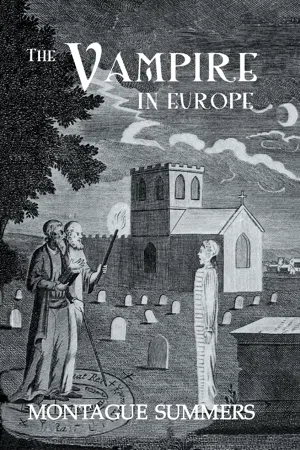
The Vampire In Europe
About this book
First published in 2005. The dark but endlessly fascinating and enduring tradition of the Vampire is here focused on Europe, particularly in ancient Greece and Rome, England and Ireland, Hungry and former Czecho-Slovakia, Russia, Romania and Bulgaria. Our forefathers, back to ancient times, were just as obsessed with the vampire as we continue to be. Written by the acknowledged and recognized expert in the field, who's also author of the History of Witchcraft and a previous book on vampires entitled The Vampire: His Kith and Kin, as well as many other books on demonology. This book will satisfy even the most demanding enthusiast.
Information
THE VAMPIRE IN EUROPE
CHAPTER I
THE VAMPIRE IN GREECE AND ROME OF OLD
ALTHOUGH perhaps, in Greek and Roman authors, it may be said that, strictly speaking there are—with one possible exception—no references to, or legends of vampires according to the exactest definition of the term as given in such standard works as Webster’s International Dictionary and Whitney’s Century Dictionary, yet there do occur frequent, if obscure, notices of cognate superstitions, esoteric rituals, and ceremonial practice, which certainly prove that vampirism was not unknown in Italy and in Greece of ancient times. Webster thus explains the word vampire: “A blood-sucking ghost or re-animated body of a dead person; a soul or re-animated body of a dead person believed to come from the grave and wander about by night sucking the blood of persons asleep, causing their death.” Whitney interprets a vampire as “A kind of spectral body which, according to a superstition existing among the Slavic and other races on the Lower Danube, leaves the grave during the night and maintains a semblance of life by sucking the warm blood of living men and women while they are asleep. Dead wizards, werewolves, heretics, and other outcasts become vampires, as do also the illegitimate offspring of parents themselves illegitimate, and anyone killed by a vampire.”
There were certain demons and blood-sucking ghosts of the most hideous malignancy in Greek and Roman lore, but the peculiar quality of the vampire, especially in Slavic tradition, is the re-animation of a dead body, which is endowed with certain mystic properties such as discerptibility, subtility, and temporal incorruption. In the ancient world vampirism was very closely connected with black magic, and among the crew of Hecate, “Queen of the phantom-world”1 we find such monstrous and terrible goblins as the ἐπωπίδες, the silent watchers of the night, who may have had something in common with the terrible “Washerwomen of the Night “in Breton legend, ghouls of most ruthless savagery and cunning. Lycophron, ὁ σκοτεινóς,2 has a reference which would seem to imply that the ἐπωπίδες were also known as “the companions” and illfare the luckless wight whose society they craved as satellite and convoy. Morning and evening, in the dark watches and at fairest noon the spectral shadow was always at his side; once and again a faint footstep would echo in his ear; the presence, now stealthy, now hatefully palpable, would ever be there until the unhappy wretch, driven to madness and desperation, fell into an early grave.3
Other among the attendance of Hecate were Mορμώ (Mormo) who, originally a hideous and harmful cacodaemon. degenerated into a bugaboo to frighten children.4 But most stygian and fiendish of all this horrid train were the ‘Eμπούσαι (Empusas), most fiendish and most evil, in many ways strangely akin to the vampire. This foul phantom, which was wont to appear with racking vertigo in a thousand loathly shapes, is alluded to by Aristophanes in the Ranae, during the dialogue between Dionysus and Xanthias when they have crossed the Acherusian Lake.
| ΞA. | Kαὶ μὴν ὁρω̑ νὴ τον Δία ϴηρίον μέγα |
| Δι. | ποȋóν τι; |
| ΞA. | δεινóν παντοδαπὸν γοȗν γίγνενται τóτε μέν γε βου͡ς, νυνὶ δ’ὀρεύς, τóτε δ’αὖ γυνὴ ὡρυιοτάτη τις. |
| Δι. | ποȗ ’στι; ϕέρ’ ἐπ’ αὐτὴυ ἴω |
| ΞA. | ἀλλ’ οὐκέτ’ αὗ γυυὴ ’στιν, ἀλλ’ ἤδη κύων |
| Δι. | ῍Εμπονσα τοίvυv ἐστί |
Again in the Ecclesiazusae we have the following dialogue, 1054–1057:
| ΓΡΑΥΣ Β. | βάδιζε δευ̑ρο. |
| NE. | μηδαμω̑ς με περιίδῃς, ἐλκόμενον ὑπὸ τη̑σδ’, ἀντιβολω̑ σ.’ |
| ΓΡΑΥΣ Β. | ἀλλ’ οὐκ ἐγώ ἀλλ´ ὁ νόμος ἔλκει σ.’ |
| NE. | οὐκ ἐμέ γ’, ἀλλ’ ἔμπονσα τις ἐζ αἳματος φλύκταιναν ημφιεσμένη. |
| Second Hag | Come hither. |
| Youth (to the Girl). | О my darling, don’t stand by, And see this creature drag me! |
| Second Hag | ‘Tis not I,’ Tis the LAW drags you. |
| Youth | ’Tis a hellish vampire, Clothed all about with blood, and boils and blisters. |
It will be noticed that in this translation, which is that of Bickley Rogers, the word Ἒμπονσα is actually rendered by “vampire” and this is perhaps, the nearest equivalent although it must always be borne in mind that a vampire is a dead person who is not really dead, but owing to certain circumstances able to lead a horrible corpse-life.
The Empusa was a demon, that is to say a spirit, who was able to assume a body, visible and tangible, but none the less not real human flesh and blood.
The best known and most highly authenticated instance of an Empusa is that which occurs in the Life of Apollonius of Tyana by Philostratus,5 book IV, xxv. In discussing the pupils of the great philosopher his biographer tells us: “Among the latter was Menippus, a Lycian of twenty-five years of age, well endowed with good judgement, and of a physique so beautifully proportioned that in mien he resembled a fine and gentlemanly athlete. Now this Menippus was supposed by most people to be loved by a foreign woman, who was gcod- looking and extremely dainty, and said that she was rich; although she was really, as it turned out, none of these things, but was only so in semblance. For as he was walking all alone along the road towards Cenchrese, he met with an apparition, and it was a woman who clasped his hand and declared that she had been long in love with him, and that she was a Phœnician woman and lived in a suburb of Corinth, and she mentioned the name of the particular suburb, and said: ‘When you reach the place this evening, you will hear my voice as I sing to you, and you shall have wine such as you never before drank, and there will be no rival to disturb you; and we two beautiful beings will live together.’ The youth consented to this, for although he was in general a strenuous philosopher, he was nevertheless susceptible to the tender passion; and he visited her in the evening, and for the future constantly sought her company as his darling, for he did not yet realize that she was a mere apparition.
“Then Apollonius looked over Menippus as a sculptor might do and he sketched an outline of the youth and examined him, and having observed his foibles, he said: ‘You are a fine youth and are hunted by fine women, but in this case you are cherishing a serpent, and a serpent cherishes you.’ And when Menippus expressed his surprise he added: ‘For this lady is of a kind you cannot marry. Why should you? Do you think that she loves you?’ ‘Indeed I do,’ said the youth, ‘since she behaves to me as if she loves me.’ ‘And would you then marry her? ‘said Apollonius. ‘Why, yes, for it would be delightful to marry a woman who loves you.’ Thereupon Apollonius asked when the wedding was to be. ‘Perhaps to-morrow,’ said the other, ‘for it brooks no delay.’ Apollonius therefore waited for the occasion of the wedding breakfast, and then, presenting himself before the guests who had just arrived, he said: ‘Where is the dainty lady at whose instance ye are come?’ ‘Here she is,’ replied Menippus, and at the same moment he rose slightly from his seat, blushing. ‘And to which of you belong the silver and gold and all the rest of the decorations of the banqueting hall?’ ‘To the lady,’ replied the youth, ‘for this is all I have of my own,’ pointing to the philosopher’s cloak which he wore.
“And Apollonius said: ‘Have you heard of the gardens of Tantalus, how they exist and yet do not exist?’ ‘Yes,’ they answered, ‘in the poems of Homer, for we certainly never went down to Hades.’ ‘As such,’ replied Apollonius, ‘you must regard this adornment, for it is not reality but the semblance of reality. And that you may realize the truth of what I say, this fine bride is one of the vampires, that is to say of those beings whom the many regard as lamias and hobgoblins. These beings fall in love, and they are devoted to the delights of Aphrodite, but especially to the flesh of human beings, and they decoy with such delights those whom they mean to devour in their feasts.’ And the lady said: ‘Cease your ill-omened talk and begone’; and she pretended to be disgusted at what she heard, and no doubt she was inclined to rail at philosophers and say that they always talked nonsense. When, however, the goblets of gold and the show of silver were proved as light as air and all fluttered away out of their sight, while the wine-bearers and the cooks and all the retinue of servants vanished before the rebukes of Apollonius, the phantom pretended to weep, and prayed him not to torture her nor to compel her to confess what she really was. But Apollonius insisted and would not let her off, and then she admitted that she was a vampire, and was fattening up Menippus with pleasures before devouring his body, for it was her habit to feed upon young and beautiful bodies, because their blood is pure and strong. I have related at length, because it was necessary to do so, this the best-known story of Apollonius; for many people are aware of it and know that the incident occurred in the centre of Hellas; but they have only heard in a general and vague manner that he once caught and overcame a lamia in Corinth but they have never learned what she was about, nor that he did it to save Menippus, but I owe my own account to Damis and to the work which he wrote.”
This famous legend is, of course, well known to English readers from the exquisite poem of Keats, Lamia.6 In this he has, either unconsciously or with intention, added one or two touches of vampirism, which are not found in the original story. For example when “the young Corinthian Lycius” is first seen by Lamia she “fell into a swooning love of him,” and what even more closely recalls the trance into which the victim of a vampire is thrown, when she is about to depart
He sick to lose
The amorous promise of her lone complain,
Swoon’d murmuring of love, and pale with pain,
The cruel lady, without any show
Of sorrow for her tender favourite’s woe,
But rather, if her eyes could brighter be,
With brighter eyes and slow amenity,
Put her new lips to his, and gave afresh
The life she had so tangled in her mesh:7
Again the poem concludes thus:
“A serpent !” echoed he; no sooner said,
Than with a frightened scream she vanished:
And Lysius’ arms were empty of delight,
As were his limbs of life, from that same night.
On the high couch he lay !—his friends came round—
Supported him,—no pulse, or breath they found,
And, in its marriage robe, the heavy body wound.
It is probable that these suggestions are purely accidental but it must be allowed that they are, at least, very striking.
Towards the end of the third century when Paganism was bitterly striving against Christianity and all undone foresaw its own defeat, the partisans of the old heathendom seeking about for some eminent figure they might put forward as a rival to the Founder of the new religion in a kind of despair resolved to set up Apollonius, to whom, as indeed to many others, shrines and oratories had been erected in various parts of Asia Minor, a land always morbidly avid for new objects of veneration. Thereupon Hierocles, a fierce persecutor, who was governor in Bithynia and in Egypt under the Emperor Diocletian,8 wrote a treatise The Lover of Truth (Philalethes) in which he endeavoured to show that the Philosopher of Tyana had been as wise and as holy, as mighty a worker of miracles and as powerful an exorcist as the Messiah of Nazareth. Naturally his work gave great offence, and was answered by many writers, particularly by Eusebius of Caesarea, the “Father of Church History,” who in effect had an easy task in disposing of his opponent. Eusebius declares that the thaumaturgy of Apollonius was probably vastly exaggerated, and emphatically what he did achieve is due to black magic.9 It has been supposed, but quite unwarrantably, that Philostratus intended his Life of Apollonius as a counterblast to the Gospels. Nothing could be further from the truth, for Eusebius is particularly careful to point out that until Hierocles issued his blasphemous tractate no Pagan writer had ever thought of advancing Apollonius as the equal and rival of Our Lord. It must be remembered, too, that other philosophers were boasted and profanely vaunted by the early Pagan controversialists as vying with our Saviour, and Lactantius tells us that it ...
Table of contents
- Cover
- Halftitle
- Title
- Copyright
- Contents
- List of Figures
- Introduction
- I. The Vampire in Greece and Rome of Old
- II. The Vampire in England and Ireland, and Some Latin Lands
- III. Hungary and Czecho-Slovakia
- IV. Modern Greece
- V. Russia, Roumania and Bulgaria
- Index
Trusted by 375,005 students
Access to over 1.5 million titles for a fair monthly price.
Study more efficiently using our study tools.
Frequently asked questions
Yes, you can cancel anytime from the Subscription tab in your account settings on the Perlego website. Your subscription will stay active until the end of your current billing period. Learn how to cancel your subscription
No, books cannot be downloaded as external files, such as PDFs, for use outside of Perlego. However, you can download books within the Perlego app for offline reading on mobile or tablet. Learn how to download books offline
Perlego offers two plans: Essential and Complete
- Essential is ideal for learners and professionals who enjoy exploring a wide range of subjects. Access the Essential Library with 800,000+ trusted titles and best-sellers across business, personal growth, and the humanities. Includes unlimited reading time and Standard Read Aloud voice.
- Complete: Perfect for advanced learners and researchers needing full, unrestricted access. Unlock 1.5M+ books across hundreds of subjects, including academic and specialized titles. The Complete Plan also includes advanced features like Premium Read Aloud and Research Assistant.
We are an online textbook subscription service, where you can get access to an entire online library for less than the price of a single book per month. With over 1.5 million books across 990+ topics, we’ve got you covered! Learn about our mission
Look out for the read-aloud symbol on your next book to see if you can listen to it. The read-aloud tool reads text aloud for you, highlighting the text as it is being read. You can pause it, speed it up and slow it down. Learn more about Read Aloud
Yes! You can use the Perlego app on both iOS and Android devices to read anytime, anywhere — even offline. Perfect for commutes or when you’re on the go.
Please note we cannot support devices running on iOS 13 and Android 7 or earlier. Learn more about using the app
Please note we cannot support devices running on iOS 13 and Android 7 or earlier. Learn more about using the app
Yes, you can access The Vampire In Europe by Montague Summers,Summers in PDF and/or ePUB format, as well as other popular books in Social Sciences & Anthropology. We have over 1.5 million books available in our catalogue for you to explore.