- 512 pages
- English
- ePUB (mobile friendly)
- Available on iOS & Android
eBook - ePub
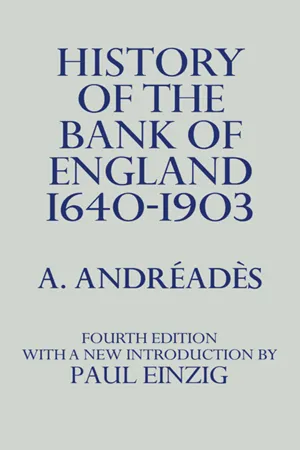
History of the Bank of England
About this book
First Published in 1966. This volume the fourth edition of Andreades classic history of the bank of England that looks at the period of 1640 to 1903, with its first edition appearing in 1909. The reprint after more than thirty years after the author's death has now secured its place among the classics of economic literature.
HISTORY OF THE BANK OF ENGLAND.
INTRODUCTION.
Importance and Difficulties of the Subject. Reasons why no History of the Bank of England has ever been written. Examination of Sources : (a) Narrative sources and general works on Banking, (b) Official publications, (c) Pamphlets and tracts. Observations in reply to two criticisms likely to be made of the present work.
THE Bank of England is the oldest of the European national banks.1 Established in 1694, it has seen the great banks which preceded it disappear one by one and has witnessed the collapse of many later foundations. At the present day it still remains the most famous, and from many points of view, the most original bank in the world.
A very slight study of English history shows the importance of this great institution to the Government and to the English nation. The loans made by the Bank to William III. and Queen Anne enabled England to regain that position among European nations which she had to all appearances hopelessly lost. The English Government sought help from the Bank on the eve of all the eighteenth century wars, and on the day of reckoning which followed the insanities of the Land Bank and of the South Sea Bubble.1 Finally, not only the establishment of public credit by the formation of the permanent debt, but the organisation of the floating debt, and even the conversion of the national debt, are in the main the work of the Bank. Such services as these have not been forgotten by the English Government. The London commercial world, which was until 1694 a prey to usurers and without even a safe place of deposit for its money, has shown its gratitude to the Old Lady of Threadneedle Street2 by the eagerness with which it has defended her in all times of danger.
Much has changed since these far-distant days. The machinery of credit has extended, and big loans have become customary. Now, when a Government wishes to borrow it makes direct appeal to the public, and individuals are familiar with more than one important bank which will discount their bills, or keep their deposits in complete security. But even to-day the importance of the Bank to the Government and to the public is hardly less striking than it was formerly. The Bank of England is, in fact, both the banker of the Treasury and the guardian of the gold reserve upon which the whole fabric of British commercial credit rests; it is this combination which makes it at once so powerful and so unique.
Certain questions naturally arise in respect to such a long-established and remarkable institution : Why, and in what manner was it founded ? What position has it held during its long existence ? What changes has it undergone ? How has it acquired its present form ? What, in short, has been its history ? And this history proves to be so varied, so exciting, so full of life and instruction that the temptation to relate it is irresistible, even though the result be indifferently good or even very imperfect. This being so, it will be asked why the history of the Bank of England has never been written ?
Is it, as Mr. Stephens1 thinks, on account of the great difficulty of such a task ? Or is it that the practical conclusions which may be deduced will in all probability be disproportionate to the labour expended ? It is perhaps somewhat late to suggest an answer to this question. It is besides, only fair to remark that although the Bank’s history has never been written, it has at any rate been attempted more than once.
The first work of the kind was written in 1797, and is called The History of the Bank of England, from the Establishment of that Institution to the present day. The book consists of 110 small pages, and fulfils sufficiently well its author’s intention, which was to give some account of the Bank, together with a concise history of the crises through which it had passed. The pamphlet is obviously inspired by the events of 1797, with which it is chiefly concerned; it is followed by a copy of the charter and of the principal regulations of the Bank.
The next account which I have been able to discover is an anonymous2 pamphlet containing 62 pages, and called The Life and Adventures of the Old Lady of Threadneedle Street, containing an account of her numerous intrigues with various eminent statesmen of the past and present times. This purports to be an autobiography, but apart from its curious form the contents are wretchedly poor. The author, who is an ardent supporter of the Bank, thinks himself witty when he calls Louis XIV. Louis the Gascon,1 or describes the Bank as being received by William III. in his palace at Kensington. When he refers to the newly opened branches, he compares the Bank to Sarah giving birth to a child in her old age, and he is guilty of a thousand other like absurdities. The book is one of the coarsest and dullest I have ever met with. It was published in 1832.
In 1848 Francis’ History of the Bank of England appeared. Mr. Stephens2 has accurately summed up its good qualities and its defects by describing it as “popular.” It is certainly not a scientific work, and the writer lived at a time when those who wrote for the mass of the public were too much influenced by the author of the Trois Musqueiaires. Mr. Francis has, however, the credit of being a pioneer in a difficult task. His position at the Bank enabled him to give various interesting details, and I must confess to having read his book carefully and with advantage.
The one really scientific work which has been published on the history of the Bank of England unfortunately deals with but a very small portion of that history. I refer to The First Nine Years of the Bank of England,3 by Thorold Rogers. It is no small praise to say that this book is a worthy companion to the same author’s great work, A History of Agriculture and Prices. It is a matter for some regret that in this book, which was written but shortly before his death, Mr. Rogers has not dealt with the period leading up to the Act of 1694, and that he begins with the actual creation of the Bank of England. This, as he explains in the preface, is due to the fact that the work was taken up accidentally. During researches connected with his History of Agriculture and Prices, he came across a weekly register of the prices of Bank stock from August 17th, 1694, to September 17th, 1703; this register was found in a statistical paper published by a City apothecary called Houghton. In addition to some short articles on passing events, the paper contained a list of the prices of corn and other commodities on the markets of different English towns, as well as a great variety of notices and advertisements. Mr. Rogers applied to the Bank for an explanation of some obscure points, and found to his surprise that they possessed no record of the prices of the shares before 1705. He consequently determined to publish this register with comments; this was the origin of the book in question, and explains why it is limited to the brief period of nine years. If it was true, as Mr. Rogers1 alleges, that the political and financial history of the Bank of England had never been written, he might congratulate himself that the gap was filled up to 1703, the last date referred to in his work.
These are, to the best of my knowledge, the only works especially devoted to the subject.
It is a curious fact that for a complete history of the Bank of England we must look, not to a book primarily concerned with the Bank itself, but to one dealing with banking in general, that is, to Macleod’s treatise on the Theory and Practice of Banking.2 In this book the Scotch economist gives the most complete existing account of the subject, especially with regard to the question of currency. Moreover, he supplies excellent analyses of the reports of Locke, Lowndes and Newton on the coinage question, and of the Bullion Report and the debates relating to it. Unfortunately, Mr. Macleod wrote history less with the object of discovering the truth than to supply proof of certain theories for which he was responsible, and of which he was for that very reason uncritical. This does not destroy the value of his work, but makes some caution necessary on the part of the reader.
Another general treatise deserving careful attention is Lawson’s History of Banking.1 This book appears superficial in form, but a more detailed study will show that, notwithstanding his stories of eccentric wills and celebrated frauds, of Quakers and adventurers, the author possesses a thorough knowledge of business and of the art of discussing a problem. Lawson is I believe the only English author who refers in his account of the Bank of England, to the close relations between this institution and the Treasury.2 There are also interesting historical chapters in Gilbart’s3 and Mr. Collins’4 books on Banking, but there is no reference to the history of the Bank in the best known of the general works, Bagehot’s Lombard Street.
In addition to the histories mentioned above, and among what may be called narrative sources,5 there are a large number of official publications devoted to the Bank of England, such as exist for all other English institutions, and which have greatly facilitated our study. These publications form a very complete series from the early ...
Table of contents
- Cover
- Halftitle
- Title
- Copyright
- Introduction to the Fourth Edition
- Author’s Preface
- Author’s Preface to the Second Edition
- Preface
- Contents
- Volume I. 1640—1819.
- Volume II. 1819—1903.
- Appendix. History of the Relations Between the Bank of England and the Treasury
- Conclusion
- Supplements—
- Bibliography
- Index
Trusted by 375,005 students
Access to over 1.5 million titles for a fair monthly price.
Study more efficiently using our study tools.
Frequently asked questions
Yes, you can cancel anytime from the Subscription tab in your account settings on the Perlego website. Your subscription will stay active until the end of your current billing period. Learn how to cancel your subscription
No, books cannot be downloaded as external files, such as PDFs, for use outside of Perlego. However, you can download books within the Perlego app for offline reading on mobile or tablet. Learn how to download books offline
Perlego offers two plans: Essential and Complete
- Essential is ideal for learners and professionals who enjoy exploring a wide range of subjects. Access the Essential Library with 800,000+ trusted titles and best-sellers across business, personal growth, and the humanities. Includes unlimited reading time and Standard Read Aloud voice.
- Complete: Perfect for advanced learners and researchers needing full, unrestricted access. Unlock 1.5M+ books across hundreds of subjects, including academic and specialized titles. The Complete Plan also includes advanced features like Premium Read Aloud and Research Assistant.
We are an online textbook subscription service, where you can get access to an entire online library for less than the price of a single book per month. With over 1.5 million books across 990+ topics, we’ve got you covered! Learn about our mission
Look out for the read-aloud symbol on your next book to see if you can listen to it. The read-aloud tool reads text aloud for you, highlighting the text as it is being read. You can pause it, speed it up and slow it down. Learn more about Read Aloud
Yes! You can use the Perlego app on both iOS and Android devices to read anytime, anywhere — even offline. Perfect for commutes or when you’re on the go.
Please note we cannot support devices running on iOS 13 and Android 7 or earlier. Learn more about using the app
Please note we cannot support devices running on iOS 13 and Android 7 or earlier. Learn more about using the app
Yes, you can access History of the Bank of England by A.M. Andreades in PDF and/or ePUB format, as well as other popular books in Business & Business General. We have over 1.5 million books available in our catalogue for you to explore.