- 504 pages
- English
- ePUB (mobile friendly)
- Available on iOS & Android
eBook - ePub
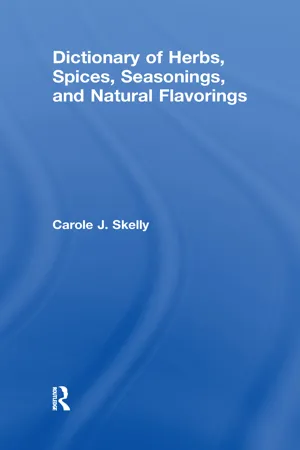
Dictionary of Herbs, Spices, Seasonings, and Natural Flavorings
About this book
First published in 1994. Originally, this collection of herb and spice names began as an aid to the ordinary person who had the curiosity to ask, What is that spice? or What is that ingredient listed in the herbal tea on the grocery store shelf? This quick reference dictionary of herbs, spices and seasonings also include botanical plant names, genus and species.
Information
Dictionary of Herbs, Spices, Seasonings, and Natural Flavorings
DOI: 10.4324/9780203054376-1
A
Aaron's beard: See Saint john's-wort.
Aaron's rod: See Houseleek and Sweet goldenrod.
Abata cola: See Cola.
Abele: See Poplar.
Abelmosk (Abelmoschus moschatus, formerly Hibiscus abelmoschus) [Malvaceae]
Abelmusk; Ambrette seed; Musk mallow; Musk seed; Rose mallow; Syrian mallow; Target-leaved hibiscus; Water mallow:
The seeds of this aromatic plant, originating in Martinique, have a very strong flavor of musk. It is used mosdy in perfumery, but in India the seeds are mixed with coffee to flavor it and to heighten its stimulating properties. GRAS Abelmoschus moschatus is closely related to okra (Abelmoschus esculentus).
The common names of Syrian mallow, target-leaved mallow, water mallow, and especially rose mallow can cause considerable confusion since they may refer also to a number of other Hibiscus species.
Absinthe: See Wormwood.
Abyssinian tea (Catha edulis) [Celastraceae]
Arabian tea; African tea; Cafta; Chat; Kat; Khat; Qat; Somali tea:
This plant is reputed to have antisoporific and antinarcotic properties. The tender shoots are chewed by Moslems as a stimulant or a tea is made from the leaves.
Acacia (Acacia senegal) [Mimosaceae, formerly in Leguminosae]
Cape gum; Egyptian thorn; Gum-arabic; Sudan gum-arabic:
Gum-arabic is a dry, gummy exudate from the stems and branches of trees of the genus Acacia, most commonly Acacia Senegal. It is used to make mucilage, as a vehicle for various compounds in pharmacy, and in cookery to prevent crystallization of sugar, as a thickener in confections, and to reduce foaming in soft drinks and sometimes beer.
Achiote: See Annotto.
Aconite: See Monkshood.
Acrid crowfoot: See Buttercup.
Adam-and-eve: See Arum.
Adder's fern: See Wall fern.
Adder's mouth: See Chickweed.
Adder's violet: See Rattlesnake plantain.
Adder's-tongue (Erythronium americanum) [Liliaceae]
Amberbell; Dog-tooth violet; Erythronium; Lamb's tongue; Rattlesnake violet; Snake leaf; Trout lily; Yellow adder's-tongue; Yellow erythronium; Yellow snakeleaf; Yellow snowdrop:
This pretty little lily, native to the United States, has been used in herbal remedies. It is an emetic and was supposed to cure scrofula.
Adima: See Saint martin's-herb.
Africa lilac: See Chinaberry.
African elemi: See Olibanum.
African marigold: See Marigold.
African tea: See Abyssinian tea.
Agave (Agave americana) [Agavaceae]
American aloe; Century plant; Flowering aloe; Maguey; Spiked aloe:
There are over 300 species of Agave native to North and South America. The species Agave americana is one of the best known. The sap of these plants has been used as an herbal remedy, being both laxative and diuretic. In Mexico the sap is fermented for pulque or distilled for tequila and mescal.
Agrimony (Agrimonia eupatoria) [Rosaceae]
Church steeples; Cockeburr; Cocklebur; Harvest-lice; Sticklewort:
This is an old herbal remedy touted to cure most anything and everything. The seeds have hooked bristles that stick to anything that brushes them. The yellow flowers can be used as a source of yellow dye.
Ague grass: See Star grass.
Ague root: See Star grass.
Ague tree: See Sassafras.
Agueweed: See Thoroughwort.
Air potato: See Wild yam.
Ajowan (Trachyspermum copticum, formerly Carum ajowan, Carum copticum, Ammi copticum, and Trachyspermum ammi) [Umbelliferae]
Ajuan; Omum:
The seed of this plant, native to India, looks somewhat like a large celery seed and has a strong taste of thyme. It is used extensively in Indian cooking. Thyme can be substituted for ajowan in Indian recipes, but the contrary is not recommended because of ajowan's much stronger and cruder taste.
Ajuan: See Ajowan.
Alant: See Elecampane.
Alberta spruce: See Spruce.
Alcanna: See Henna.
Alder (Alnus oregona, formerly rubra) [Betulaceae]
Oregon alder; Red alder
(Alnus rugosa, formerly serrulata)
Hazel alder; Smooth alder; Speckled alder:
The bark of these North American shrubs has astringent qualities. It is very bitter and is used as a flavoring for vermouth and in certain cordials.
Alder buckthorn: See Cascara.
Alder dogwood: See Cascara.
Alecost: See Costmary.
Alehoof: See Ground ivy.
Alexanders (Smyrnium olusatrum) [Umbelliferae]
Allisanders; Black lovage; Horse parsley
(Zizia aurea, formerly Thaspium aureum) [Umbelliferae]
Golden alexanders; Meadow parsnip:
Alexanders, indigenous to the Mediterranean area, has been naturalized in Great Britain for many years. It grows wild there on waste lands and cliffs near the sea. It has some resemblance to celery in both appearance and flavor and will grow up to four feet in height. Some describe the flavor as being more like parsley. It was used much like celery as both a vegetable and a seasoning. In France where it also grows wild, it is called horse parsley and is used in cooking as a substitute for parsley. The meadow parsnip, Zizia aurea [Umbelliferae], is called golden alexanders. Angelica atropurpurea [Umbelliferae] is also called alexanders. See Angelica.
Alexandria senna: See Cassia.
Alfalfa (Medicago sativa) [Leguminosae]
Buffalo herb; Lucerne; Purple medic:
Alfalfa leaves are a common ingredient in herbal teas. Alfalfa is known as lucerne in Australia. GRAS
Alfilaria: See Storksbill.
Algarroba bean: See Carob.
All-heal: See Herb carpenter, Mistletoe, and Valerian.
Alleluia: See Sorrel.
Allgood: See Good-king-henry.
Alliaria (Alliaria petiolata, formerly Sisymbrium alliaria) [Cruciferae]
Donkey's foot; Garlic mustard; Jack-by-the-hedge; Onion nettle; Sauce alone:
This is a weed-type plant common in Europe, Asia and the eastern United States and Canada. Its coarsely toothed, nettle-like leaves have a strong smell of garlic when crushed. It was commonly used as a flavoring and a salad herb. It tends to lose its flavor in cooking but is good raw in meat or cheese sandwiches. Its leaves have been used as a pharmaceutical plaster.
Allisanders: See Alexanders.
Allspice (Pimenta dioica, formerly officinalis, a.k.a. Eugenia pimento) [Myrtaceae]
Clove pepper; Jamaica pepper; Myrtle pepper; Pimenta; Toute-épice:
Allsp...
Table of contents
- Cover
- Half Title Page
- Title Page
- Copyright Page
- Dedication Page
- Table of Contents
- Introduction
- Note of Explanation
- Dictionary
- Special Note
- Families
- Genera
- Sources Consulted
Trusted by 375,005 students
Access to over 1.5 million titles for a fair monthly price.
Study more efficiently using our study tools.
Frequently asked questions
Yes, you can cancel anytime from the Subscription tab in your account settings on the Perlego website. Your subscription will stay active until the end of your current billing period. Learn how to cancel your subscription
No, books cannot be downloaded as external files, such as PDFs, for use outside of Perlego. However, you can download books within the Perlego app for offline reading on mobile or tablet. Learn how to download books offline
Perlego offers two plans: Essential and Complete
- Essential is ideal for learners and professionals who enjoy exploring a wide range of subjects. Access the Essential Library with 800,000+ trusted titles and best-sellers across business, personal growth, and the humanities. Includes unlimited reading time and Standard Read Aloud voice.
- Complete: Perfect for advanced learners and researchers needing full, unrestricted access. Unlock 1.5M+ books across hundreds of subjects, including academic and specialized titles. The Complete Plan also includes advanced features like Premium Read Aloud and Research Assistant.
We are an online textbook subscription service, where you can get access to an entire online library for less than the price of a single book per month. With over 1.5 million books across 990+ topics, we’ve got you covered! Learn about our mission
Look out for the read-aloud symbol on your next book to see if you can listen to it. The read-aloud tool reads text aloud for you, highlighting the text as it is being read. You can pause it, speed it up and slow it down. Learn more about Read Aloud
Yes! You can use the Perlego app on both iOS and Android devices to read anytime, anywhere — even offline. Perfect for commutes or when you’re on the go.
Please note we cannot support devices running on iOS 13 and Android 7 or earlier. Learn more about using the app
Please note we cannot support devices running on iOS 13 and Android 7 or earlier. Learn more about using the app
Yes, you can access Dictionary of Herbs, Spices, Seasonings, and Natural Flavorings by Carole J. Skelly in PDF and/or ePUB format, as well as other popular books in Social Sciences & Sociology. We have over 1.5 million books available in our catalogue for you to explore.