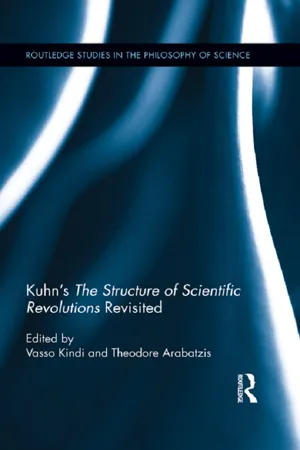
Kuhn's The Structure of Scientific Revolutions Revisited
eBook - ePub

Kuhn's The Structure of Scientific Revolutions Revisited

  1. 260 pages
  2. English
  3. ePUB (mobile friendly)
  4. Available on iOS & Android
eBook - ePub

Kuhn's The Structure of Scientific Revolutions Revisited

About this book

The year 2012 marks the 50th anniversary of the publication of Thomas S. Kuhn's The Structure of Scientific Revolutions. Up until recently, the book's philosophical reception has been shaped, for the most part, by the debates and the climate in philosophy of science in the 1960s and 1970s; this new collection of essays takes a renewed look at this work.

This volume concentrates on particular issues addressed or raised in light of recent scholarship and without the pressure of the immediate concerns scholars had at the time of the Structure's publication. There has been extensive research on all of the major issues concerning the development of science which are discussed in Structure, work in which the scholars contributing to this volume have all been actively involved. In recent years they have pursued novel research on a number of topics relevant to Structure's concerns, such as the nature and function of concepts, the complexity of logical positivism and its legacy, the relation of history to philosophy of science, the character of scientific progress and rationality, and scientific realism, all of which are brought together and given new light in this text. In this way, our book makes new connections and undertakes new approaches in an effort to understand the Structure's significance in the canon of philosophy of science.

Frequently asked questions

Yes, you can cancel anytime from the Subscription tab in your account settings on the Perlego website. Your subscription will stay active until the end of your current billing period. Learn how to cancel your subscription.
At the moment all of our mobile-responsive ePub books are available to download via the app. Most of our PDFs are also available to download and we're working on making the final remaining ones downloadable now. Learn more here.
Perlego offers two plans: Essential and Complete
  • Essential is ideal for learners and professionals who enjoy exploring a wide range of subjects. Access the Essential Library with 800,000+ trusted titles and best-sellers across business, personal growth, and the humanities. Includes unlimited reading time and Standard Read Aloud voice.
  • Complete: Perfect for advanced learners and researchers needing full, unrestricted access. Unlock 1.4M+ books across hundreds of subjects, including academic and specialized titles. The Complete Plan also includes advanced features like Premium Read Aloud and Research Assistant.
Both plans are available with monthly, semester, or annual billing cycles.
We are an online textbook subscription service, where you can get access to an entire online library for less than the price of a single book per month. With over 1 million books across 1000+ topics, we’ve got you covered! Learn more here.
Look out for the read-aloud symbol on your next book to see if you can listen to it. The read-aloud tool reads text aloud for you, highlighting the text as it is being read. You can pause it, speed it up and slow it down. Learn more here.
Yes! You can use the Perlego app on both iOS or Android devices to read anytime, anywhere — even offline. Perfect for commutes or when you’re on the go.
Please note we cannot support devices running on iOS 13 and Android 7 or earlier. Learn more about using the app.
Yes, you can access Kuhn's The Structure of Scientific Revolutions Revisited by Vasso Kindi, Theodore Arabatzis, Vasso Kindi,Theodore Arabatzis in PDF and/or ePUB format, as well as other popular books in History & Philosophical Essays. We have over one million books available in our catalogue for you to explore.

Information

Publisher
Routledge
Year
2013
Print ISBN
9781138910874
eBook ISBN
9781136243202

Table of contents

  1. Cover Page
  2. Title Page
  3. Copyright Page
  4. Contents
  5. List of Figures and Tables
  6. Acknowledgments
  7. 1 Introduction
  8. Part I: Origins and Early Reception
  9. Part II: Key Concepts
  10. Part III: Implications
  11. Contributors
  12. Index