This book looks at the militaries of the late-Soviet and post-Soviet republics. Beginning with the end of the Soviet era, it recognises that the successor states did not spring from nowhere, but inherited a legacy that influenced all that followed. The book discusses how politicians control the instruments that are the manifestation of the state's monopoly on violence, and how society views and supports the military. By taking a bottom up empirical approach that examines the personnel, leaders, organisations and institutions, and their outlook and attitudes, the book presents a comprehensive picture of the armed forces, showing how the armed forces are very significantly shaped by the surrounding political and social environment. The book goes on to examine the armed forces in action, and highlights that to truly understand the militaries, studies need to go beyond looking at the static structures.
eBook - ePub
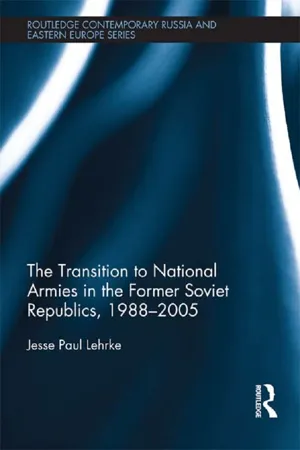
The Transition to National Armies in the Former Soviet Republics, 1988-2005
- 250 pages
- English
- ePUB (mobile friendly)
- Available on iOS & Android
eBook - ePub
The Transition to National Armies in the Former Soviet Republics, 1988-2005
About this book
1 The Soviet Armed Forces in their final decade
Introduction
Like all births, the births of the armed forces of the former Soviet republics began with a union – in this case a union of 17 republics into one of the largest and most ambitious national and ideological projects every conducted: the Union of Soviet Socialist Republics (USSR). It is with an examination of this union that any account, hoping to explain later developments, must begin. Specifically, this chapter examines the evolution of the Soviet Armed Forces in the period leading up to the revolutionary events of 1989–1991. The chapter begins with a brief overview of the Soviet political and military structure for the non-specialist. Next, the chapter examines the four aspects that determine the character of the military: the unit identity of its personnel, leadership, organizations and institutions. Within the discussion of these four aspects, the military's relationship with the regime and the society will be given equal attention as factors that are purely internal to the military. At the end of each of the four sections there will be, when necessary, ‘Some concluding remarks’ to discuss additional important aspects that did not fit neatly into one of the four categories. More general summaries of the four aspects will be made in the chapter's conclusion, especially comparing their relative strengths and weaknesses. This will highlight how they then fit together in a unique way, which unified the Soviet Armed Forces and bonded it to the state and society.
The focus of this chapter is on the 1980s, with special focus on the 1985 to 1988 period. However, militaries are deeply tied to their histories and slow to change. Even minor reforms can take three to four years to diffuse through the system, the time it takes to rotate out old enlisted soldiers and train and rotate in new junior officers, while major reforms can take ten to twenty years to implement (McNeill 1982; Porter 1990: 297; Ralston 1990; Wildman 1980: 20, 22). Thus the following discussion will often refer to developments from the 1970s, or even 1960s. This time-lag factor will also be essential to keep in mind when examining the military reforms that began in 1987 and 1988. Many of the implications of these reforms were not felt until 1990 at the earliest or even until 1992, which means they will be discussed more in Chapter 3 and Chapter 5.
In order to further limit the scope of the discussion, this chapter (and all subsequent chapters) will tend to focus on the operational forces that have intervention capability (Luttwak 1968/1979: 61–4). These include the ground forces, which are found mainly but not exclusively in the Army, and the operational forces of the MVD and KGB. Such operational forces fill traditional military roles and the rest of the armed forces are culturally and organizationally modelled after them, in keeping with the fractal nature of military institutional design (Janowitz 1960: 40). By focusing on these forces we will be able to draw some conclusions that are generally valid about the Soviet military overall, although attention will be drawn to key exceptions. Additionally, these forces are typically those that we will be able to observe ‘in action’ and thus use in the analysis in subsequent chapters.
Overview of the Soviet political–military system (circa 1988)
The Union of Soviet Socialist Republics (USSR, or Soviet Union) was founded as a single-party communist state in 1922 following the 1917 revolution and subsequent civil war. Stretching from the Baltic Sea in Europe across the Eurasian continent it was at the time the largest country in the world. It consisted of 15 Soviet Socialist Republics (SSRs, also Union Republics) as well as numerous other lower-level administrative entities (Autonomous Soviet Socialist Republic, or ASSRs, Autonomous Oblasts, and so on), but in practice it was highly centralized, with most power lying in Moscow. By the end of the 1980s, the country had an ethnically diverse population of over 290 million and an advanced – even if stagnating – industrial planned economy.
The most powerful figure in the Soviet political system was the secretary general of the Communist Party of the Soviet Union (CPSU). He (and it always was a male) was followed in importance by the members of the Politburo, of which there were approximately a dozen voting members and usually as many non-voting ‘candidate’ members at any given time. Together the secretary general and the Politburo formed the primary collective decision-making committee of the communist oligarchy (Clemens 2000: 116; see also Bathurst 1992: 30; E. Jones 1984). The secretary general and members of the Politburo were appointed by the Communist Party Central Committee (CPCC), which theoretically also had the power to remove them – although this power was rarely used. The CPCC also appointed a Central Committee Secretariat, which served as the staff and bureaucracy of the executive branch (Hough 1997: 84; McFaul 2002b: 44). There was also a legislative branch – the Supreme Soviet. However, it met rarely and its day-to-day business was handled by a Presidium, which was headed by the chair of the Presidium, who was usually the secretary general. This same general structure was replicated at the level of the republics, athough until 1988 their power was limited (Scott and Scott 1983: 25–6).
The secretary general was the head of the Soviet Armed Forces, which included the five service branches of the Ministry of Defence (MoD; ground forces, navy, air force, air defence forces and strategic rocket forces), but also included the so-called security forces of the Ministry of Internal Affairs (MVD) and Committee for State Security (KGB). Each of these ‘power ministries’ was headed by a minister who typically sat also on the Politburo. Thus they were politically appointed by the CPCC, as were the majority of the deputy ministers. Unity of effort between these ministries was ensured by centralization and ‘linking institutions’ such as the Defence Council and General Staff, which will be discussed in depth later. From this broad glimpse at the overall system we move now to where we must start, with the individual citizen-cum-soldier.
From an individual to a unit
The Soviet Union had a difficult time promoting small group cohesion between soldiers serving together in units. Instead most soldiers identified themselves with groups spread throughout the military or in the general society. On a fundamental level, this was due to the very nature of the Soviet state and society. First, the USSR followed the pattern of many authoritarian states by choosing not to promote cohesion between small groups of likeminded or like-situated individuals, as doing so can foster egalitarian and democratic ideals (Osiel 1999: 214). The regime instead preferred the individuals ‘atomized’ and ‘homogenized’, tied only to higher loyalties. Even outside the military, this ‘atomization’ of Soviet society inhibited group formation beyond the nuclear family – what Nichols (2001: 13) says was comparable to the ‘amoral familism’ of southern Italy described by Edward Banfield (Putnam in Reppert 2001: 109). It is from this atomized society that the military drew its human resources (i.e. individual persons) to be subsequently moulded into soldiers.
Subsequent to their conscription, the conditions that the new recruit encounters can either fulfil his/her primary needs and thus build group identity, or instead, fail to fulfil these needs and thus lead an individual to maintain his/her identification with societal groups. In the USSR, the coercive process of drawing individuals into the military, together with the harsh internal conditions of military life, inhibited military group bonding and encouraged individuals to retain militarily dysfunctional group loyalties. This failure to promote small military group identification comes down to four primary factors. The first two of these related to government policy, as well as its interaction with socio-demographic conditions and trends. These were the system of conscription, which sought to use the military as a ‘school for the nation’, and the military stationing policy for personnel assignments. The second two factors are internal ‘non-official relations’ within the military.1 These were dedovshchina, which was the system of seniority and hazing within the military, and zemliachestvo (occasionally gruppovshchina), which was the development of ethnic and/or regional groupings within the military (Elkner 2004; Meyer 1991–1992). We will now turn to discussing each of these in more detail.
The system of conscription
Once an individual is separated from society the military socialization process begins. This socialization either isolates conscripted individuals from society or allows them to remain connected with society. A certain degree of isolation is required in order to re-condition conscripts and prepare them for the rigours and requirements of military life and combat conditions. However, a certain amount of connection to society is also desirable in order to link the individual service members to higher loyalties than the military organization, to motivate the soldiers during war to protect and defend something/someone, and to justify the conscription/‘citizen-in-arms’ system. Thus, military socialization seeks to obtain a functional and effective balance between complete integration with and total isolation from society.
The system of universal (male) conscription utilized by the Soviet Union ensured an initial integration with society. The regime did this by drawing fairly evenly from the numerous social and ethnic groups in Soviet society. This was a purposive policy, as the Soviet regime (like many states) saw the military as a ‘school for the nation’ that would help construct a modern and loyal ‘New Soviet man’ (E. Jones 1985: 45, 148–79; Krebs 2004; Lathrop 1981; Rakowska-Harmstone 1979; Simes 1981–1982: 136–7). However, systems of conscription in most states never attain their ‘universal’ ideal and most often those conscripted are socio-economically distinct from the majority – and certainly from the ruling – sections of the state, tending instead to be from poor, rural, uneducated backgrounds (Skocpol 1979: 290). In the USSR, due to manpower short-ages and the sheer size of the military, this was not the case and conscription came close to being truly universal, although some urban political elites did manage to secure deferments for their draft-age sons (E. Jones 1990: 256; Porter 1990: 329–30; see also Odom 1998: 247). Approximately 75–80 per cent of the 18-year-old draft pool was conscripted even after all deferrals, and many of those who deferred were still subject to conscription later in their twenties (E. Jones 1985: 56–7; 1990: 256). As a consequence of this universal conscription, the increasing diversification of Soviet society in the 1970s and 1980s was reflected in the military.
One aspect of this diversification was increased conscription of individuals from urban areas due to increased urbanization of the country. By the mid-1980s, the percentage of conscripts classified as workers was at 67.6, versus only 13.3 per cent from peasant (rural farming) backgrounds (Donnelly 1979: 109; E. Jones 1985: 150; E. Jones 1990: 253; Rakowska-Harmstone 1979: 138). This ratio was almost evenly split at 50–50 in the 1960s and the late 1970s still saw 25 per cent of conscripts come from rural backgrounds (Donnelly 1979; E. Jones 1985: 150; E. Jones 1990: 253). Another aspect of diversification was the higher educational level in society (Connor 2003: 67, passim). This was increasingly reflected within the Soviet Armed Forces when deferments for educational purposes were discontinued in 1982, not to be re-introduced until mid-1989 (Fane 1990; E. Jones 1985: 60, 62–3; E. Jones 1990: 251).
While these changes had a greater effect on how these individuals bonded to military organizations, and will thus be revisited later, they also had consequences for peer bonding. First, urbanized and educated conscripts tended to be more integrated with mainstream society and have denser social networks. They thus had more numerous and stronger bonds with civilian groups. While this would not necessarily influence their ability to bond with members of their military units, universal conscription drew in not only the Soviet Union's finest, but also drew upon ‘undesirable’ social groups (E. Jones 1985: 106). In 1989, a leading reformist in the Supreme Soviet claimed that 45 per cent of conscripts had ‘various mental aberrations’ and that 15 per cent had criminal records (Tsouras 1994: 301; see also Alexiev 1988; Fane 1990). Individuals drafted two years into their university education would hardly be amenable to bonding with criminals and the mentally challenged, and vice versa.
Additionally, the very nature of a conscription-based system limits the amount of time available for a sense of group belonging to develop, despite the ‘total’ nature of the military institution (B. A. Watson 1997: 135). Each unit replaced 25 per cent of its conscripts in mass every six months. While this alone would not prevent group identification, the fact that initial training was conducted within each unit – as opposed to having special training units – magnified the inhibiting effect (Donnelly 1979: 107). Typically, initial training is a time when unit-level bonding is learned through the isolation of a small group that is then subjected to group punishment to encourage teamwork and, thereby, bonding. In the Soviet system, the group was not isolated, and as a result – although the 25 per cent of a unit that was in a specific cohort might (and did) bond – they would rarely bond with the 75 per cent who had been an active tool of their harsh initial military experience.
The success of universal conscription, combined with changes in Soviet demographics and society, thus initially inhibited group bonding within the military and ensured that the majority of conscripts had a high probability of being connected to societal groups. The next step is to determine how, after conscription and training, internal military conditions influenced whether this connection to society was severed or maintained, and whether these conditions made unit-level group bonding possible.
Military stationing policy
In order to prevent the system of universal conscription from leading to a ‘localization’ of forces which could threaten national unity, the Soviet military coupled it with a distant stationing policy that limited the number of recruits serving in the territory of their home republics (Brusstar and Jones 1995: 6; Odom 1998: 44–5).2 Thus, integration with society was countered by physical separation intended to sever the conscripts’ connections to civilian social groups. However, with the advance of modern communication technology and rapid transportation in the late 1970s and into the 1980s, conscripts were more easily able to maintain social ties to people and groups back ‘home’, regardless of physical distance (Connor 2003: 66; E. Jones 1985: 164–5).
In addition to limiting conscripts’ connection to their homes, the military also attempted to minimize the contact between military personnel and the civilian population in the vicinity of its military bases. This was made easier by the relatively short (two-year) duration of military service. As anyone who has moved far from home can attest, social integration into a new local community can take years. In reality the conscripts had even less time to integrate, as during the first quarter of their service the new conscripts were largely isolated for initial training purposes. Furthermore, during a conscript's entire military service there was no authorized off-base housing and no automatic home leaves or weekend passes; in fact free time in general was extremely limited in the Soviet Armed Forces (E. Jones 1985: 162–3; E. Jones 1990: 239). The few privileges and passes that did exist were generally monopolized by more senior conscripts in the final six months of their service.
Thus, the Soviet Union was more effective than many states at separating its soldiers from its citizens, even if modern technology had reduced this ability somewhat. Such physical isolation from society should have increased bonding amongst the soldiers. However, the internal conditions of military life – to be discussed below – prevented such group bonds from forming. This made military service in the Soviet Union both ‘unpleasant and lonely, and largely divorced from civilian society’ (E. Jones 1990: 239, emphasis added). A conscript's primary motivation was to survive as best he could until the end of his service when he could rejoin the social groups that he had left behind but never replaced.
Dedovshchina and Zemliachestvo
Two significant factors made the internal conditions of military life inhospitable to the formation of a unified small group identity. These factors were the phenomena of dedovshchina and zemliachestvo. Not only did these phenomena lead conscripts to maintain their bonds to distant social groups, but they also led to the development of ‘diffuse’ identity groups within the military. These groups encompassed only a small part of any given military unit and also included members outside the unit.
Dedovshchina was a system of hazing by the different conscript cohorts based on their seniority (Deriglazova 2005: 75; Holloway 1989–1990: 14–15).3 The Soviet system usually required conscripts to serve two years and had a new intake of conscripts every six months (E. Jones 1985: 70). It thus had four cohorts at any given time.4 While all military organizations exhibit some manifestations of hazing and/or seniority-based preference, dedovshchina was an exceptionally severe system, leading in some cases to the deaths of new conscripts at the hand of their fellow soldiers or through suicide, as well as to revenge attacks by hazed soldiers (Elkner 2004; Human Rights Watch 1990; Human Rights Watch 2003: 2, passim).
Dedovshchina meant that the closest thing to a group identity formed across units – amongst members of the same cohort (E. Jones 1985: 168). Since it is the military unit that must bond together if it is to be combat-effective, such cross-unit group formation was undesirable from a military perspective. The combination of the in-unit initial training discussed above with the dedovshchina cohort seniority system meant that the initia...
Table of contents
- Front Cover
- The Transition to National Armies in the Former Soviet Republics, 1988–2005
- Routledge contemporary Russia and Eastern Europe series
- Title Page
- Copyright
- Contents
- Preface
- List of abbreviations
- 1 The Soviet Armed Forces in their final decade
- 2 The Soviet Armed Forces and domestic security: the repression of 1989–1991
- 3 The transformation of the Soviet Armed Forces in its final years (1989–1991)
- 4 The defection of the Soviet Armed Forces and the end of the USSR: the August putsch of 1991
- 5 The reconstruction and evolution of the armed forces in the Soviet successor states: Russia, Armenia, Georgia and Ukraine
- 6 The new armed forces and domestic security: revolutions and repression in Russia, Armenia, Georgia and Ukraine
- Conclusion: paths to new national armies, recent developments and looking ahead
- Notes
- References
- Index
Trusted by 375,005 students
Access to over 1.5 million titles for a fair monthly price.
Study more efficiently using our study tools.
Information
Publisher
RoutledgeEdition
1Year
2013Topic
Social SciencesPrint ISBN
9781138108257
9780415688369
Subtopic
Ethnic StudieseBook ISBN
9781135108861
Index
Social SciencesFrequently asked questions
Yes, you can cancel anytime from the Subscription tab in your account settings on the Perlego website. Your subscription will stay active until the end of your current billing period. Learn how to cancel your subscription
No, books cannot be downloaded as external files, such as PDFs, for use outside of Perlego. However, you can download books within the Perlego app for offline reading on mobile or tablet. Learn how to download books offline
Perlego offers two plans: Essential and Complete
- Essential is ideal for learners and professionals who enjoy exploring a wide range of subjects. Access the Essential Library with 800,000+ trusted titles and best-sellers across business, personal growth, and the humanities. Includes unlimited reading time and Standard Read Aloud voice.
- Complete: Perfect for advanced learners and researchers needing full, unrestricted access. Unlock 1.5M+ books across hundreds of subjects, including academic and specialized titles. The Complete Plan also includes advanced features like Premium Read Aloud and Research Assistant.
We are an online textbook subscription service, where you can get access to an entire online library for less than the price of a single book per month. With over 1.5 million books across 990+ topics, we’ve got you covered! Learn about our mission
Look out for the read-aloud symbol on your next book to see if you can listen to it. The read-aloud tool reads text aloud for you, highlighting the text as it is being read. You can pause it, speed it up and slow it down. Learn more about Read Aloud
Yes! You can use the Perlego app on both iOS and Android devices to read anytime, anywhere — even offline. Perfect for commutes or when you’re on the go.
Please note we cannot support devices running on iOS 13 and Android 7 or earlier. Learn more about using the app
Please note we cannot support devices running on iOS 13 and Android 7 or earlier. Learn more about using the app
Yes, you can access The Transition to National Armies in the Former Soviet Republics, 1988-2005 by Jesse Paul Lehrke in PDF and/or ePUB format, as well as other popular books in Social Sciences & Ethnic Studies. We have over 1.5 million books available in our catalogue for you to explore.