This book provides a comprehensive introduction to business organisation and administration. Written in a straightforward, readable style this textbook covers all the major aspects of the subject. Starting with the organisational background it goes on to cover the functions of the important departments within the firm, the role of the administrative officer, and other areas of knowledge vital to the smooth running of a business. There are self-assessment questions at the end of each section, past exam questions, study and exam tips and a full index.
The organisational background to business administration
1
The management framework to business administration
1.1 WHAT IS BUSINESS ADMINISTRATION?
Defining terms is not easy, particularly in the field of management and administration where ideas change from time to time and popular usage of words may vary. The consensus in recent years is that the word ‘administration’ implies some fairly detailed involvement in the activities of an organisation, and certainly business administration syllabuses seem to have developed into quite detailed lists of aspects of business organisation which students should study. We may therefore define business administration as ‘that part of the management of a business organisation which seeks to implement the decisions made by top management and achieve the objectives which it has specified’. Its true representative is the managing director, who is both the representative of the board to the ordinary workforce, and the representative of the workforce in any feedback to the board. As the representative of the board, the managing director must communicate the objectives to the staff and, no doubt, in the process arranges to break them down into a sequence of activities which can be achieved as time goes by. In the process of attempting to realise the objectives specified, some comparison between the actual results achieved and the plans made will become possible. This may call for reporting back to board level about various aspects; the difficulties encountered, the unrealistic nature of the original plans or possibly their inadequancy in view of the potential revealed. The managing director would present such a report, or arrange to have it presented by a suitable executive.
The managing director cannot, except in the very smallest organisations, do all the work of administration personally, and will be assisted by a team of senior executives, several of whom may have boardroom status. As such they will usually be known as executive directors to distinguish them from part-time directors. The latter have an advisory capacity, bringing certain types of expertise to the boardroom, but not having any part to play in putting the plans into execution. The executive directors are of a lower stature than the managing director, and in most day-to-day situations report to him/her. They may be referred to as ‘managers’, for example the marketing manager or sales manager, the personnel manager, the factory manager, etc. A typical board of directors is discussed more fully later in this chapter.
1.2 WHAT IS MANAGEMENT?
If business administration is only part of management, what exactly is management? The term is used loosely to describe many activities. It is often said that every soldier has a field marshal's baton in his knapsack, and similarly every employee may aspire to management. It is not long before the new employee begins to feel that he/she is management material and the slightest supervisory role encourages claims to be ‘middle management’. We shall see that where staff are coming in at fairly mature levels after long educational programmes, authority on particular matters (say computerised systems) may lie with the newest recruit. It is therefore unwise to deny anyone's claim to be management material: there are many grades of management.
When we try to define management we must therefore limit the definition to what is usually thought of as ‘top-management’. A suitable definition today might be:
Management is the process of determining the objectives of an enterprise; deciding how these objectives are to be achieved in general terms; devising an appropriate organisation to pursue the objectives; providing funds which will enable the organisation to be adequately supplied with staff equipment and other items necessary; making initial arrangements to commence operations and then keeping them under constant review.
It will be seen that these top-level activities are initially above the level of ‘business administration’ as defined in 1.1 above but merge into it once the first top-level decisions have been made. Some at least of the top management team become mere administrators when the chairman of the board declares the board meeting adjourned.
1.3 THE BOARD OF DIRECTORS
In business life today most important organisations are limited companies or public corporations which have a rather similar structure. We will therefore leave out of our discussion such firms as sole traders and partnerships which are run on rather personal lines in accordance with the wishes of the individuals who own them. In considering large-scale organisations we seek to see the framework of the organisation, and how it is organised to fulfil its objectives, rather than the individuals concerned. Individuals come and go, but the organisation persists. Indeed, this continuity of the enterprise is one of the most important features of the limited company and similar organisations. The death or departure of any individual makes no real difference to the organisation, which continues to offer its products for sale and to employ the rest of its workforce even though the head of the firm is no longer present.
The ‘board of directors’ is the most important part of any limited company, and the chairman of the board is the true head of the firm. Although frequently he is only a part-time member, who is not in attendance at head office all the time, he is a person of the very widest experience and absolutely familiar with the activities of the company and its objectives as stated in the ‘objects’ clause of its Memorandum of Association.
There may be a deputy-chairman, whose function is obviously to replace the chairman should he be absent or called away from a meeting temporarily. If there is no such person actually appointed there will usually be in standing orders a formula for the appointment of a deputy-chairman in a temporary capacity as and when required. This might mean that any other director could be appointed, according to the nature of the main subject matter of the meeting – a person who was not hotly contesting the main subject being desirable so that a proper debate could take place, without bias.
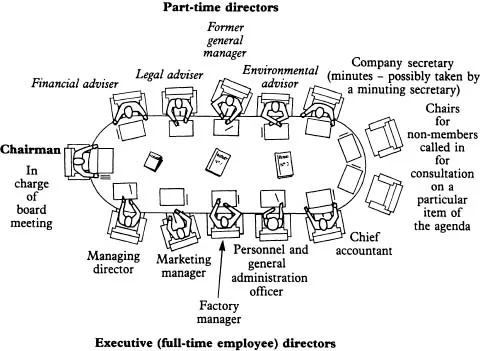
The other members of the board are called directors. The most powerful director after the chairman is the managing director, who is charged by the board with the task of actually running the firm, and putting the decisions taken at board meetings into effect. Other directors may be the heads of important departments, so that like the managing director they are full-time employees, with important functions to perform. All such directors are called executive directors. Frequently the factory manager, the marketing manager, the chief accountant and the general adminstration officer are executive directors. Other directors may be only part-time directors, who have experience which will be of service to the company. Financial expertise, legal knowledge, technical expertise in various fields, etc., are thus made available to the company relatively inexpensively since many directors serve for a thousand or so pounds per year only. The contribution such directors make may be invaluable, and although a particular director only attends perhaps once a month he is usually available for consultation at any time should a situation calling for his type of expertise arise. A typical board is illustrated in Fig. 1.1.
Fig. 1.1 A Board of Directors
Functions of the board of directors
Everything that happens in a company takes place through the authority of the board of directors. The minutes of a board meeting embody resolutions passed by the directors which authorise the managing director and the other executive directors to perform such acts as are necessary to implement board policies. The functions of the board may therefore be listed as follows:
1 The determination of policy; the clarification of the company's objectives and the formulation of plans to achieve them.
2 The establishment of a proper organisation, with a suitable executive structure; including the appointment of appropriately qualified executives to fill the posts thus created.
3 The board must ensure compliance with the detailed legal requirements of the Companies Act 1985. There are hundred of points in the Act which carry penalties if they are not performed. A typical phrase from the Act reads:
If a company fails to comply with any provision of sections (1) to (7) above, every officer of the company shall be liable on summary conviction to imprisonment fo...
Table of contents
Cover
Half Title
Title Page
Original Copyright Page
Copyright Page
Table of Contents
Acknowledgements
Foreword
General Study and Exam Tips
Part One: The Organisational Background to Business Administration
Part Two: Functions Within Organisations
Part Three: The Administrative Officer’s Role
Index
Trusted by 375,005 students
Access to over 1.5 million titles for a fair monthly price.
Study more efficiently using our study tools.
Frequently asked questions
Yes, you can cancel anytime from the Subscription tab in your account settings on the Perlego website. Your subscription will stay active until the end of your current billing period. Learn how to cancel your subscription
No, books cannot be downloaded as external files, such as PDFs, for use outside of Perlego. However, you can download books within the Perlego app for offline reading on mobile or tablet. Learn how to download books offline
Perlego offers two plans: Essential and Complete
Essential is ideal for learners and professionals who enjoy exploring a wide range of subjects. Access the Essential Library with 800,000+ trusted titles and best-sellers across business, personal growth, and the humanities. Includes unlimited reading time and Standard Read Aloud voice.
Complete: Perfect for advanced learners and researchers needing full, unrestricted access. Unlock 1.5M+ books across hundreds of subjects, including academic and specialized titles. The Complete Plan also includes advanced features like Premium Read Aloud and Research Assistant.
Both plans are available with monthly, semester, or annual billing cycles.
We are an online textbook subscription service, where you can get access to an entire online library for less than the price of a single book per month. With over 1.5 million books across 990+ topics, we’ve got you covered! Learn about our mission
Look out for the read-aloud symbol on your next book to see if you can listen to it. The read-aloud tool reads text aloud for you, highlighting the text as it is being read. You can pause it, speed it up and slow it down. Learn more about Read Aloud
Yes! You can use the Perlego app on both iOS and Android devices to read anytime, anywhere — even offline. Perfect for commutes or when you’re on the go. Please note we cannot support devices running on iOS 13 and Android 7 or earlier. Learn more about using the app
Yes, you can access Organisation and Administration for Business (RLE: Organizations) by Geoffrey Whitehead in PDF and/or ePUB format, as well as other popular books in Business & Business General. We have over 1.5 million books available in our catalogue for you to explore.