- 384 pages
- English
- ePUB (mobile friendly)
- Available on iOS & Android
eBook - ePub
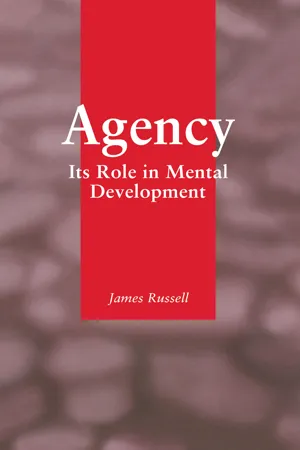
About this book
The idea behind this book is that developing a conception of the physical world and a conception of mind is impossible without the exercise of agency, meaning "the power to alter at will one's perceptual inputs". The thesis is derived from a philosphical account of the role of agency in knowledge.; The book is divided into three parts. In Part One, the author argues that "purely representational" theories of mind and of mental development have been overvalued, thereby clearing the ground for the book's central thesis. In Part Two, he proposes that, because objective experience depends upon the experience of agency, the development of the "object concept" in human infants is grounded in the development of executive-attentional capacities. In Part Three, an analysis of the links between agency and self-awareness generates an original theory of the nature of certain stage-like transitions in mental functioning and of the relationship between executive and mentalizing defects in autism.; The book should be of interest to students and researchers in cognitive- developmental psychology, to philosophers of mind, and to anybody with an interest in cognitive science.
Information
Publisher
Psychology PressYear
2013Print ISBN
9781138876965
9780863772283
Edition
1eBook ISBN
9781134832095
Part 1
Symbols, Models, and Connections
Setting the Scene
While, in the last 10 years or so1, the mainstream of cognitive developmental research has been flowing inexorably towards a sea of questions about children’s “theory of mind”, philosophers and developmental psychologists have often found themselves travelling in the same boat. It is fair to say though that the boat has been a narrow one—at least in philosophical terms.
We have been taken up with questions about the status of folk psychology, with the tensions between “simulation” and the “theory-theory”, and we have accordingly not moved far beyond the game of “hunt the theory”—Is it like a scientific theory? Can we call it a “theory” at all? What is the One True Theory of meta-representation? And this has led us to neglect philosophical work with a different and more direct kind of relevance, where the concern is with how it is possible at all that we should be minds set apart from a physical world. Here questions are asked about the “pre-theoretical mind”, questions that can be answered without prejudice to how development actually happens; although how we answer them will surely constrain (to put it mildly) empirical accounts of how it does actually happen. They are questions about how our cognitive capacities have to be grounded—questions about what is necessary for adequate mental development.
What I am calling “how-is-it-possible” questions require for their answers what are called (after Kant) “transcendental” arguments, and they take this form: we know X (or believe Y or have the capacity to do Z) and this would not be possible for us unless our experience had form F; therefore our experience has form F. It is the kind of a priori theorising in which the founding fathers of cognitive developmental psychology often engaged. Most notably, James Mark Baldwin drifted elegantly but confusingly between the transcendental and the empirical, and coined the phrase “genetic epistemology” to describe his programme (Russell, 1978, for a précis of his major work); and Jean Piaget borrowed Baldwin’s phrase.
Although Piaget was a far more focused and scientific thinker than Baldwin, the transcendental and the empirical strands in his work are nearly as hard to disentangle. Piaget collected observations and devised tasks, but it is obvious to the reader that nothing in a child’s behaviour or judgement would be allowed to undermine his fundamental assumptions—that thinking is a form of action; that thought is adaptive and adequate only insofar as it is “structured”; that learning occurs through the tension between “assimilation” and “accommodation”. And lying at the heart of these assumptions was the following transcendental inference: we know X (e.g. what constitutes a rational inference) and we would not know this unless our experience were structured by our agency; therefore our experience must be structured by our agency.
My main aim in this book is to present the case for aversion of Piaget’s transcendental inference, and to show how this both illuminates empirical work and inspires new hypotheses. The form in which I present it—it is more Piaget-flavoured than Piagetian and so I’ll write it with a small “p”—is this: ‘We have a conception of the external world and a conception of our own and others’ minds; we would not have these conceptions unless we experienced our own agency and did so in a particular way; therefore adequate mental development depends on adequate, early agency.” In Parts 2, I discuss knowledge of objects and in Part 3 knowledge of minds; and right now I need to say a few words about how Part 1 will be located relative to these.
Part 1 is essentially an attempt at clearing away some ground in order to allow my piagetian thesis a proper run for its money, by which I mean clearing the ground of developmental meta-theories that would appear to marginalise the piagetian one. My first target will be Jerry Fodor’s (1976) “language of thought” (LOT) doctrine. If Fodor’s arguments about the necessity for LOT are correct, then a form of nativism is forced on us, and this would seem to foreclose options on the piagetian view. There are a number of reasons why this is so and the easiest to state concisely is that nativism of this kind would have us regard agency as an innate, formal computational module rather than as the exercise of a capacity for first-person experience. [In fact Alan Leslie (in press) has recently gone down the Fodorian road and posited the “theory of body mechanism”.] Accordingly, I spend some time presenting a case against the LOT thesis.
The second representational theory to be discussed is one that leads us to regard development as the process through which the child’s thought becomes progressively more adequate as his or her mental representations become progressively more structurally isomorphic to that which they represent. This is “mental models” theory; and I have some sceptical remarks to make about it both as a theory of cognition and as a developmental theory.
The third kind of theory is one that on the surface at least looks essentially empiricist and associationist—connectionism. What I do here is to argue that, whatever shortcomings connectionism may or may not have in other areas, it is the computational theory best placed to model agency. Connectionist models will be discussed towards the end of Part 1 and they will also crop up in the final sections of Parts 2 and 3, because, in common with certain other developmental psychologists with a Piagetian cast of mind (e.g. Bates & Elman, 1993) I am an enthusiast for this approach and see connectionist models as providing existence-proofs that certain kinds of learning, and therefore certain modes of development, are possible in principle.
What is the “status” of a book like this? Surely a thesis that is neither squarely philosophical nor squarely empirical is bound to be incoherent on some level? It certainly can be, and philosophers have complained with justification about such incoherence in Piaget’s own work (e.g. Hamlyn, 1978). All I will say is that I try to be clear about when my claims can be overturned by an argument or by an experiment.
Why be Sceptical about “Purely Representational” Theories?
As I said, in the main body of this book I shall be arguing that only agents can develop a conception of the external world and a conception of mind—that the exercise of agency is a necessary condition for what we call in developmental psychology “object permanence” and a “theory of mind”. And by “agency” I shall mean the ability to alter at will one’s perceptual inputs—motorically or attentionally. Although this claim sounds a grand one, it is almost modest; perhaps not as modest as the claim that breathing is a necessary condition for human cognitive development, but certainly more interesting.
Why exactly do the three metatheories of development just described (LOT, mental models, connectionism) impede such a view? They do so insofar as they all, in different ways and with different places of emphasis, take agency to be derivative of the primary mental function which is that of representing reality. All three assume that what must happen in mental development is the mind coming to be in the right representational state. These adequate representations will, of course, “cause” appropriate actions, and the theories will refer, in their different ways, to “operations” which have to be performed on these representations; but agency, as I have just described it, has nothing essential to do: it is a power conferred on the organism by adequately structured representations.
It would certainly be crazy to try to do cognitive and developmental psychology without concerning oneself with mental representation; this was the “Behaviourist” programme for cognition, and that failed entirely. Of course cognition involves representation and of course representations develop, and a theory of development that was concerned exclusively with how children come to control their behaviour and their mental states (never saying what these consisted in) would be absurd. And remember that I will be arguing that the third of these representational theories (connectionism) has the conceptual resources to model the sub-personal2 conditions for agency; I will attempt to show how it exercises them. That said, I do have objections to make to the imperialistic nature of these three theories, to their assumption that cognition just is (1) the manipulation of mental symbols, or (2) the construction of mental models, or (3) the achievement of the target input-output mapping in neural networks. My arguments will be directed against these ambitions.
Before coming to the first of these representational theories—LOT—I will make a few general remarks about the role of representation in thought.
It is clear that thoughts function as a medium for representing actual and possible states of affairs. Indeed we can only understand intelligent actions on the assumption that they are driven by representations of the environment not, in a stimulus-response or “direct” fashion, by the environment itself. We behave, that is, on the basis of how we, rightly or wrongly, take reality to be—on the basis of our representations of it.
That said, it cannot be true that the representational phenomena of which we are aware when we think (phenomena such as mental images and sub-vocal sentences) actually constitute thinking. And so the view that, say, identifies thinking there are green apples with having a mental image of green apples, and that identifies the thought that green apples are bad for the digestion with having a sentence to that effect come into consciousness is unacceptable for at least two reasons. In the first place, thinking of this kind involves belief, and believing is more than representing: beliefs must involve a commitment to the truth of one’s mental representation. And, without assuming this commitment, it is impossible to understand the link between belief and action: we act on the basis of our beliefs, even if they are false. It is not at all clear, then, how having a mental image or entertaining a mental sentence can capture the fact of commitment to truth, and attempts to explain belief in terms of the inherent character of the representational elements are doomed. David Hume, for example, who held more or less that the representational elements (“impressions*)are similar to mental images, argued that a believed impression has greater “force and vivacity” than one that is not believed; but he could give no reason why the fact of a mental-image-like mental episode’s being forceful and vivid should lead us to believe something (what?) about that which is being represented before the mind’s eye. A Humean is even more stretched to explain the differences between the varieties of mental orientation to what is represented (e.g. hoping, expecting, desiring “that X”—see following paragraphs) in terms of degrees and kinds of “force and vivacity”.
But what about the images and verbalised thoughts that pop unbidden into our minds without any commitment to their truth; and what about our idle fantasies? Granted, not all mental episodes are believed, but we can only make sense of such episodes insofar as they can be set against cases where the thinker is also a believer. There can only be disbelieved and unwanted thoughts against a background of thoughts that are believed and willed.
The point is, then, that, although the so-called content of a thought (i.e. the proposition “... that X”) can be regarded as a representation, the attitude of belief (or disbelief or indifference) cannot plausibly be regarded in that way. Belief is called a “propositional attitude” by philosophers; and of course there are many other varieties of them. We can hope that, wish that, fear that, expect that, pretend that, have a sneaking suspicion that, and so on. In what sense are these attitudes “representations” of anything?
The first impediment, then, to the view that thoughts are nothing more than representations of reality or of possible realities is that it is not at all clear how one can regard the thinker’s propositional attitudes—some philosophers refer to these as forms of relation between the thinker and the content—to these representations as themselves being representations.
The second problem with saying that mental images and sub-vocal sentences are equivalent to thoughts is a rather more familiar one, and one that raises what is sometimes called “the homunculus problem*. If thinking of an apple is having a mental image of an apple, and if thinking that unripe apples are bad for the digestion is having the mental sentence “Apples are bad for the digestion” in our mind’s ear, then what is to prevent us, in the first case from interpreting that mental picture as a picture of a smooth, green orange and, in the second case, interpreting the sentence as the first line of a joke rather than as a sincere belief? In other words, any picture, any sentence—any table, or formula, or map—indeed anything with a remotely representational status stands in need of interpretation3. How is this interpretation to be fixed as being such-and-such? You might say by some mental system further downstream which unpacks it, analyses it, and treats it as grist to some interpretative machinery. But this is no help to us if we want to be thoroughly representational about thought. The problem also occurs in theories of perception. What is seeing an apple? Is it like having a picture of an apple somewhere in the brain? If it is, then we need a little person in the brain—an homunculus—to look at this mental picture, and he will in turn need another homunculus in his brain to look at that picture, and so on and so on. The problem concerns, then, how we might give a thoroughly representational account of thinking if all we have to conjure with are representations. Doesn’t the representing have to stop somewhere?
With these questions in mind, we can now turn to the LOT doctrine. As you will see, its main selling-point is that it offers a solution to the homunculus problem.
1.1: Symbol Processing and “The Language of Thought”
J. A. Fodor (1976) pointed out that there are languages that do not require further interpretation but which support processes with a mental character, namely, the languages used by digital computers. If so, we would seem to have a kind of existence-proof that the homunculus problem can be avoided; for here are systems that perform mental functions using only symbols and rules, and whose representational devices do not have to be interpreted by some homunculus-like entity downstream.
The programming languages of a computer (e.g. Lisp, Prolog, C), Fodor argued, require interpretation only in the technical sense that they have to be translated (“compiled”) into another language for the computer to run the program. However the language into which they are translated—the “machine code”—does not itself require an interpretation, rather, it causes the machine to function. The claim is then made that any system that performs cognitive operations requires a language in which to perform them, insofar as any system must compute over representations. Fodor calls this the “language of thought” (LOT), a language, of similar status to a machine code, that causes the cognitive wheels to turn.
How does this deal with the problem, raised earlier, about the non-representational nature of the propositional attitudes? We can say that within LOT different sentences have different locations (metaphorically speaking) within the computing system; some end up in a “belief box”, some in an “intention box”, some in the “desire box”, and so forth (Fodor, 1987). The “location” of a mental sentence will determine its causal role and thus its links to action. For example, we act on what we believe to be true and try to make our wishes come true whenever possible; and what enables us to do this is the geography of our mental sentences.
What would Fodorians reply to those who say that “causing a mental system to function” is one thing but “thinking”, as we take it to be in our folk psychology, is quite another? They would say that this objection merely shows that the objector is in the grip of a dualist prejudice-a prejudice against any account of thinking “as we take it to be” being presented at a sub-personal level (at the mechanistic level of causally interacting symbols, in this case). Folk psychology cannot emerge from nowhere: there can be no folk psychology in creatures that lack the representational format for it. Indeed Fodor (1987) goes further and says that the categories of LOT must map onto the categories of folk psychology, taking, thereby, a “realist” view of folk-psychological notions such as “intention” and “belief”, taking these to refer to sui generis computational states.
But, putting to one side the question of whether or not there is a close fit between LOT and everyday cognition, it is important to recognise LOT as a species of functionalism, with functionalism being one of the main alternatives to mind-body dualism. On functionalism, a mental state comes to be the state it is because of the three kinds of causal relation into which it enters: (1) its causation by perceptual inputs; (2) its causation of motor outputs; (3) its causal interplay with other states.
1.1(i) The Slippery Slope from LOT to Strong Nativism
Fodor (1976) was very explicit about LOT’S consequences for cognitive developmental psychology. Here is the argument.
Natural language symbols are learned. But a moment’s reflection tells us that symbols in LOT cannot be learned. The reason is that in the case of natural language a symbol— “dog” for example—is a sign that the developing child learns; whereas in LOT the symbol (let’s call it) DOG is the representational atom that supports the capacity to think of dogs. Imagine somebody who was unable to think of dogs—whose mental system lack...
Table of contents
- Cover Page
- Title Page
- Copyright Page
- Dedication
- Contents
- Acknowledgements
- Part 1 Symbols, Models, and Connections
- Part 2 Knowledge of Objects
- Part 3 Action and Our Knowledge of Minds
- Coda Looking Back and Going Forward
- References
- Author Index
- Subject Index
Trusted by 375,005 students
Access to over 1.5 million titles for a fair monthly price.
Study more efficiently using our study tools.
Frequently asked questions
Yes, you can cancel anytime from the Subscription tab in your account settings on the Perlego website. Your subscription will stay active until the end of your current billing period. Learn how to cancel your subscription
No, books cannot be downloaded as external files, such as PDFs, for use outside of Perlego. However, you can download books within the Perlego app for offline reading on mobile or tablet. Learn how to download books offline
Perlego offers two plans: Essential and Complete
- Essential is ideal for learners and professionals who enjoy exploring a wide range of subjects. Access the Essential Library with 800,000+ trusted titles and best-sellers across business, personal growth, and the humanities. Includes unlimited reading time and Standard Read Aloud voice.
- Complete: Perfect for advanced learners and researchers needing full, unrestricted access. Unlock 1.5M+ books across hundreds of subjects, including academic and specialized titles. The Complete Plan also includes advanced features like Premium Read Aloud and Research Assistant.
We are an online textbook subscription service, where you can get access to an entire online library for less than the price of a single book per month. With over 1.5 million books across 990+ topics, we’ve got you covered! Learn about our mission
Look out for the read-aloud symbol on your next book to see if you can listen to it. The read-aloud tool reads text aloud for you, highlighting the text as it is being read. You can pause it, speed it up and slow it down. Learn more about Read Aloud
Yes! You can use the Perlego app on both iOS and Android devices to read anytime, anywhere — even offline. Perfect for commutes or when you’re on the go.
Please note we cannot support devices running on iOS 13 and Android 7 or earlier. Learn more about using the app
Please note we cannot support devices running on iOS 13 and Android 7 or earlier. Learn more about using the app
Yes, you can access Agency by James Russell in PDF and/or ePUB format, as well as other popular books in Psychology & Developmental Psychology. We have over 1.5 million books available in our catalogue for you to explore.