Stella Chess and Alexander Thomas' new book illuminates one of the most significant theoretical and practical implications in professional publications on temperament today: the concept of goodness of fit. When individuals achieve accordance with the properties and expectations of their respective environments, they have attained goodness of fit, which ultimately enables their psychological growth and health. They can function on a healthy level with a potential for a positive life course.
Beginning with a clear definition and explanation of the concept of goodness of fit, the book goes on to delineate the evolution of the goodness of fit concept, its clinical applications, and the biopsychosocial elements relevant to the goodness of fit model. The authors provide insightful step-by-step commentaries on individual case histories that concern such problems. Each case is unique and intriguing, and is reviewed by the authors in a compelling manner. As is appropriate to their research, they have wisely taken into account a wide variety of environmental expectations and demands-parental and other caregivers' child practices and goals, peer group judgments, special community values, as well as cultural and ethnic diversity. They also address possible educational rules and expectations, career stresses, sexual issues and marital conflicts.
In the past, clinical applications of the concept of goodness of fit have been restricted to a modest number of community parent guidance temperament programs and have not received their due attention. In their recent work, however, Chess and Thomas, long-standing psychiatrists with forty years of clinical experience, step outside past boundaries and explore a panoply of clinical cases, including all age-periods, ranging from infancy to adulthood. Using the clinical data obtained from numerous case histories, the authors develop an insightful clinical system from which researchers and clinicians of mental health professionals, pediatricians and educators alike can benefit.
Goodness of Fit: Clinical Applications, From Infancy through Adult Life aims to answer the question of how to create a healthy consonance between individuals and their environments in order to achieve optimal development, and will undoubtedly enhance both our understanding of psychological development and personality maturation as well as the clinical methods used to analyze them.
eBook - ePub
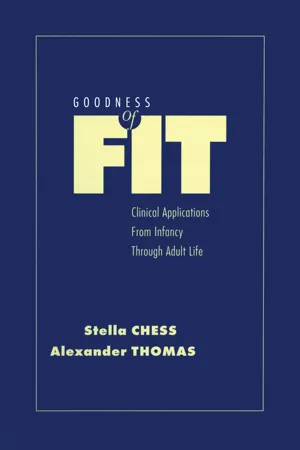
Goodness of Fit
Clinical Applications, From Infancy through Adult Life
- 246 pages
- English
- ePUB (mobile friendly)
- Available on iOS & Android
eBook - ePub
About this book
Information
PART
I
EVOLUTION OF THE GOODNESS OF FIT CONCEPT
1
CHAPTER
Goodness of Fit: A Special Developmental Concept and Its Clinical Applications

It is a specific definitive and comprehensive concept of normal and deviant psychological development. The concept also has extensive clinical applications.
Our Definition
Goodness of fit results when the properties of the environment and its expectations and demands are in accord with the organism’s own capacities, characteristics, and style of behaving. When consonance between organism and environment is present, optimal development in a progressive direction is possible. Conversely, poorness of fit involves discrepancies and dissonances between environmental opportunities and demands and the capacities of the organism, so that distorted development and maladaptive functioning occur. Goodness of fit is never an abstraction, but is always goodness of fit in terms of the values and demands of a given culture or socioeconomic group (Thomas & Chess, 1977, pp. 11–12).
Psychological Development
Utilization of a goodness of fit paradigm demands first that the study of psychological development at any age-period assemble the specific hard facts of the individual’s behavior, motivations, temperament, cognitive level, and special talents. At the same time, the factual nature of the environmental expectations and demands, as well as any unusual or unexpected events, is also gathered. Then, according to our definition, the student of development can examine these comprehensive data and select the pertinent aspects of the individual’s characteristics and the relevant items of the environmental status. The data can then be organized to develop an interactional individual-environmental process. If the process is manifested as a goodness of fit at that age-period, the individual will be functioning on a healthy level, with a potential for a positive life course. If the interactional process is manifested as a poorness of fit at that age-period, the individual will be functioning on an unhealthy level, with potentially unfavorable and even pathogenic consequences.
At sequential age-periods, the psychological development, whether with goodness or poorness of fit, may be consistent. On the other hand, at different age-periods there may be change, such as goodness of fit altering to a poorness of fit. It may then remain consistent or may shift back to goodness of fit. Or a similar pattern of variability may change from a poorness of fit, etcetera. The consistency or change of goodness/poorness of fit over time is determined by the constancy versus the variability in the individual and his or her environment at sequential age-periods.
To orient the reader, the pertinent factors of the development of individual and environmental characteristics are spelled out in each chapter. Infancy (Chapter 5), Toddler and Preschool Periods (Chapter 6), School Age and Middle Childhood (Chapter 7), Adolescence (Chapter 8), and Adulthood (Chapter 9). An additional chapter discusses the dynamics of continuity and change of personality development (Chapter 10).
Clinical Applications
Secondly, a clinician’s use of the goodness of fit concept also requires that the clinical history assemble the specific hard facts of the patient’s characteristics, and the details of the expression of symptoms including their origin, developmental course, and current state. At the same time, the history of the factual nature of the previous and current environmental status should be included.
Once this history is obtained, a clinician has the first diagnostic responsibility. Does the data indicate that the patient may be suffering from a psychotic mental illness, such as schizophrenia, manic-depressive illness, severe depression, or any other physiological system affecting the brain and producing a mental illness? If so, the therapeutic program for such a case would require the use of the effective psychotropic drugs and other special programs provided by specialized therapists or treatment institutes.
If the diagnostic evaluation eliminates the possibility of a substantial psychiatric illness, a therapist can turn his/her attention to the patient’s symptoms. We are now confronting psychiatric disorders such as anxiety disorders, adjustment disorders, personality disorders, sexual disorders, social anxiety disorders, and relational problems such as marital dysfunction. This list conforms to the DSM-IV. Other symptomatic disorders such as educational, marital, or vocational problems may also be responsible.
It has now been established that the symptoms are due to a lesser psychiatric disorder, or alternatively to a dysfunctional episode in the life course. The likelihood is that the patient has come to the therapist asking for help with symptoms, which are the consequences of the poorness of fit in the individual–environment interactional process. It is quite possible that the data a therapist has gained from the detailed factual history will be sufficient to formulate the patient’s poorness of fit and its symptomatic consequences. In some cases, these data may provide significant clues for understanding the structure of this particular poorness of fit, but not sufficient to validate the hypothesis. In those cases, additional factual information from family, friends, or other sources invited by the patient may be required to fill out the necessary details of the unfavorable interactional process.
Once a therapist has formulated the clear poorness of fit elements responsible for the patient’s psychological symptoms, the next crucial step is the transformation of the poorness of fit to a goodness of fit. This is achieved by starting with a carefully detailed factual scrutiny of the unfavorable interactional process. Through such a scrutiny, the therapist can identify what specific change or changes in the patient’s functioning and/or the environment’s influence is required. Such a metamorphosis is the basic therapeutic process essential to alter a poorness to a goodness of fit. In most cases, patients are willing to embrace a program to alter their actions—sometimes fearfully, sometimes reluctantly, and sometimes with enthusiasm.
However, if a therapist has succeeded in identifying the pivotal change, the therapy will be successful. Once the goodness of fit is achieved it is desirable to arrange several follow-up discussions—one after several weeks, others after six months or a year—to make sure the achievement of goodness of fit has become, in fact, an essential and automatic manner of functioning.
A most important chapter (Chapter 19), entitled Guidelines for the Clinician, has been devoted to a detailed description of successive steps for the management and treatment of a patient, starting from the referral and first session. From that, the logical sequence of steps one-by-one are spelled out to analyze the dynamic evolution of a poorness of fit, and therapeutic strategies are described that will advance the therapeutic process so as to ameliorate or cure the person’s psychological disturbances.
In this chapter we have made it clear that in the developmental concept and research strategies of goodness of fit and its clinical applications, facts are the keystone for a human being. Facts include behavior, emotions, motivations, ideas, goals, and values. However, they do not include speculations, unverified assumptions, or generalizations regarding a person’s characteristics.
In Chapter 3 we have formulated brief but meaningful critiques of several current major theoretical concepts and their clinical applications in the psychological and psychiatric fields. But, at this point, it is desirable to contrast the factual sina qua non of the goodness of fit with the opposite approach of data collection within psychoanalytic theory, research, and clinical applications. Psychoanalysis remains an influential field for clinicians and a number of other mental health professionals, as well as for academicians in the arts and literature. They have utilized Freud’s highly complex structure of the developmental life-course and elaborated techniques in psychoanalytically-oriented treatment of patients and in erudite but questionable reconstruction of the influences on the lives of real artists such as Shakespeare, and fictional characters such as Hamlet.
Freud has emphasized the crucial importance of early life determinism, to wit, “The events of the first years are of paramount importance … a (child’s) whole subsequent life” (1949, p. 83). With this edict, psychoanalysts, and other professionals, have searched for those particular presumed traumatic events of “paramount importance” in the infant’s life. Various techniques have been employed in the older child or adult, especially by probing to reveal repressed infantile memories. These methods and their presumed findings have been subjected to a number of scholarly critiques (see Chapter 3).
In 1996, Dr. Peter Wolff, Professor of Psychiatry at Harvard, who has been dedicated to an examination of child development for decades, published a challenging paper, “The Irrelevance of Infant Observations for Psychoanalysis.” With the many very dubious methods attempting to discover the infantile memories of older children and adults, Wolff has observed that, “the current consensus among psychoanalysts holds that direct infant observations are one means for testing the developmental propositions of psychoanalytic theory.” He critically reviewed a number of these psychoanalytic early childhood researchers and concluded that, “psychoanalytically informed infant observations may be the sources for new theories of social-environmental development, but that they are essentially irrelevant for psychoanalysis as a psychology of meanings, unconscious ideas, and hidden motives” (p. 369).
A very recent statement of one experienced and thoughtful psychiatrist and psychoanalyst confirms Wolff’s devastating critique of psychoanalytic research on infant observers. At a meeting of a large group of psychoanalysts in New York in March 1998, Dr. Robert Michels, Professor of Psychiatry at Cornell University, was quoted as stating that, “We are experts not in helping learn facts but in helping them construct useful myths. We are fantasy doctors, not reality doctors. We don’t help patients decide what is true.” From the newspaper reporter at the meeting, it appears that most of the psychoanalysts at the meeting agreed with Dr. Michels’ statement (Boxer, N.Y. Times, 1998).
Thoughtful psychoanalysts, such as Cooper, Kernberg, and Person (1989) are faced with a serious dilemma. In their volume, they refer to a number of Freud’s contradictions and inconsistencies among his theories. But they contend that the current generation of analysts have developed “newer ideas out of our own data and intellectual climate” but admit that “these views have yet to be integrated into a single overarching analytic theory” (1989, p. 2). However, Wolff and Michels have emphatically asserted that the infantile theories based on a central structure of psychoanalysis are founded on invalid factual data, even constructed into a “comfortable myth.” Confronted with this reality, how can psychoanalysts hope to even achieve a “single overarching analytic theory”?
The chapter on Infancy (Chapter 5), reviewing the non-analytic research studies of the last 30 years, demonstrates changes in this view of the neonate’s functioning. In one study after another, based on the classical scientific criteria, researchers have found valid factual data on infantile abilities and functions of perception, temperament, learning, social communication, and neural plasticity.
Our definition of the goodness/poorness of fit concept involves another significant theoretical aspect of poorness of fit called vulnerability.
In goodness of fit the consonance between organism and environment is present and indicates that the organism’s own capacities, characteristics, and style of behaving are basically normal. Also, that the properties of the environment and its expectations and demands are in accord indicates that the environment is benign.
For a poorness of fit, the issue is different. The characteristics and capacities of the organism are not clearly specified. Neither are the discrepancies and dissonances of the environment clarified. A poorness of fit leads to pathological functioning. Does this mean that the person’s capacities and characteristics are pathological, and/or that the environment is excessively stressful? We have studied the dynamics of the person-environment interaction in a number of cases with poorness of fit. The result of this study has led us to a specific postulation. A person’s pathological symptoms resulting from the development of a poorness of fit do not necessarily reflect his/her abnormal capacities and characteristics. The individual suffering from a poorness of fit is not bedeviled from some unconscious pathological pattern. Nor is a person’s development of a poorness of fit based on some basic pathology. Rather, the individual is normal, but suffers from a distinct vulnerability.
Webster’s New World Dictionary defines vulnerable as, “open to, or easily hurt by criticism or attacked,” or “affected by a specified influence.” In other words, an individual does not have an intrinsic liability but rather a characteristic that is “easily hurt by criticism or attacked” if “affected by a specified influence.” For a typical example, Norman (see Chapter 10) started life as a normal infant and would probably have continued to develop without major problems throughout his life-course except for one vulnerability, his distractibility and low attention span. Moreover, this vulnerability need not have distressed him and could have been at most a minor interference with his functioning from time to time. However, his temperamental characteristics became a serious vulnerability because he was “affected by a specific influence,” namely his father’s persistent derogation, criticism, and sniping at his characteristic behavior. We postulate that this youngster’s severe vulnerability with its disastrous consequences was due to his father’s frequent negative pronouncements. This temperament-environment interactional process started with the boy’s normal, but inconvenient (to the father) style of functioning, and the pathological development occurred during the process of the interaction. This leads to the formulation of the concept: the pathology is in the interaction.
This paradigm, the evolution of poorness of fit with its pathological consequences, was due to the interaction of an individual with a specific vulnerability created by the environmental outside influence and stress. This vulnerability-environmental stress generated increasing dysfunction of the individual. To repeat, the pathology was generated in the interaction.
The reader can apply this paradigm, with the vulnerability and the pathology in the interaction, in one case after another, as will be described in succeeding chapters. Chapter 18, entitled “Normalcy and Vulnerability vs. Pathology” discusses this paradigm in detail, with many case examples and their clinical implications.
2
CHAPTER
The Origins of the Goodness of Fit Concept
In the early 1950s, as therapists working with children and adult patients, we were troubled at the dominant child-parent relationship theory of the times. To put it simply, if a child had a behavior problem it was presumed to have been caused by a pathogenic mother’s behav...
Table of contents
- Cover Page
- Half-Title Page
- Title Page
- Copyright Page
- Dedication
- Table of Contents
- Foreword
- Preface
- Part I. Evolution of the Goodness of Fit Concept
- Part II. Goodness of Fit: Clinical Applications
- Part III. The Importance of the Biopsychosocial Model
- Part IV. Clinical Applications
- Part V. Conclusion: The Basic Structure of Goodness of Fit
- Appendix: Temperament Definitions, Categories, and Ratings
- Index
Trusted by 375,005 students
Access to over 1.5 million titles for a fair monthly price.
Study more efficiently using our study tools.
Frequently asked questions
Yes, you can cancel anytime from the Subscription tab in your account settings on the Perlego website. Your subscription will stay active until the end of your current billing period. Learn how to cancel your subscription
No, books cannot be downloaded as external files, such as PDFs, for use outside of Perlego. However, you can download books within the Perlego app for offline reading on mobile or tablet. Learn how to download books offline
Perlego offers two plans: Essential and Complete
- Essential is ideal for learners and professionals who enjoy exploring a wide range of subjects. Access the Essential Library with 800,000+ trusted titles and best-sellers across business, personal growth, and the humanities. Includes unlimited reading time and Standard Read Aloud voice.
- Complete: Perfect for advanced learners and researchers needing full, unrestricted access. Unlock 1.5M+ books across hundreds of subjects, including academic and specialized titles. The Complete Plan also includes advanced features like Premium Read Aloud and Research Assistant.
We are an online textbook subscription service, where you can get access to an entire online library for less than the price of a single book per month. With over 1.5 million books across 990+ topics, we’ve got you covered! Learn about our mission
Look out for the read-aloud symbol on your next book to see if you can listen to it. The read-aloud tool reads text aloud for you, highlighting the text as it is being read. You can pause it, speed it up and slow it down. Learn more about Read Aloud
Yes! You can use the Perlego app on both iOS and Android devices to read anytime, anywhere — even offline. Perfect for commutes or when you’re on the go.
Please note we cannot support devices running on iOS 13 and Android 7 or earlier. Learn more about using the app
Please note we cannot support devices running on iOS 13 and Android 7 or earlier. Learn more about using the app
Yes, you can access Goodness of Fit by Stella Chess,Alexander Thomas in PDF and/or ePUB format, as well as other popular books in Psychology & Clinical Psychology. We have over 1.5 million books available in our catalogue for you to explore.