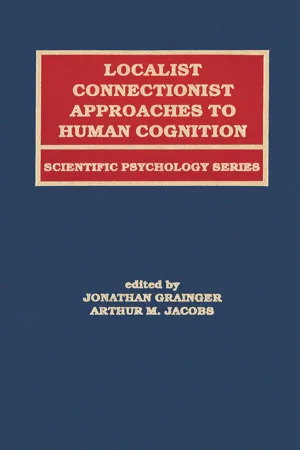
This volume provides an overview of a relatively neglected branch of connectionism known as localist connectionism. The singling out of localist connectionism is motivated by the fact that some critical modeling strategies have been more readily applied in the development and testing of localist as opposed to distributed connectionist models (models using distributed hidden-unit representations and trained with a particular learning algorithm, typically back-propagation). One major theme emerging from this book is that localist connectionism currently provides an interesting means of evolving from verbal-boxological models of human cognition to computer-implemented algorithmic models. The other central messages conveyed are that the highly delicate issue of model testing, evaluation, and selection must be taken seriously, and that model-builders of the localist connectionist family have already shown exemplary steps in this direction.
eBook - ePub
Localist Connectionist Approaches To Human Cognition
- 384 pages
- English
- ePUB (mobile friendly)
- Available on iOS & Android
eBook - ePub
Localist Connectionist Approaches To Human Cognition
About this book
Information
Table of contents
- Cover
- Halftitle
- Title
- Copyright
- Contents
- Preface
- 1 On Localist Connectionism and Psychological Science
- 2 A Model of Selective Attention as a Mechanism of Cognitive Control
- 3 A Model of Human Face Recognition
- 4 Simulating the Time Course of Spoken Word Recognition: An Analysis of Lexical Competition in TRACE
- 5 MROM-p: An Interactive Activation, Multiple Readout Model of Orthographic and Phonological Processes in Visual Word Recognition
- 6 The BIA Model and Bilingual Word Recognition
- 7 Modeling Immediate Serial Recall With a Localist Implementation of the Primacy Model
- 8 Modeling the Production of Object Specifications
- 9 Hanging Together: A Connectionist Model of Similarity
- 10 Issues in Selecting Mathematical Models of Cognition
- Author Index
- Subject Index
Trusted by 375,005 students
Access to over 1.5 million titles for a fair monthly price.
Study more efficiently using our study tools.
Frequently asked questions
Yes, you can cancel anytime from the Subscription tab in your account settings on the Perlego website. Your subscription will stay active until the end of your current billing period. Learn how to cancel your subscription
No, books cannot be downloaded as external files, such as PDFs, for use outside of Perlego. However, you can download books within the Perlego app for offline reading on mobile or tablet. Learn how to download books offline
Perlego offers two plans: Essential and Complete
- Essential is ideal for learners and professionals who enjoy exploring a wide range of subjects. Access the Essential Library with 800,000+ trusted titles and best-sellers across business, personal growth, and the humanities. Includes unlimited reading time and Standard Read Aloud voice.
- Complete: Perfect for advanced learners and researchers needing full, unrestricted access. Unlock 1.5M+ books across hundreds of subjects, including academic and specialized titles. The Complete Plan also includes advanced features like Premium Read Aloud and Research Assistant.
We are an online textbook subscription service, where you can get access to an entire online library for less than the price of a single book per month. With over 1.5 million books across 990+ topics, we’ve got you covered! Learn about our mission
Look out for the read-aloud symbol on your next book to see if you can listen to it. The read-aloud tool reads text aloud for you, highlighting the text as it is being read. You can pause it, speed it up and slow it down. Learn more about Read Aloud
Yes! You can use the Perlego app on both iOS and Android devices to read anytime, anywhere — even offline. Perfect for commutes or when you’re on the go.
Please note we cannot support devices running on iOS 13 and Android 7 or earlier. Learn more about using the app
Please note we cannot support devices running on iOS 13 and Android 7 or earlier. Learn more about using the app
Yes, you can access Localist Connectionist Approaches To Human Cognition by Jonathan Grainger,Arthur M. Jacobs,Arthur Jacobs in PDF and/or ePUB format, as well as other popular books in Psychology & Cognitive Psychology & Cognition. We have over 1.5 million books available in our catalogue for you to explore.