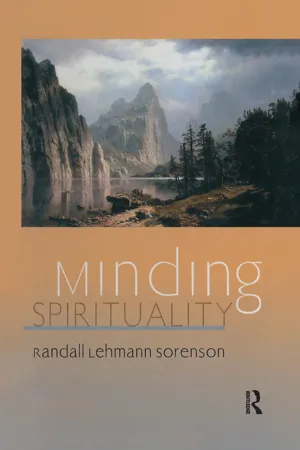
In Minding Spirituality, Randall Sorenson, a clinical psychoanalyst, "invites us to take an interest in our patients' spirituality that is respectful but not diffident, curious but not reductionistic, welcoming but not indoctrinating." Out of this invitation emerges a fascinating and broadening investigation of how contemporary psychoanalysis can "mind" spirituality in the threefold sense of being bothered by it, of attending to it, and of cultivating it.
Both the questions Sorenson asks, and the answers he begins to formulate, reflect progressive changes in the psychoanalytic understanding of spirituality. Sorenson begins by quantitatively analyzing 75 years of journal literature and documenting how psychoanalytic approaches to religious and spiritual experiences have evolved far beyond the "wholesale pathologizing of religion" prevalent during Freud's lifetime. Then, in successive chapters, he explores and illustrates the kind of clinical technique appropriate to the modern treatment of religious issues. And the issue of technique is consequential in more than one way -- Sorenson presents evidence that how analysts work clinically has a greater impact on their patients' spirituality than the patients' own parents have.
Sorenson brings an array of disciplinary perspectives to bear in examining the multiple relationships among psychoanalysis, religion, and spirituality. Empirical analysis, psychoanalytic history, sociology of religion, comparative theory, and sustained clinical interpretation all enter into his effort to open a dialogue that is clinically relevant. Turning traditional critiques of psychoanalytic training on their head, he argues that psychoanalytic education has much to learn from models of contemporary theological education. Beautifully crafted and engagingly written, Minding Spirituality not only invites interdisciplinary dialogue but, via Sorenson's wide-ranging and passionately open-minded scholarship, exemplifies it.
- 200 pages
- English
- ePUB (mobile friendly)
- Available on iOS & Android
eBook - ePub
Minding Spirituality
About this book
Information
Chapter 1
Minding Spirituality
As the French and English workers, using massive tunnel-boring machines, drilled out from the shores of their respective homelands and toward each other midway beneath the English Channel, they chiseled the last few feet with a much smaller probe, hoping for a point of contact. Through the resulting small opening, the first thing the lead French worker heard was a voice addressing him from the other side with a greeting of “Bonjour!” Chuckling, the Frenchman replied, “Hello.” At this, the English tunnelers heard shouts coming to them from the other side of the portal exclaiming “God save the Queen!” to which the English workers answered with cries of “Vive la France!” (Associated Press, 1990).
There is much at which to marvel in the completion of the English Channel Tunnel (or “Chunnel” as it has been nicknamed) not least of which is that the two drilling teams managed to meet at all. It would have been a difficult enough feat to accomplish had the Chunnel been simply a straight line, since in that case either crew’s initial misalignment by as little as an inch would have made the tunnels miss each other and, to make matters worse, the boring machines were incapable of backing up. Although citizens of Dover with a telescope on a clear day could claim to read the hands of the clock on the Calais town hall, tunneling under the seabed required the workers to stay within a narrow band of geologic chalk that was impervious to water, structurally stable, and relatively easy to mine. The problem was not only that deviation from this chalk stratum meant encountering unstable and porous rock that would cause the tunnel to collapse and fill with water, but also the chalk stratum itself wasn’t straight or level. The narrow band pitched and dipped, angled one way and then another. Global positioning satellites gave the miners who were navigating several hundred feet beneath the water’s surface an estimate of latitude and longitude, but equipment used at the time could not give reliable information about their vertical location. Local measurements relative to the surface were equally unworkable because the earth’s rotation and wind patterns actually make sea level different on the English and French sides of the Channel. Line-of-sight measurements were tricky for surveyors because air near tunnel walls is warmer than air a few feet away from the walls, causing refraction much like how a stick appears to bend where it enters water. Some of the most helpful information came from geologists, who determined the tunnelers’ relative depths according to fossil evidence obtained at the leading edge of the tunnel’s face. In the end, the two crews proved to be out of line horizontally by a mere 20 inches, which caused one engineer to remark, “It was like throwing out a line to the moon and getting within a 10-foot circle” (Redman, 1990, p. 49).
Another marvel beyond the fact that the two groups managed to meet at all is the way they greeted one another once they met. Their greetings, in addition to the Chunnel project overall, serve as a useful metaphor for imagining constructive relations between psychoanalysis and spirituality. Two groups who had been episodic enemies across centuries, who appreciated the respective benefits of their separation from each other, and who had developed completely different cultures, now managed to acknowledge each other’s legitimacy, at least momentarily, and to greet one another not only in the other’s native tongue (Bonjour, Hello) but also within the other’s indigenous values (God save the Queen, Vive la France). This didn’t mean, of course, that the French had suddenly become English, or vice versa, but the Chunnel can be seen as an expression of a desire to make contact, along with a belief that making such contact could offer something beneficial to both sides.
That said, the French and the English had distinctly different attitudes toward the prospect of any link between their countries. Fetherston (1997) compared the two:
As in the past, the groups that opposed the tunnel drew their energy from a vast seething pool of antitunnel feeling that lay close beneath the calm, often cool surface of British society. That society—riven though it might be by divisions of class, geography, education, wealth, color and accent—wished, on balance, that the whole idea of a tunnel would simply go away. In France, there were islands of doubt among the sailors and dockworkers of Calais and shoals of Anglophobic resistance, but these were scattered in an ocean of enthusiasm. The French loved great projects, and a Channel tunnel, though it did not strike the eye as handsomely as would a grand bridge across the strait, was surely a grand projet. To appreciate it was to show intelligence and good taste. In Britain, enthusiasm for the tunnel marked one as a crank [p. 84].
The English preference for insularity was observed as long ago as William Shakespeare, who called England “this precious stone set in the silver sea” for which the Channel served “as a moat defensive … against the envy of less happier lands” (King Richard the Second), and as recently as the Sun, London’s leading tabloid, which warned, “It won’t be long before the garlic-breathed bastilles will be here in droves once the Channel Tunnel is open” (Redman, 1990, p. 49). The English were wary of the Chunnel serving as a conduit for contamination from foreigners, including their animals, whether pets or wild beasts roaming the Continent. The English have a profound fear of rabies, a disease that, although eradicated in Britain in 1902 by the slaughtering of all suspected dogs, British immigration posters continue to emphasize today even more than the threat of terrorist bombs. At the behest of English citizens, a boundary fence with mesh fine enough to stop small animals and even rodents from entering (in France) and exiting (in England) was erected at both ends of the tunnel, with the fence extending down into the ground to block burrowing creatures as well. Roving patrol dogs and in-tunnel closed circuit television cameras supplement police encouragement for the public to report any animal, or anyone seen with an animal, near the tunnel. Electrified grids near the entrances pulse with 150,000 volts and extend 10 feet back into the tunnels so that no animal could leap across. A worker commented wryly that, if a person accidentally stepped on the grid, “[He’d] never have to worry about getting rabies” (Fetherston, 1997, p. 364).
A case could be made that, when it comes to spirituality, psychoanalysis historically has behaved like the English toward the prospect of a tunnel to France, and when it comes to psychoanalysis, religion or spirituality has behaved more like the French. It is not just that Freud’s (1914) reveling in his “years of splendid isolation” (p. 22) is similar to the English preference for insularity, or that the number of people worldwide with various sorts of religious involvements far surpasses the number of people with experience in analysis, much as the population of a continent outnumbers the population of an island. It is also that psychoanalysis and spirituality have had distinctly different levels of interest in making contact with each other. For many religious leaders, to appreciate psychoanalysis has been evidence of intelligence and good taste; by contrast, for many psychoanalysts, at least historically, to appreciate spirituality or religion marked one as a crank. Whereas Freud thought psychoanalysis precluded the possibility of its practitioners being religious leaders, throughout the first 100 years of psychoanalysis, religious leaders such as Freud’s contemporary, the Swiss Lutheran pastor, Oskar Pfister (1928), and later Anton Boisen (1936), the founder of the pastoral counseling movement in North America and Europe, have argued for the benefits of cross-cultural contact more in the spirit of Bonjour/Hello and God save the Queen/Vive la France. Whereas Freud imagined psychoanalysis as a profession in which practitioners need not be physicians and should not be priests (Meng and Freud, 1965, p. 126), Alan Jones (1985), himself an Episcopal priest, described psychoanalysis and contemplative spirituality as twins separated at birth and raised independently without either being aware of the other’s existence.
Jones may have a point. Cynics who cast aspersions on the value and legitimacy of a connection between England and France (or, for that matter, between psychoanalysis and spirituality) because such a link is deemed artificial, and thus inappropriate, may be shortsighted. Geologists tell us that England and France have been linked by naturally occurring land bridges many times, the most recent appearing about 8300 years ago. What is more, the waters that now divide England and France, however choppy and inclement, are shallow: if Westminster Cathedral were placed on the floor at the deepest part of the Channel, its top would rise well above the water’s surface, and the Eiffel Tower would likewise stand nearly three-quarters above water. Across even longer stretches of geologic time, if the pangaea hypothesis about plate tectonics is correct, England and France were indeed, as Jones’ metaphor suggests, once joined in a common ancestry.
Defining Spirituality and Religion
The Second Edition of the Oxford English Dictionary (OED2) defines spirituality as “attachment to or regard for things of the spirit as opposed to material or worldly interests,” and throughout its definitions it is important to add that the OED2 consistently links spirituality with ecclesiastical pursuits. This link between spirituality and religion may perplex those who presume antithetical relations, particularly in the sense of being “spiritual but not religious.” Presuming such a dichotomy, however, has proven problematic in at least three ways. First, it is not the only logical possibility, as even those authors who are sympathetic to a distinction between spirituality and religion are quick to point out (Roof, 1999, p. 178; Fuller, 2001). If some people describe themselves as “spiritual but not religious,” others are “religious but not spiritual,” “both spiritual and religious,” or “neither religious nor spiritual.” To limit investigation to only the first group excludes vast portions of the American population who are in one of the other logical categories, and is therefore a second way that requiring spirituality to exclude religion is problematic. Sociologist Robert Wuthnow (1998) argues that a society’s experience of spirituality parallels its sense of the social order. Times of relative tranquility and stability promote what Wuthnow calls “a spirituality of dwelling” whose archetype is the cathedral; times of social ferment and transition, by contrast, foster a much more provisional and nomadic sensibility that he calls a “spirituality of seeking” that is better symbolized by a tent. It might be tempting to see the former as religion and the latter as spirituality but to do so according to Wuthnow’s typology is a mistake because a spirituality of dwelling, although different than a spirituality of seeking, is an expression of spirituality nevertheless. And sociologists Hout and Fischer (2002) caution that, even among the small but growing number of Americans who claim no religious preference, and who therefore could be candidates for the “spiritual but not religious” category, the majority continue to hold conventionally religious beliefs. A third limitation is clinical. Some of the most difficult patients for many analysts to reach are those who describe themselves as “spiritual and religious,” or even “religious but not spiritual.” To exclude these patients a priori is to forego understanding the patient populations for whom many analysts often admit they most need help. This book, therefore, treats religion as one possible expression of spirituality that, while not synonymous with it, is also not necessarily inimical to it.
There are two predominant approaches to defining religion: substantive and functional. Substantive approaches emphasize specific beliefs or practices as the hallmark of religion (examples are prayer and belief in God or a Higher Power), but these founder when confronted with major world religions like Buddhism that are not necessarily theistic and thus do not fit the substantive criteria. Functional approaches to religion attempt to avoid the limitations of substantive definitions by focusing on what religions do and how they function in the lives of participants rather than on specific beliefs or practices. One example of a functional approach is Paul Tillich’s (1958) definition that a person’s religion is whatever he or she holds as his or her ultimate concern. If substantive definitions stumble by not being inclusive enough, functional definitions of religion falter by being overly inclusive (depending on the person, ultimate concerns could be anything from a walk on the beach to a good game of golf). The result is that no one can be excluded, even those who do not identify themselves as religious.
The etymology of the word religion is typically associated with legere (to gather together) or ligare (to bind or tie together, from which we get the English word ligament), although another possible root is alego (to care for or have regard for), which suggests that religion is about what we hold dear (Saler, 1993, p. 65; Schlauch, 1999). Whatever its etymological roots, it is also worth noting that the word religion invokes the language of an outsider and is experience-distant from the perspective of adherents of many historic traditions of spirituality, including Judaism, Christianity, and Islam, among others (Smith, 1963, pp. 125–126). For an observant Jew, for example, Judaism isn’t religion per se; it is a way of life. The same applies for a Christian or a Muslim. As Smith (1963) observes:
So for the Hindu, the Buddhist, the Tierra del Fuegan. If we would comprehend these we must look not at their religion but at the universe, so far as possible through their eyes. It is what the Hindu is able to see, by being Hindu, that is significant. Until we can see it too, we have not come to grips with the religious quality of his life. And we may be sure that as he looks around him, he does not see “Hinduism.” Like the rest of us, he sees his wife’s death, his child’s minor and major aspirations, his money-lender’s mercilessness, the calm of a starlit evening, his own mortality [p. 138].
How well psychoanalysis learns to see things like the man’s experience of his wife’s death, his children’s aspirations, or the calm of a starlit evening is the focus of this book. The relationship between psychoanalysis and spirituality is legitimately complex, which is what makes it so rewarding to examine.
Three Ways of “Minding” Spirituality
One way psychoanalysis has minded spirituality is in the sense of being bothered by it, much as the English feared contamination that might spread to them through the Chunnel. Only instead of electrified grids, fine mesh extending well below ground level, surveillance cameras and patrol dogs, psychoanalysis has kept spirituality and religious experience at bay by interpreting it as psychopathology and nothing more. This interpretation has a point. Religion and spirituality certainly have been used for pathological purposes throughout human history and have been a source of intolerance, bigotry, and xenophobia. But a case could be made that the very values of tolerance, respect for individual difference, and the free pursuit of knowledge that pathological manifestations of religion oppose also stem from various theological traditions (Marsden, 1994; Cahill, 1998, 1999), which highlights a beneficial role of religion. One of the themes of this book is a call for a more nuanced psychoanalytic appreciation for religion and spirituality as something more than simply wholesale psychopathology. Such appreciation is more complicated than psychoanalytic splitting that simplifies religion or spirituality as either “all good” or “all bad,” (or, for that matter, regards religion as “all bad” and spirituality as “all good”).
Freud objected to priests as analysts because he thought the resulting transference would be contaminated by the sort of credulity and rank capitulation to authority that he took to be religion’s core. He sought a professional class that did not yet exist—secular caretakers of the soul (Seelensorger). So when Pfister reminded Freud that Protestantism had been a movement to abolish differences between laity and clergy, he asked if Freud really wished to exclude from analytic work a “priesthood” understood in this secularized sense. Freud replied that his opinion about priests as analysts hadn’t been very tolerant and then conceded with a verbal shrug: “For the present I put up with doctors, so why not priests too?” (Meng and Freud, 1963, pp. 128–129). Another theme of this book is that psychoanalytic theory, as well as philosophies of science more broadly, has continued to evolve and change in the years since Freud’s death, and that many of these changes have implications for the analysis of religious experience that are very different from what analysts once assumed. Contemporary psychoanalytic epistemologies support fewer reductionistic and dismissive interpretations of religious experience, and contemporary philosophies of science no longer sustain the dichotomy that Freud imagined between scientific skepticism and religious credulity. In one sense, these changes actually make religion and spirituality even more bothersome for psychoanalysis today than they were for Freud, since it is much more difficult to dismiss them now as having no legitimate commonality with psychoanalytic pursuits. Psychoanalysis is right to continue minding spirituality in the sense of being bothered by it because the two are not in the same business, although the lines of demarcation are no longer what Freud once envisioned. The goal is not to spiritualize psychoanalysis, to psychoanalyze spirituality, or to harmonize or minimize differences by subsuming one discipline into the other, but rather to let each stand in genuine conversation with the other and to welcome ongoing difference.
A word of warning: this stance of dialogue is particularly difficult for fundamentalists, be they religious or psychoanalytic. Martin Marty, in his five volume treatment of fundamentalism (Marty and Appleby, 1991–1995), reminds us that there are many kinds of fundamentalists, including Christian, Jewish, Islamic, and Buddhist, to name just a few. Paul Williamson (Hood, Hill, and Williamson, in press) argues that fundamentalism is best defined not by any particular religious beliefs, or even by a style of cognitive rigidity, but by a commitment to intratextuality that privileges a revered text (and traditions associated with it) above all other sources of knowledge. Fundamentalists dismiss outsiders as unbelievers (in God; in psychoanalysis) and therefore persons to be kept at a distance and to be viewed as a threat to the purity and security of the fundamentalist worldview (a liability I take up in more detail in chapter 6). In Williamson’s view, nonfundamentalists tend to be characterized by what he calls intertextuality: a willingness to engage alterity, to listen to outsiders, and not only to have a community’s sacred texts interpret current experience, but also to have that experience shape or inform the community’s understanding of its texts. I have found that fundamentalists, whether religious or psychoanalytic, tend to reject the sort of conversation this book proposes, as though dialogue were superfluous and all further thought on the matter foregone and foreclosed. Even so, I believe fundamentalists have something important to contribute, and in my view genuine conversation requires neither fundamentalists’ capitulation nor the minimizing of difference or disagreement. Greeting one another in the other’s language and idiom did not mean that the French and English tunnelers forfeited their national identities.
A second way that psychoanalysis can mind spirituality is to be alert to its presence and attending to moments of transition between various levels of experience, much as signs on the British underground transit warn travelers exiting subway cars to “mind the gap” when stepping out onto the platform, and other British signage alerts pedestrians to “mind the step,” if there is movement proceeding up or down. Just as the British hoped that the whole idea of a Chunnel would simply go away if they ignored it, there is evidence that psychoanalysis, when not pathologizing spirituality, has tended to ignore it. For example, I searched the catalog of the Library of Congress for books published in English during the past 50 years that either had the word “spirituality” ...
Table of contents
- Cover
- Halftitle
- Title
- Copyright
- Dedication
- Author
- Contents
- Acknowledgments
- Introduction
- 1 Minding Spirituality
- 2 Ongoing Change in Psychoanalytic Theory: Implications for Analysis of Religious Experience
- 3 How Being “Religious” Was Treated in Psychoanalytic Journals from 1920 to 1994
- 4 The Patient’s Experience of the Analyst’s Spirituality
- 5 The Analyst’s Experience of the Patient’s Religion: Clinical Considerations
- 6 Psychoanalytic Institutes as Religious Denominations: Fundamentalism, Progeny, and Ongoing Reformation
- 7 Psychoanalysis and Religion: Are They in the Same Business?
- References
- Index
Trusted by 375,005 students
Access to over 1.5 million titles for a fair monthly price.
Study more efficiently using our study tools.
Frequently asked questions
Yes, you can cancel anytime from the Subscription tab in your account settings on the Perlego website. Your subscription will stay active until the end of your current billing period. Learn how to cancel your subscription
No, books cannot be downloaded as external files, such as PDFs, for use outside of Perlego. However, you can download books within the Perlego app for offline reading on mobile or tablet. Learn how to download books offline
Perlego offers two plans: Essential and Complete
- Essential is ideal for learners and professionals who enjoy exploring a wide range of subjects. Access the Essential Library with 800,000+ trusted titles and best-sellers across business, personal growth, and the humanities. Includes unlimited reading time and Standard Read Aloud voice.
- Complete: Perfect for advanced learners and researchers needing full, unrestricted access. Unlock 1.5M+ books across hundreds of subjects, including academic and specialized titles. The Complete Plan also includes advanced features like Premium Read Aloud and Research Assistant.
We are an online textbook subscription service, where you can get access to an entire online library for less than the price of a single book per month. With over 1.5 million books across 990+ topics, we’ve got you covered! Learn about our mission
Look out for the read-aloud symbol on your next book to see if you can listen to it. The read-aloud tool reads text aloud for you, highlighting the text as it is being read. You can pause it, speed it up and slow it down. Learn more about Read Aloud
Yes! You can use the Perlego app on both iOS and Android devices to read anytime, anywhere — even offline. Perfect for commutes or when you’re on the go.
Please note we cannot support devices running on iOS 13 and Android 7 or earlier. Learn more about using the app
Please note we cannot support devices running on iOS 13 and Android 7 or earlier. Learn more about using the app
Yes, you can access Minding Spirituality by Randall Lehmann Sorenson in PDF and/or ePUB format, as well as other popular books in Psychology & Applied Psychology. We have over 1.5 million books available in our catalogue for you to explore.