eBook - ePub
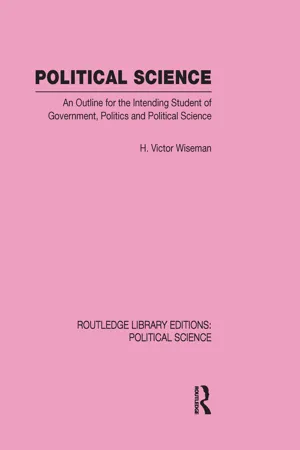
Political Science (Routledge Library Editions: Political Science Volume 14)
An Outline For The Intending Student of Government, Politics and Political Science
- 204 pages
- English
- ePUB (mobile friendly)
- Available on iOS & Android
eBook - ePub
Political Science (Routledge Library Editions: Political Science Volume 14)
An Outline For The Intending Student of Government, Politics and Political Science
About this book
This book, originally published in 1959, makes explicit the social principles which underlie the procedures and political practice of the modern democratic state. The authors take the view that in the modern welfare state there are problems connected with the nature of law, with concepts like rights, justice, equality, property, punishment, responsibility and liberty and which modern philosophical techniques can illuminate.
Trusted by 375,005 students
Access to over 1.5 million titles for a fair monthly price.
Study more efficiently using our study tools.
Information
1
Introduction:
Government, Politics and
Political Science
H. Victor Wiseman
IN RECENT YEARS THERE HAS BEEN A STARTLING PROLIFERATION of departments of politics, government, political studies and political science (all of which, the student is advised, are virtually synonymous) and of political studies (whether called civics, citizenship courses, liberal studies or social studies) in colleges and schools. The purpose of this volume is to attempt to justify these developments and to assist prospective students to understand what is involved in such studies and what opportunities they provide for both intellectual and vocational advancement.
‘The never-ending din of politics’, to use Lord Balfour’s phrase, assails the public ear with increasing intensity, enhanced now by the visual aid of television. Consider the issues which within a short period call for debate and decision. The British government may have to consider the implications of a possible strike for the national economy and its prices and incomes policy; news of a worsened balance of payments situation and its relevance to a forthcoming budget; defence policy and the choice between aircraft carriers and long-distance aircraft; events in Vietnam, Malaysia, Rhodesia, Nigeria, Aden, Uganda—from China to Peru, in fact. Parliament may debate development plans and incentives to investment, the law relating to abortion or homosexuality, the social services and foreign policy. Regional Councils may be striving to cope with the immediate problems of pit or railway closures and, simultaneously, with long-term plans for their region. Local authorities may be considering rate increases and restrictions on capital development and the ‘threat’ of a royal commission. Trade unions may be discussing wages and overtime, professional associations the national health service or comprehensive schools, student bodies the size of grants or university discipline, churches a fixed Easter, groups of citizens noise at London Airport, a threat to National Parks, the restoration of the ‘cat’ or of capital punishment, the future of the Territorial Army, the problem of foster-parents and care of children, and a multitude of other problems. The prime minister may have to take time off to consider a possible general election in the midst of objective or partisan advice from politicians, newspapers, television commentators, even from international financiers, the ‘gnomes of Zurich’. All this, directly or indirectly, is political activity. It is concerned to persuade, influence and convince the authoritative decision-makers in the political system.
How may this ‘din’ affect various groups in the community? A large number of citizens may remain relatively unaffected. They will be more interested in their favourite football team or this week’s pools, in the Test Match series or the racing results, in the Top Ten or ‘Double Your Money’, in the problems of Ena Sharpies or Nurse Beattie; or, of course, in symphony concerts or art exhibitions, Lunar II or cancer research. Nor are such people necessarily entirely uninterested in politics. They may be intermittently concerned when their own special interests are affected. There are latent’ groups or apparently unconcerned individuals who, in certain circumstances, may be aroused. Many remain unmoved by political events because nothing normally affects their political loyalties; family, tradition, class, education and other factors may ensure that for most of their lives they are ‘either little Liberals or little Conservatives’—or Labour supporters. Theirs is not indifference but commitment to politics.
There will be partisans and activists. Supporters and members of local parties who are ‘opinion-leaders’ will talk politics—usually to prove their party right, though within party meetings they may be more critical. There will be the politicians, whose week-end speeches will inevitably aim to justify or castigate government policies. These speeches will seldom appear objective, despite the factual research done by party offices and research centres, for such facts will have been pre-selected to support rather than test a thesis. Most newspapers will ‘take good care that the Whig (or Tory) dogs get the worst of it’. Personalities rather than policies will be discussed.
Other speakers, publicists or journalists will attempt to present balanced argument and opinion on the issues of the day and may examine those issues against broad principles and long-term as well as immediate implications. Advice may be offered and preferences expressed, but generally the argument will lead to a conclusion rather than start with a conclusion justified by (selective) argument. Such contributions to public discussion serve the useful function of criticising with a degree of objectivity the issues on which the public must make up their minds. If the student of politics needs to examine partisan sources to understand how partisans see the issues, he will need also to use the ‘quality’ newspapers and journals as a source of information on current affairs which are too recent to appear in the textbooks, and of intelligent opinions about problems and issues which may seldom be discussed by politicians or the popular press.
Not even this more serious comment, however, is exactly equivalent to the analysis provided by political scientists. Before we examine such analysis, however, in order to demonstrate how it differs from what has already been discussed and how essential it is to a sound appraisal of the latter, it is necessary to consider the view that ‘politics’ are undesirable and unnecessary and to establish the fact that no society can solve its problems without politics.
Objections to Politics1
Some are bored with politics, others deplore them. The first may be people who in the political as in other fields lack concern for most things outside their own immediate interest or who do not feel the stimulus or possess the capacity to think beyond today. They may feel that political, like other problems, are too difficult and complicated for ordinary understanding, or are beyond their control. Such attitudes may produce Bagehot’s ‘deferentials’ who leave such things to their ‘betters’. This is sometimes alleged to be the reason for the numerous ‘working-class Conservatives’, though Karl Marx would have described them less politely as lumpen-proletariat!
The bored are perhaps not as dangerous as those who deplore and denigrate politics. A degree of apathy helps to reduce political tension, though too much, especially if it leads to a sense of ‘alienation’ from society may produce conditions favouring totalitarianism. The denigrators are more dangerous, partly because their dislike of politics may appear justifiable on plausible rational grounds. It is a threat to society if politicians as such are held in contempt. In the United States the profession of politician is not highly regarded, sometimes with justification. The French parliament was once described as the ‘House without windows’. The politicians never looked out at the ‘real world’ and their activities were contemptuously dismissed by de Gaulle as ‘the system’. But the phrase also implied that the French people did not look in; their cynicism, apathy, incivisme, which took the form of unwillingness to pay taxes or of Poujadism, also helped to destroy the system. In Britain, although respect for politicians seems somewhat to have diminished in recent years, the bureaucrat is more frequently the object of contempt or hostility. All such attitudes may, in fact, help to produce the disease of which they complain.
Objections to politics are as old as Plato’s Republic; his philosopher-kings were to remedy the evils of city-state politics. Sir Toby Belch ‘had as lief be a Brownist as a politician’. Adam Smith referred to ‘that vulgar and insidious animal called statesman or politician’. Professor Miller described the reaction against politics as ‘the rage of Caliban at seeing his face in the glass; politics is all too human’. There have been more sophisticated objections to pursuing the study or vocation of politics. Hobbes suggested that those who had studied ‘the science of justice and equity’ might be unwilling to pass on their knowledge for fear of offending ‘those who have power to hurt’. A simpler aspect of this is the attitude of those who claim to have ‘no politics’ for fear they offend employers, customers, friends or family. A contemporary political scientist has warned that political reflection can be subversive of political institutions by undermining that certainty which is essential to effective action. This kind of argument is heard in peacetime as well as war-time from those who believe that rational thought may call in question accepted values and practices. New ideas may always be dangerous. Once it was religion which ought not to be questioned. Now it may be the ‘traditional wisdom’, the American way of life, or Marxism-Leninism. The political scientist, still more the political philosopher, would doubt whether even so-called fundamental principles ought never to be questioned. Such questioning is ‘political’ even if those who indulge in it pretend otherwise, just as acceptance of things as they are is ‘political’ however much the attitude may be justified in other terms.
Practical objections to politics are, perhaps, even more significant than emotional rejection or philosophical quietism. There are those who want to ‘get on with the job’, the technologists and administrators who want to ‘get away from politics’—or, at least, ‘party politics’ (as though the alternative to ‘party politics’ is not either individualism run riot or tyranny). So, we have demands for a businessman’s government, a ‘ministry of all the talents’, government by experts—forgetting that, to quote an eminent statesman, the country might manage very well for a short period under the rule of civil servants but at the end of it an enraged population would want to hang them all from the nearest lamp-post. Or, at the very least, we are urged to take certain things ‘out of politics’—education, housing, the health service, even defence or foreign policy. This is usually a request to accept a particular point of view which, of course, it is claimed is ‘non-political’. Why, in the face of all these arguments, is it asserted that politics is not only necessary but should be a subject for serious study?
The Political System—the Necessity of Politics
In every society there are conflicts between demands for certain satisfactions; these conflicts are the flesh and blood of all political systems. Politics has been described as the study of ‘who gets what, when and how?’ A political act is something more than a piece of agreed routine; political situations arise out of disagreement about the allocation of scarce resources among unlimited ends. If this resembles a definition of economics, such allocation cannot be made solely through the ‘higgling of the market’. In every society the government sector of economic life is increasing as is the proportion of government budgets of the gross national product. Governments impinge more and more on the daily behaviour of individuals and families; farm prices, wages, welfare conditions all become political. The status of politics consequently increases as does interest in politics; the need for political service grows as does political participation. As the level of education rises there is a demand that more than one side of controversial questions be put.
No society can meet all its members’ wants, needs and desires. Nor is any twentieth-century society likely to be content with the distribution of its resources in accordance with the relative bargaining power of its members as measured by capacity to pay in a competitive economy. The ‘revolution of rising expectations’, the contrast between ‘private affluence and public squalor’, affect relations within and between states. Citizens, as individuals or in groups, must call upon the decision-making machinery of society to settle disagreements. Someone or some group must be in a position to say what must be done and how, and to obtain acceptance of decisions subject to the continuous right to attempt to modify them. Alternative ends and means are constantly suggested; how can we decide between them?
Not all problems can be resolved by the application of simple ‘principles’ or absolute values. The very decision to support a particular moral code, ideology, ‘political religion’, set of principles, for a society as opposed to an individual, is a political decision and one of great concern especially in developing nations where such basis of ‘legitimacy’ does not exist or where traditional orientations to politics conflict with goals of modernisation. The moral principle of the ‘divine right of kings’ was replaced by the moral principle of the ‘social contract’ only by the most political of all means —civil war and revolution. Even more clearly political is the application of such moral codes to a given set of circumstances.
Even if facts are not ignored or distorted by ideological prepossessions there is no one ‘factual’ answer to each problem, discoverable by pure reason or computer techniques. With the latter, everything depends on the questions asked, the ‘programming’, which remains a matter of preference and human choice. Economic assistance to backward countries may be accepted as desirable; there is still room for argument about the most effective means of helping—largescale industrialisation, smaller projects based on ‘intermediate technology’, agricultural improvements, aid or trade? A decision to build a certain kind of road or bridge may be made on pure engineering principles; where to put them demands a political answer. The suggestion that Regional Economic Planning Councils should act as pressure groups to get their ‘fair share’ was a political demand. Assistance for Ghana’s Volta River Dam and refusal of help for the United Arab Republic’s Aswan Dam did not result from technical arguments. Even had this been the case, the decision would still have involved political consequences, advice on which could not be given by the ‘pure’ technologist. Opinions differ as to whether the resources of the southern states of America, or South Africa, or Rhodesia should be used to protect white supremacy or to achieve equality. These are problems which are likely sources of political conflict which appears impossible of satisfactory mutual practical compromise between the individuals and groups involved. On such questions there are no logical, reasoned, quantifiable solutions.
Even on less basic issues rights are inherently scarce and involve placing obligations on others. The choice between greater expenditure on defence or education, or, within defence on one weapon rather than another, or, within education on primary, secondary or higher, and the allocation of costs, can be made only by a political decision. For example, the cost of social change involved in automation will not fall evenly on everyone; society must decide how it shall be allocated even if the decision is to do nothing and thus repeat something like the ‘long-drawn-out agony of the handloom weavers’ in the nineteenth century. Such decision is particularly difficult when social costs are involved; should the ‘natural’ distribution of industry be controlled to minimise the social cost of concentration in areas vulnerable to attack in war, or of a flight from ‘depression’ areas? How should the cost of capital development or of war be shared between present and future generations, i.e. between present taxation and interest on long-term loans (paid out of taxation levied on future generations)? More generally, there is a constant division between those who get more of their demands satisfied and those who get less, which is a matter not merely of economic satisfactions but of other values such as status, respect, honours. A balance between those conflicting interests cannot be achieved by the unregulated pursuit of self-interest or profit. Individuals and groups are likely to view most problems from the point of view of their own position in the social structure. Someone must have the power to compromise conflicting interests, to legitimate claims; to put the ‘public interest’ no higher, it at least demands the peaceful solution of conflicts. Compromise and legitimation are the functions of those who occupy political status.
Further, even if all the facts were clear and agreed, and the means of achieving ends revealed as desirable by such facts were equally clear and agreed, there would remain the Question of priorities; a decision would be required between alternatives in the face of limited resources. The language of priorities is the religion of socialism, declared Mr. Aneurin Bevan. But socialism, like tradition, the American dream, Marxism, Pan-Africanism or any other ‘principle’, appears frequently to be an inadequate guide to action in any given set of circumstances. There is thus the problem of choice between methods of deciding between alternatives, whether of ends or means, since the Quaker ‘sense of the meeting’ is clearly inappropriate and consensus will not descend from the skies. The choice is between dictatorship, expert decision-making, democratic decision, or even consulting the oracle! It follows, therefore, that every society requires that some people have some power over other people (acquired and used by whatever means) which is recognised by a sufficiently large number of the latter as legitimate, acceptable to them. Competition for such power (and for influence over the holders of power) must be regularised or institutionalised if society is not to break down. Politics is a striving to share such power, or to influence its distribution, as well as the actual exercise of such power. The criterion of a ‘political question’ is its concern with the distribution, maintenance or transfer of such power. Some people inevitably have more power than others. Many do not exercise direct power but do influence the actions of others. Further, there will be some who, armed with the authority of the state, will be able to exercise legitimate compulsion over others.
Not every member of a society will agree with all the goals to be pursued or with the means of seeking to achieve them. Many may be unaware of precisely what goals are being pursued. Leaders’ goals may differ from those of followers; leaders may use resources for purposes which might be rejected if made public and fully understood. But whatever the proportion of members who know what goals are set or how they are aimed at—of ‘politically relevant’ members— politics implies conflict about how the facilities and personnel at the command of the government shall be used. If force and compulsion were necessary to decide such conflict by each and every individual or group in his or its own interest, there would be Hobbes’ ‘war of each against all’. So, many people must occupy political (or, more restrictedly, official) status which entitle them, because such status are recognised by the rest, to settle such conflicts.
Some of the basic issues of politics, at least in general terms, are reasonably clear. First, which of the innumerable claims and counter-claims should be established as rights by the state and the government, with the corollary that such rights imply enforceable obligations, and which should be left to the arena of bargaining between individuals and groups. This is the perennial question of the functions of the state which has been answered differently in different communities and differently in the same community at different times. This broad decision is a political one, despite attempts of political philosophers to enunciate eternal rules or basic criteria like John Stuart Mill’s (untenable) distinction between self-regarding and other-regarding actions, the first of which he suggested should be immune to state regulation. It is not unusual for ordinary citizens to answer this kind of problem on the basis of some such principle as laissez-faire, socialism, natural justice or individual freedom. This last is an example of how far one may be led astray by the automatic application of such ‘principles’: freedom of the person came to be applied to ‘fictitious persons’ such as corporations, which then became endowed with legal freedom to invade the freedom of the individuals...
Table of contents
- Front Cover
- Half Title
- Title Page
- Copyright
- Title Page
- Copyright
- CONTENTS
- Preface
- 1. Introduction: Government, Politics and Political Science
- 2. British Government
- 3. Public Administration
- 4. Local Government
- 5. Comparative Government
- 6. Political Behaviour: Parties, Groups and Elections
- 7. Political Theory
- Appendix. A Guide to Courses and Opportunities
- Index
Frequently asked questions
Yes, you can cancel anytime from the Subscription tab in your account settings on the Perlego website. Your subscription will stay active until the end of your current billing period. Learn how to cancel your subscription
No, books cannot be downloaded as external files, such as PDFs, for use outside of Perlego. However, you can download books within the Perlego app for offline reading on mobile or tablet. Learn how to download books offline
Perlego offers two plans: Essential and Complete
- Essential is ideal for learners and professionals who enjoy exploring a wide range of subjects. Access the Essential Library with 800,000+ trusted titles and best-sellers across business, personal growth, and the humanities. Includes unlimited reading time and Standard Read Aloud voice.
- Complete: Perfect for advanced learners and researchers needing full, unrestricted access. Unlock 1.5M+ books across hundreds of subjects, including academic and specialized titles. The Complete Plan also includes advanced features like Premium Read Aloud and Research Assistant.
We are an online textbook subscription service, where you can get access to an entire online library for less than the price of a single book per month. With over 1.5 million books across 990+ topics, we’ve got you covered! Learn about our mission
Look out for the read-aloud symbol on your next book to see if you can listen to it. The read-aloud tool reads text aloud for you, highlighting the text as it is being read. You can pause it, speed it up and slow it down. Learn more about Read Aloud
Yes! You can use the Perlego app on both iOS and Android devices to read anytime, anywhere — even offline. Perfect for commutes or when you’re on the go.
Please note we cannot support devices running on iOS 13 and Android 7 or earlier. Learn more about using the app
Please note we cannot support devices running on iOS 13 and Android 7 or earlier. Learn more about using the app
Yes, you can access Political Science (Routledge Library Editions: Political Science Volume 14) by H. Victor Wiseman in PDF and/or ePUB format, as well as other popular books in Politics & International Relations & Politics. We have over 1.5 million books available in our catalogue for you to explore.