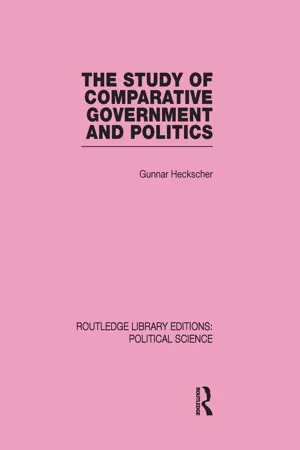
Originally published in 1957, the first part of the book discusses the general problems of approach, classification, typology and terminology, and examines ancillary fields of study and the methods of teaching comparative government. Part Two is concerned with studies of particular areas, democratic control of foreign policy, political parties, contemporary revolutionary movements, parliamentary procedures, electoral systems and elections, and nationalized industries.
- 172 pages
- English
- ePUB (mobile friendly)
- Available on iOS & Android
eBook - ePub
The Study of Comparative Government and Politics
About this book
Trusted by 375,005 students
Access to over 1.5 million titles for a fair monthly price.
Study more efficiently using our study tools.
Information
Subtopic
PoliticaPART ONE

INTRODUCTION
THE need of studying comparative government has always been recognised. In fact, all the classical works on political theory were more or less based on a comparative approach. It is known that Aristotle prepared a number of studies of various governments before embarking on his Politics; medieval authors, while less eclectic in their approach, yet attempted to bring in as much comparison as was possible under the circumstances; and in the seventeenth century comparisons of different types of government appeared practically in every page of political philosophy. One has only to glance through some chapters of, e.g., Montesquieu and Rousseau to note the enormous importance given by them to the findings of comparative government. When the study of political science was established in the nineteenth century, a number of the most important works were monographs dealing with only one country. Yet no one reading Bagehot or Dicey can fail to observe that some of their most important ideas are based on comparison; and there were in this period other authors consciously attempting a presentation in the field of comparative government, such as Ostrogorski and Bryce.
Recently, the method of comparison has come under intensified discussion. Indirectly, already some of the older works discuss questions of this type, but it is only in the last ten years that interest in methodological problems has become conscious. A report by a research panel in comparative government was published in 1944. The UNESCO handbook in Contemporary Political Science at least touched on the question. It was discussed to a considerable extent at the round table on the teaching of political science organised by I.P.S.A. in 1952 and in the subsequent report by W. A. Robson.1 The interest shown on this occasion was, in fact, the main reason for I.P.S.A.’s decision to devote a particular round table to the study of comparative government. In the meantime the report of the inter-university seminar organised at Evanston by the Social Science Research Council in the summer of 1952 had been published together with comments. Obviously, this report loomed rather large in the discussions at the international round table, although it was originally meant to be only tentative and explorative. As a means of stimulating discussion it was, however, extremely successful.
The international round table organised by I.P.S.A. was held in Florence April 5–10, 1954, under the very favourable auspices created by the Italian Political Science Association. It comprised over fifty participants drawn from fourteen different countries. Twenty-seven working papers, dealing with various aspects of the problem, were submitted by the participants.
In preparing the following report, the reporter has felt free to draw extensively on the papers and other contributions by the participants of the round table, even though it has not been possible to make explicit reference to them except in comparatively few cases. He is, therefore, particularly anxious to express already at the outset his feeling of gratitude towards all those who co-operated in achieving whatever results were gained at the Florence meeting. On the other hand, no formal agreement was reached or even attempted as to the conclusions, and on a considerable number of points major disagreements remained at the end of the discussions. The reporter, therefore, is responsible not only for the presentation of the subject matter but also for all conclusions and opinions presented in the report.
It is true that terms like ‘comparative government’ (or ‘comparative politics’)—as well as so many other descriptions of practical scientific fields—are des étiquettes procédurales and that no absolute or precise limits can be stated as to what should or should not be included in the study. This vagueness is at the back of certain difficulties which will appear in the following. At the same time, except for certain border-line cases there seems to be general agreement as to what is meant by the term. There is also agreement on the importance of studying it and on the whole even on the reasons for which such a study is regarded as profitable.
It is almost a platitude to point out what these reasons are. Comparative studies are the core of any study of ‘foreign’ governments. They are of pedagogical importance, especially if we are to gain a reasonably realistic and relativistic view of our own government. Because of the growth of international contacts, scientific, political or economic comparisons between different countries, as well as a knowledge of foreign institutions, are of great practical value.
These reasons may be called ‘informational’ or ‘utilitarian.’ They include the pragmatic approach: we want to draw on foreign examples which may give us ideas for the development of our own institutions. Similarly, we may flatter ourselves that a knowledge of our institutions may help others: ‘the discipline has a mission to fulfil in imparting our experience to other nations and to integrating scientifically their institutions into a universal pattern of civilised government.’ Nobody can be expected to deny the strength of considerations such as these.
But there are other reasons concerned with the development of political science itself. If we regard our field of study as mainly descriptive, comparisons are required to help us refine our tools of description. If we have hopes of establishing a general theory on an inductive basis, we can do so only through comparison. If we attempt to test specific hypotheses, this is possible only if we bring in a sufficient number of examples, to be investigated by the comparative method.
So much for the reasons in favour of comparative studies. The question of whether or not we should devote ourselves to discussing the methodology is a different one. It might be argued—and it sometimes is argued—that there is no point in discussing method. We should simply go ahead and work, and suitable methods will develop without any special effort on our part.
This ‘direct’ approach is attractive, and we all frequently feel inclined towards it. But further consideration makes it clear that it is not to be taken literally. There are obvious advantages in taking stock, critically, of methods used so far in order to see how they can be improved. In our case this is particularly important since political science and comparative government are not uniformly developed all over the world. In many countries a legalistic or deductive approach still dominates teaching and research, and political science is just coming in. Scholars working there, and coming to their work with an exclusively legal or philosophical training, are eager to make use of the experience of countries where political studies have had a longer tradition, and especially to obviate the necessity of repeating mistakes formerly committed there.
Another consideration should be added. The ‘work’ achieved is not uniform in value. There must be some standards by which we can judge a piece of research and see whether or not it is worthy of our interest. Both for evaluation and for improvement methodological discussions and studies are useful, not to say indispensable.
On the other hand, it is equally dangerous to misunderstand the character of methodology. There is no a priori deductive theory to be developed without regard to the exigencies of actual research and teaching. What we attempt is rather a statement of procedure based on critical observation of work performed so far. While a number of knotty theoretical problems have to be dealt with at various stages, methodology is on the whole intensely practical and not a science in itself.
1 The University Teaching of Political Science published by UNESCO.
GENERAL METHODOLOGICAL PROBLEMS
A NUMBER of the problems discussed, both at the Florence meeting and otherwise, are only superficially—if at all—specific to the study of comparative government. Questions concerning the validity of results, the needs of hypothesising, the establishment of a general theory, etc., obviously relate no more to comparative government than to other aspects of political science. In most cases they are common to all social sciences or even to the whole field of humanistic study. Even when we discuss the applicability, e.g., of Mill's method of differences, this is only superficially a specific problem. Whether or not this method is applicable in the field of comparative government depends almost entirely on the general character of results attained in political science.
It would be tempting simply to leave all these questions aside. They seem to be outside the scope of our subject, and in any case we can hardly expect to solve them at this stage. Unfortunately, such a procedure is impossible in view of the present state of discussion. There is no consensus on these points, but rather general disagreement or even confusion. On the other hand, whatever we try to establish with regard to comparative government has to be based on assumptions of a fairly general character. The methodology of comparison is not a self-contained separate subject, but part of the general method of political science. The fundamental assumptions, therefore, have to be discussed even if the results of the discussions are inconclusive and some of the arguments no more than commonplaces.
For political science as well as for other fields of scholarship and scientific study, the fundamental questions are those concerned with truth and validity. Certain aspects can be disposed of rather quickly. It is against the assumptions of Western civilisation to assert that any science can ever be permitted to deviate for any reason from the quest for truth. This should be self-evident and on the whole is so regarded, but we sometimes forget the implications. I quote a paper by Professor Beer of Harvard University: ‘In the United States, for instance, it is not uncommon to speak of the teaching of political science as “education for citizenship.” Whether one objects to this or not depends on what it means. But on the face of it, the notion seems to me an abomination. I should prefer the premise— vague as it is—that our task is to try to teach the truth—and that means regardless of its possible consequences on society or the state. Conceivably this premise may conflict with the notion that we are “educating for citizenship.” In the bad state, the wise man may be the bad citizen. Or indeed, even in a good state, a wise man may choose not to be, in any real sense, a citizen at all.’ As a matter of fact, the talk about ‘education for citizenship’ is probably not as bad as it seems. Those who use it frequently accept the slightly naive assumption of liberalism that truth will always be triumphant and that the best citizen is he who has acquired the greatest respect for it. But an unsophisticated person may sometimes forget this basic consideration, and where this happens, scientific truth is in danger and scholars may be subjected to witch-hunts.
Another point is concerned less with outside influence than with the psychology of scientists themselves. We all hold a great number of theories and assumptions, on which we base our reasoning. These basic assumptions may or may not be generally accepted. In many cases they are implicit, although never expressly stated. It is highly desirable that they should be brought to the surface and made explicit to the greatest possible extent, since our reasoning may be unintelligible where this is not the case. On the other hand, we are not always conscious of our own assumptions. Particularly where they seem to us (but not necessarily to others) to be self-evident, they may not at all appear on the surface. This is always a danger, but it is particularly dangerous where we move in an international setting or else under circumstances where it can be suspected that basic differences exist among writers on the same or similar subjects. Consequently, a special effort is required to make implicit assumptions and theories explicit if we are to avoid serious misunderstandings and complications.
This brings us to a more fundamental question, that of criteria of relevance. It is sometimes argued that our functions are ‘merely descriptive’ and that this should relieve us of a number of considerations which might otherwise be necessary. It is submitted that this is an altogether unrealistic assumption. Photographical description is beyond the realm of possibility, if indeed desirable. It is completely impossible to ‘merely describe’ in the sense of giving ‘all the facts’: facts and data always have to be selected. Consequently, there has to be a basis of selection. What we mean when we say ‘all the facts’ is all the relevant facts; it remains to set a standard by which we can decide which facts are relevant or not.
This observation has led some scholars to the conclusion that the selection of data has to be based on a previously established general theory. Undoubtedly, this approach is far from impossible in itself. Provided there is a general theory, and provided it is universally accepted or at least universally regarded as of fundamental interest, it can be used as a criterion of relevance. Some of the theories in the physical sciences, such as the theory of relativity, appear to have been successfully used for such purposes.
We may for the moment leave aside the question whether the circumstances of social sciences in general and of comparative government in particular are such as to warrant the employment of this method even under the most favourable conditions. At any rate, it would be a fatal mistake to regard it as the only possible approach. It is equally reasonable and much more simple to regard the question of relevance in the light of particular problems. These problems may be as limited as we like, and it follows that the standard of relevance need not be absolute. Certain data may be irrelevant in connection with one problem but highly important in the light of another. Let us assume that we are collecting data on the activity of cabinet ministers. If our problem is that of the inner mechanism of a cabinet certain facts are important; if we are concerned with parliamentary leadership we concentrate on others. Certain data may be relevant to both problems, particularly since the two are closely connected; but in a majority of cases our choice of data depends on which of the two problems we are concerned with. And for a third problem the social and educational background of ministers, their moral standards, etc., may be of fundamental importance—which leads us to select a third set of data.
The problem of validity is of a more basic and fundamental character. In approaching it social scientists in general and political scientists in particular seem to suffer from a hypnotic preoccupation with the exact natural sciences. Physics, mathematics, chemistry, mechanics, are regarded as preeminently scientific and all other scholars are developing an inferiority complex. Consequently, they yearn for measurable quantities, absolute conclusions on causality, etc.
This seems to be particularly true of those who do not have even a superficial acquaintance with natural science. Closer observation should be encouraging. In the first place natural science is not a monolithic block, and all natural sciences are not equally exact. The standards of biology are indeed very far from those of pure mathematics and mechanics. Secondly, largely as a result of recent development, physics and chemistry also deal to a considerable extent with non-measurable quantities and with approximations. The whole field of nuclear physics is a case in point. And finally, the social sciences are not alone suffering from these limitations. We have to accept the fact that all cultural sciences, including history, law, etc., are rather different from the exact natural sciences in this respect. Some fields, such as the very fashionable one of psychology, offer even less hope of exactitude than do the older humanistic sciences.
Consequently, we have to accept the fact that the social sciences are not ‘scientific’ in exactly the same way and to the same extent as, let us say, physics. In political science, as well as in other cultural sciences, ‘scientificness’ is hardly more than an attitude of mind. This, of course, does not dispense us from considering critically the reliability and especially the validity of our results. We may hope that in some very distant future we shall be able to obtain a reliability and a validity comparable to those of the exact natural sciences. But since the sciences of man deal with realities which are more complicated than those of the former, it is improbable that this desirable result will come in sight within the near future.
Two solutions would then seem to be possible. Either we have to exclude all problems where such an attitude is at present unattainable—which in practice would mean that we shall have to stop working—or else we have to be content with results which are only very approximate in character. The first proposal has never been advanced, and consequently we are left with the latter.
Thus, we have to accept our own limitations. By the same token, however, we must see that we are conscious of them. We may possibly observe general tendencies, but we cannot expect to find ‘laws of political behaviour.’ If we promise to do more than we can, we cease to be scientists, but as long as we make it clear to ourselves and to others that our results are imperfect, we may continue to work with a good conscience and make shift with unsatisfactory measures and classifications, hoping that our tools will ultimately improve.
The need for consciousness of our own limitations can hardly be overemphasised. We may, for instance, establish ‘systems’ to illustrate our meaning and to list the components influencing developments (or as many as possible of them). We may hope to prove that these components really are important for the result, but we must not assume that we are able empirically to establish the ‘weight’ or ‘value’ of each of them. We have to accept that our scie...
Table of contents
- Front Cover
- Half Title
- Title Page
- Copyright
- Title Page
- Copyright
- PREFACE
- CONTENTS
- PART ONE
- PART TWO: THE APPLICATION OF COMPARATIVE METHODS IN POLITICAL SCIENCE
- INDEX
Frequently asked questions
Yes, you can cancel anytime from the Subscription tab in your account settings on the Perlego website. Your subscription will stay active until the end of your current billing period. Learn how to cancel your subscription
No, books cannot be downloaded as external files, such as PDFs, for use outside of Perlego. However, you can download books within the Perlego app for offline reading on mobile or tablet. Learn how to download books offline
Perlego offers two plans: Essential and Complete
- Essential is ideal for learners and professionals who enjoy exploring a wide range of subjects. Access the Essential Library with 800,000+ trusted titles and best-sellers across business, personal growth, and the humanities. Includes unlimited reading time and Standard Read Aloud voice.
- Complete: Perfect for advanced learners and researchers needing full, unrestricted access. Unlock 1.5M+ books across hundreds of subjects, including academic and specialized titles. The Complete Plan also includes advanced features like Premium Read Aloud and Research Assistant.
We are an online textbook subscription service, where you can get access to an entire online library for less than the price of a single book per month. With over 1.5 million books across 990+ topics, we’ve got you covered! Learn about our mission
Look out for the read-aloud symbol on your next book to see if you can listen to it. The read-aloud tool reads text aloud for you, highlighting the text as it is being read. You can pause it, speed it up and slow it down. Learn more about Read Aloud
Yes! You can use the Perlego app on both iOS and Android devices to read anytime, anywhere — even offline. Perfect for commutes or when you’re on the go.
Please note we cannot support devices running on iOS 13 and Android 7 or earlier. Learn more about using the app
Please note we cannot support devices running on iOS 13 and Android 7 or earlier. Learn more about using the app
Yes, you can access The Study of Comparative Government and Politics by Gunnar Heckscher in PDF and/or ePUB format, as well as other popular books in Politica e relazioni internazionali & Politica. We have over 1.5 million books available in our catalogue for you to explore.