eBook - ePub
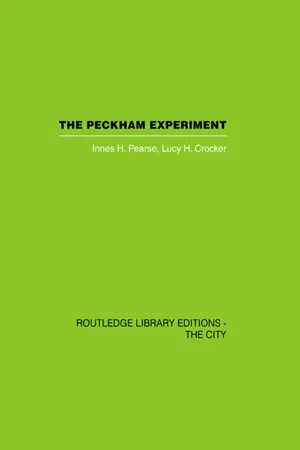
The Peckham Experiment
A study of the living structure of society
- 334 pages
- English
- ePUB (mobile friendly)
- Available on iOS & Android
eBook - ePub
About this book
First published in 2006. This volume looks at the Peckham Health Centre Experiment which over five years, the health-parenthood, the family and the home was the subject. The experiment needed time for the families to congregate and to function, and time for the scientist to understand what he saw. This book is evidence of how greatly time was needed and the observations made.
Information
CHAPTER I
LIVING THINGS
Living cannot be interpreted in terms of materio-dynamics. Some other cosmic principle is at work not included in and not defined by the laws of matter or of radiation, however “deep the waters” into which the study of these have led. “The universe can be best pictured, although still very imperfectly and inadequately, as consisting of pure thought, the thought of what, for want of a wider word, we must describe as a mathematical thinker”.1 Possible though it is to conceive of thought without personal attributes, that concept is nevertheless impossible divorced from the quality of livingness. But this picture does not disclose to us the nature of the livingness behind thought; it only implies that when the laws of Living are disclosed they may demand yet one more co-ordinate on our graphs and yet another mathematic even more intricate than the last.
Setting out as biologists to study Living, we shall not attempt to define the nature of Life any more than the physical scientist defines the ultimate of Energy, but merely proceed to examine its manifestations in the living entity and to determine the laws that underlie its operation.
But for the manifest of Life we have as yet no exact name, that is to say, we are not any more discriminately aware of its nature and identity than man must always have been of the sun's rays before Science began to work its own magic with them. So, before proceeding to grope our way forward in the study of the manifest of Life we must name it. Throughout this book we propose to call it ‘function’.
Appropriation of the word ‘function’ for the manifest of Life raises with workers in other fields of Science an issue demanding clarification. The physiologist, long first in the field in the study of the mechanism of the living body, uses the word ‘function’ freely, and in our understanding indiscriminately, to cover several distinguishable operations of organism not all of which are significant in the study of living. To illustrate this we might refer to one of the common technical procedures of the physiologist where, by excision or other means, he isolates organs from the general influences of the body in which they occur, and fixing their environmental conditions, proceeds to observe their ‘functional’ response under given stimuli. Perhaps the best known and extreme example of this type of procedure is the excised chicken-heart which was kept beating in a bottle some twenty-five years after the death of the chicken. This heart ceased to beat and ‘died’ owing to a single oversight in which there was failure to adjust the perfusing fluid,—evidence that its ‘survival’ was dependent upon the rigid fixation of its environment.
This brilliant experiment gives us information about the mechanism of heart muscle, but it gives none either of the functioning heart or of the living chicken. It is not unlike the information gained from the bench test of an internal combustion engine. A bench test is a valuable test, but it gives no indication of the final performance, for example, of an aeroplane in flight,—a tool in the hands of a skilled pilot instant to adjust the machine to the least suspicion of environmental change. The conditions imposed upon the engine by the will of the living pilot in response to changes he encounters in the environment will to a very large extent nullify the value of the information gained from the bench test for what is commonly called ‘practical’ use—for which the engine was in fact invented. Certainly the inferences to be drawn from the performance of the engine in these two circumstances are not identical. With most physiological studies this is no less true; they yield information about the body but not about its ‘living’.
So, two distinct and different studies may be made: one of the response of organism, organs or tissues in a controlled, artificial or fixed environment—physiological operation; the other of the behaviour of the living organism as a unity in an ever changing and free environment—biological function. It is for the latter that we shall consistently reserve the word ‘function’ in this book.
The next step is to determine through what unit function is manifest; and where and how it can most easily be studied.
A unit is the smallest ‘parcel’, aggregate or organisation which exhibits the characteristic attributes of any substance, potency or entity. Technically, living entities are called ‘organisms’. Before, therefore, we can answer these two questions, a further question must be asked: What is an organism?
By ‘organism’ we understand any living entity capable of performing the full cycle of its specific existence. Not all living entities fall within this definition. For example, a soldier-ant is a living entity but it is not an organism, for alone it is unable to complete the cycle of ant-hood. In the ant species various operations integral to ant are delegated to various entities in the heap. The queen alone can lay eggs; the soldiers protect the queen; the workers feed her, etc. Each entity has its own special work to contribute to the organism, and without that contribution the function of ant is abrogated and continued life in the organism, ‘ant’, ceases.1
The ant-heap alone represents the full range of function of ant-hood. It is then the ant-heap that represents the unit-organism ‘ant’. Similarly, it is the hive of bees—not the single bee representing a specific operation essential to the hive, or colony—that forms the organism ‘bee’.
“And for their monarch Queen—an egg casting machine Helpless without attendance as a farmer's drill, By bedels driven and gear'd and in furrows steer'd Well watched the while, and treated with respect and care So long as she run well, oil'd stoked and kept in trim”.2
Bridges knew the Queen to be but the ovary—a mere organ of the organism—‘bee’. But here in the hive of bees there is so extreme a degree of separation of the respective organs of the whole organism that the casual observer has been deceived into regarding each bee as a separate organism.
Seen from the same aspect of function, two frogs, male and female, compose the organism ‘frog’, for though one frog or one soldier-ant is an integral part of the organism ‘frog’ or ‘ant’, neither alone represents the unit-organism capable of the full functional cycle of their species. This is so obvious that it may be wondered why we stress the point. It is, however, of the greatest importance to the student of function, for were we to Btudy male frogs or soldier-ants alone, in ignorance of their connection with the facultative species ‘frog’ or with the ant-heap, we should never arrive at a knowledge of the full functional capacity of their respective species. The part cannot declare the function of the whole.
As students of function in man (homo sapiens) we must then at the outset be careful not to take anything for granted: not to mistake the individual for the whole organism, for, as we have seen, the individual may be but an organ of a more complex organism. By a mistake of this order we should be doomed to miss the manifestations of function that we are seeking.
In studying the mechanics and dynamics of the human body this point is not of the same critical significance. For instance, the student has merely to make an adjustment for the sex of the individual studied, to arrive at a knowledge of the mechanism of the body of the species. If he is conversant with the anatomy of a man it will serve—with the addition of facts about the difference in weight, shape, structure of bone, etc., together with a knowledge of the difference in the sex organs—for a knowledge of the anatomy of the human species. What knowledge he has of the bio-chemistry of the alimentary system can be applied with success to either sex indiscriminately. When we come, however, to function, this method no longer serves, for we find that man and woman are not functionally identical entities exhibiting merely superficial differences aligning them for cooperation, as in the reciprocity of mechanism; not merely two entities with capacities so nearly equivalent that they can shoulder the same tasks and by means of a statistical correction be regarded as interchangeable units, as, for example, in the ‘science’ of economics, in industry, or in the labour market. In the functional sphere man and woman do not work reciprocally as in mechanism, but mutually as diverse parts or organs of a unified organism —like a small ant-heap linked in the continuity—or what later we shall have to call the ‘specificity’—of a ‘functional organisation’.
After mating has occurred, invoking a hew functional organisation, we no longer have a man and woman who, shackled like the links of a chain, have joined hands in marriage, but one bi-polar unity—with maleness and femaleness at its opposite poles. How can we visualise such a unity? In the physical realm it is perhaps not unlike the solution of metal within metal such as we find in some of the amalgams. Or, in the physiological realm, perhaps we are led to recall the bi-axial construction of the features of the human body: right and left handed, right and left kidneyed, right and left hearted, right and left eyed. The unity of the mated pair, dual like the body, is right and left individualled, as it were. Thus, the human organism, like the body itself, is a unity balanced in function as in feature.
The reader may perhaps find this a difficult conception to grasp; may object that any process of merging of two individualities suggests loss rather than gain, and hence is one that cannot represent the true picture of progressive human functioning. On the contrary, the new polarity of the functioning organism brings with it for each individual a measure of fulfilment unobtainable by either alone.
We know the opprobrium implied in the expression ‘one-eyedness’. This is not without reason. If we look more closely at the mechanism of optics we see that each eye looking separately sees a field more limited than that covered by the two together. But this is not all. Binocular vision does not merely reproduce in a combined and enlarged picture the field of view of each separate eye. The two eyes acting as a unity create a novel image. So there emerges the ‘solid reality’ of a stereograph, which no one-eyed vision can achieve. What applies to vision seems to apply to all functional action: it is dependent upon duality operating in unity. So too with the mated pair we find duality operating in the unity of male and female. Hence man also is bi-polar in function. There is no sacrifice here; neither is it compromise. Just as the eyes in binocular vision produce a stereograph, an origination or novelty, so it is the ‘parenthood’ engendered by the unity of two diversities—mature manhood and womanhood —which originates, or brings the new to birth.
Thus when two diverse individuals function as an organism, all that they encounter acquires a new significance. It is not merely the addition of the experience of one to that of the other, making the combined view a larger whole seen, but that with new polarity a new quality is given to their apprehension. And this quality of perception is given not only to what is experienced at the moment, but that experience itself influences what they in their new functional orientation will in the future experience —hence altering their every action.
The supreme and most concrete example of such an origination or novelty from the fusion of two diversities is, of course, the child. It is a reproduction neither of mother nor of father; indeed, not a reproduction at all. It is a new and unique individuality that is originated through the bipolarity of organismal function.
So it is through the unified mutual action of two entities, man and woman, that alone the full function of Man is manifest: that full and rich diversification of his species proceeds, and that human potentiality finds its full expression. Thus while the individual man (or woman) is a satisfactory subject for study by the zoologist, physiologist or pathologist, only man-and-women as a unity can meet the needs of the biologist setting out to study function.1 What then are we to call this functional unity— this concept of the biological unit? We have named it ‘family’ implying by that word the mated pair either with or as yet without children, and it is in this sense that the word ‘family’ will be used throughout this book.
There are other difficulties and subtle snares with which biological material confronts the student. Function is not always explicit. Like force, it may be potential or latent; that is to say, the full range of functional manifestation of the species may only become explicit in certain circumstances the nature of which we do not yet understand, and which may well chance to be absent when and as we observe. We may, in fact, only be familiar with rudimentary manifestations of function in the life of any species. In ignorance of any fuller manifestation, how easy to take these to be the full expression of its potentialities. A striking example of such a situation is to be found in the case of the Mexican axylotl, tadpole of the salamander (Amblystoma). This large aquatic tadpole can and usually does live, breed, rear its kind and die in its unmetamorphosed (tadpole) state. Only many years after it had become known to the zoologist and familiar as a fashionable parlour pet was it discovered to be merely the tadpole or larval state of a land-walking salamander catalogued as a different species. Because the axylotl was able to live and propagate its kind in its immature form, its potentiality for living a different and wider existence, for acquiring lungs and walking on dry land, was missed even by the zoologist.2 To snares of this nature the experimenter must be alive as he approaches the field of function in human biology, for he may not assume that man as we now know him is man whose potentialities have already found their full expression.
We have already shown in an earlier publication1 that there are three distinct states in which man may exist while carrying on his daily life. Hampered by disorders he may suffer from the ravages of disease; cloaking his disorders by the use of his reserves, he may be buoyed up by a false sense of ‘wellbeing’, or, lastly, he may live a full functional existence in which his development is proceeding according to his potentiality. The difference between these three states has been shown to depend on the several relationships of the individual to his environment. In the last of these three states only, is man free to act in mutual response to an ever changing environment. It is this last state which we recognise as the legitimate field of Health or ‘wholeness’. This field of Health or sanity with which we as biologists are concerned will be found to be distinct from that of Sickness, where subject to disorder the individual obeys the laws of pathology. In Health man observes a different natural law: — the law of function with which we are here concerned.
It might with reason be asked:—Why entertain the idea of using man, with all his complexity, as the experimental animal in what is so new and difficult a field, for surely the first necessity is to find the simplest organism for investigation? The zoologist hitherto concerned with the classification of species and the particulate description of living entities, has turne...
Table of contents
- Cover
- Half Title
- Full Title
- Copyright
- FOREWORD—1947.
- AUTHORS' NOTE
- CONTENTS
- Historical
- Chapter I Living Things
- Chapter II Man in the Making
- Chapter III Basic Technique
- Chapter IV The Health Centre
- Chapter V Health Overhaul
- Chapter VI Findings of Overhaul
- Chapter VII New Member-families
- Chapter VIII The Family Grows
- Chapter IX Infancy
- Chapter X School Days
- Chapter XI Growing Up
- Chapter XII Courtship and Mating
- Chapter XIII The Birth of a Family
- Chapter XIV Social Poverty
- Chapter XV Social Sufficiency
- Chapter XVI A Community Grows
- Appendices
- Index
Trusted by 375,005 students
Access to over 1.5 million titles for a fair monthly price.
Study more efficiently using our study tools.
Frequently asked questions
Yes, you can cancel anytime from the Subscription tab in your account settings on the Perlego website. Your subscription will stay active until the end of your current billing period. Learn how to cancel your subscription
No, books cannot be downloaded as external files, such as PDFs, for use outside of Perlego. However, you can download books within the Perlego app for offline reading on mobile or tablet. Learn how to download books offline
We are an online textbook subscription service, where you can get access to an entire online library for less than the price of a single book per month. With over 1.5 million books across 990+ topics, we’ve got you covered! Learn about our mission
Look out for the read-aloud symbol on your next book to see if you can listen to it. The read-aloud tool reads text aloud for you, highlighting the text as it is being read. You can pause it, speed it up and slow it down. Learn more about Read Aloud
Yes! You can use the Perlego app on both iOS and Android devices to read anytime, anywhere — even offline. Perfect for commutes or when you’re on the go.
Please note we cannot support devices running on iOS 13 and Android 7 or earlier. Learn more about using the app
Please note we cannot support devices running on iOS 13 and Android 7 or earlier. Learn more about using the app
Yes, you can access The Peckham Experiment by Innes H. Pearse,Lucy H. Crocker in PDF and/or ePUB format, as well as other popular books in Architecture & Urban Planning & Landscaping. We have over 1.5 million books available in our catalogue for you to explore.