- 13 pages
- English
- ePUB (mobile friendly)
- Available on iOS & Android
eBook - ePub
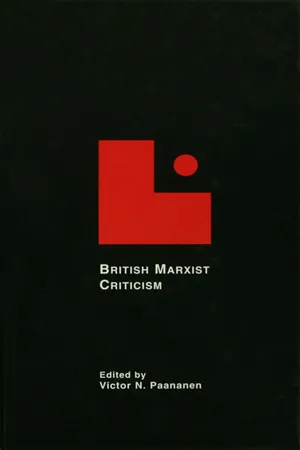
British Marxist Criticism
About this book
First Published in 2000. British Marxist Criticism provides selective but extensive annotated bibliographies, introductory essays, and important pieces of work from each of eight British critics who sought to explain literary production according to the principles of Marxism.
Information
Appendix
Excerpts from the critical writing of Alick West, Christopher Caudwell, Jack Lindsay, A. L. Morton, Arnold Kettle, Margot Heinemann, Raymond Williams, and Terry Eagleton.
Walter Pater
I
‘Dear Pater was always afraid,’ Wilde is reported to have said, ‘of my propaganda.’ He was even a little afraid of his own. From the retirement of his classical fellowship at Brasenose College, Oxford, he published in 1873—he was born in 1839—a volume of essays entitled The Renaissance, of which Wilde said, ‘It is my golden book.’ Its ‘Conclusion’ contained a passage which, until the first world war, many an Oxford student could have repeated by heart. We all, he says, lie under sentence of death with indefinite reprieve:
we have an interval, and then our place knows us no more. Some spend this interval in listlessness, some in high passions, the wisest in art and song. For our one chance is in expanding that interval, in getting as many pulsations as possible into the given time. High passions give one this quickened sense of life, ecstasy and sorrow of love, political or religious enthusiasm, or the ‘enthusiasm of humanity.’ Only, be sure it is passion, that it does yield you this fruit of a quickened, multiplied consciousness. Of this wisdom, the poetic passion, the desire of beauty, the love of art for art’s sake has most; for art comes to you professing frankly to give nothing but the highest quality to your moments as they pass, and simply for those moments’ sake.
These ideas were frowned upon by the Oxford authorities as dangerous hedonism, and Pater was caricatured, in a style which anticipated the Punch cartoons of Wilde, by W. H. Mallock in The New Republic. In the next edition of The Renaissance Pater suppressed the ‘Conclusion’. But in subsequent editions he restored it; for though he was timid, he was also dogged.
One must ask why Pater’s immoral gospel of art, as it was considered, should have provoked so much abuse. For in The Renaissance there is a trend which was to the interest of the same conservatism as delivered the attacks.
The essays that compose the book have a dual character. They are objective historical studies of great figures in the history of the Renaissance and of humanism—Pico della Mirandola, Botticelli, Winckelmann, and others. They are also a kind of imaginary living. Through the writing Pater is giving form to the pleasure which he has enjoyed through art. He is doing what in the ‘Conclusion’ he calls on others to do: by making himself conscious of his response to art he is living, he believes, with the greatest possible intensity.
Some eighty years previously, at the time of the French Revolution, German idealist philosophy, by which Pater was strongly influenced, had also said that in aesthetic activity man’s powers were at their highest. But the passion of art and beauty had not been counterposed, as it is by Pater in the passage we have quoted, to the ‘enthusiasm of humanity’. For ‘the most perfect of all works of art’, said Schiller in his Letters on the Aesthetic Education of Man, is ‘the building up of true political freedom’ ; and if we are to create that most perfect work of art, we must indeed ‘follow the path of aesthetics since it is through Beauty that we arrive at Freedom’. The road must be, Schiller thought, through beauty because direct political action was made impossible by an insoluble antagonism. When man recognises himself as man, says Schiller, he finds himself part of the political body of the ‘natural State’, which is based on force and not on laws. Man’s reason and his desire for freedom, the very qualities that make him man, rebel at this servitude, and he must by his very nature strive to abolish the natural State and to put in its place the State of reason. But during the process of change society cannot cease for an instant. Schiller was persuaded by what seemed to him the excesses of the French Revolution that the natural State based upon force must be preserved even while it was being done away with.
When the mechanic has the works of a clock to repair, he lets the wheels run down; but the living clockwork of the State must be repaired while it is in motion, and here it is a case of changing the wheels as they revolve. We must therefore search for some support for the continuation of society, to make it independent of the actual State which we want to abolish.
That support was to be found in the aesthetic education of man; and the end of that education was the foundation of the ‘aesthetic State’, where the bonds between men are not those of force but the unity that is in art and beauty. How the ‘aesthetic State’ was to be brought into being—that, Schiller had to confess, he did not know.
As Pater appears to conceive it, man’s aesthetic education is to enable him to give the highest content to his own life only, not to change the character of the State. But three years before The Renaissance was published the brief power of the Paris Commune marked the beginning of the end of Schiller’s ‘natural State’. For the Paris Commune was essentially a new kind of State, whose aim was the emancipation of labour: which means that man’s labour is no longer forced to create the instruments of its own oppression, but is free to make a human world. The ‘most perfect of all works of art’ was being undertaken with the hitherto impossible assurance of achievement, since in the working-class movement and the science of socialism there was the power and the understanding to bring it into being.
In saying, like Schiller, that we must follow the path of aesthetics, while making the goal purely aesthetic and not, as Schiller had made it, political as well as aesthetic, Pater was propagating the weakness of German idealist philosophy. He made art abstract at a time when it was becoming, in a new sense, actual: for with the growth of the socialist movement a new epoch was coining near when men would be able to create a more human world and to realise the vision of poets as never before. The knowledge and understanding of this fact was itself an encouragement to strive to create the ‘most perfect of all works of art’; but the theory of ‘art for art’s sake’, with its implication that art belonged only to the ideal realm of thought, hindered this knowledge and understanding, and was thus to the interest of those who did not want the more human world because it would be a world in which they would no longer rule.
This is not to suggest that Pater’s work is to be explained by such political motives. Nevertheless, Pater’s tendency towards abstraction in his philosophy of art seems to confirm the truth of Engels’ comment, in the Introduction to The Civil War in France, on the manner in which ‘the superstitious belief in the State has been carried over from philosophy into the general consciousness of the bourgeois and even of many workers’. It is a superstitious belief in the sense that the State is conceived as the embodiment of absolute, metaphysical justice and law; and this idealism at the heart of one’s social consciousness tends to influence all one’s general and abstract thinking. Ever since the French Revolution, of which the Paris Commune may be regarded as the continuation and development, there had been in bourgeois ideology an increasing emphasis upon the ideal reality of the State against the unpleasantly material reality of growing working-class power; and every other form of belief in ideal reality was thereby encouraged and favoured. It would have been surprising if Pater, in the outward circumstances of whose academic life there was no counteracting influence, had not been affected by the general ‘superstitious belief in ideal abstractions.
Hence Pater’s relation to the new forces of his time is different from that of the artists whom he studies to their own changing age. They welcomed the rise of bourgeois society more than Pater welcomed the rise of the socialist movement, and for that reason they knew more about their own present than Pater knew about his; and they were less held to their historical past, and still surviving present, of feudalism than Pater was held to a capitalism of whose nature he was largely unaware. Not sharing with them the common experience of active participation in new historical movement, Pater abstracts the makers of the Renaissance and of humanism from their time as in his general theory he abstracts art from activity, aesthetics from politics, the individual from society. Botticelli’s work, for instance, he interprets as the indifferentism of an artist who was neither for Jehovah nor for his enemies. And who would feel the spirit of da Vinci in the incantatory rhythms of Pater’s reverie on the Mona Lisa?
Hers is the head upon which all ‘the ends of the world are come, and the eyelids are a little weary.
In this return to the art of a rising individualism in order to find sustenance for the dreams of an ageing individualism, Pater was putting forward no subversive doctrine. Was it mere Victorian cant which denounced him as immoral?
II
If that were all, Pater’s work would not be worth study. But, in my experience, it is. Pater is an artist; and though an artist’s general theory of art may indirectly express and serve ‘the ruling ideas of the ruling class’ in Marx’s well-known phrase, yet the activity of art is rooted in the activity of the people who are society and never wholly in society’s political form.
Already in the ‘Conclusion’ to The Renaissance there is a contradiction. Pater’s ‘art for art’s sake’ means for him ‘art for life’s sake’. Through art a man satisfies what is for Pater his strongest need—’the demand of the intellect to feel itself alive’. Art must be enjoyed for art’s sake not because it belongs to no sphere except its own, but because art heightens living through its specific quality as art, which is beauty. And Pater, unlike some philosophers of aesthetics in his day, believed that the beauty which intensifies the experience of living can be felt and known not only in works of art, but in people. To see beauty as it really is in all its manifestations and to realise with the clearest possible precision its value for one’s own personal being is to make the most of life. That is the law which the individual, Pater says, must give himself and in obedience to which he must reject as alien everything that might lessen and restrict his experience of beauty. He says in the ‘Conclusion’:
The theory, or idea, or system, which requires of us the sacrifice of any part of this experience, in consideration of some interest into which we cannot enter, or some abstract morality we have not identified with ourselves, or what is only conventional, has no real claim upon us.
Among the things that must be rejected is permanence. The moments to which, Pater said, art gives the highest quality are moments in a perpetual ‘now’. Through beauty, the mind becomes aware of that ceaseless change which is its own essential reality, ‘that continual vanishing away, that strange perpetual weaving and unweaving of ourselves’. The life to be lived through beauty denies every metaphysical absolute. In an early essay on Coleridge, criticising his endeavour to frame a universal system, Pater wrote:
Modern thought is distinguished from ancient by its cultivation of the ‘relative’ spirit in place of the ‘absolute’.... The philosophical conception of the relative has been developed in modern times through the influence of the sciences of observation. Those sciences reveal types of life evanescing into each other by inexpressible refinements of change. Things pass into their opposites by accumulation of undefinable quantities… . Hard and abstract moralities are yielding to a more exact estimate of the subtlety and complexity of our life. Always, as an organism increases m perfection, the conditions of its life become more complex. Man is the most complex of the products of nature. Character merges into temperament: the nervous system refines itself into intellect. Man’s physical organism is played upon not only by the physical conditions about it, but by remote laws of inheritance, the vibration of long-past acts reaching him in the midst of the new order of things in which he lives. When we have estimated these conditions he is still not yet simple and isolated; for the mind of the race, the character of the age, sway him this way or that through the medium of language and current ideas. It seems as if the most opposite statements about him were alike true: he is so receptive, all the influences of nature and society ceaselessly playing upon him, so that every hour in his life is unique, changed altogether by a stray word, or glance, or touch.
It is a characteristic passage in the unresolved relation between the unique hour and the general change. One tendency of Pater’s thought is to concentrate the universal process into the particular moment so that in ‘a stray word, or glance, or touch’ is all the movement of the world. But since that movement is not one of hours but ages, it cannot be apprehended only through the stray, accidental moment. In his endeavour to charge the individual experience with the meaning of the whole movement Pater sometimes practices a kind of reversed metaphysics and invests particular reality with a transcendent and inexpressible significance, which is felt in a slow and ritualistic rhythm of the style.
But a contrary movement of his thought is dominant. He is profoundly aware of the intellectual change in the whole thought of his time through the growth of what he calls the relative spirit and the weakening of the metaphysical systems of the past; and it is striking how his terms of thought resemble the dialectics which is the general theoretical basis of the science of socialism. It was partly its energy of change which drew Pater to the Renaissance. To liberate the mind from all fixed forms and abstract absolutes, to enrich the experience of real and present living— therein Pater saw the service which the Renaissance rendered to man by its art. Though he abstracted its art from its social reality by using it as material to meditate on art for art’s sake, yet he felt with delight how in the Renaissance human consciousness was freeing itself from medievalism.
This progress towards freedom, moreover, he clearly perceived to be not an achievement of self-sufficient individuals, but a long historical process whose beginnings are to be found in the middle ages themselves, and whose continuation was in the relative spirit of his own day. Aesthetic appreciation of beauty, therefore, involves historical consciousness. In an essay on the cathedral of Amiens, Pater asks himself the question which he says is the salt of all aesthetic study—’What, precisely what, is this to me?’ The cathedral of Amiens is for...
Table of contents
- Cover Page
- Half Title page
- Series
- Title Page
- Copyright Page
- Dedication
- Contents
- General Editor's Preface
- Introduction
- Alick West (1895–1972)
- Christopher Caudwell (1907–1937)
- Jack Lindsay (1900–1990)
- A. L. Morton (1903–1987)
- Arnold Kettle (1916–1986)
- Margot Heinemann (1913–1992)
- Raymond Williams (1921–1988)
- Terry Eagleton (b. 1943)
- Appendix
- Walter Pater
- Excerpt from Romance and Realism
- Symmetry, Asymmetry, Structure, Dominance
- Genius on the Border
- The Artist and Politics
- Louis Macneice, John Cornford and Clive Branson: Three Left-Wing Poets
- Base and Superstructure in Marxist Cultural Theory
- Base and Superstructure in Raymond Williams
- Sources and Permissions
Trusted by 375,005 students
Access to over 1.5 million titles for a fair monthly price.
Study more efficiently using our study tools.
Frequently asked questions
Yes, you can cancel anytime from the Subscription tab in your account settings on the Perlego website. Your subscription will stay active until the end of your current billing period. Learn how to cancel your subscription
No, books cannot be downloaded as external files, such as PDFs, for use outside of Perlego. However, you can download books within the Perlego app for offline reading on mobile or tablet. Learn how to download books offline
We are an online textbook subscription service, where you can get access to an entire online library for less than the price of a single book per month. With over 1.5 million books across 990+ topics, we’ve got you covered! Learn about our mission
Look out for the read-aloud symbol on your next book to see if you can listen to it. The read-aloud tool reads text aloud for you, highlighting the text as it is being read. You can pause it, speed it up and slow it down. Learn more about Read Aloud
Yes! You can use the Perlego app on both iOS and Android devices to read anytime, anywhere — even offline. Perfect for commutes or when you’re on the go.
Please note we cannot support devices running on iOS 13 and Android 7 or earlier. Learn more about using the app
Please note we cannot support devices running on iOS 13 and Android 7 or earlier. Learn more about using the app
Yes, you can access British Marxist Criticism by Victor N. Paananen in PDF and/or ePUB format, as well as other popular books in Literature & Literary Criticism. We have over 1.5 million books available in our catalogue for you to explore.