- 198 pages
- English
- ePUB (mobile friendly)
- Available on iOS & Android
eBook - ePub
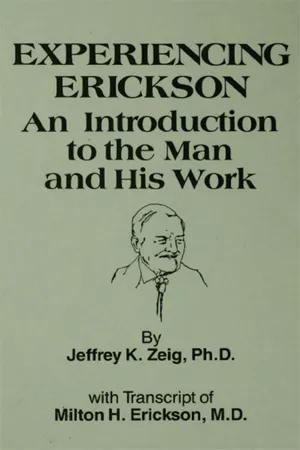
Experiencing Erikson
About this book
The work and legacy of Milton H. Erickson, M.D. - his interpersonal approaches and techniques designed to liberate potentials for self-help in either the hypnotic or waking state - are having an increasing influence on numerous mental health professionals, as well as on the whole field of psychotherapy. Jeffrey K. Zeig, Ph.D., a leading practitioner and teacher of Ericksonian psychotherapy and a former student of Erickson's, who remained close with him until Erickson's death, has written a uniquely personal view of Erickson himself, his basic ideas and techniques, his contributions to psychotherapy, and his highly individual methods of teaching.
Information
CHAPTER 1
Erickson’s Creativity
“Genius” refers to the attendant spirit of a person. It also signifies a person endowed with transcendent mental ability and inventiveness. Erickson’s genius derived from the intersection of his intelligence, humanity, inquisitiveness, inventiveness, and perceptiveness. He also was diligent in developing and honing his abilities.
Erickson’s genius was in four areas: as a hypnotist; as a psychotherapist; as a teacher; and as an individual who turned physical disability to advantage. Considered together, his achievements in these four areas make him seem like a person who was larger than life.
THE HYPNOTIST
If one were studying the history of hypnosis, one would probably read first about the 18th century practitioner Mesmer. And then about Charcot, Braid, Liébeault, and Bernheim, all of whom worked with hypnosis in the 19th century.
And then, in the 20th century, one would read about Erickson. He was the father of modern medical hypnosis. His creativity in devising new methods of hypnotic induction and utilization was extraordinary. He co-authored five books on the topic and published more than 130 professional articles, most of them on hypnotherapy. He was founder and first president of the American Society of Clinical Hypnosis; he initiated and for ten years edited its official organ, The American Journal of Clinical Hypnosis. He traveled widely, especially in the United States, to teach hypnosis to professionals and was generally known as “Mr. Hypnosis” (Secter, 1982, p. 453). Erickson legitimized hypnosis so that it was no longer the “court jester in the solemn halls of orthodoxy” (Watzlawick, 1982, p. 148).
Prior to Erickson, hypnotherapy was not a distinct discipline or primary therapeutic tool. However, hypnosis has been an important seed in the development of disparate disciplines of psychotherapy. The psychoanalyst, Sigmund Freud; the Gestalt therapist, Fritz Perls; the behaviorist, Joseph Wolpe; and the Transactional Analyst, Eric Berne—all were familiar with hypnosis but rejected it in favor of developing their particular approaches to therapy and advancing their theories of personality and change. Erickson stayed with hypnosis because he was a pragmatist who saw that hypnosis could influence a patient to change. He did not develop a special theory of hypnosis, but he departed radically from the traditional use of hypnosis whereby the operator force-feeds suggestions into a passive subject. Instead his method was to bring forth and utilize inner resources (cf. Hammond, 1984).
Ericksonian hypnosis is used to elicit therapeutic responses, the essence of which is to get the patient to cooperate. Patients enter psychotherapy because they have difficulty accomplishing tasks they set for themselves. It is the job of the therapist to get the patient to follow his or her own desires to the extent possible, and to this end hypnosis can often be effective in surmounting impasses. It makes more available to patients their own potentials for self-help.
Although formal hypnosis is a model par excellence of influence communication, rather than using it solely, Erickson pioneered naturalistic methods, i.e., taking techniques from hypnosis and effectively applying them to psychotherapy without the necessity of an induction ritual. Actually, he used formal hypnosis in only a fifth of the cases he treated (Beahrs, 1971), but he consistently used hypnotic technique even when he was not “doing hypnosis.” (The cases of John, Joe, and Barbie were such examples, and will be discussed later.) The naturalistic approach was the essence of Erickson’s strategic approach to brief therapy, the second area of Erickson’s genius.
THE PSYCHOTHERAPIST
With the publication by Jay Haley of Uncommon Therapy (1973), Erickson became generally known as the father of brief strategic approaches to psychotherapy. As a remarkably successful practitioner of these approaches, he added a tremendous number of new cases and methods to the literature of brief strategic psychotherapy; more cases are still being discovered in tapes from old lectures (e.g., Rossi, Ryan, & Sharp, 1983; Rossi & Ryan, 1985).
Haley (1980) wrote that therapy is a problem, not a solution. The problem is that patients are in therapy. The solution is to get them out of therapy and living their own independent lives as quickly as possible. Erickson would have agreed with that position. His strategic therapy was a common-sense approach, usually directed at the presenting problem. While on the surface his strategic techniques seemed uncommon, actually he had uncommon common sense.
It is a bit bizarre to put a phobic person on a couch and ask him or her to free associate for exactly 50 minutes. It is common sense to get phobic people to violate their phobias by inserting them into the feared situation in such a way that they can learn mastery. In this way and others, Erickson was one of the first modern practitioners to take therapy out of the realm of the patients’ mind (and the consulting room) and make it part of their real life. His facility for doing so was an aspect of his great inventiveness and creativity.
THE TEACHER
Another departure from tradition was Erickson’s method of teaching. In 1980, I published A Teaching Seminar with Milton H. Erickson (1980a), a transcript of a one-week seminar for professionals that demonstrated his uncommon teaching methods. He told interesting stories, mainly about successful psychotherapy but also about his family, and he conducted demonstrations of hypnotherapy. He didn’t supervise students by listening to tapes of their sessions or by observing them and guiding therapies they conducted. (I was Erickson’s student over a six-year time span and he referred many patients to me, but he never saw or heard me conduct a hypnotic induction or a session of therapy.) Instead, Erickson taught by using multiple-level influence communication to elicit resources; this was the same way he did psychotherapy, as well as the same way he did hypnosis. He blurred the lines between “hypnosis,” “teaching,” and “psychotherapy.” When he was teaching, he was doing hypnosis; when he was conducting hypnosis, he was doing psychotherapy.
Erickson was a consistent man whose goal was to communicate as relevantly as possible most of the time; he communicated to have the maximum specified effect. And he always had a goal in mind. An anecdote sheds light on his teaching philosophy. In response to my comment that a tape of one of his old lectures in the 1950s seemed to me like one long hypnotic induction, he said that he didn’t listen to his tapes: “I usually didn’t teach content; I taught to motivate.”
In the Ericksonian concept, there should not be a large distinction between hypnosis, teaching, and psychotherapy because in all of those areas one relies on unconscious learning. The underlying philosophy is that people already have the resources they need to effect change. Therefore, psychotherapy and hypnosis—and to a large extent even teaching—are processes of eliciting and developing resources and helping the person to combine resources in new, more effective ways.
THE INDIVIDUAL
As original as Erickson was as a hypnotist, psychotherapist, and teacher, he was even more of an original in the way that he lived his life. There were evidences of this every hour, but his individuality was particularly well-expressed in the way he surmounted staggering physical obstacles on his way to a full life.
Erickson’s numerous physical problems are recounted below in a letter dated December 10, 1984, from his wife, Elizabeth Erickson to a student who himself had an attack of polio and wrote to her inquiring about Erickson’s struggles. Although her account isn’t meant as one, Mrs. Erickson’s memories are an eloquent testimonial to this fourth area of Erickson’s genius, one that eclipsed the previous three.
About Erickson: His Physical Struggles
My late husband, Milton H. Erickson, suffered his initial attack of poliomyelitis at the age of 17 (in 1919). It was an extremely severe infection. He was completely paralyzed, unable to do other than speak and move his eyes and was aware that he was not expected to survive. He was cared for in his farm home by his mother and a live-in practical nurse. As the paralysis subsided to some extent, this nurse, on her own, used the type of therapy later popularized (against much medical opposition) by the Australian nurse, Sister Kenny. That is, she developed a system of hot packs, massage, and moving the paralyzed limbs, and motivating patient participation.
Milton, on his own, developed a system of mental concentration on a minimum movement, mentally reliving such movement over and over. As he regained more strength, he utilized every opportunity to exercise more and more muscles to strengthen them, learning to walk with crutches, learning to balance on and ride his bicycle; and finally, by obtaining a canoe, some basic provisions and camping gear, a few dollars, he planned a summer-long canoe trip, starting at the lake near the University of Wisconsin campus, following the waterway to the Mississippi River and proceeding south beyond St. Louis, returning upriver the same way.
A friend planned on accompanying him but at the last moment withdrew. Milton proceeded alone in spite of his physical handicaps, not telling his parents it would be a trip alone. After many adventures and coping with multiple problems, but learning various means of such coping, and meeting many interesting characters, some of them helpful, he completed the trip in far better health with powerfully developed shoulder muscles, ready to undertake college and medical school.
He told me many years later that his permanent loss of muscles, mostly on the right side, would ordinarily have led to carrying the left shoulder much higher than the right, and a visibly twisted torso. By dint of sheer physical effort, practiced in front of a mirror, he managed to level off his shoulders, greatly increasing the spinal curvature which would have resulted in any case from the polio, but would have been to a much lesser degree. He felt that the more nearly normal appearance was well worth the effort. During World War II, he was given a very intensive physical examination to see if he could be qualified for limited service as a medical officer. X rays taken of his spine at that time were met with amazement and disbelief by the specialists doing the examination.
While he was justifiably proud of this achievement of level shoulders, in retrospect it may have had some long-term bad effects. In his later years, one of his more knowledgeable physicians told me that at least some of his recurrent periods of complete disability, progressive loss of muscles, and great pain might be due to settling of bones of the twisted spinal column aggravated by arthritic changes, leading to pinching and further degeneration of the surviving portions of the spinal nerves.
I first met Milton in 1935 and we were married in 1936. He then was a vigorous, active man, with a marked limp on the right side. He walked with a cane but could do so for long distances. He had broad, powerful shoulders.
He had some brief episodes of pain in muscles and joints, but nothing serious that I can recall until the late 1940s. During the war, the staff duties at Eloise Hospital (later known as Wayne County General Hospital and Infirmary at Eloise) were greatly increased due to lack of personnel. He was also involved in teaching Residents at Eloise, and medical students in the accelerated medical school program at Wayne University College of Medicine in downtown Detroit. Additionally, he spent many hours (either before or after a full day’s session at Eloise) giving psychiatric examinations to military inductees at the downtown induction station, riding there and back on the bus as we did not have gasoline. All this work did not bother him.
A point I now wish to make is that his recurrent attacks usually seemed to be triggered by some severe physical stress. In the late summer or early fall of 1947, he was riding his bicycle from our apartment on the grounds to his office (also on the grounds, some distance away). He rode for exercise. A dog ran against the wheel and he was thrown, sustaining scrapes and superficial cuts, some on the face area and with ground-in dirt.
He had never had tetanus toxoid, so decided that no matter the risk (because of his life-long multiple allergies) to take the old style tetanus antitoxin shots. About 10 days later he developed severe serum sickness, including muscle pains, a near-comatose episode, and other symptomatology. He would partly recover, resume his office work and some teaching, then would become ill again.
Finally, in the spring of 1948, he became so ill that he was hospitalized at the University of Michigan Hospital in Ann Arbor. None of the doctors, including the outstanding neurologists there, could offer any advice except that the cold wet Michigan winter and his multiple fall and spring allergies were aggravating his condition and that we should consider taking leave for the summer and spending it in a dry, warm area with clean air and away from the allergens of Michigan.
We decided on Phoenix, Arizona, because it was the only place in Arizona, Nevada, or New Mexico where we knew anyone. The Superintendent of Arizona State Hospital (the only institution in the entire state of less than 800,000 population which accommodated the mentally ill, alcoholics, senile, grossly retarded, and the “criminally insane” in a separate branch) was Dr. John Larson, an old friend, formerly a prominent Detroit psychiatrist and research physiologist. He had come out West for his young son’s health and was running this small, minimally funded institution in antiquated buildings with a minimal, elderly medical staff; and was doing an incredibly able job of making it one of the most progressive and well-run institutions in the Southwest. Milton was pleased to be able to help. At the end of June, I drove out to Arizona with the four youngest children. The two older boys, then 17 and 19, stayed in Michigan. A few days after I left, Milton left the Ann Arbor hospital and was put on the plane by a friend to travel to Arizona, where Dr. Larson met him and put him up until I arrived a few days later. Milton was then recovering. We stayed at a motel a week, and then rented a small cottage for the summer.
During that time, I only recall one fairly short episode of relapse, and he felt so well he decided to join the State Hospital staff. I flew home for a few days and made moving arrangements, and on my return we moved to the hospital grounds. The 17-year-old son joined us by bus. Until spring of 1949, Milton worked hard, enthusiastically and with much energy, developing progressive changes at the State Hospital. Then Dr. Larson had a clash with a group of political members of the Arizona State Board of Control, resigned, and left the state. Milton resigned and decided to go into private practice.
We bought a house in Phoenix and were getting ready to move when he became severely but only briefly ill. He was hospitalized for a few days during the move, then came home and slowly regained strength while he gradually built up his practice. We originally intended to rent a regular office in a medical building but at this point I think he realized that he needed to exert himself physically less and rest more, so we realized the practical advantage of using a room in the house as a study and office where, when he had a free hour or so, he could go to bed if he wished. Therefore, from then until his death in 1980, his office was in the home.
In the fall of 1949, he was hospitalized twice—the recurrence was then considered to be a revival of the serum sickness, brought on by allergies to local allergens to which he had become sensitized, as well as dust and some foods. He had a very fine allergist who treated him for several years, recommending shots of antigens, as dust-free an environment as possible, and identification and avoidance of food sensitivities.
The next and the most severe episode was in 1953. The local doctors were sympathetic but had no recommendations. A medical friend at Johns Hopkins Hospital said he would have Milton admitted there for treatment if 1 could get him there. I could not go with him as I had two young children, born in 1949 and 1951, besides the other children still at home. Arrangements were made for two young medical interns to go with him by train; he was met by an ambulance, and the young men flew home.
Milton was hospitalized in Maryland for some time, recovering, and was examined by neurologists, orthopedists, and many other specialists. Then he seemed to be all right, but they still did not know of a diagnosis or a prognosis. They would have preferred to have him stay indefinitely for further testing, but he requested, and was given, a discharge and came home.
It was apparent that although he felt okay again, he had developed a lot of additional muscle impairment. Some months later, after he was well back into the schedule of work again, an orthopedist friend was visited by a renowned neurologist. This doctor examined Milton and said that in evaluating the recent muscle loss, he could make only one re...
Table of contents
- Cover
- Halftitle
- Title
- Copyright
- Contents
- Foreword
- Introduction
- 1. Erickson’s Creativity
- 2. The Ericksonian Approach
- 3. Experiences with Erickson: Personal Therapy, Supervision, Cases Reported by Former Patients, and Cases Observed
- 4. Milton Erickson: A Transcript, December 3-5, 1973
- Appendix A. My Life Story by Diane Chow
- Appendix B. Eva Parton
- Appendix C. Millie Parton
- References
Trusted by 375,005 students
Access to over 1.5 million titles for a fair monthly price.
Study more efficiently using our study tools.
Frequently asked questions
Yes, you can cancel anytime from the Subscription tab in your account settings on the Perlego website. Your subscription will stay active until the end of your current billing period. Learn how to cancel your subscription
No, books cannot be downloaded as external files, such as PDFs, for use outside of Perlego. However, you can download books within the Perlego app for offline reading on mobile or tablet. Learn how to download books offline
Perlego offers two plans: Essential and Complete
- Essential is ideal for learners and professionals who enjoy exploring a wide range of subjects. Access the Essential Library with 800,000+ trusted titles and best-sellers across business, personal growth, and the humanities. Includes unlimited reading time and Standard Read Aloud voice.
- Complete: Perfect for advanced learners and researchers needing full, unrestricted access. Unlock 1.5M+ books across hundreds of subjects, including academic and specialized titles. The Complete Plan also includes advanced features like Premium Read Aloud and Research Assistant.
We are an online textbook subscription service, where you can get access to an entire online library for less than the price of a single book per month. With over 1.5 million books across 990+ topics, we’ve got you covered! Learn about our mission
Look out for the read-aloud symbol on your next book to see if you can listen to it. The read-aloud tool reads text aloud for you, highlighting the text as it is being read. You can pause it, speed it up and slow it down. Learn more about Read Aloud
Yes! You can use the Perlego app on both iOS and Android devices to read anytime, anywhere — even offline. Perfect for commutes or when you’re on the go.
Please note we cannot support devices running on iOS 13 and Android 7 or earlier. Learn more about using the app
Please note we cannot support devices running on iOS 13 and Android 7 or earlier. Learn more about using the app
Yes, you can access Experiencing Erikson by Jeffery K. Zeig in PDF and/or ePUB format, as well as other popular books in Psychology & Mental Health in Psychology. We have over 1.5 million books available in our catalogue for you to explore.