- 420 pages
- English
- ePUB (mobile friendly)
- Available on iOS & Android
eBook - ePub
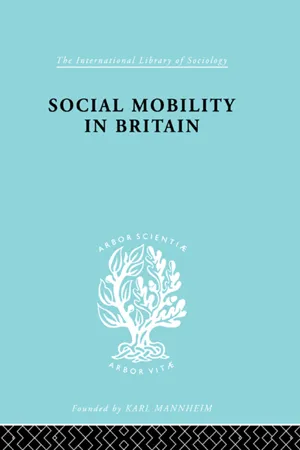
Social Mobility in Britain
About this book
This is Volume XVI of twenty-one in a series on Race, Class and Social Structure. Originally published in 1954, this study looks at social mobility in Great Britain; including social grading of occupations, social stratification, a sample and the educational experience of adults in England and Wales as of July 1949.
Information
I
Introduction
D. V. GLASS
THE studies brought together in this volume represent the first main results of a programme of research now being carried out through the Department of Sociological and Demographic Research of the London School of Economics. The programme as a whole is concerned with the processes of social selection and differentiation which are at work in Britain, with the formation of social strata, and with the nature, composition and functions of those strata. Such problems are central to the study of social structure; they are of direct concern both for the development of sociological theory and for the formulation of social policy.
No research programme dealing with problems of this kind could aim at being exhaustive. The field is vast, touching—at least at its edges—the whole area of social relations. And the boundaries and content have been changing as recent developments in economic and social policy have affected the rôles of the different social institutions. Some delimitation of scope was essential, even though it was obvious that there could be no sharp demarcation and that to illuminate one sector would often involve the study of other sectors.
As a starting-point it was proposed to focus upon the formation and structure of the ‘middle classes’. Much has been said in recent years about the changing circumstances of this section of the community. But in Britain, at least, the discussion has not generally been based upon systematic, objective, prior study. Indeed, save in respect of their early history the ‘middle classes’ of Britain have not been much exposed to investigation.1 The social reformers of the late nineteenth and early twentieth centuries were understandably interested in the ‘working class’ and in the problems of poverty, and it became the custom for the local social survey—a major British contribution to empirical social research—to keep within those limits. There had long been concern with the professions, and the work of Carr-Saunders and Wilson has not been surpassed in Britain or in any other country.1 But that work relates to the development of professional structure and codes, and to the place of professionalism in society, rather than to actual recruitment to the professions or to the extent to which, because the rise in the minimum educational requirements of the professions has been more rapid than the expansion of educational opportunities for the community as a whole, the supply of professional men has continued to come largely from the ‘middle classes’. Similarly, there had been much interest in the general question of the selection of ‘the nation’s leaders’, and its relationship to educational opportunities. But the level of interest before World War II was not high enough—or, perhaps, not of the kind—to provide the funds and collaboration indispensable for really comprehensive inquiries. The studies undertaken were thus inevitably limited in range and depth. Characteristically, lack of adequate social research did not prevent the passing of the 1944 Education Act, which, so far as social stratification is concerned, is probably the most important measure of the last half-century. Equally characteristically, however, no central provision was made to ascertain the social consequences of this great expansion of educational opportunity—its effects upon the existing ‘middle classes’, for example, or its rôle in the formation of new élites. Both in relation to the recent past and to the present, there is obviously more than enough scope for studies of the ‘middle classes’.
Given the definition of the narrower province of inquiry, the ‘middle classes’, certain specific studies were relevant—such as the degree of self-recruitment of particular groups, and especially of the professions and the higher Civil Service; the factors affecting the prestige of ‘middle-class’ occupations in the community and the carry-over of occupational prestige into other realms of activity; differentiation within the ‘middle classes’; and the nature and distinctiveness of ‘middle-class’ aspirations and ideals. But no less obviously studies of this kind would be truncated if confined to the ‘middle classes’. The prestige of the professions and of other white-collar occupations cannot be considered without reference to a possible overall hierarchy of occupational prestige. Self-recruitment in the professions and the higher Civil Service would have little meaning unless compared with self-recruitment in other occupational groups. Indeed, it was clear that the study of particular groups needed, as background, a general investigation of social status and social mobility in Britain. Hence it was upon this general investigation that first inquiries were focused. Later studies will deal specifically with the ‘middle classes’ as a whole or with subdivisions of them, such as the Higher Civil Service or the various professions. The present volume, however, is concerned with the general picture of social status and social mobility in Britain. The successive chapters, which examine various aspects of that general picture, aim to be self-contained and self-explanatory, and it is not, therefore, necessary to refer in detail to them here. But since the material on which the chapters are based derives from a series of studies—covering seven new field investigations—it is desirable to describe briefly the framework within which those studies were set. The description will also show, it is hoped, that though the sequence of the chapters may appear a little odd, it is not entirely capricious.
The core of the general investigation is the study of social mobility in Britain—of the extent of movement in social status or social position by individuals of diverse social origins. Such a study assumes a hierarchy of social status—that society is arranged in a series of layers—and that there are criteria which may be used to indicate the status level, or position in the hierarchy, of an individual or a group.1 It needs no elaborate conceptual framework or tests of carefully formulated hypotheses to show that there are different levels of social status in contemporary Britain. What is more difficult is the choice of a criterion or criteria which will give at least a useful first approximation of the social status of an individual. In a society divided into a series of ‘estates’, the rank, privileges and contents of those ‘estates’ being defined by law, there should theoretically be no problem in identifying the position of an individual in the social hierarchy. But in contemporary society, the different levels are not so specified and the criteria chosen must reflect a customary rather than a legal structure. Earlier studies have often used occupation as an index of social status and there is much to be said for this. Certainly, groups constructed of occupations of presumed similar status have shown consistent patterns in fertility and mortality as well as in the degree of self-recruitment. And this is not surprising for it is evident that, in our own society for example, occupation reflects the combined influence of a number of factors linked to social status. Moreover, there is an important advantage in using, as a first approximation, a single criterion, for the relationship and influence of other separate factors or determinants may then be examined separately. Available knowledge certainly gives strong support to the use of occupation as an initial index of social status in Britain, and it has been so used in the present research.
But in previous British studies, the classification of occupations in terms of social status was not based upon deliberate empirical research. The classification reflected the views of a small number of persons, themselves mainly ‘middle class’ in position. It was unlikely that this would greatly affect the ranking of occupations at the extreme ends of the scale. But in the middle ranges, in which in any case there would tend to be less agreement, ‘middle class’ bias of judgement might be significant. Moreover, in the most widely used classification, that of the Registrar General of England and Wales, manual occupations were divided up into categories of skill, though it cannot simply be assumed that skill and social status are perfectly correlated.1
Hence in order to use occupation as an index of social status, it was necessary to begin the general investigation of social mobility by a new empirical study (see Chapter II). The study was limited in scope and objective. Equating the social status of an occupation with the prestige it had in the community, the study aimed to discover if there was substantial agreement in the community as a whole on the position of various occupations in a hierarchy of social prestige—of occupations regarded as stereotypes, not as influenced by personal knowledge of individual, and possibly exceptional, cases. A wide measure of agreement was found—sufficient to justify the construction of a series of broad groups constituting a scale of prestige. Accordingly, the groups could then be used in the second main stage of the general investigation.
The second stage consisted in obtaining the life histories—in respect of social origins, education, occupation, marriage and fertility—of a random sample of 10,000 adults, the sample representing the adult civilian population of Great Britain. This was a very substantial task, and would have presented extremely serious difficulties if the work had fallen to an ad hoc group of untrained interviewers. Fortunately, however, with the help of the Inter-Departmental Committee on Economic and Social Research, and with the sponsorship of the Ministry of Labour, it was possible to make use of the services of the Government Social Survey. This organization gave valuable advice on the questionnaires and designed the sample; while, through its interviewers, the actual field work was carried out most effectively.
It was to the occupational data collected by this investigation that the prestige scale of occupations was applied. For the main purpose of the investigation was not to study occupations as such, but levels of social status. By using the prestige scale, even though it was a crude first approximation, it was possible to assign occupations to social status categories. And this having been done, a wide range of analyses could be undertaken. Thus it was possible to see whether there were consistent and significant differences between the levels of education attained by individuals whose fathers were at different levels of social status (Chapter V), and to examine the relationship between the social status of fathers and sons (Chapters VIII and IX). Similarly, the relationship between the social origins of brides and grooms could be studied (Chapter XII), and the influence on fertility of upward or downward social mobility.1 These questions are discussed in detail in subsequent chapters and need not be elaborated here. It is, however, worth noting that, because of the nature of the sample investigation, the whole range of questions could be examined within a single framework, using common criteria and bases of classification. In dealing with the various aspects of social mobility, a common method of analysis was also developed and applied—a method which attempts to overcome some of the main difficulties involved in comparing the mobility of persons of different social origins, whether that mobility is considered in terms of occupational achievement or marriage.
Fitting into these two central studies, six more specialized inquiries were undertaken, dealing with particular aspects of the general question of social status and social mobility. One of these went beyond the simple prestige scale of occupations, to explore a wider range of attitudes to and determinants of social status, and to examine the relation between social status and political opinions (Chapter III). Two studies are concerned with problems of educational selection. The main material on education—the material collected by the central sample investigation—relates to individuals who had passed through the school system before the 1944 Education Act had come into force. But some important social factors influencing selection and achievement in the new secondary school system are considered in the two additional studies (Chapters VI and VII). The remaining special studies are focused on particular aspects of social mobility. The basic collection of material on social mobility is analysed in terms of movements between broad status categories. This analysis is supplemented by a study of self-recruitment in four professions, a study based upon information relating to university students (Chapter XI). Similarly, social status, in the central investigation, is discussed in terms of occupation. But there are other possibilities of obtaining social prestige in the community, and it is important to know whether these are effective alternatives—in the sense that they are opportunities available to and used by individuals engaged in occupations of low prestige—or whether they reflect, and perhaps intensify, the prestige hierarchy of the world of employment. Leadership in voluntary associations is often regarded as offering an alternative basis of social prestige, and the two final studies examine the structure of voluntary associations from this point of view (Chapters XIII and XIV).
One difference between the central investigation and the more specialized inquiries should be emphasized. The central investigation relates to Great Britain as a whole, and is based upon a sample designed to represent the whole community. This approach was followed because of the need to obtain a valid, overall view against which subsequent local or sectional studies, dealing with specific topics in greater detail, might be set. The special inquiries are local in character, with two exceptions—the studies of self-recruitment in...
Table of contents
- Cover
- Title
- Contents
- Preface
- Part I
- Part II
- Part III
- Part IV
- Index of Persons and Organizations
- Index of Subjects
Trusted by 375,005 students
Access to over 1.5 million titles for a fair monthly price.
Study more efficiently using our study tools.
Frequently asked questions
Yes, you can cancel anytime from the Subscription tab in your account settings on the Perlego website. Your subscription will stay active until the end of your current billing period. Learn how to cancel your subscription
No, books cannot be downloaded as external files, such as PDFs, for use outside of Perlego. However, you can download books within the Perlego app for offline reading on mobile or tablet. Learn how to download books offline
Perlego offers two plans: Essential and Complete
- Essential is ideal for learners and professionals who enjoy exploring a wide range of subjects. Access the Essential Library with 800,000+ trusted titles and best-sellers across business, personal growth, and the humanities. Includes unlimited reading time and Standard Read Aloud voice.
- Complete: Perfect for advanced learners and researchers needing full, unrestricted access. Unlock 1.5M+ books across hundreds of subjects, including academic and specialized titles. The Complete Plan also includes advanced features like Premium Read Aloud and Research Assistant.
We are an online textbook subscription service, where you can get access to an entire online library for less than the price of a single book per month. With over 1.5 million books across 990+ topics, we’ve got you covered! Learn about our mission
Look out for the read-aloud symbol on your next book to see if you can listen to it. The read-aloud tool reads text aloud for you, highlighting the text as it is being read. You can pause it, speed it up and slow it down. Learn more about Read Aloud
Yes! You can use the Perlego app on both iOS and Android devices to read anytime, anywhere — even offline. Perfect for commutes or when you’re on the go.
Please note we cannot support devices running on iOS 13 and Android 7 or earlier. Learn more about using the app
Please note we cannot support devices running on iOS 13 and Android 7 or earlier. Learn more about using the app
Yes, you can access Social Mobility in Britain by D. V. Glass,D.V. Glass in PDF and/or ePUB format, as well as other popular books in Social Sciences & Sociology. We have over 1.5 million books available in our catalogue for you to explore.