This is Volume VIII of thirty-two in a series on Developmental Psychology. Originally published in 1923, the author wites that our knowledge of human instincts and capacities, of the processes of learning and remembering, of mental work and fatigue, and of individual differences and their causes has been much increased in the past score of years. This Briefer Course represents a simpler treatment of the more fundamental subject matter of these volumes, organized as a text-book in Educational Psychology for students in colleges and schools.
The arts and sciences serve human welfare by helping man to change the world, including man himself, for the better. The word education refers especially to those elements of science and art which are concerned with changes in man himself. Wisdom and economy in improving man's wants and in making him better able to satisfy them depend upon knowledge—first, of what his nature is, apart from education, and second, of the laws which govern changes in it. It is the province of educational psychology to give such knowledge of the original nature of man and of the laws of modifiability or learning, in the case of intellect, character and skill.
A man's nature and the changes that take place in it may be described in terms of the responses—of thought, feeling, action and attitude—which he makes, and of the bonds by which these are connected with the situations which life offers. Any fact of intellect, character or skill means a tendency to respond in a certain way to a certain situation—involves a situation or state of affairs influencing the man, a response or state of affairs in the man, and a connection or bond whereby the latter is the result of the former.
ORIGINAL versus LEARNED TENDENCIES
Any man possesses at the very start of his life—that is, at the moment when the ovum and spermatozoon which are to produce him have united—numerous well-defined tendencies to future behavior.* Between the situations which he will meet and the responses which he will make to them, pre-formed bonds exist. It is already determined by the constitution of these two germs, that under certain circumstances he will see and hear and feel and act in certain ways. His intellect and morals, as well as his bodily organs and movements, are in part the consequence of the nature of the embryo in the first moment of its life. What a man is and does throughout life is a result of whatever constitution he has at the start and of all the forces that act upon it before and after birth. I shall use the term ‘original nature’ for the former and ‘environment’ for the latter.
THE PROBLEMS OF ORIGINAL NATURE
Elementary psychology acquaints us with the fact that men are, apart from education, equipped with tendencies to feel and act in certain ways in certain circumstances—that the response to be made to a situation may be determined by man's inborn organization. It is, in fact, a general law that, other things being equal, the response to any situation will be that which is by original nature connected with that situation, or with some situation like it. Any neurone will, when stimulated, transmit the stimulus, other things being equal, to the neurone with which it is by inborn organization most closely connected. The basis of intellect and character is this fund of unlearned tendencies, this original arrangement of the neurones in the brain.
The original connections may develop at various dates and may exist for only limited times; their waxing and waning may be sudden or gradual. They are the starting point for all education or other human control. The aim of education is to perpetuate some of them, to eliminate some, and to modify or redirect others. They are perpetuated by providing the stimuli adequate to arouse them and give them exercise, and by associating satisfaction with their action. They are eliminated by withholding these stimuli so that they abort through disuse, or by associating discomfort with their action. They are redirected by substituting, in the situation-connection-response series, another response instead of the undesirable original one; or by attaching the response to another situation in connection with which it works less or no harm, or even positive good.
It is a first principle of education to utilize any individual's original nature as a means to changing him for the better—to produce in him the information, habits, powers, interests and ideals which are desirable.
The behavior of man in the family, in business, in the state, in religion and in every other affair of life is rooted in his unlearned, original equipment of instincts and capacities. All schemes of improving human life must take account of man's original nature, most of all when their aim is to reverse or counteract it.
NAMES FOR ORIGINAL TENDENCIES
Three terms, reflexes, instincts, and inborn capacities, di-vide the work of naming these unlearned tendencies. When the tendency concerns a very definite and uniform response to a very simple sensory situation, and when the connection between the situation and the response is very hard to modify and is also very strong so that it is almost inevitable, the connection or response to which it leads is called a reflex. Thus the knee-jerk is a very definite and uniform response to the simple sense-stimulus of sudden hard pressure against a certain spot. It is hard to lessen, to increase, or otherwise control the movement, and, given the situation, the response almost always comes. When the response is more indefinite, the situation more complex, and the connection more modifiable, instinct becomes the customary term. Thus one's misery at being scorned is too indefinite a response to too complex a situation and is too easily modifiable to be called a reflex. When the tendency is to an extremely indefinite response or set of responses to a very complex situation, and when the connection's final degree of strength is commonly due to very large con-tributions from training, it has seemed more appropriate to replace reflex and instinct by some term like capacity, or ten-dency, or potentiality. Thus an original tendency to respond to the circumstances of school education by achievement in learning the arts and sciences is called the capacity for scholarship.
There is, of course, no gap between reflexes and instincts, or between instincts and the still less easily describable original tendencies. The fact is that original tendencies range with respect to the nature of the responses from such as are single, simple, definite, uniform within the individual and only slightly variable amongst individuals, to responses that are highly compound, complex, vague, and variable within one individual's life and amongst individuals. They range with respect to the nature of the situation from simple facts like temperature, oxygen or humidity, to very complex Tacts like ‘meeting suddenly and unexpectedly a large animal when in the dark without human companions,’ and include extra-bodily, bodily, and what would be commonly called purely mental, situations. They range with respect to the bond or connection from slight modifi-ability to great modifiability, and from very close likeness amongst individuals to fairly wide variability.
Much labor has been spent in trying to make hard and fast distinctions between reflexes and instincts and between instincts and these vaguer predispositions which are here called capacities. It is more useful and more scientific to avoid such distinctions in thought, since in fact there is a continuous gradation.
THE COMPONENTS OF AN ORIGINAL TENDENCY
A typical reflex, or instinct, or capacity, as a whole, includes the ability to be sensitive to a certain situation, the ability to make a certain response, and the existence of a bond or connection whereby that response is made to that situation. For instance, the young chick is sensitive to the absence of other members of his species, is able to peep, and is so organized that the absence of other members of the species makes him peep. But the tendency to be sensitive to a certain situation may exist without the existence of a connection therewith of any further exclusive response, and the tendency to make a certain response may exist without the existence of a connection limiting that response exclusively to any single situation. The three-year-old child is by inborn nature markedly sensitive to the presence and acts of other human beings, but the exact nature of his response varies. The original tendency to cry is very strong, but there is no one situation to which it is exclusively bound.
Original nature seems to decide that the individual will respond somehow to certain situations more often than it decides just what he will do, and to decide that he will make certain responses more often than it decides just when he will make them. So, for convenience in thinking about man's unlearned equipment, this appearance of multiple response to one same situation and multiple causation of one same response may be taken roughly as the fact.
It must not, however, be taken to mean that the result of an action set up in the sensory neurones by a situation is essentially unpredictable—that, for instance, exactly the same neur-one-action (paralleling, let us say, the sight of a dog by a certain two-year-old child) may lead, in the two-year-old, now to the act of crying, at another time to shy retreat, at another to effusive joy, and at still another to curious examination of the newcomer, all regardless of any modification by experience. On the contrary, in the same organism the same neurone-action will always produce the same result—in the same individual the really same situation will always produce the same response. The apparent existence of an original sensitivity unconnected with any one particular response, so that apparently the same cause produces different results, is to be explained in one of two ways. First, the apparently same situations may really be different. Thus, the sight of a dog to an infant in its mother's arms is not the same situation as the sight of a dog to an infant alone on the doorstep. Being held in its mother's arms is a part of the situation that may account for the response of mild curiosity in the former case and fear in the latter. Second, if the situations are really identical, the apparently same organism really differs. Thus a dog seen by a child, healthy, rested and calm, may lead to only curiosity, whereas, if seen by the same child, ill, fatigued, and nervously irritable, it may lead to fear.
Similarly, the really same response is never made to different situations by the same organism. When the same response seems to be made to different situations, closer inspection will show that the responses do differ; or that the situations were, in respect to the element that determined the response, identical; or that the organism is itself different. Thus, though ‘a ball seen,’ ‘a tin soldier seen,’ and ‘a rattle seen’ alike provoke ‘reaching for,’ the total responses do differ, the central nervous system being provoked to three different responses manifested as three different sense-impressions—of a ball, of a tin soldier, and of a rattle. Thus, if ‘ball grasped,’ ‘tin soldier grasped,’ and ‘rattle grasped’ alike provoke ‘throwing,’ it is because only one particular component, common to the three situations, is effective in determining the act. Thus, if a child now weeps whenever spoken to, whereas before he wept only when hurt or scolded, it is because he is now exhausted, excited, or otherwise changed.
The original connections between situation and response are never due to chance in its true sense, but there are many minor coöperating forces by which a current of conduction in the same sensory neurones or receptors may, on different occasions, diverge to produce different results in behavior, and by which very different sensory stimulations may converge to a substantially common consequence.
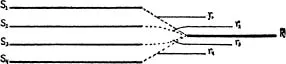
One may use several useful abstract schemes by which to think of man's original equipment of reflexes, instincts and capacities. Perhaps the most convenient is a series of S-R connections of three types. Some are of the type—S1 leads to R1, its peculiar sequent; some are of the type—S1 leads to R1 or R2or R3 or R4 or R5, etc., according to very minor casual contributory causes; some are of the type—S1 leads to R+r1, S2 leads to R+r2, S3 leads to R+r3 etc., where r1 r2 and r3 are minor results.
Graphically this scheme is represented by Figs. 1, 2 and 3.
FIG. 1.
FIG. 2.
FIG. 3.
Besides such a system of tendencies deciding which response any given situation will produce, there are certain tendencies that decide the status of features common to all situation-response connections. There is, for example, in man an original tendency whereby any connection once made tends, other things being equal, to persist. There is also a tendency whereby any connection or response may or may not be in readiness to be made—may be excited to action easily or with difficulty. These tendencies toward the presence or absence of a certain feature in all connections or responses will be examined by themselves in due time.
THE ACTION OF ORIGINAL TENDENCIES
We can imagine a man's life so arranged that one after another original tendency should be called into play, each by itself. Let him be in a certain status, and let, successively, the light grow five times as intense, snuff be blown up his nostrils, a dear friend approach, and the earth quake, without in any case any other changes whatever either in the surroundings or in his internal status. Then the pupils of his eyes would contract, he would sneeze, he would smile, and he would start.
The original tendencies of man, however, rarely act one at a time in isolation one from another. Life apart from learning would not be a simple serial arrangement, over and over, of a hundred or so situations, each a dynamic unit; and of a hundred or so responses, fitted to these situations by a one-to-one correspondence. On the contrary, they coöperate in multitudinous combinations. Their combination may be apparent in behavior, as when the tendencies to look at a bright moving object, to reach for a small object passing a foot away, and to smile at a smiling familiar face combine to make a baby smilingly fixate and reach for the watch which his father swings. O...
Table of contents
Cover
Half Title
Full Title
Copyright
CONTENTS
PART I The Original Nature of Man
PART II The Psychology of Learning
PART III Individual Differences and Their Causes
BIBLIOGRAPHY OF REFERENCES MADE IN THE TEXT
INDEX
Trusted by 375,005 students
Access to over 1.5 million titles for a fair monthly price.
Study more efficiently using our study tools.
Frequently asked questions
Yes, you can cancel anytime from the Subscription tab in your account settings on the Perlego website. Your subscription will stay active until the end of your current billing period. Learn how to cancel your subscription
No, books cannot be downloaded as external files, such as PDFs, for use outside of Perlego. However, you can download books within the Perlego app for offline reading on mobile or tablet. Learn how to download books offline
Perlego offers two plans: Essential and Complete
Essential is ideal for learners and professionals who enjoy exploring a wide range of subjects. Access the Essential Library with 800,000+ trusted titles and best-sellers across business, personal growth, and the humanities. Includes unlimited reading time and Standard Read Aloud voice.
Complete: Perfect for advanced learners and researchers needing full, unrestricted access. Unlock 1.5M+ books across hundreds of subjects, including academic and specialized titles. The Complete Plan also includes advanced features like Premium Read Aloud and Research Assistant.
Both plans are available with monthly, semester, or annual billing cycles.
We are an online textbook subscription service, where you can get access to an entire online library for less than the price of a single book per month. With over 1.5 million books across 990+ topics, we’ve got you covered! Learn about our mission
Look out for the read-aloud symbol on your next book to see if you can listen to it. The read-aloud tool reads text aloud for you, highlighting the text as it is being read. You can pause it, speed it up and slow it down. Learn more about Read Aloud
Yes! You can use the Perlego app on both iOS and Android devices to read anytime, anywhere — even offline. Perfect for commutes or when you’re on the go. Please note we cannot support devices running on iOS 13 and Android 7 or earlier. Learn more about using the app
Yes, you can access Education Psychology by E.L. Thorndike,Thorndike, E L,E L Thorndike in PDF and/or ePUB format, as well as other popular books in Medicine & Health Care Delivery. We have over 1.5 million books available in our catalogue for you to explore.