- 256 pages
- English
- ePUB (mobile friendly)
- Available on iOS & Android
eBook - ePub
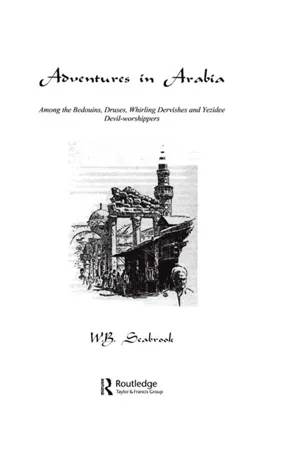
Adventures In Arabia
About this book
First published in 1928, few Westerners have succeeded in identifying themselves so completely with Arabian life as the author of this volume. He went to Arabia for no political, humanitarian or reasonable purpose but purely for the joy of it.
Information
AMONG THE BEDOUINS

Chapter One
“IN THE FACE OF ALLAH”
FOUAD TAIMANI, my guide, was plainly nervous. Indeed, the landscape was not calculated to inspire confidence. We had ridden for days through flat desolation, down from the Hauran toward the ancient wilderness of Moab, and were now approaching a range of ugly, barren hills.
The English that Fouad had learned in mission-school was quaint, but not courageous:
“Alas, my sir, the grain is few. The Beduw are enhungered. I fear that they may fall upon us and spoil us.”
As we entered the hills he continued:
“I pray you, sir, let us go swiftly, for this spot is evil. It was here but yesterday, hard by, as we were warned in Ramtah, that the Beduw fell upon a man and despoiled him of his camel, and when he cried out and ran after them they deprived him also of his life.”
I was not particularly afraid of being deprived of my life, for while the Bedouins are professional robbers they seldom kill farengi as close as we were to the French and British posts. A mere robbery—even though accompanied by occasional native bloodshed—entails little consequence for the marauders ; but the murder of a European is habitually followed by aeroplanes and hangings. If they can’t catch the guilty ones they hang a few of their cousins or fellow-tribesmen.
As a matter of fact, we passed through these hills unmolested, without seeing a living soul.
On the following day, however, among the rock gorges less than six hours* ride from Amman, Fouad, who was some paces ahead of me in the narrow defile, turned a sharp angle, and exclaimed with bitter finality:
“Ya wail immi!” (“Alas, what grief for my mother!”)
In the instant before my mare’s head also came round the angle I failed to understand the significance of his mournful ejaculation. I couldn’t imagine what we had come upon in this lonely spot that might cause grief to an old woman back in the hills of the Lebanon. I invented a long-lost second son, lying dead or wounded in our path.
I was totally surprised when confronted instead by six dirty and evil-looking men on horseback, with rifles across their saddle-pommels.
Even then I was not sure they meant to rob us, for not a weapon was levelled, and no rifle or pistol was raised at any moment during the queer little drama that ensued. It turned out afterward that we had been ‘covered’ by two of their companions who were dismounted and hidden among the rocks.
After his first cry of pain Fouad behaved splendidly. He had exchanged some words which I could not follow with the Bedouin who seemed to be in command, and now said to me:
“Our lives shall be spared, but we must be deprived of all our goods. And they mean also to deprive us of our horses. Yet the garments upon our backs may remain to us, and our water-bag, that we may proceed by foot to Amman.”
This programme, which Fouad was ready to accept with Oriental fatalism, seemed highly distasteful to me. Amir Amin Arslan had discussed such emergencies at great length previously in his palace at Beirut, and had drilled me thoroughly in what he advised as the best way to meet them.
I held up my right hand, palm forward, and said, partly in bad Arabic, and partly in English which Fouad had to translate:
“Ana bwajh el Beduw [I am in the face of all Bedouins], and bear upon my body the proof. I come unarmed, and not under the protection of the farengi flying-machines, but under that of your own desert laws. I am already dhaif [a guest protected by the sanctuary laws] in the black tents, for I go to my brother, Mitkhal Pasha, sheikh of sheikhs. I am dackhile [inviolate] to you and to all Bedouins, so that if you take aught from me shame will be upon you and upon your tribe. If you are in great want I will give you freely all that I possess, even my horses, and my water-bag, and the little gold you know to be in° my purse, even the clothing from my back. But I must offer them as gifts, and you must accept them as gifts ; for if you take by force one nail from my horse’s shoe your faces will be blackened and the shame will be upon your tribe.”
My little oration was met with scowls and mutterings.
“They say,” Fouad explained, “that these are strange words from a farengi—and that the desert laws are only for the people of the desert—also that you are without doubt a liar—but they are puzzled that you should offer all that you have as gifts.”
“Are there those among you who can read Arabic?” I asked. Fortunately for us two of them could. I produced my precious letters, signed by Amir Amin Arslan, the first a general letter of safe conduct in the desert, which read:
In the name of Allah, the Merciful, the Compassionate. This man is in my face, and in the face of Mitkhal Pasha el Fayiz, sheikh of sheikhs of the Beni Sakhr, with whom, if he is touched, will be blood feud.
They peered at it together, mumbling the words, and then read it aloud to their surly companions. They
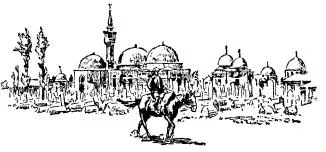
THE TOMB OF FATIMA
The resting-place of the daughter of Mohammed in the Damascus oasis gardens.
The resting-place of the daughter of Mohammed in the Damascus oasis gardens.
passed it about from hand to hand, and all had a look at it.
It would make a charming dénouement to say that they became immediately friendly, embraced us as brothers, and took us to their tents as honoured guests—but human nature is not like that, except in fiction. They were angry and disappointed. Luckily for us they were straggling members of a tribe that couldn’t risk trouble with the powerful Beni Sakhr, and after a few words of muttered apology they reined their horses aside, and motioned us to pass on.
“Would it not be better,” I whispered to Fouad, “to offer them a couple of pounds in friendship?”
“No,” he said; “if they had dared to take anything they would have taken all.”
The city of Amman, which we reached that afternoon —ancient Philadelphia to the archaeologists who take keen interest in its Greco-Roman ruins, and famed in still earlier Bible history as capital of the Ammonite kingdom whose people David conquered and tortured “under saws, and under harrows of iron”—was like a little Paradise, with its green trees and streams and fountains, after our hard, hot journey.
Old Jeremiah’s prophecy that the Lord would “roar from on high” and make Amman “a desolate heap … no more remembered” had—fortunately for my convenience—been unfulfilled. Amman to-day is the busy capital of Transjordania, ruled over by the Amir Abdullah, under British supervision. The handsome modern Oriental palace they have built for him braves Jehovah’s wrath and floats the green flag of Islam from Amman’s highest hill.
More to my immediate purpose was the native hotel, where I had a noble bath in a stone outhouse off the catinfested back-yard, deluged to my heart’s content by gallons of water that poured down from a huge zinc tank suspended by chains from the ceiling. A fat, motherly old woman, no whit embarrassed by my nakedness, stood in the doorway with towels and a three-legged stool and my clothes. I guessed her to be Christian, and so she was—a native of Beit-Lachem (Bethlehem).
And from her, later in the evening, we had the last Christian meal I was destined to taste for many weeks— a meal that I looked back on longingly when in the desert. It consisted of four quarts of beer, fresh butter, bread in the loaf, and an enormous platter of fried eggs.
We slept like logs, atop the counterpane of the bed, with our own blankets as covering—a simple trick that frequently discourages the ‘biter of strangers’ A bright light kept burning in the room offers an additional protection.
The next morning while I lay lazily abed, sore from three days in the saddle, Fouad went scouting for news in the cafés and market.
We knew that Mitkhal Pasha would probably be camped somewhere in the edge of the desert out from Amman. His principal village, Um-el-Akmid, lay only one long day’s journey eastward in a little oasis on the old caravan route to Bagdad, and it was in this neighbourhood that his allied tribes, more than fifteen thousand strong, with their thirty thousand head of camels, sheep, and goats, assembled in the autumn for their great winter rahla south in search of pastures.
But he might be anywhere within a circle of three hundred miles or more. He might be off to the eastward on one of his occasional ghrazzwat (raids), or visiting the sheikh of some friendly tribe.
Amir Abdullah, the native ruler, would probably know exactly where Mitkhal could be found, for he and the powerful sheikh called each other ‘cousin’ and had been intimate friends and cronies for years. I had planned to pay my respects to the Amir, and counted on obtaining from him not only directions, but a guide and escort.
Of course, there was the British military headquarters, but I had learned already that the man who wishes to hold the confidence and friendship of the Arab will do well to steer clear of all foreign entanglements, and trust himself entirely to native protection and hospitality. Not only did this policy open doors for me that no European ‘official’ traveller had ever entered, but I think that on one or two occasions it saved my life.
Fouad returned to the hotel about eleven o’clock, saying that Amir Abdullah was in Jerusalem and would not return for three days, but that Rakaby Pasha, his Prime Minister, would receive me at two o’clock.
A dilapidated Ford driven by a fourteen-year-old boy —the best vehicle our hotel garage could supply—trans-ported us to the palace, and a native guard in khaki showed us into the Prime Minister’s reception hall—a high-ceilinged, square, plastered room, with a mélange of European and Oriental furniture, horsehair sofas and chairs of the ugliest Victorian period, rugs, low divan couches, and tabourets.
After keeping us waiting for a quarter of an hour Rakaby Pasha entered. He was a man past sixty, with an aggressive and disagreeable personality. He was florid, white-haired, inclined to unhealthy stoutness. Except for his red fez, he was dressed in conventional European clothes, frock coat, a heavy gold watchchain across his paunch. He was a Syrian Moslem, a Dama-scene ; but from his appearance one might have guessed him to be a Greek banker.
We spoke in French. He asked me with cold politeness what I”required.” Cold politeness from an Oriental under such circumstances was equivalent to deliberate discourtesy.
I regretted that I had come to him, but told him simply who I was and what I wanted—an American friend of Amir Amin Arslan, with letters to Mitkhal Pasha, whom I hoped to visit. He asked my business or profession, and I told him that in America I lived by writing.
“I have heard,” said he, “of writers who enter our country pretending friendship and literary interest, but who really have some secret secondary motive, and who always end by making trouble —”
Without reflecting on the consequences, I lost my temper and replied:
“I have heard also of native Prime Ministers in Syria who were suspicious because they themselves were notoriously dishonourable and corrupt, and who frequently sold their own people traitorously to the French and English for personal gain. I shall ask you to try to believe that I am not the type of writer you have so courteously de-scribed—and assure you of my conviction that you are not the kind of Prime Minister I just mentioned. I shall also bid you good-day.”
Fouad had turned white as a sheet, and so far forgot himself as to precede me out of the door—but when we reached the ramshackle Ford in the courtyard below and were once outside the palace gate, he heaved a deep sigh, and said, “Ah, sir, how greatly do I admire at your indiscretion!”
I think he meant it as a compliment, but I have never been quite sure.
“What shall we do n...
Table of contents
- Cover
- Half Title
- Title Page
- Copyright Page
- Dedication
- ACKNOWLEDGMENT
- PREFACE
- Table of Contents
- ILLUSTRATIONS
- AMONG THE BEDOUINS
- AMONG THE DRUSES
- AMONG THE DERFISHES
- AMONG THE YEZIDEES
- INDEX
Trusted by 375,005 students
Access to over 1.5 million titles for a fair monthly price.
Study more efficiently using our study tools.
Frequently asked questions
Yes, you can cancel anytime from the Subscription tab in your account settings on the Perlego website. Your subscription will stay active until the end of your current billing period. Learn how to cancel your subscription
No, books cannot be downloaded as external files, such as PDFs, for use outside of Perlego. However, you can download books within the Perlego app for offline reading on mobile or tablet. Learn how to download books offline
Perlego offers two plans: Essential and Complete
- Essential is ideal for learners and professionals who enjoy exploring a wide range of subjects. Access the Essential Library with 800,000+ trusted titles and best-sellers across business, personal growth, and the humanities. Includes unlimited reading time and Standard Read Aloud voice.
- Complete: Perfect for advanced learners and researchers needing full, unrestricted access. Unlock 1.5M+ books across hundreds of subjects, including academic and specialized titles. The Complete Plan also includes advanced features like Premium Read Aloud and Research Assistant.
We are an online textbook subscription service, where you can get access to an entire online library for less than the price of a single book per month. With over 1.5 million books across 990+ topics, we’ve got you covered! Learn about our mission
Look out for the read-aloud symbol on your next book to see if you can listen to it. The read-aloud tool reads text aloud for you, highlighting the text as it is being read. You can pause it, speed it up and slow it down. Learn more about Read Aloud
Yes! You can use the Perlego app on both iOS and Android devices to read anytime, anywhere — even offline. Perfect for commutes or when you’re on the go.
Please note we cannot support devices running on iOS 13 and Android 7 or earlier. Learn more about using the app
Please note we cannot support devices running on iOS 13 and Android 7 or earlier. Learn more about using the app
Yes, you can access Adventures In Arabia by W.B. Seabrook,Seabrook in PDF and/or ePUB format, as well as other popular books in Social Sciences & Anthropology. We have over 1.5 million books available in our catalogue for you to explore.