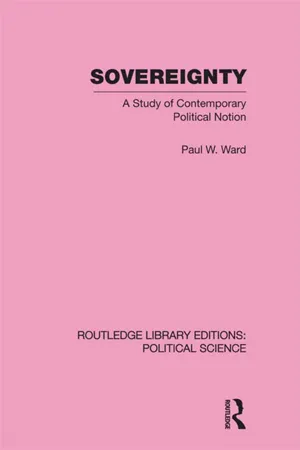
This volume analyzes the meaning of the term 'sovereignty' in early twentieth century thought by tracing the historical roots of the doctrine and surveying the origin of it back to feudal times.
eBook - ePub
Sovereignty
About this book
Information
SOVEREIGNTY
Chapter I
INTRODUCTORY SURVEY
History of the concept has been well discussed.
THE history of the concept of sovereignty* has been, for the most part, amply treated. What the important men in the history of political philosophy have said regarding the nature, locus, extent, and basis of sovereignty is available to even the cursory reader. Political history has been revealed as a field in which men have invented device after device, in which they have formed and often reformed principle after principle, in the effort to solve the difficulties in which they have found themselves. It is the purpose of the present study to throw additional light upon the meaning of the term “sovereignty” in contemporary thought. To that end a brief preliminary survey of its origin and some of the historical uses to which it has been put may prove illuminating, without making any pretence of adding to historical knowledge.
Three general phases are apparent in the history of the notion ; (1) its emergence from the complex materials of ancient tradition and late mediæval usage ; (2) its specific enunciation and application by the absolute monarchs of the early modern period ; (3) its repeated reinterpretation since 1688 and the historical rise of responsible government. The interest throughout the subsequent pages is not merely in the intellectual content of the various doctrines, the what, but also in the why.
Origins of the modern concept.
The modern idea of sovereignty is obviously the heir of ancient concepts of supreme authority. Aristotle recognized that the Greek city's authority must be in the hands of one, or of a few, or of many.* The Roman people were supreme in Rome, and the Emperors ruled through the transference of that authority to them. The renewed interest in the Roman law and the rediscovery of Aristotle were the means of making available for the modern world this inheritance of ancient doctrine. However, the chief roots of the modern doctrine of sovereignty lie elsewhere and have received too slight attention from writers on the subject. A survey of the origin of the modern conception leads back to the feudal system. The elaborate organization of fiefs had come to include almost all the land of Western Europe, † which was held by dukes, counts, lords and knights in a descending order from the kings. Each man was suzerain or “sovereign” in his own domain, and had vassals in turn, or let the land out to peasants or villains. Usage even permitted a husband to be “sovereign” to his wife.* The distinction between suzerainty and sovereignty is not always explicity made.† Both meant “lordship.” Sovereignty was “overlordship,” however, while a suzerain was a lord who usually had another over him. “Sovereignty” subsequently became synonymous with finality of authority, and involved a tacit independence of any supposed superiors. The feudal system was essentially personal in character, and was based on dominion over land; its law was customary and private. By the tenth century it had become so formal in character that a vassal might capture his lord and sovereign in war and exact a fief, vowing homage to him while he was still a prisoner.* Its general structure remained unaltered, however, and subsequent history is intelligible only as the system of personal loyalties, and land tenures which constituted feudalism are recognized as providing the general framework within which development took place. Notions of supreme power came down from antiquity, but the factual basis of the “sovereignty” of the early modern monarch, the concrete context of mutual obligations and interests in terms of which he claimed authority, was furnished by the total complex of human attitudes as they emerged from feudalism.
Papacy first asserts Monarchical Omnicompetence.
When Gierke says† that “it was within the Church that the idea of Monarchical Omnicompetence first began to appear,” he points out that the Papacy first tried to unify the existing systems. Both Gregory VII (d. 1085) and Innocent III (d. 1216) claimed a plenitudo potestatis vested by God in the Pope, although the opponents of the Pope insisted, of course, on a potestas limitata. The Papacy sought to make its own head, the Pope, the supreme person.* The Pope and Emperor struggled for personal possession of the loyalties of all subordinates, each claiming the plenitudo potestatis or Imperium of a Roman Cæsar. The term “sovereignty,” as later used, had not yet been developed. Inevitably Pope and Emperor clashed, and the extinction of the house of Hohenstaufen in 1254 made clear that the Papacy was finally victorious in the struggle. The Pope determined the succession of Philip, Otto IV, and Frederick II to the imperial throne. John of England formally yielded his kingdom as a fief of the Roman see and became a vassal of the Pope. The King of Aragon became a vassal with full feudal ceremony, and lands conquered from the heathen and infidels were held by the Papacy. The idea of lordship received a new profundity from Christianity. The head of Christendom, by dint of careful work, became also the over-lord of all Western Europe. The Pope conquered the Emperor; largely, be it noted, by utilizing lesser feudal lords against that ancient office. The Empire tottered on for several generations, but the Emperor was obviously shorn of his power. Those princes upon whom the Pope always could rely in his opposition to the Empire began to assume a new position, however. Once the Emperor was reduced to a figurehead, they grew restive at being restrained by the ambitious and unenforced claims of the see of Rome. A bare century elapsed before the insubordination which the Pope had encouraged against the Emperor was turned against himself. It was in this struggle of the Church, victorious over the feudal Empire, with the feudal lords of Germany, France and England, that the modern concept of sovereignty was developed.* Sovereignty in the Austinian sense, as Figgis says,† was unknown in any single nation in the Middle Ages. The plenitudo potestatis was international or supemational. In the Empire and the Church the closest factual approach to the modern notion appeared, largely due to the degree of centralization. Supreme power was the object for which both the late Popes and Emperors struggled, and that suprema potestas was not yet sovereignty in the modern sense. To achieve the personal hegemony of mediæval Europe was one thing ; to be sovereign of a modern state was another.*
Philip the Fair and Lewis of Bavaria opposed by Papal writers.
The two outstanding princes who led the rebellion against the Papacy were Philip the Fair of France and Lewis of Bavaria. The quarrel between Philip and Boniface over taxation, obviously a temporal matter, gave occasion for the former to deny categorically the Papacy's temporal power. He asserted that in temporal affairs he was “subject to no one.” The papal position, as embodied in the bull Unum Sanctum, was carefully supported by papal writers, notably Ægidius Romanus.* The ultimate ownership of temporal goods lay in the Church, according to him, and no one could hold property by law of the state justly save by Church authority. This position was obviously dominion over land, asserted as inhering in the papal office. In the struggle subsequently against Lewis of Bavaria the Pope had equally strong support for his position. Augustinus Triumphus† asserted that the Pope could exempt no one from his power in temporal matters, and could, as the interpreter and ordainer of all law, appropriate the property of kings and princes. The Papacy was trying to compensate for its lack of physical power by diplomacy and propaganda. When a system reaches the postulation of its own infallibility, however, it is already in decay. Privileges are exaggerated when they are about to be lost. So the claims of the Papacy became heightened as its submergence became more certain. Indeed, the Papacy took possession of a system already in decay. A large number of factors contributed to the decadence of the system. The formation of national languages and ideals, and the development of towns had no small part to play. If the Pope in former days had been able to reach past the Emperor and claim support for his position from the Emperor's vassals, it was equally true that after the Pope's victory the leading contenders for power, the local princes, could reach beneath their turbulent feudal retainers and gain support from towns and burghers. A new orientation was in the making.
The views of Peter Dubois.
Previous theories were opposed by a new realism in the supporters of Philip. Peter Dubois (born c. 1255) took a very practical view of affairs. He recognized that the French King had consolidated his position and in consequence possessed actual political power superior to the Pope, however much the latter might be superior, theoretically, even to the Emperor, as a result of the Donation of Constantine. Without sufficient power the theoretical superiority of the Pope was vain ; and the Pope could never possess that power. With Machiavellian candour Dubois pointed out that most Popes have been old men, lacking proper connections for wide temporal power ; besides, their business is to save souls rather than to dabble in politics. For the latter task no one was so well qualified, in the opinion of Dubois, as the King of France ; to him, therefore, should fall the leadership of Christendom.* Here was a direct denial of the papal claims of Boniface VIII justified by an appeal to the facts. Dubois preached the suppression of the temporal power of the Pope,* the confiscation by the French king of the wealth of ecclesiastical institutions† and the organization of an arbitrated international peace under the leadership of the King of France.‡
Marsiglio supports Lewis.
With the Defensor Pacis of Marsiglio (published 1324) political thinking emerged into a more modern atmosphere. Marsiglio did not live in a modern world, however. As one of the Franciscans supporting Lewis of Bavaria against John XXII,§; he accompanied his monarch on his expedition to Rome and was even named papal vicar in the city after the antipope was chosen. The attempt to make a modern monarchy out of the old Empire failed, but Marsiglio sketched a political theory as the intellectual justification for such an attempt.|| His great work began where Dubois began, with the necessity for maintaining peace. After outlining the origin of government, following Aristotle, he insisted that monarchy is the most perfect type of rule. Classical influence was apparent throughout the thought of Marsiglio ; the people were the supreme power in the State. The community of all citizens or their majority was the authoritative lawgiver, according to him. For the enforcement of the people's wishes the election of a king was regarded as useful ; the hereditary principle was not endorsed. The king received his authority by election ; he was the instrument of the people, to whom he was responsible. There was little of the theory of the Holy Roman Empire in Marsiglio, and much of the Greek city state and Roman law. It is significant that the Emperor was given no specific treatment at all ; presumably he was a monarch, elected as any other monarch ought to be. The full animus of Marsiglio appeared when he carried the doctrine of the people's supremacy into ecclesiastical affairs. The direct antithesis of the Papal theory was the result, and a theoretical basis was laid for the conciliar movement and the Reformation.
The emergence of the early modern Monarch.
Doctrines of popular supremacy have a propaganda flavour in the historical situation of Marsiglio. “The People” refers to the secular nobility, as it does later in Althusius and Mariana.* Classical theories helped clear thinkers to envisage a future better for themselves than the present, at least as good as the past, but the hard facts of contemporary politics made clear that the insistence on imperial supremacy by Lewis meant German domination of Italy, while the insistence on papal superiority meant the extension of the power of France under whose sway the Pope had fallen. The background is essential to our understanding of the situation, and that background was decaying mediævalism. The Empire was dying, the Church in turn was being put off the temporal throne, which she had appropriated for herself, by the aggregation of powers into the hands of local princes. These local leaders, but lately subordinate to Church and Empire, were consolida...
Table of contents
- Front Cover
- Half Title
- Title Page
- Copyright
- Title Page
- Dedication
- Acknowledgments
- CONTENTS
- Chapter I INTRODUCTORY SURVEY
- Chapter II CONTEMPORARY IDEALISTIC METAPHYSICS AND THE SOVEREIGN STATE
- Chapter III CONTEMPORARY PLURALISTS
- Chapter IV CONTEMPORARY INTERNATIONALISM AND THE SOVEREIGN STATE
- Chapter V THE REAL ISSUES
- Bibliography
Trusted by 375,005 students
Access to over 1.5 million titles for a fair monthly price.
Study more efficiently using our study tools.
Frequently asked questions
Yes, you can cancel anytime from the Subscription tab in your account settings on the Perlego website. Your subscription will stay active until the end of your current billing period. Learn how to cancel your subscription
No, books cannot be downloaded as external files, such as PDFs, for use outside of Perlego. However, you can download books within the Perlego app for offline reading on mobile or tablet. Learn how to download books offline
We are an online textbook subscription service, where you can get access to an entire online library for less than the price of a single book per month. With over 1.5 million books across 990+ topics, we’ve got you covered! Learn about our mission
Look out for the read-aloud symbol on your next book to see if you can listen to it. The read-aloud tool reads text aloud for you, highlighting the text as it is being read. You can pause it, speed it up and slow it down. Learn more about Read Aloud
Yes! You can use the Perlego app on both iOS and Android devices to read anytime, anywhere — even offline. Perfect for commutes or when you’re on the go.
Please note we cannot support devices running on iOS 13 and Android 7 or earlier. Learn more about using the app
Please note we cannot support devices running on iOS 13 and Android 7 or earlier. Learn more about using the app
Yes, you can access Sovereignty by Paul Ward in PDF and/or ePUB format, as well as other popular books in Politics & International Relations & Politics. We have over 1.5 million books available in our catalogue for you to explore.