- 240 pages
- English
- ePUB (mobile friendly)
- Available on iOS & Android
eBook - ePub
Telepathy and Clairvoyance
About this book
This is Volume XXXIII of thirty-eight in the General Psychology series. Originally published in 1925, this study looks at two areas: a consideration of certain obscure mental phenomena, which grouped into two main classes, naming them respectively Telepathie (telepathy) and Hellsehen (clairvoyance).
Information
II
Experiments
A. Telepathy
I TOOK no active interest in supernormal phenomena until 1912. My acquaintance with the subject was limited to the reading of a few books and essays, and to the witnessing of a few table-turning sittings. My attitude was not one of a priori opposition or negation, but rather of cautious expectation. This line of thought was really opened up to me through meeting Professor L. Staudenmaier, author of Die Magie als Experimentelle Naturwissenschaft (Leipzig, 1912), who also lived in Freising. At about the same time, i.e. in the latter half of 1912, I received a letter from my friend Dr. W. von Wasielewski, telling me of some experiments on telepathy he had made with Miss v. B., a lady of his acquaintance. In October, 1912, he came to stay with me in Freising, and told me more about his experiments, which interested me greatly. We -decided then and there to ask Miss v. B. to come to Freising for some further experiments. She kindly accepted our invitation.
As we had not mentioned to one another our intentions of publishing our results, we both felt at liberty to include them in a treatise on the subject. When we realized that both of us had done so, we decided to leave things as they were; in fact, it seemed rather a good thing that two independent descriptions of experiments should have been published, using the same records as a foundation.
Our first series of experiments dealt mainly with telepathy, as we had no idea that Miss v. B. was gifted with clairvoyance. I conducted the séance, chose the objects, and kept the records, but in order to save time, refrained from acting as agent.
The experiments were carried out as follows: we put a three-panelled screen covered with a thick rug round three sides of my writing-table chair. The rug acted as a roof and hung down the sides, so that it would have been quite impossible to see anything through the chinks in the screen. The table at which Dr. v.Wasielewski and I sat was from ten to twelve feet behind the back of this chair. Miss v. B. sat down in this chair while the doctor and I adjourned to a distant room on the same landing. We subsequently went upstairs to a bedroom where we chose the objects, pausing in several other rooms on our return so as to make it impossible for the medium to know in which room we had chosen the objects for the experiments. Before letting the doctor come in with the object chosen for a particular experiment, I made sure that Miss v. B. was seated in her chair. The doctor sat down back to back with her, and about nine feet away. I sat facing him in such a position that I could see the screen behind him, and could notice any attempt on the part of the medium to look round the screen. I never once saw her do so during the frequent intervals when I was not writing. Even if she had tried to see the object she would have failed, as it was hidden from her by the doctor's body. I got up several times and crept to a place whence I could see what she was doing, and every time I looked she was sitting quietly with her legs crossed. We did not hypnotize Miss v. B., nor did she go into a trance, but maintained full consciousness throughout the experiments. I must add that there were no mIrrors or bright surfaces in the room.
Sitting of October 25th, 1912
We meant to begin our experiments after dinner, but made a few trials before, which I will mention for the sake of completeness.
1st Experiment. Time 6-7 p.m. Object: a shaving-brush. " Dark—Iongish, round—as if from a bouquet— as if from a branch—a curious thing—like a small stick. Like leather." (Dr. v. W.: " How do you mean like leather? ") " As if made of leather—cannot be a fruit—it is very difficult to tell—now it is getting coloured—vividly coloured." Negative.
2nd Experiment. Object: a pair of scissors. Miss v. B. had just stated that it was made of metal, when we were called in to dinner. We locked up the scissors1 and did not allude to the experiment during dinner. After dinner, when Miss v. B. had settled down on her chair behind the screen, we took the scissors out of the drawer and continued the experiment. Miss v. B. did not know we were going on with the experiment.
8.14¾ p.m. Dr. v. W. takes up the scissors.
8.16¾. Miss v. B. says: " Seems to be very large— I am still very much taken up with my thoughts—now it seems to be a small narrow thing—it is very difficult to identify."
8.21½. " I am afraid I am very absent-minded— to-day's impressions keep cropping up—now I see one of Mrs. Tischner's pictures—is it a coin? " (Dr. v. W.: " No.")
8.22½. " It is getting round and shiny—keeps on shining—now it is becoming like a ring."
8.24. " It is still made of metal—shines like metal or glass—round and yet long—as if it were a pair of scissors—there are two round things at the bottom, and then it gets long."
8.26½. " Must be a pair of scissors—(then with certainty) it is a pair of scissors." Positive.
3rd Experiment. Object: a violin. The doctor is a good violinist, so you will believe me when I say that he did not touch the strings by mistake and simplify the " telepathy ".
8.36½ p.m. The experiment begins.
8.37¾. " It seems to be small—longish—rounded— dull-coloured."
8.39. " Reddish—yellowish—reminds one of an egg—like an elongated sphere—oval—dull reddish yellow, like a ball: but it isn't a ball."
8.42½. " Like a dyed egg, but it has a dark spot on the top of it."
8.43¼. " Now it looks like a fruit, probably a pear, now it is lengthening considerably."
8.45½. " It is bright red now "—(Dr. v. W.: " Is it not getting clearer or larger?")—" It is getting quite dark—something long with a handle with a twist at the end—getting large—what can it be?—It has got still larger and has light streaks on it. It looks as if made of dark wood—rounded at the bottom, and has a long handle which is twisted at the end like a snail's shell.—Now it looks as if it were a violin."
8.49. " It must be a violin—looks like a violin "— (Dr. v. W.: " What colour? ")—" brown "—(Now the doctor says: "We will only proceed with this experiment for a short time, so as not to tire you, and then stop," so as to try and mislead her).—(In rather an offended tone) " I can't help it, it really does look like a violin." Positive.
4th Experiment. Object: a conical flask of greenish flashed glass with a conical stopper.
The flask was not taken into the room. Dr. v. W. looked at it carefully in the dining-room; we went to the bedroom, stayed there for some time, and came back to my study. Miss v. B. was sitting at the table, with the doctor about five feet from her at right angles and opposite to me.
9.16½ p.m.
9.19. " How plastic it looks! "
9-21. " Looks like a figure, and yet it does not—I think it will be very difficult this time."
9.23. " Not like a picture—more like something plastic."
9.24. "The whole thing is very bright, and there is something in the middle which looks like glass or silvered plate glass, like a building or a figure. Like a figure with an appendage. It is curiously long—with a figure to the right and one to the left. It glistens every now and again—there must be some water connected with it—a form is placed on something—it rises gradually "—(T.: " In what way ")—" it is low on the sides and rises gradually."
9.29. " It still looks as if there were water, more so in the middle than outside—there is a figure on each side—looks as if it was made of some light stone— I keep on seeing water or something bright."
9-31½. The doctor moves up to her side and takes hold of her left hand, as the experiment is not progressing satisfactorily.
9-32. " I can't help it—I still see it glistening—now I see a form—something riding on an animal."
9.35. A pause.
9.37. " A bowl of water—a big bowl—more water— three forms—forms riding and water."
The doctor and I went to fetch the object. He went quite gently into the room next but one and fetched the flask out of the cupboard, while I tramped upstairs. We did this to obviate any possibility of Miss v. B. getting any clues. I made sure that she was sitting in her niche so that she could see neither door nor table; then the doctor came in, keeping the object hidden till we were both seated as in the previous experiments.
9.39. (Almost immediately) " I see it more clearly —it glistens—it shines like water."
9.41. " It is something tall which sparkles in the middle—I don't see any more figures."
We had not told the medium whether she was right or wrong; we had only said that the experiment would get on better if we fetched the object.
" The object is taller than it is broad—it sparkles tremendously—seems polished—it is taking shape— like a ninepin—like a bottle, but it sparkles tremendously. It glistens like water, and yet it is coloured —as if it were green—like a green bottle glistening in the middle. It must be polished."
9.45. " A cut-glass flask—but much narrower than it is broad. A tall thin flask—green and white—made of glass."
The description of the object given after it had been fetched was very good. " It glistens like water and yet it is coloured " describes flashed glass perfectly. Positive.
5th Experiment. Object: a drawing.
I just want to mention a single experiment, the only successful one on telepathy done with a Miss S., from Munich. We had chosen a number of figures between one and nine, and she had given some of them correctly, but not more than we should be led to expect according to the theory of probabilities; so I omit the record here.
Before I made her acquaintance, Miss S. had attended a few table-turning séeances, at which she had fallen into trance. We had two sittings together, and I will publish an experiment tried in the first one later on, when we reach the category to which it belongs.
The second sitting was a very long table-turning séance, at which a French soldier, who was still alive— an acquaintance of Miss S.'s—said that he was in control. At last Miss S. fell into trance. As the table-turning did not interest me, I broke it off and gave a small drawing to a friend of hers, with whom she had declared herself to be in telepathic communication several times. This lady was seated facing Miss S., at a distance of about 9 feet, with the drawing in front of her, protected from Miss S.'s view by a book. The medium was in deep trance. Her eyes were tightly shut, and I was able to ascertain that her eyeballs were turned up, so we took no further precautions, as it was quite impossible for her to see the drawing.
" Two rectangles—a small one like the sign of the Jews—a rectangle, a small one—a triangle."
I asked her to draw what she saw: I put a pencil in her hand, which was quite limp, and then held a piece of paper on her lap, the paper lying on the flat of my hand. I think that this sketch, drawn with closed eyes, is a surprisingly positive test, which could not possibly be referred to chance. Positive.
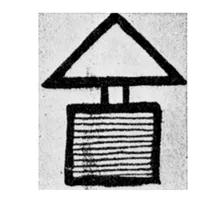
FIG. 1.
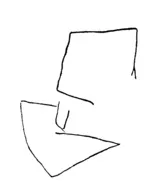
FIG. 2.
At our later sittings I put her into trance with a few passes, as she took such a long time to fall into trance, but got no decisive results.
Discussion of the Results
As we have seen, all the experiments except No. 1 were solved without a single mistake. The main question is: Has fraud played any part in it all? Have any points been neglected which should have influenced a clear judgment on this series of experiments? Are there any illusions or mistakes which play an important part without our being aware of them? Can one or several of these factors explain all our results, or are we obliged to conclude that the information was gained by telepathy or at any rate by some super-sensuous means? The first question is whether the persons taking part in the experiments were reliable. It is generally taken for granted that the experimenters, in this case Wasielewski and I, are trustworthy men, trying their best to obtain reliable data, unless any facts proving the contrary have been brought up against us. Readers with whom we are not personally acquainted can only form an opinion on the subject for themselves by reading our books and other publications. Of course this can never exclude the possibility of objective lack of veracity, i.e. error or deception.
Naturally, I can offer no absolute proof of the trust-worthiness and reliability of Miss von B. But I fancy that the arrangement of the experiments made it almost impossible for Miss von B. to obtain sensuous knowledge of the objects even had she wanted to, and so did away with a great many possible sources of error. But there are other factors which speak strongly against any cause for distrust. The medium was never hypnotized and never fell into trance, which puts unconscious fraud, as it is known in such cases, out of the question. She gave the impression of having sound nerves and a sound mind, without any signs of hysteria. This impression was corroborated by what I heard about her from her relatives, and by what I saw of her later on when she stayed at our house and I at hers. Hysteria would surely have shown itself somewhere. So I think I can safely say that she was not hysterical, and had n...
Table of contents
- Cover
- Title
- Copyright
- INTRODUCTION
- Contents
- PREFACE
- I. INTRODUCTORY
- II. EXPERIMENT
- III. ON THE THEORY OF TELEPATHY AND CLAIRVOYANCE
- IV. CONCLUSION
Trusted by 375,005 students
Access to over 1.5 million titles for a fair monthly price.
Study more efficiently using our study tools.
Frequently asked questions
Yes, you can cancel anytime from the Subscription tab in your account settings on the Perlego website. Your subscription will stay active until the end of your current billing period. Learn how to cancel your subscription
No, books cannot be downloaded as external files, such as PDFs, for use outside of Perlego. However, you can download books within the Perlego app for offline reading on mobile or tablet. Learn how to download books offline
Perlego offers two plans: Essential and Complete
- Essential is ideal for learners and professionals who enjoy exploring a wide range of subjects. Access the Essential Library with 800,000+ trusted titles and best-sellers across business, personal growth, and the humanities. Includes unlimited reading time and Standard Read Aloud voice.
- Complete: Perfect for advanced learners and researchers needing full, unrestricted access. Unlock 1.5M+ books across hundreds of subjects, including academic and specialized titles. The Complete Plan also includes advanced features like Premium Read Aloud and Research Assistant.
We are an online textbook subscription service, where you can get access to an entire online library for less than the price of a single book per month. With over 1.5 million books across 990+ topics, we’ve got you covered! Learn about our mission
Look out for the read-aloud symbol on your next book to see if you can listen to it. The read-aloud tool reads text aloud for you, highlighting the text as it is being read. You can pause it, speed it up and slow it down. Learn more about Read Aloud
Yes! You can use the Perlego app on both iOS and Android devices to read anytime, anywhere — even offline. Perfect for commutes or when you’re on the go.
Please note we cannot support devices running on iOS 13 and Android 7 or earlier. Learn more about using the app
Please note we cannot support devices running on iOS 13 and Android 7 or earlier. Learn more about using the app
Yes, you can access Telepathy and Clairvoyance by Rudolf Tischner,Tischner, Rudolf in PDF and/or ePUB format, as well as other popular books in Médecine & Prestation de soins de santé. We have over 1.5 million books available in our catalogue for you to explore.