- 230 pages
- English
- ePUB (mobile friendly)
- Available on iOS & Android
eBook - ePub
About this book
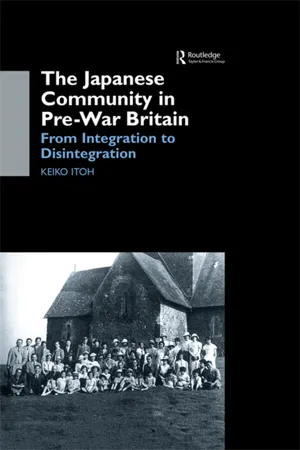
Explores the origins of the community, and compares the experience of the Japanese to that of other national groups. The book discusses the community's involvement in the arts, religion and sport; intermarriage; and the second generation, and concludes by considering the impact of deteriorating relations in the 1930s and of the Second World War.
Information
CHAPTER ONE
The Japanese in Britain
For about four decades after 1866, when foreign travel was finally allowed by the Tokugawa bakufu, the Japanese in Britain consisted mainly of students and government officials. The students were mostly of samurai stock who would return to Japan after their studies abroad to become leaders in government, industry or education. A large portion of government officials were naval engineers and officers, in Britain to supervise the building of Japanese naval vessels in British shipyards. The Japanese population of about 250 was concentrated not only in London, but significantly in Scotland and the Northeast of England. It was only in the first decade of the 1900s that increased Japanese business and banking activities made London the centre of the Japanese community, which became more and more diverse in composition as opportunities for foreign travel, however limited, expanded. By the inter-war period, which this study focuses on, the Japanese in Britain were a diverse group, ranging from acrobats to aristocrats. In numbers, they grew significantly from the earlier years, but never reached more than a total population of 1,800 in a given year. Anywhere between a quarter to half of the population were long-term settlers as opposed to a transient population whose stay in Britain was less than a few years.1 There was never any mass Japanese immigration to Britain or other European countries as there was to the United States and Latin America, where many Japanese from the agricultural prefectures in the south-west of Japan landed. In general, those who came to Britain, as those who went to other American and European cities, were more urban and better educated, who left Japan to pursue business opportunities, or to further their education and training, and in some cases to seek new experiences and fortune. Most arrived intending to stay for a limited period and then to return to their home country, as was the case with many immigrants, regardless of social status, the world over.
The aim of this chapter is to set the scene: for a Japanese who arrived in Britain in the early decades of the 1900s, what kind of an environment awaited him? What was the size and composition of the Japanese community, and what kind of community social groupings were there? The conclusion I reach from the analysis of the data is that, despite the different types and classes of people, the Japanese community in Britain was a cohesive one. The evidence shows a strong presence of the elite among the population steering the whole towards respectability and acceptance within the country that they saw as a model of western advancement and civility.
The receiving environment
Compared to the historical experiences of racial and ethnic minorities in the US, immigrants to Britain enjoyed far more freedom and security. Generally speaking, British society has been admired for its sense of liberty and there has been an equally strong opinion that this quality extends to the history of immigrants and refugees.2 Victorians prided themselves on their open-door policy towards refugees and Britain was thought of as the very cradle of tolerance, particularly towards those groups who were not seen as economic threats to the British. Makino Yoshio (who was known as Yoshio Markino), a Japanese artist, arrived in London in December 1897, after spending four years in San Francisco.3 His own description of his move from the United States to Britain best illustrates the differences of the two respective receiving environments.
As I had been in America previously for four years, naturally I used to compare everything here with that of America; and what great contrast between the two countries – especially to a Japanese! … I ran away from home to San Francisco in July 1893, with a hope to become a poet or a writer in English. All my friends there advised me to become an artist instead, because one cannot master a foreign language. So I entered into Hopkin’s Art College. Of course I was penniless. I had to make a livelihood by washing windows and dishes, or a little better thing, making sets of false teeth for some dentists … I was rather amused with my poor life, but by no means did I feel pleasant with the way those Californians treated me. It is the world-known fact that they hate Japanese. While I have been there four years I never went out to the parks, for I was frightened of those savage people, who threw stones and bricks at me. Even when I was walking on the street the showers of pebbles used to fall upon me often. And I was spat on more occasionally. Of course they were very low-class peoples, but even better-class peoples had not a very nice manner to the Japanese. If I got into tram-car and sat down on an empty seat beside some ladies, they used to glare at me with such disgusting expression, and would get up and go away to find out a seat far away from me.
… After such experiences I was naturally surprised with the cosmopolitan ideas of the Londoners. I started my first sightseeing from Hyde Park and the Green Park and St. James’s Park … I so timidly walked inside the rail. Nobody shouted me. Then I went near the crowds of people with still more fear. Being quite ignorant of the English civilisation I anticipated some pebble-showers every minute. I waited and waited with beating heart, but nothing happened to me at all … Nobody spat on me! ‘Hallo, hallo, what’s matter?’ I said in my heart. ‘Perhaps they don’t know I am a Japanese.’ I took off my hat on purpose to show my black hair. Finally one man pushed me quite accidentally, and he touched his hand to his hat and apologised me very politely.4
Even among the Japanese who had not lived in America before coming to Britain, the English sense of ‘fair play’ and ‘minding one’s own business’ were repeatedly mentioned as aspects of British culture most treasured by the Japanese who lived in Britain in the inter-war years.5 Ishii Itaro, a diplomat who arrived on assignment to the Japanese Embassy in London as a First Secretary in 1927, recalled how mundane his mornings in London were, compared to during his assignment to Washington in the early 1920s.
There were many issues that had to be discussed between Britain and Japan over China, but their positions were so far apart at that stage that there was little diplomatic activity. Work at the Embassy was relegated to an easy daily routine. In the mornings, we divided the task of looking through all the papers to prepare our reporting cables to Japan. From my Washington days, I had been used to a regular dose of ‘morning shocks’ from the daily anti-Japanese articles in the American papers. I almost missed those in London, where there was not a trace of such articles.6
Restrictions on entry into Britain were not imposed until 1905, when, in response to a campaign mounted against the Jews from Russian Poland, the tradition of free entry for aliens was broken in significant fashion. Controls were established over an ‘immigrant ship’, defined as one which carried twenty or more alien steerage passengers and such ships were required to berth at specific immigrant ports. However, immigrants could go before an Appeals Board if objections were raised to their admission and any immigrant who could prove that entry to Britain was being sought to avoid persecution for a political offence was explicitly safeguarded.7 Immigration became further restricted with the 1914 Aliens Act, amended in 1918, which was then reaffirmed and extended in the 1919 Aliens Act. Under this Act, renewed every year until 1971, the Home Secretary was given considerable powers over the entry, movement, residence and deportation of aliens. Entry became dependent upon the discretion of an immigration officer, and once aliens took up residence, restrictions were imposed on employment in the civil service and armed forces.8 For the Japanese arriving in Britain, however, such restrictions were minor compared to those imposed by the US authorities.9
Among the British public, there was a strand of admiration for Japan in the years before 1914. Between 1894 and 1905, Japan achieved spectacular military successes against China and Russia. She also emerged among the victors in the First World War, having declared war on Germany in August 1914, under the terms of the Anglo-Japanese Alliance. Among military circles within Britain, and curiously, Fabian Socialist intellectuals, there was fascination with Japan’s swift emergence as the most powerful nation in East Asia, and a number of books and editorials appeared on bushido, the samurai code of ethics.10 Beatrice Webb wrote in her diary in 1904 that Japan was ‘a rising star of human self control and enlightenment’,11 and the Webbs became absorbed in the cult of Japan and wrote about the country in particularly glowing terms at the time of their visit to the Far East in 1911. Moreover, the revision of the unequal treaties, and the signing of the Anglo-Japanese Alliance in 1902, entered into on a basis of equality, recognised the international status of Japan among nations and marked the beginning of a special relationship with Britain.
At the same time, however, Britain was not immune from the concept of the ‘Yellow Peril’, the fear of future Asian dominance, which emerged in the late 19th century in America, Australia and Europe. In Britain this fear was further spurned by the 1900 Boxer Rebellion as well as the Japanese victory in the Russo-Japanese war of 1904–5. While Japan’s victory was generally admired, it also created anxiety in some quarters over the prospect of invasion by the hordes of Asia, possibly organised by Japan, particularly as the level of fertility among the Chinese was contemplated. It was quite possible to hold this fear alongside an admiration of Japanese efficiency.12 The protestations and foreboding for the future, however, were a minority view in Britain. The general atmosphere was one of admiration for the Japanese, not only for their valour but also for their magnanimity, in view of Japan’s decision not to demand an indemnity. Generally speaking, the Japanese received much more favourable treatment than would appear to have been meted out to most other non-western peoples.13
For example, although the Chinese in Britain were numerically insignificant in the years before World War I, with a population of 207 in 1871, which increased to 1,319 by 1911, fear of the Chinese as a source of cheap labour was undoubtedly present in Britain in the late 19th century.14 With the increasing recruitment of Chinese into the shipping industry, it was from among seamen that the fiercest and most persistent hostility developed. Beyond the labour market, allegations emerged regarding sexual behaviour among the Chinese.15 In short, despite their numerical insignificance, the Chinese were not immune from hostility, or even from violence, as evidenced in 1911, when, in a night of rioting, all of Cardiff’s thirty or so Chinese laundries were destroyed.16 It was to a large extent the easily identifiable and different looking character of the Chinese, combined with their exotic habits of opium taking and reported sexual encounters with underage white girls that drew public attention.
As for the Japanese, although their numbers were somewhat smaller than the Chinese, in 1911 there were as many as 594 Japanese in Britain. However, even though the Japanese were physically as alien looking as the Chinese to British eyes, they seemed to have escaped overt prejudice.17
Japanese population trends in Britain
Among the earlier arrivals from Japan to Britain were: two young Japanese Christian converts, known as Christopher and Cosmos, who arrived in Thomas Cavendish’s Globe in 1587; a group of about eleven sailors who arrived with Captain John Saris of the East India Company in 1614; a young boy from a Japanese mother and British father called Uriemon, known as William Eaton, who became a denizen of England in 1639 after studying at Trinity College, Cambridge; and Otokichi, who landed in London in 1835 from a shipwreck.18 These accidental arrivals took place during Japan’s 250 years of seclusion under the Edo bakufu’ss sakoku (closed country) policy. The first intentional travels abroad were initially in the form of bakufu missions, followed by bakufu students and other students sent from individual han. In the years before 1866 when overseas travel was still illegal, a group of five students from Choshu arrived in London in 1863, followed by a group of 19 students from Satsuma in 1865.19 A wave of travel abroad came with the end of the ban and introduction of passports, especially in 1867 for the international exhibition in Paris.20 A more systematic flow of Japanese to Britain, however, began after the Meiji Restoration in 1868 when the new government embarked on the policy of catching up with the West. Officials and students were sent abroad by the government, and private Japanese also travelled overseas for observation and education. As many as 350 students were sent to the West under government sponsorship in the years 1871–3, one third of whom came to Britain.21 In 1875, the Meiji government authorised the first of a number of shipbuilding programmes which led to an increased Japanese presence in the Northeast of Britain. The majority of the first Japanese who came were from the nobility and upper classes with a view of returning to Japan after their period of training.
According to the official records of the Imperial Japanese Yearbook,22 the number of Japanese nationals in Britain between 1911 and 1937 were as follows:

While one can question the accuracy of some of these figures,23 generally speaking, the number of Japanese increased immediately following the end of the First World War, and remained on average somewhere between 1000 and 1500, with the exception of a few years in the late 1920s and an all time high of over 1800 in 1935. The reason for the decline in numbers in the second half of the 1920s is most likely an economic one. The Great Kanto Earthquake which hit Tokyo Bay on 1 September 1923 resulted in over one hundred thousand deaths and destruction of assets worth about 38 per cent of Japan’s national income of 1923. The economic consequences of the earthquake contributed to the Japanese banking collapse of 1927.
Japanese companies with branch offices in London were inevitably affected by these economic trends, the most prominent example being the collapse in April 1927 of Suzuki Shoten, which was until then Japan’s third largest trading company.24 Suzuki employees and their families based in London were immediately recalled to Japan, although, as we shall later see, some opted to remain in Britain.
The proportion of females in relation to males remained consistently low during the 1920s, at between 10 to 20 per cent, and increased in the 1930s, up to as high as 50 per cent. This is not necessarily because more Japanese women were arriving in Britain, which was the case in the United States where Japanese ‘picture brides’ arrived en masse, but because Japanese men were marrying Englishwomen, who would a...
Table of contents
- Cover
- Halftitle
- Title
- Copyright
- Contents
- List of Illustrations
- Preface
- Acknowledgements
- Note on Japanese Names
- Introduction
- Chapter 1 The Japanese in Britain
- Chapter 2 Japanese ‘Expatriate’ Businesses in Britain
- Chapter 3 The ‘Independent’ Smaller Japanese Businesses
- Chapter 4 Marriage
- Chapter 5 The Arts, Sports and Religion
- Chapter 6 Childhood
- Chapter 7 Epilogue
- Appendices
- Notes
- Bibliography
- Index
Trusted by 375,005 students
Access to over 1.5 million titles for a fair monthly price.
Study more efficiently using our study tools.
Frequently asked questions
Yes, you can cancel anytime from the Subscription tab in your account settings on the Perlego website. Your subscription will stay active until the end of your current billing period. Learn how to cancel your subscription
No, books cannot be downloaded as external files, such as PDFs, for use outside of Perlego. However, you can download books within the Perlego app for offline reading on mobile or tablet. Learn how to download books offline
Perlego offers two plans: Essential and Complete
- Essential is ideal for learners and professionals who enjoy exploring a wide range of subjects. Access the Essential Library with 800,000+ trusted titles and best-sellers across business, personal growth, and the humanities. Includes unlimited reading time and Standard Read Aloud voice.
- Complete: Perfect for advanced learners and researchers needing full, unrestricted access. Unlock 1.5M+ books across hundreds of subjects, including academic and specialized titles. The Complete Plan also includes advanced features like Premium Read Aloud and Research Assistant.
We are an online textbook subscription service, where you can get access to an entire online library for less than the price of a single book per month. With over 1.5 million books across 990+ topics, we’ve got you covered! Learn about our mission
Look out for the read-aloud symbol on your next book to see if you can listen to it. The read-aloud tool reads text aloud for you, highlighting the text as it is being read. You can pause it, speed it up and slow it down. Learn more about Read Aloud
Yes! You can use the Perlego app on both iOS and Android devices to read anytime, anywhere — even offline. Perfect for commutes or when you’re on the go.
Please note we cannot support devices running on iOS 13 and Android 7 or earlier. Learn more about using the app
Please note we cannot support devices running on iOS 13 and Android 7 or earlier. Learn more about using the app
Yes, you can access The Japanese Community in Pre-War Britain by Keiko Itoh in PDF and/or ePUB format, as well as other popular books in Social Sciences & Ethnic Studies. We have over 1.5 million books available in our catalogue for you to explore.