- 166 pages
- English
- ePUB (mobile friendly)
- Available on iOS & Android
eBook - ePub
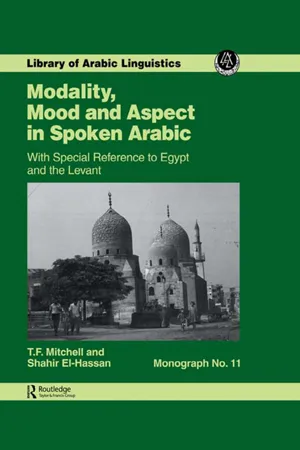
Modality, Mood and Aspect in Spoken Arabic
About this book
First published in 1995. Part of the library of Arabic Linguistics series which devotes itself to all issues of Arabic linguistics in all its manifestations on both the theoretical and applied levels. The results of these studies will also be of use in the field of linguistics in general, as well as related subjects. This book is Monography 11 and looks at modality, mood and aspect in spoken Arabic with special reference to Egypt and the Levant.
Information
1 Introduction
1.1 Background
We take the view expressed in Labov (1973) that “the competence of the native speaker reaches far beyond the dialect he uses himself”. Adult speakers of a certain language variety are capable of understanding and, to a lesser extent, imitating the utterances of speakers of varieties (/lects) other than their own. We also subscribe to a variationist approach to language study. Any definitive grammar, or part thereof, must take cognizance of variation as a salient feature of language, but to date scarcely any grammar of any language has systematically done so. There are many grammars of contemporary English, for instance, but even the most detailed and comprehensive of them cannot claim to account for the variability attested in English, even if definition of the language is so limited as to subsume only varieties used in the UK and USA.
Educated Spoken Arabic (ESA) is a form of conversational Arabic used by educated speakers from one or more Arab countries. The first attempt at the systematic study of this variety was made in the late 1970s - early 1980s in the Department of Linguistics and Phonetics of the University of Leeds, with the support of the British Social Science Research Council. The authors were members of the research team, together with the late Professor M.H. Ibrahim, Dr A-M Sallam, Dr A.R. Alsayed and Mr D. Barber. The countries represented by the Arab research fellows were Egypt, Jordan, Palestine and Syria. A fairly representative corpus of ESA consisting of unscripted, extempore conversations and discussions spanning a variety of topics, settings, and role relations was collected by the research fellows in Egypt, Jordan, Kuwait, Lebanon and Syria. The speakers were all educated Arabs, young men and women from a wide range of occupational groups. They were encouraged to speak as freely as they desired, and, more often than not, were aware that the conversation was being recorded. The task had its problems both of a technical kind and those having to do with elicitation techniques conducive to the accumulation of a natural and unconscious flow of spontaneous speech. In any case, no language corpus is ever complete and recourse was also had to such other sources as radio talks, discussions and debates which were known to be unscripted. In addition, the help of numerous further informants was sought, primarily among graduate Arab students at the University of Leeds, for the purposes of checking and validating on the one hand, and on the other for the elicitation of specific and more structured examples. The intuitions of the Arab research fellows also formed part of the data on which this work was based. Finally, use was made of any published work pertaining to the area of study.
The attempt to study ESA was motivated by an awareness on the part of the researchers of its existence as a highly significant form of spoken Arabic whose grammar is largely shared by Egypt and the countries of the Levant. To demonstrate the fact of mostly shared usage, at least within such specifiable regions, material has been deliberately selected from informal educated speech for two main reasons. First, serious divergence among speakers might prima facie be expected in speech closer to vernacular Arabic. Second, the grammar and semantics of modality, mood, and aspect are such as to require the use of material predominantly, though not exclusively, drawn from the mother-tongue end of the stylistic spectrum of conversation, whereas other topics, for example that of sentence structure, may equally appeal to features that occur in the written language. Moreover, the functional uses of stylistically informal categories, the “ethical dative”, for example, are also largely shared, and to proscribe them, as influential Arab agencies tend to do, would serve simply to impoverish educated speech. From a regional standpoint, the decision was expressly taken to concentrate on the “middle region” of the Arab world, in which the habit of crossing areal boundaries is long established. We are convinced that the polylectal approach we have adopted is justifiable as a coherent descriptive device that treats ESA as a single entity and accounts for a great deal of its characteristic variability. Regional differences are lexical (and phonological) before they are grammatical. In the very rare case of substantial grammatical difference, and the even rarer case of entailed unintelligibility among speakers, we have drawn attention to specific facts of regional divergence. Otherwise, the grammar pertains to the linguistic competence of speakers from the whole region, yet allows for the expression of local linguistic loyalty. Space has precluded us from providing paradigms, for example of the tenses, representative of informal usage in the several countries involved as well as of formal usage over-all. Such differences are explained where necessary for the reader but do not give rise to problems of comprehension among Levantine and Egyptian speakers.
1.2 Style and related matters
Relaxed conversation is not conducted in the language of books or newspapers, though the written language contributes powerfully to the lexical resources of ESA. The language of a literate society comprises two distinct, complementary norms, written and spoken, and the forms of interaction between them. The Arabic written norm is strongly institutionalized, but authoritative grammars and dictionaries of educated speech are wholly lacking and urgently needed. ESA, both within and across national boundaries, is a mixture of the shared written language and regionally varied vernaculars or mother-tongues. This mixture involves variation which can be described in terms of three stylistic grades as well as of regional distinctions. The stylistic categories recognized are Formal (F), which draws notably on the written language, Informal (-F), closer to a given regional vernacular, and a middle, often hybrid grade. The last two may where necessary be symbolized -Fb and -Fa. Excluded from ESA, therefore, are, on the one hand, stigmatized and stridently local features and forms, and, on the other, the high-flown Arabic appropriate to reading aloud, otherwise termed “spoken prose”. The small measure of overlap which occurs at the ends of the ESA stylistic spectrum between F and HF (high-flown), and between -Fb and a given vernacular, is to be expected in a situation where institutional crystallization in the form of “law-giving” texts is awaited. Moreover, overlap at borderlines is necessary in order to cater for the inherent variability of language and its users. We do not in this book set out to explore the stylistic distinctions of ESA, but have dealt with the topic at some length in other work cited in the bibliography.
Educated speech within and across borders feeds off the written language and helps to create and maintain a supraregional standard, but the latter cannot remain artificial, unintelligible to and unusable by all save the initiated few. ESA constantly oscillates between written and vernacular Arabic and written-vernacular hybridization. Any comprehensive standard must remain in touch with varieties of the living, orally developed and developing language. The interaction and intermingling of written and (unstigmatized) vernacular should be positively encouraged, for each needs and should feed off the other for optimal communicativeness. It is a two-way matter, and this is far from always understood. It is not a question of a supposed inarticulateness of speech, closely bound as it is to the needs of immediacy and the physical conditions of its production and perception, as opposed to the more leisurely, “thoughtful” nature of its written counterpart. It is rather a matter of the flexibility and variability that are inherently characteristic of all language and that are assured in substantial measure by the constant interplay of written and spoken manifestations of language in a literate society. It would be unrealistic, even insensitive to believe that the restricted variety of “spoken prose” can serve more than a limited number of the educated Arab’s spoken needs. These are, in fact, mostly met by ESA, the norms of which are sui generis. At the same time, shared knowledge of the institutionalized written language facilitates communication within and across national frontiers. As educated spoken Arabic needs a vernacular base, so it must also have a written “superstructure”.
It will be seen, nevertheless, that the notion of diglossia does not provide an adequate descriptive framework for ESA. It has to be seen rather as a first approximation to a statement of the distribution of varieties of Arabic among a set of language functions, and it is not, therefore, strictly germane to the needs of grammar writing. It is not possible for the grammarian, concerned as he is with, let us say, the categories of morphological analysis or with such grammatical categories as complementation, tense, aspect, modality, gender, number, person, and the like, to cater for the infinite number of sociolinguistic factors - speaker relationships, settings, etc. - that conduce to the choice of this style or that. Nevertheless, research clearly shows that, at least as far as Arabic is concerned, it is not only possible but imperative, if the needs of adequate description are to be met, to present grammatical analysis in relation to an accompanying framework of stylistic-cum-regional variation. One should not allow oneself to be put off by any fuzziness of stylistic boundaries or by disagreements over what should go here and what there; the usual run of grammatical rules is, in truth, no clearer. If he agrees that syntax and semantics are mutually defining and refining, then the grammarian does well to reflect that leaks are all too easily discernible in any of his supposedly watertight rules. In this book, therefore, answers given to certain problems of ESA grammar will doubtless not be definitive, but no linguistic theory or description yet has been. This is hardly surprising in the case of Arabic, not only from the nature of the subject matter itself, but also in the present total absence of institutionalized grammars and dictionaries of ESA, in the continuing circumstance of hostility in influential circles towards its systematic study, and in the light of the extreme difficulty found in organizing relevant research. On the last question, it might be said in conclusion that, if experience on the Leeds project is anything to go by, then to bring and retain five appropriately qualified post-doctoral researchers together over a period of years devoted to the study of their own Arabic speech, is a total impossibility. Perhaps the Arab countries in situ will one day themselves oblige and thereby oblige themselves.
1.3 The verb phrase in brief
Since the book is concerned with what we consider to be the most interesting features of the verb phrase (VP), it seems appropriate that we should summarize the main constituents of the VP and at the same time take the opportunity to introduce terms which may be unfamiliar to some readers. Relevant aspects of the morpho-syntactic categories of the verb: voice, tense, mood, and aspect, are dealt with under Chapters 2 and 3 below. The principal constituents of the VP, whose treatment is expanded individually in later sections, are as follows:
1.3.1 Verbs “proper”, which are the only essential constituents of VP. A VP must consist of a minimum of one verb, and conversely one verb is a sufficient constituent of VP. So-called “verbless sentences” are regarded as containing a “deleted” copula and are not, therefore, exceptional. The VP may contain more than one verb. In such a sentence as -F E biyhaawil yittiSil biina “He is trying to contact us”, the second verb (yittiSil) and following elements are regarded as “embedded” sentences and the preceding verb as “matrix”. Embedded sentences are often introduced (as complements) by the complementizer ’inn (F/HF ’an), as in -F E xaafit ’innu(h) yiktišif issirr “she was afraid that he might discover the secret”. Other sequential types are discussed at 2.10-11 and under 3. See also 1.3.4 below.
1.3.2 Verbal particles, which are exclusively associated with verb forms, e.g. °am in -F Lev (’i)lmαyya °amtižri “The water is running” or qαd in F qαd najaḥat kull il °amaliyyaat “All the operations have been completely successful”. Verbal particles include the modal and aspectual particles which are dealt with at length subsequently, and also negative particles like the informal maa (Lev), ma -š (EJ), miš (E), and the HF laa, lam, and Ian, which occur at times in F-style ESA. Particles of command/request like yαllα in -F E yαllα nruuh “Let’s go” also belong under this heading.
1.3.3 Pre-verbal elements, which, occurring before verb forms, are illustrated by the modal elements laazim, °aayiz, bidd-, etc. which are accounted for at length below. Pre-verbal elements precede any verbal particles and the most frequent of them are variously participial or nominal in form.
1.3.4 Complements of the verb, which are structural elements whose omission renders the sentence incomplete or unacceptable. It is possible to base a classification of verbs (intransitive, copular, mono-transitive, di-transitive, catenative, etc.) on the forms of their appropriate complementation, but a classification will not be attempted here. Examples of complements are min kalaam ilžiiraan and salwa mudarrisa in -F Lev °aayziin nixlαS min kalaam ilziiraan “We want to be rid of the neighbours’ gossip” and -F E ’ilwaziir °ayyin salwa mudarrisa “The minister appointed Salwa as a teacher”. °aayziin nixlαS and ’ilwaziir °ayyin are incomplete and usable only elliptically.
Complements are of several kinds and include, for example, predicative complements in sentences containing copular verbs, so that, e.g., the predicative adjective °αTšααn is complementary in -F E ’ilkalbi kaan °αTšααn “The dog was thirsty”; and object complements like the direct object ilbaab in fataḥ ilbaab “He opened the door”. The complement may be an embedded sentence, e.g. TTαqs itġαyyαr as part of innu(h) TTαqs itġαyyαr in -F J lααḥαĐt innu(h) TTαqs itgαyyαr “I noticed that the weather (had) changed”. (This is, in fact, again an object complement and ’inn marks the nominal nature of the following sentence. Elsewhere, sentences of this kind may occur as subjects of the including or matrix sentence, as in -F E yis °idni ’inni baštaġal ma °aaki “I am pleased to be working with you (s.f.)”; lit. (It) pleases me that I am working with you.) With the sensory verb simi°/yisma° “to hear” and others of the type, ’inn marks “hearsay” in contrast with direct aural perception, but the sentence remainders after simi °t are both object complements in e.g. -F E simi °tu(h) yimši “I heard him walking along” and simi °t innu(h) saafir “I heard he had gone”.
Complement types are subdivisible in several ways. Predicative complements, for example, are mostly subdivisible in accordance with grammatical type and include adjectival (as °αTšααn above), nominal (e.g. Tαbiib in ‘axuu(h) Sααr Tαbiib “His brother became a doctor”), verbal (e.g. yiḥki °arαbi in Dirααr Dαll yiḥki °arαbi “Dirar went on talking Arabic”), prepositional phrasal (e.g. fii maktabu(h) in Lev maa kaan fli maktabu(h) “He wasn’t in his office”), locative in space and time (e.g. hinaak in -F E ‘il’ustaaz kan hinaak “The teacher was there”), sentential (e.g. lxamiis w ijjum °a mawsim ’α °rααS in -F J ’issabab ittaani ’innu(h) lxamiis w ijjum °a mawsim ’α °rααS “The second reason (is) that Thursday and Friday (are) wedding days). Embedded sentences, for their part, are subdivisible in accordance with such factors as the admissibility, inadmissibility, or optionality of a complementizer, especially ’inn, with a preceding catenative verb. Catenative verbs are those which are complemented by a VP, variously tensed (past or nonpast) or nominalized (as verbal noun). A verb is catenative in relation to a following verb, which in turn is catenated in relation to the catenative. More than one catenative may co-occur, as in -F E ḥaawil yi’uum yimši “He tried (ḥaawil) to stand (yi’uum) and walk (yimši)”, -F J maa ’idrat tiqin °u(h) yġayyir taxαSSαSu(h) “She couldn’t (maa ‘idrat) persuade him (tiqin °u(h)) to change (yġayyir) his specialism”, -F Lev E kunt aḥibb aruuḥ ažlis hinaak “I used to (kunt) like (aḥibb) to go (aruuḥ) and sit (ažlis) there”. An example of catenated VN is ḥaawil kitaaba “He tried writing” (cf. ḥaawil yiktib “He tried to write”). Not all catenatives permit the catenated verb to appear in its nominalized form. For example, catenative (-copular-aspectual) Dαll/y(i)Dill “to continue, carry on (doing s.t.)” occurs only with a catenated verb in the non-past tense, e.g. Dαll yiktib “He carried on writing”. Subdivision of catenatives is possible on the basis of the admissible forms of accompanying catenated verbs, but, once again, our purpose will not be served by undertaking such classification here. (See 2.10-11 and Appendix B.)
Note: Catenation should not be equated with asyndetic sequence like that of ruḥt and ’abilt in e.g. -F E fa ruḥtɨ ’abiltɨ nyaazi muSTαfα “So I went and met Niazi Mustafa”, where the verbs may optionally be separated by the co-ordinator wi/wa “and”. Imperative clusters like -F E xud išrab “Take (it and) drink (it)!” are likewise examples of coordination, not of catenation.
1.3.5 Adjuncts Complements should be distinguished from adjuncts, an adverbial subclass, which are in general omissible without prejudice to the completeness of the sentence. The direct object ilbaab in the earlier fataḥ ilbaab “He opened the door” and reciprocal bα °D in ’iššaḥḥa(a)tiin by(i)krαhu bα °D “Beggars hate one another” are both complements and contrast as to their inomissibility with the indirect object ilfa’iir in -F E ‘iddeet ilfa’iir ginee(h) “I gave the poor man a pound”, with the cognate object Dαrb in -F E Dαrαbu(h) Dαrbɨ gaamid “He beat him severely” (lit. he beat him a severe beating), and with the specifying object zeetuun in the case of the di- or doubly transitive verb in -F Lev °amyizra °u l’αrD zeetuun “They are planting the land (with) olives”. Adjuncts often correspond to the traditional adverbial divisions of time, place, manner, purpose, cause, etc. They are subject to some positional constraints, sometimes in relation one to another when more than one co-occur, and whether or not it is wished to topicalize or highlight one of them. We cannot go into details here. Suffice it to say that, for example, the sentential type usually occurs after other types, as lamma kaanu Tullααb “when they were students” in °aašu fi sa °aada taamma (manner-adjunct) fi ngiltira (place-adjunct) lamma kaanu Tullααb (time-adjunct) “They lived completely happily in England when they were students”. Unlike other types, manner-adjuncts seem to resist topicalization, so that, for example, fi sa °aada taamma may not be front-shifted in the preceding sentence. Thoroughgoing analysis would, of course, require far higher specification than can be attempted here.
2 Modality and Mood1
2.1 Introductory
2.1.1 Sentence-facets
Sentences are commonly thought to comprise three components, the propositional, the functional, and the expressive, though the terms are by ...
Table of contents
- Cover
- Halftitle
- Title
- Copyright
- Editor’s Note
- Contents
- Preface
- Acknowledgement
- Transcription
- Abbreviations
- Note on style
- 1 Introduction
- 2 Modality and Mood
- 3 Aspect with some further reference to tense
- Appendix A The “ethic(al) dative”
- Appendix B Catenation
- Bibliography
- Index
Trusted by 375,005 students
Access to over 1.5 million titles for a fair monthly price.
Study more efficiently using our study tools.
Frequently asked questions
Yes, you can cancel anytime from the Subscription tab in your account settings on the Perlego website. Your subscription will stay active until the end of your current billing period. Learn how to cancel your subscription
No, books cannot be downloaded as external files, such as PDFs, for use outside of Perlego. However, you can download books within the Perlego app for offline reading on mobile or tablet. Learn how to download books offline
Perlego offers two plans: Essential and Complete
- Essential is ideal for learners and professionals who enjoy exploring a wide range of subjects. Access the Essential Library with 800,000+ trusted titles and best-sellers across business, personal growth, and the humanities. Includes unlimited reading time and Standard Read Aloud voice.
- Complete: Perfect for advanced learners and researchers needing full, unrestricted access. Unlock 1.5M+ books across hundreds of subjects, including academic and specialized titles. The Complete Plan also includes advanced features like Premium Read Aloud and Research Assistant.
We are an online textbook subscription service, where you can get access to an entire online library for less than the price of a single book per month. With over 1.5 million books across 990+ topics, we’ve got you covered! Learn about our mission
Look out for the read-aloud symbol on your next book to see if you can listen to it. The read-aloud tool reads text aloud for you, highlighting the text as it is being read. You can pause it, speed it up and slow it down. Learn more about Read Aloud
Yes! You can use the Perlego app on both iOS and Android devices to read anytime, anywhere — even offline. Perfect for commutes or when you’re on the go.
Please note we cannot support devices running on iOS 13 and Android 7 or earlier. Learn more about using the app
Please note we cannot support devices running on iOS 13 and Android 7 or earlier. Learn more about using the app
Yes, you can access Modality, Mood and Aspect in Spoken Arabic by Mitchell,T.F. Mitchell,S.A. ai-Hassan in PDF and/or ePUB format, as well as other popular books in Social Sciences & Anthropology. We have over 1.5 million books available in our catalogue for you to explore.