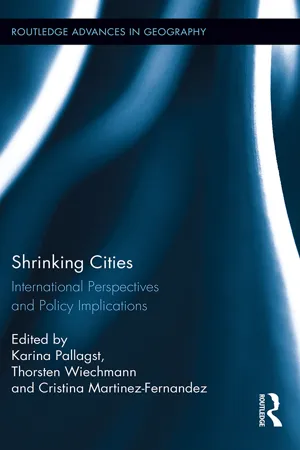
The shrinking city phenomenon is a multidimensional process that affects cities, parts of cities or metropolitan areas around the world that have experienced dramatic decline in their economic and social bases. Shrinkage is not a new phenomenon in the study of cities. However, shrinking cities lack the precision of systemic analysis where other factors now at work are analyzed: the new economy, globalization, aging population (a new population transition) and other factors related to the search for quality of life or a safer environment. This volume places shrinking cities in a global perspective, setting the context for in-depth case studies of cities within Mexico, Brazil, Indonesia, Germany, France, Great Britain, South Korea, Australia, and the USA, which consider specific economic, social, environmental, cultural and land-use issues.
eBook - ePub
Shrinking Cities
International Perspectives and Policy Implications
- 318 pages
- English
- ePUB (mobile friendly)
- Available on iOS & Android
eBook - ePub
Shrinking Cities
International Perspectives and Policy Implications
About this book
Information
Part I
Shrinkage in a Global Perspective
1 Introduction
Shrinking Cities: An Emerging Planning Phenomenon
When investigating shrinking cities, one encounters manifold striking loose ends regarding what the shrinkage of cities or regions means: is it a taboo, a planning paradigm, a research agenda, a justification for bulldozing abandoned quarters or “old wine in new bottles”? There is meanwhile consensus that urban shrinkage is a multidimensional phenomenon encompassing regions, cities and parts of cities or metropolitan areas that are experiencing a dramatic decline in their economic and social bases and are facing population losses. The causes of this urban decline are complex, but in many ways they can be understood as socio-spatial manifestations of the forces of globalization (Pallagst 2007; Martinez-Fernandez et al. 2012).
In most cases, also the ones dealt with in this book, urban shrinkage is considered to be the effect of economic decline. Marked by a loss of employment opportunities and the attendant out-migration of population, many shrinking cities have suffered from the postindustrial shift from manufacturing to service industries (e.g., Pittsburgh, Saint Louis and Manchester). Other factors contributing to this decline are the transformations in the high-tech sector (e.g., the collapse of the dot-com industry in California) and economic changes wrought by the dissolution of socialist systems (e.g., in East Germany). In recent years, the global economic crisis has proven to accelerate shrinkage processes and bring new cities on the agenda of shrinkage. There are nevertheless various types of shrinking cities depending on the causes of shrinkage. Table 1.1 illustrates these factors.
Table 1.1 Types of Shrinkage

Source: SCiRN research, unpublished.
These processes, among others, have drained essential investment and resources from many urban areas, leaving the remaining cities with a diminishing fiscal base (Pallagst 2007).
Despite the fact that the economic impacts of globalization have a strong influence in producing shrinking cities, economic transformations do not affect all cities and countries in the same way. On the contrary, shrinkage can show very different characteristics depending on national, regional and local contexts (Wiechmann 2003; Oswalt 2006; Cunningham-Sabot and Fol 2007; Baron et al. 2010; Wiechmann and Pallagst 2012).
What adds to the complexity of the shrinkage discourse is that there is no clear definition of shrinking cities, but rather a range of various interpretations of the phenomenon. Brandstetter et al. (2005) detect a wide spectrum of definitions, ranging from a natural growth-opposing process to decline with negative implications. Combining previous approaches, they further speculate that urban shrinkage is a cyclical process, embedded in a broader context of growing and shrinking.
In fact, German planners are the forerunners of the current shrinking cities debate. However, for the most part, these discussions take place in German and are centered on a German epistemic community, with little or no links to other countries’ scholars. Problem solving within national boundaries is typical for the shrinking cities debate—and perhaps also for planning in general.
Complexities, uncertainties and even contradictions are high for shrinking cites when it comes to regarding the ways forward. Why is that so? Shrinking cities today are facing numerous problems, and these cities appear in various stalemate or downward-spiral situations. It is thus not surprising that shrinkage has grown as a body of research in recent years. Reckien and Martinez-Fernandez, for example, mention that “the need of planning for growth is parallel to the need of planning for shrinkage” (2011: 1390). In their typology of shrinkage, they notice a large variety of “spatial mismatches” that are hindering the prosperity or turnaround of shrinking cites, ranging from education mismatches to investment mismatches. Bontje and Musterd (2012) argue in the same direction when hinting at perceived “losses” shrinking cities have to face apart from the obvious losses in population.
But these downswing processes are more complex and need to be viewed from various angles: Hoekveld (2012), for example, observes that shrinkage does not happen in a linear pattern, but in line with regional trajectories, most often in circular motions and loops. In this shrinking cities roller coaster it is yet unclear why some cities manage a successful turnaround while others remain in full swing downward. Usual suspects in this respect are Detroit, which lost 25 percent of her population between censuses 2000 and 2010 because of the economic crisis (US Census data), while Bilbao managed to become a role model for cities rising as phoenixes from the ashes (Power et al. 2010). Within the urban fabric the picture is even more differentiated as it seems to be common that some urban areas are prospering and others remain in decline (Rink et al. 2012). One might argue that urban policies of the past are to blame. Cheshire (2006) investigated common policy routes of urban development in order for cities to become resurgent or robust. He applies a critical view of common policies and pleas for further investigating the true implications of policies for cities. There is consensus that when it comes to a city’s quality of life, much is at stake and many planning decisions of the past seem like a trial-and-error mode.
What does this mean for planners and policy makers? Campbell (1996) notices that in communities that are poor, resource dependent and jeopardized by shrinkage, it is unlikely difficult to juggle the demands of justice, growth and the environment. According to Campbell (1996) in these communities exists mistrust in environmental protection, and the threat of making no-win decisions in favor of short-term economic growth are high. Nevertheless, green infrastructure and right-sizing shrinking cites are viable options for shrinking cites today (Schilling and Logan 2008). Thus conflicts and the need to make the “right” decisions lie at hand for shrinking cities.
There is, however, slight evidence that shrinking cites are not only to be perceived as negative. On the contrary, despite the harsh realities of unemployment and threats of cutting down services, life satisfaction is apparently high in shrinking cities (Delken 2008), and “people can live happily in shrinking cities” (Delken 2008: 217).
Capitalizing on the positive aspects of shrinkage seems inevitable, because it is more than apparent for urban development that “shrinkage has become common in urban Europe, and is likely to continue into the future” (Rink et al. 2012: 162).
An International Shrinking Cities— Discourse on the Rise
While there is an extensive planning debate in some European countries about shrinking cities, the phenomenon has for many years been overlooked in international comparative research. Nevertheless, a comparative viewpoint is essential to shrinking cities research because the phenomenon of shrinking can be seen all over the world, albeit within different cultural and socioeconomic settings.
In order to fill this eminent gap in planning-related knowledge and expertise, an international team of researchers under the aegis of the Shrinking Cities International Research Network (SCiRN) is taking the lead of scholarly research work on shrinking cities in an international perspective. This multinational/multidisciplinary team of urban planners, architects, geographers, transportation engineers, sociologists, policy analysts and practitioners is scrutinizing experiences and case studies from the US, Canada, Mexico, Brazil, Germany, France, United Kingdom, South Korea, China, Japan and Australia.
SCiRN defines a shrinking city, for its specific research focus more precisely, as a densely populated urban area with a minimum population of ten thousand residents that has faced population losses in large parts for more than two years and is undergoing economic transformations with some symptoms of a structural crisis (Wiechmann 2008). SCiRN, whose research is presented in this book, is determined to trace different patterns of shrinkage and respective solutions in order to offer guidelines for cities’ revitalization efforts all over the globe.
Preliminary research questions to be presented here—albeit through different lenses—are:
- What are the different effects of city shrinkage on demographics, economics, social life and urban form?
- What urban and regional policies, programs and strategies have been successful in addressing the problem of shrinking cities?
- What are the respective roles of public and private initiatives? How can they be coordinated? Who are the key players in the redevelopment process of shrinking cities?
- What are the key factors linking globalization and city shrinkage? Can successful approaches be generalized or are they locally/regionally specific?
- Which assumptions, concepts, values and practices of planning and development need revision in view of the shrinking cities phenomena? Is there a need for a new vision and a shift in paradigm for urban and regional planning and growth?
- What are the policy implications of shrinking cities for urban and regional development? What are the respective roles of local, regional and national policies and programs?
The international discussion on shrinking cities is still an ongoing process. However, a first comparison reveals a multitude of similarities and differences ranging from midrange theories of changing growth paradigms to the mere pattern of shrinkage. Whatever the diverse picture of shrinkage may look like, this networked research will be vital in redefining land policy and regional governance for the international planning debate.
In this book, the SCiRN definition of shrinking cities and the negative effects of globalization serve as cross-cultural concepts or parallels in the research work. The analytical framework of the shrinking cities project is empirically based on case study analysis. The main purpose is to understand different types of city shrinkage and the role that different approaches, policies and strategies have in the regeneration of shrinking cities. In this way, case studies will inform both a rich diversity of analytical perspectives and country-based study of the challenges faced by shrinking cities.
Cases Presented in this Book
This volume offers a varied yet coherent collection of case studies on shrinking cities in eleven countries in America, Asia, Australia and Europe. The single case studies depart from different theoretical perspectives on shrinkage and the causes as well as the effects of shrinkage differ widely. However, before the focus is on cases, the contribution by Cunningham-Sabot, Audirac, Fol and Martinez-Fernandez offers a reflection on theoretical approaches to “shrinking cities.” The chapter identifies the multidimensional and interrelated driving forces shaping the shrinking cities global phenomenon and analyzes its multifaceted effects. It foregrounds various theoretical explanations of shrinking cities from the “traditional” explanations of urban decline to the more recent approaches of globalization and “glocalization.” It is argued that the term “shrinking cities” is not simply a new “wrapping” for a long-known phenomenon in urban history; rather, it connotes an urban process that is, at least in part, new in its foundation, spatial manifestations and social, economic and environmental implications. Consequently, the new urban reality would have to be addressed with new approaches.
The second part of the book offers a selection of case studies on urban change and the role of shrinkage in five continents. Chapters 3 to 5 deal with the historical development and recent transformation processes in the United States of America. Beauregard examines shrinking cities in a historical perspective. His contribution documents the prevalence, severity, persistence and regional incidence of urban population loss from the fifty largest US cities by population for every decade from 1790 to 2000. The historical trajectory suggests three periods: one encompassing the widespread urban growth that occurred between 1820 and 1920, the second capturing the extensive urban decline between 1950 and 1980 and the current period (1980–2000) in which assertions of resurgence and shrinkage are framed. Beauregard concludes that the current period of shrinkage is distinguishable from the earlier periods of decline, because of the prevalence of population loss in certain places like Youngstown, Erie, Flint, Detroit, Camden and Rochester. Research on shrinking cities should therefore focus on the question of why these particular cities have not (yet) rebounded from the prior years of decline.
Based on Soja’s thesis of a Fourth Urban Revolution, Audirac distinguishes the shrinking cities concept from conventional notions of urban decline, in that it denotes today’s global scope of deindustrialization. It connotes the urban degenerative effects of the breakdown of Fordist agglomeration economies and of the global diffusion of contemporary post-Fordist systems of production—based on an evolving macro-spatial division of labor and power. Chapter 4 discusses views on suburbanization and its relationship to shrinking cities and examines urban shrinkage in the US in light of the current fore-closure crisis. It presents a critical overview of popular interventions proffered as solutions to shrinking cities and concludes with some thoughts about the implications of the foreclosure crisis for the future of shrinking cities.
In the following chapter Pallagst discusses urban development approaches in shrinking US cities, using the examples of Pittsburgh, Pennsylvania, Youngstown, Ohio, and San Jose, California. Each of these cities represents a different path taken by shrinkage and a different set of related planning strategies. The conclusion calls for an interdependent view of planning for both growth and shrinkage, offering political and planning perspectives for shrinking cities that fit growth-related planning traditions in the US.
Chapters 6 to 8 draw attention to the policies and planning strategies in dealing with urban shrinkage in Europe. First, Albecker and Fol analyze the transformation processes at work in the suburbs surrounding Paris through the examples of two towns that adjoin the city, Saint-Denis and Issy-les-Moulineaux. In the late 1960s, these territories were deeply affected by deindustrialization and went into economic and demographic decline. However, from the 1980s onwards, both are emerging from decline. They are taking partly divergent paths. The analysis shows that national decentralization policies led to a scattering of jurisdictions in the Paris region and reinforced both inequalities of economic and social development as well as local individualism in the inner-ring suburbs.
In their contribution, Cunningham-Sabot and Roth compare urban shrinkage in France and the United Kingdom. The cities of Glasgow and Saint-Etienne have endured severe economic as well as demographic shrinkage. Chapter 7 analyzes the factors a...
Table of contents
- Cover Page
- Half Title page
- Series page
- Title Page
- Copyright Page
- Contents
- List of Figures
- List of Tables
- Foreword
- Part I Shrinkage in a Global Perspective
- Part II Urban Change and the Role of Shrinkage
- Part III Strategic and Policy Implications
- Contributors
- Index
Trusted by 375,005 students
Access to over 1.5 million titles for a fair monthly price.
Study more efficiently using our study tools.
Frequently asked questions
Yes, you can cancel anytime from the Subscription tab in your account settings on the Perlego website. Your subscription will stay active until the end of your current billing period. Learn how to cancel your subscription
No, books cannot be downloaded as external files, such as PDFs, for use outside of Perlego. However, you can download books within the Perlego app for offline reading on mobile or tablet. Learn how to download books offline
Perlego offers two plans: Essential and Complete
- Essential is ideal for learners and professionals who enjoy exploring a wide range of subjects. Access the Essential Library with 800,000+ trusted titles and best-sellers across business, personal growth, and the humanities. Includes unlimited reading time and Standard Read Aloud voice.
- Complete: Perfect for advanced learners and researchers needing full, unrestricted access. Unlock 1.5M+ books across hundreds of subjects, including academic and specialized titles. The Complete Plan also includes advanced features like Premium Read Aloud and Research Assistant.
We are an online textbook subscription service, where you can get access to an entire online library for less than the price of a single book per month. With over 1.5 million books across 990+ topics, we’ve got you covered! Learn about our mission
Look out for the read-aloud symbol on your next book to see if you can listen to it. The read-aloud tool reads text aloud for you, highlighting the text as it is being read. You can pause it, speed it up and slow it down. Learn more about Read Aloud
Yes! You can use the Perlego app on both iOS and Android devices to read anytime, anywhere — even offline. Perfect for commutes or when you’re on the go.
Please note we cannot support devices running on iOS 13 and Android 7 or earlier. Learn more about using the app
Please note we cannot support devices running on iOS 13 and Android 7 or earlier. Learn more about using the app
Yes, you can access Shrinking Cities by Karina Pallagst,Thorsten Wiechmann,Cristina Martinez-Fernandez in PDF and/or ePUB format, as well as other popular books in Ciencias sociales & Geografía humana. We have over 1.5 million books available in our catalogue for you to explore.